2007 AUDI R8 child restraint
[x] Cancel search: child restraintPage 73 of 210
Seats and storage71
Controls
Safety
Driving tips
General maintenance
Self-help
Technical data
– Turn the adjuster wheel to set the angle of the back-
rest as required.
Unlocking backrest
– Press one of the two levers ⇒page 68, fig. 63
upwards and fold down the backrest.
WARNING
•
Never adjust the driver's seat when the vehicle is moving - this
could lead to an accident.
•
The electrical seat adjustment also works when the ignition is
off and when the key is not in the ignition. To avoid accidental inju-
ries, never leave children unattended in the vehicle.
•
Be careful when adjusting the seat height. Careless or uncon-
trolled use of the seat adjustment can cause injuries.
•
Do not drive with the backrests of the front seats reclined too
far as otherwise the seat belt and airbag could fail to restrain the
wearer properly in an accident, possibly leading to injury.
•
For safety reasons the front seat backrests must be locked
while driving.
Head restraintsFront head restraints
In combination with properly worn seat belts, the head
restraints offer effective protection. However, they must
always be properly adjusted to suit the height of the occu-
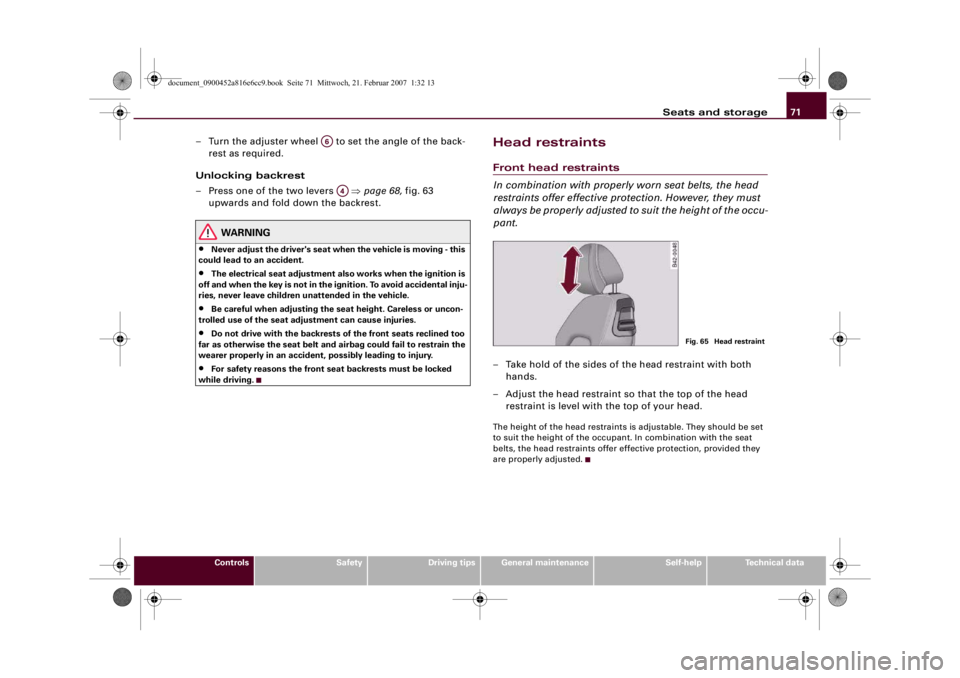
pant.– Take hold of the sides of the head restraint with both
hands.
– Adjust the head restraint so that the top of the head
restraint is level with the top of your head.The height of the head restraints is adjustable. They should be set
to suit the height of the occupant. In combination with the seat
belts, the head restraints offer effective protection, provided they
are properly adjusted.
A6
A4
Fig. 65 Head restraint
document_0900452a816e6cc9.book Seite 71 Mittwoch, 21. Februar 2007 1:32 13
Page 104 of 210

Safe driving 102Safe drivingGeneral notesSafety is the first priority
Your safety is our first priority.This chapter contains important information, tips, sugges-
tions and warnings that you should read and observe for
your own safety and the safety of your passengers.
WARNING
•
The information in this chapter is important for the driver of
the vehicle and all passengers. The other chapters in this manual
(and, where applicable, in the other literature supplied with the
vehicle) contain further important notes which you should read
and observe for your own safety and that of your passengers.
•
Ensure that the complete vehicle wallet is always in the vehicle.
This is especially important when you lend or sell the vehicle to
others.
Safety features
The safety features listed here are part of the vehicle's
occupant restraint system. They work together to help
reduce the risk of injury in a wide variety of accident situ-
ations.Your safety and the safety of your passengers should not be left to
chance. In the event of an accident, the safety features incorporated
in your vehicle are capable of reducing the risk of injury. These are
just a few of the safety features in your Audi:•
Three-point seat belts for all seats,
•
Belt force limiters for the front seats,
•
Belt pre-tensioners for the front seats,
•
Front airbags,
•
Head/thorax airbags in the backrests,
•
“ISOFIX” mountings* for “ISOFIX” child safety seats on the front
passenger's seat,
•
Height-adjustable head restraints in the backrests,
•
Adjustable steering column.
These individual safety features are harmonised to provide you and
your passengers with the best possible protection in accident situ-
ations. However, they can only be effective if you and your passen-
gers sit in the correct position and adjust and use the safety equip-
ment properly.
For these reasons, this chapter explains why these safety features
are so important, how they can protect you, what you need to
remember when using them, and how you and your passengers can
gain the most benefit from them. There are also a number of impor-
tant safety warnings which you and your passengers should always
observe in order to minimise the risk of injury.
Safety is everyone's responsibility!
Before every trip
The driver is responsible for the safety of the passengers
and the safe operation of the vehicle at all times.For your own safety and the safety of your passengers,
always note the following points before every trip:
– Make sure that all lights and turn signals are working
properly.
document_0900452a816e6cc9.book Seite 102 Mittwoch, 21. Februar 2007 1:32 13
Page 105 of 210

Safe driving103
Controls
Safety
Driving tips
General maintenance
Self-help
Technical data
– Check the tyre pressures.
– Make sure that all windows are clean and give good visi-
bility to the outside.
– Secure all luggage and other items carefully.
– Make sure that no objects can interfere with the pedals.
– Adjust the front seat, head restraint and mirrors
correctly.
– Make sure that the head restraints for all passengers are
adjusted to the correct position.
– Make sure that children are protected with suitable
safety seats and properly worn seat belts ⇒page 122.
– Sit in the correct position in your seat and make sure that
your passengers do the same. ⇒page 67.
– Fasten your seat belt correctly. Make sure that your
passengers do the same ⇒page 109.What affects driving safety?
Safety on the road is directly related to how you drive, and
can also be affected by the passengers in the vehicle.The driver is responsible for the safety of the vehicle and all
its occupants. If your ability to drive is impaired in any way,
you endanger yourself and other road users ⇒. There-
fore:
– Do not let yourself be distracted by passengers or by
using a mobile phone, etc.
– Never drive when your driving ability is impaired (by
medication, alcohol, drugs, etc.).– Obey all traffic regulations and speed limits.
– Always adjust your speed to suit the road, traffic and
weather conditions.
– Take frequent breaks on long trips. Do not drive for more
than two hours without a stop.
– If possible, avoid driving when you are tired or stressed.
WARNING
•
Distractions while driving or any kind of impairment to your
driving ability increase the risk of accident and injury.
•
Do not store loose objects on the dashboard. These objects
could fly around the interior when the vehicle is moving (under
acceleration or whilst cornering) and distract the driver – this
could lead to an accident.
document_0900452a816e6cc9.book Seite 103 Mittwoch, 21. Februar 2007 1:32 13
Page 108 of 210

Safe driving 106Correct adjustment of head restraints
Properly adjusted head restraints are an important part of
the vehicle's occupant protection system. They can help
to reduce the risk of injuries in most accident situations.The head restraints must be adjusted properly to provide
maximum protection.
– Adjust the head restraint so that the top of the head
restraint is level with the top of your head ⇒fig. 84 and
⇒fig. 85.For more information on how to adjust the head restraints, see
⇒page 71.
WARNING
Travelling with the head restraints removed or incorrectly
adjusted increases the risk of severe injuries.•
Incorrectly adjusted head restraints could lead to death in the
event of a collision or accident.
•
Incorrectly adjusted head restraints can also increase the risk
of injury during sudden or unexpected braking or other manoeu-
vres.
•
The head restraints must always be adjusted according to the
occupant's size.
Examples of incorrect sitting positions
Occupants can suffer severe or fatal injuries injuries if
they sit in an incorrect position while the vehicle is
moving.Seat belts can only provide maximum protection if the belt
webbing is positioned correctly. Sitting out of position
greatly reduces the effectiveness of the seat belts and
increases the risk of injury since the belt webbing is not
worn in the position for which it is designed. The driver is
responsible for the safety of all vehicle occupants, espe-
cially for children.
– Never allow anyone to sit out of position while the
vehicle is moving ⇒.The following list shows just some examples of incorrect sitting
positions which can be dangerous to all occupants. The list is not
complete, but will help to make you aware of possible dangers
which can be avoided.
Therefore, whenever the vehicle is moving:•
never stand up in the vehicle,
Fig. 84 Correctly
adjusted head restraint
(seen from the front)Fig. 85 Correctly
adjusted head restraint
(seen from the side)
document_0900452a816e6cc9.book Seite 106 Mittwoch, 21. Februar 2007 1:32 13
Page 115 of 210

Seat belts113
Controls
Safety
Driving tips
General maintenance
Self-help
Technical data
WARNING
•
The diagonal part of the belt should never be positioned across
the neck, but roughly over the centre of the shoulder; it should fit
closely against the upper part of the body. The lap part of the belt
must be worn tightly across the hips, and not over the abdomen
⇒page 112, fig. 92. Pull the belt tight if necessary to take up any
slack.
•
Always make sure that belt is positioned properly. Incorrectly
worn seat belts can give rise to injuries even in a minor collision.
•
Seat belts worn too loose can result in injuries because they
allow excessive forward movement in a crash; the occupant will
be brought to a sudden stop by the belt webbing.
Wearing and adjusting the seat belts during pregnancy
To afford the best protection for the unborn child it is
important for the mother to wear the seat belt properly at
all times.Women should always ensure they adjust the seat belt
correctly during pregnancy.– Adjust the front seat and head restraint correctly before
putting on the seat belt ⇒page 67, “Seats and storage”.
– To fasten the belt, take hold of the latch plate and pull it
slowly down across your chest. Wear the lap portion of
the seat belt as low as possible over the hips so that there
is no pressure on the stomach ⇒fig. 93, ⇒.
– Insert the latch plate into the buckle for the appropriate
seat and push it down until it is securely locked with an
audible click ⇒page 112, fig. 91.
– Pull the belt to check that it is now securely fastened.
WARNING
During pregnancy, women should especially make sure to wear
the lap portion of the seat belt as low as possible across the hips
so that there is no pressure on the stomach.Taking off the seat belts
The red button releases the belt from the buckle.– Press the red button in the seat belt buckle ⇒fig. 94. The
latch plate will spring out of the buckle.
Fig. 93 Positioning
seat belts during preg-
nancy
Fig. 94 The latch plate
of the belt springs out
of the buckle
document_0900452a816e6cc9.book Seite 113 Mittwoch, 21. Februar 2007 1:32 13
Page 120 of 210

Airbag system 118
WARNING
•
It is important for the driver and front passenger to maintain a
distance of at least 25 cm from the steering wheel or dashboard
⇒page 117, fig. 98. The airbag system will not be able to give the
required protection if you sit too close to the steering wheel or
dashboard. There is also a risk of injury if the airbags are inflated.
The front seats and head restraints must always be positioned
correctly for the height of the occupant.
•
If you do not wear a seat belt, if you lean forward or to the side,
or are not seated correctly while the vehicle is in motion, you are
at greater risk of injury. Should the airbag system be triggered in
an accident there is an even greater risk of injury.
•
Never let a child travel on the front seat without an appropriate
restraint system. If the airbag is triggered in an accident, the child
could sustain serious or fatal injuries ⇒page 122, “Child safety”.
•
Never install a rearward-facing child safety seat on the front
passenger's seat unless the front passenger's airbag has been
deactivated. However, if you have no alternative but to use a rear-
ward-facing child seat on the front passenger's seat, the front
passenger's airbag must be deactivated beforehand by means of
the key-operated switch ⇒page 120, “Deactivating the airbags”.
Failure to observe this precaution could result in serious or poten-
tially fatal injury.
•
Occupants sitting in the front of the car must never carry any
objects or pets in the space between them and the airbags, or
allow children or other passengers to travel in this position.
•
Do not cover or stick anything on the steering wheel hub or the
soft plastic surface of the airbag unit on the passenger's side of
the dashboard, and do not obstruct or modify them in any way.
These parts should only be cleaned with a dry cloth (or with a
cloth moistened with plain water). It is also important not to
attach any objects such as cup holders or telephone mountings to
the surfaces covering the airbag units.
•
Any work on the airbag system or removal and installation of
the airbag components for other repairs (such as repairs to the
steering wheel) should be performed by a qualified workshop.Note
If necessary, you can deactivate the front passenger's airbag by
means of the key-operated switch ⇒page 120, “Deactivating the
airbags”.Side airbagsDescription of side airbags
The airbag system is not a substitute for the seat belts.The side airbags are located in the backrest padding of the front
seats ⇒fig. 99. The locations of the airbags are marked with the
word “AIRBAG”.
In conjunction with the three-point seat belts, the side airbags give
the occupants additional protection for the whole upper part of the
body (i.e. the chest, stomach and pelvis) in the event of a severe side
WARNING (continued)
Fig. 99 Location of
side airbag in driver's
seat
document_0900452a816e6cc9.book Seite 118 Mittwoch, 21. Februar 2007 1:32 13
Page 124 of 210

Child safety 122Child safetyPoints to remember if children are
travelling in the carIntroductionThe physical principles involved and the forces acting in a collision
apply to children just as much as adults ⇒page 110, “Forces acting
in a collision”. But, unlike adults, children do not have fully devel-
oped muscle and bone structures. This means that children are
subject to a greater risk of injury.
To reduce this risk, children must always use special child restraint
systems when travelling in the car.
Use only child restraint systems which are officially approved under
the European standard ECE R 44 and are suitable for the child. ECE R
refers to the Economic Commission of Europe Recommendation,
which categorises child restraint systems in 5 groups ⇒page 123,
“Child seat categories”. Child restraints that have been tested and
approved under the ECE R 44 standard bear the ECE-R 44 test mark
on the seat (the letter E in a circle with the test number below it).
We recommend using child restraint systems from the range of
Audi Genuine Accessories available from Audi R8 dealers. The
“Huckepack” range includes suitable restraint systems for all ages.
These systems have been specially designed for use in Audi vehicles
and comply with the ECE R 44 standard.
Follow the manufacturer's instructions and observe any statutory
requirements when installing and using child restraints ⇒ in
“Important safety notes for using child safety seats”.
Important safety notes for using child safety seats
Correct use of child safety seats can help to reduce the
risk of injury in an accident.
WARNING
•
All vehicle occupants, especially children, must wear a seat
belt while the vehicle is in motion.
•
Children who are less than 1.5 metres tall must not wear a
normal seat belt without a child restraint, as this could cause inju-
ries to the abdominal and neck areas.
•
Babies and children must never travel on another occupant's
lap.
•
A suitable child safety seat can protect your child ⇒page 123,
“Child safety seats”.
•
Never allow two children to occupy one child safety seat.
•
Never leave a child without supervision in a child safety seat.
•
Never allow a child to travel in the car without a suitable child
restraint.
•
Never allow a child to stand up or kneel on a seat while the car
is moving. In an accident, the child could be catapulted through
the car, causing possibly fatal injuries to itself and other occu-
pants.
•
If children lean forward or are otherwise out of position when
the car is moving, they are at greater risk of injury in an accident.
This is especially the case if the airbag is activated during an acci-
dent. There is then a risk of serious or potentially fatal injury.
•
To ensure proper protection, it is important to wear the seat
belts in the correct position ⇒page 112, “How to wear seat belts
properly”. Always check that the belt is properly positioned
document_0900452a816e6cc9.book Seite 122 Mittwoch, 21. Februar 2007 1:32 13
Page 125 of 210
Child safety123
Controls
Safety
Driving tips
General maintenance
Self-help
Technical data according to the instructions provided by the manufacturer of the
child safety seat. Incorrectly worn seat belts can give rise to inju-
ries even in a minor collision.
•
Never install a rearward-facing child safety seat on the front
passenger's seat unless the front passenger's airbag has been
deactivated.
•
Extra caution is advised if you are installing a child safety seat
using the same mounting bolts as the existing car seat belts. The
bolts must be screwed in all the way to the full depth of the
mounting holes and tightened to a torque of 50 Nm. Failure to
observe this precaution could result in potentially fatal injury. We
recommend having the installation performed by a qualified work-
shop.
•
Do not use a rearward-facing child safety seat on the front
passenger's seat unless the front passenger's airbag has been
deactivated. The child seat would be directly in the path of the
airbag as it inflates, and the child could sustain serious or fatal
injuries if the airbag were to be deployed.
•
However, if you have no alternative but to use a rearward-
facing child seat on the front passenger's seat, the front
passenger's airbag must be deactivated beforehand by means of
the key-operated switch. Failure to observe this precaution could
result in serious or potentially fatal injury.
•
Make sure that the front passenger's airbag is reactivated by
means of the key-operated switch as soon as the child seat is no
longer needed on the front passenger's seat.
•
When using a child safety seat of the type which faces in the
direction of travel, the front passenger's seat must be moved back
to the rearmost position.
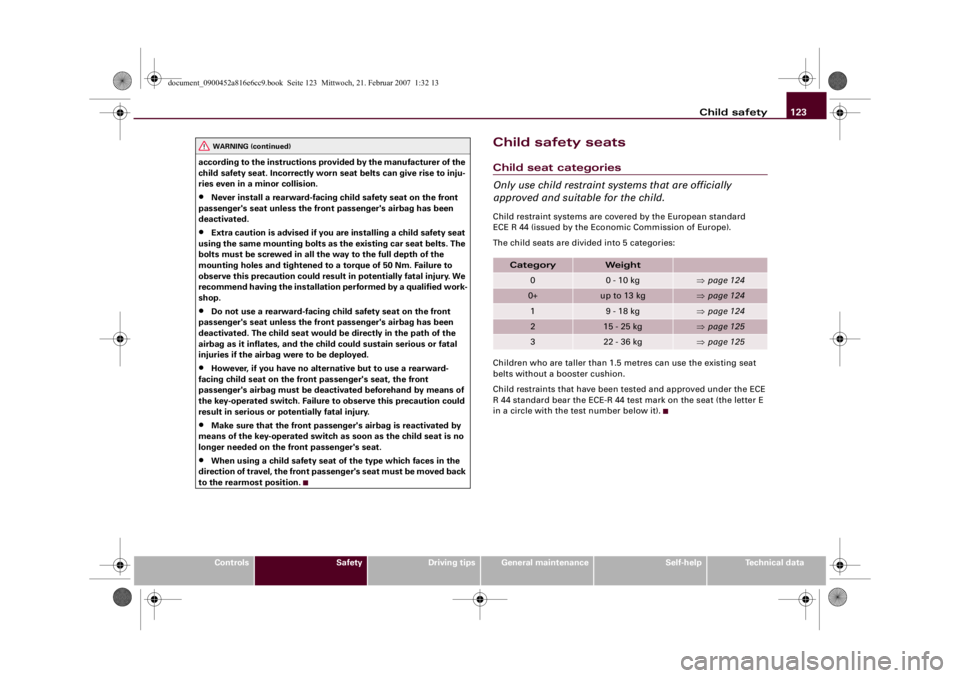
Child safety seatsChild seat categories
Only use child restraint systems that are officially
approved and suitable for the child.Child restraint systems are covered by the European standard
ECE R 44 (issued by the Economic Commission of Europe).
The child seats are divided into 5 categories:
Children who are taller than 1.5 metres can use the existing seat
belts without a booster cushion.
Child restraints that have been tested and approved under the ECE
R 44 standard bear the ECE-R 44 test mark on the seat (the letter E
in a circle with the test number below it).
WARNING (continued)
Category
Weight
0
0 - 10 kg
⇒page 124
0+
up to 13 kg
⇒page 124
1
9 - 18 kg
⇒page 124
2
15 - 25 kg
⇒page 125
3
22 - 36 kg
⇒page 125
document_0900452a816e6cc9.book Seite 123 Mittwoch, 21. Februar 2007 1:32 13