2007 AUDI R8 ABS
[x] Cancel search: ABSPage 7 of 210
Notes on this Owner's Manual5
Controls
Safety
Driving tips
General maintenance
Self-help
Technical data
Notes on this Owner's ManualThis Owner's Manual contains important information, tips, sugges-
tions and warnings.
Please ensure that this Owner's Manual is always kept in the vehicle.
It should always be available to anyone else driving the vehicle, i.e.
anyone renting, borrowing or buying the vehicle from you.
This manual describes the equipment available for the vehicle at the
time of going to print. Some of the equipment described here will
not be available until a later date, or may only be available in certain
markets.
Some sections of this Owner's Manual do not apply to all vehicles.
If this is the case, a text at the start of the section indicates which
vehicles it applies to, e. g. “Applies to vehicles: with R tronic”. This
optional equipment is also marked with an asterisk “*”.
Illustrations are intended as a general guide, and may vary from the
equipment fitted in your vehicle in some details.
At the beginning of this Owner's Manual, you will find a table of
contents showing all the items described in this manual in the order
in which they appear. An alphabetical index is included at the end
of the Owner's Manual.
All references to positions such as “left”, “right”, “front” or “rear”
are given as seen facing in the direction of travel.
* optional equipment
The section is continued on the following page.
Denotes the end of a section.
®Registered trademarks are marked ®. However, the absence of
this symbol does not constitute a waiver of the rights
concerning any proprietary name.
⇒ Refers to a “WARNING” within the same section. If the
WARNING symbol is followed by a page number the warning text
referred to is included in a different section.
WARNING
Texts with this symbol contain safety information. They warn you
of serious dangers, possibly involving accident or injury.
Caution
Texts with this symbol draw your attention to a possible risk of
damage to your vehicle.
For the sake of the environment
Texts with this symbol refer to points relevant to the protection of
the environment.
Note
Texts with this symbol contain additional information of a more
general nature.
document_0900452a816e6cc9.book Seite 5 Mittwoch, 21. Februar 2007 1:32 13
Page 18 of 210

Instruments and warning/indicator lamps 16
Note•
Yellow symbols are accompanied by one warning chime. The
function indicated should be checked as soon as possible.
•
A red symbol is accompanied by three warning chimes. The
symbol will keep flashing until the fault is corrected.
Applies to vehicles: with Audi magnetic rideAudi magnetic ride
This warning lamp monitors the damping effect of the
shock absorbers.The warning lamp
lights up when the ignition is switched on.
Note
If the warning lamp lights up while the vehicle is moving, this indi-
cates a vehicle damping malfunction. The suspension should be
checked immediately by a qualified workshop.Applies to vehicles: with tyre pressure monitoring systemTyre pressure monitoring system
Th e t y re p re s s u re s h o u l d b e c o rre c t e d as s o o n as p o s s i b l e
if it is too low.If the
symbol appears, the tyre pressure on at least one
of the wheels is too low.–Stop the vehicle.
– Check the tyre(s).
– Adjust the tyre pressure ⇒page 167.
For more detailed information on the tyre pressure monitoring
system please refer to ⇒page 172.Engine management
This warning lamp monitors the engine management
system.The
warning lamp (Electronic Power Control) lights up when the
ignition is switched on to show that the lamp is working properly.Note
If the warning lamp lights up while the vehicle is moving, this indi-
cates a fault in the engine management system. The engine should
be serviced by a qualified workshop without delay.Electronic stabilisation program (ESP)
This warning lamp monitors the electronic stabilisation
program.The warning lamp
has the following functions:
•
It flashes when the ESP or traction control system (ASR) inter-
venes while the vehicle is in motion.
•
It lights up when the ignition is switched on and should go out
again after about 2 seconds. This signals that the lamp is working
properly.
•
It will light up continuously if there is a malfunction in the ESP.
•
It will light up continuously if the ESP is switched off.
Seat belt warning lamp
⇒page 18
Fault in brake system / handbrake is
applied
⇒page 18
Anti-lock brake system (ABS)
⇒page 19
document_0900452a816e6cc9.book Seite 16 Mittwoch, 21. Februar 2007 1:32 13
Page 19 of 210

Instruments and warning/indicator lamps17
Controls
Safety
Driving tips
General maintenance
Self-help
Technical data
•
It will also come on if a fault should occur in the ABS because the
ESP operates in conjunction with the ABS.
If the warning lamp lights up and stays on after the engine is
started, this may mean that the control system has temporarily
switched off the ESP. In this case the ESP can be reactivated by
switching the ignition off and then on again. If the warning lamp
goes out, this means the system is fully functional.
For further information on the ESP ⇒page 132.
If the battery is disconnected and then reconnected, this warning
lamp will light up when the engine is started and stay on until you
have driven a few metres.
Emission control system
If the warning lamp lights up continuously you should take your
vehicle to a qualified workshop as soon as possible in order to have
the fault rectified.
If the warning lamp flashes drive on at reduced speed and seek
professional help in order to avoid damage to the catalytic
converter.
For further information on the catalytic converter ⇒page 138.Main beam headlights
The indicator lamp
lights up when the main beams are on or
when the headlight flasher is operated.
For further information on the main beam headlights ⇒page 56.
Rear spoiler
This warning lamp monitors the automatic electrically
operated rear spoiler.The warning lamp
has the following functions:
•
It lights up when the ignition is switched on and should go out
again after about 3 seconds. This signals that the lamp is working
properly.
•
It lights up if a malfunction occurs on the automatic rear spoiler.
For further information on the automatic rear spoiler ⇒page 134.
Turn signals and hazard warning lights
Depending on which turn signal is operated, either the left
or
right
indicator lamp flashes. Both indicator lamps will flash when
the hazard warning lights are switched on.
If one turn signal should fail, the indicator lamp will start flashing
twice as fast.
For further information on the turn signals ⇒page 56.
Applies to vehicles: with cruise control systemCruise control
The indicator lamp
in the instrument cluster lights up when the
cruise control system is operating.
Airbag system
This warning lamp monitors the airbag and seat belt
tensioner system.The warning lamp
should light up for a few seconds when the
ignition is switched on.
document_0900452a816e6cc9.book Seite 17 Mittwoch, 21. Februar 2007 1:32 13
Page 20 of 210

Instruments and warning/indicator lamps 18If the warning lamp does not go out, or if it lights up, flashes or
flickers when the vehicle is moving, this indicates a malfunction in
the system. This is also the case if the warning lamp does not light
up when the ignition is switched on.
WARNING
If a malfunction should occur, have the system checked immedi-
ately by a qualified workshop. If this is neglected, there is a risk
that the airbag system and/or belt tensioners may not be acti-
vated in an accident.Alternator
The warning lamp signals a fault in the alternator or in
the vehicle's electrical system.The warning lamp
lights up when the ignition is switched on. It
should go out when the engine starts running.
If the warning lamp lights up when you are driving, you can
normally continue as far as the nearest qualified workshop.
However, you should avoid using electrical equipment that is not
absolutely necessary because this will drain the battery.
Caution
If the coolant warning lamp
in the instrument display lights up
as well while driving ⇒page 35, stop the vehicle immediately and
switch off the engine. In this case the coolant pump is no longer
being driven, and there is a risk of engine damage.
Seat belt warning lamp
The warning lamp acts as a reminder to fasten the seat
belts.After switching on the ignition, the warning lamp
will remain lit
until the driver has fastened his seat belt. When the vehicle has
gathered speed you will also hear a warning chime.
For further information on the seat belts ⇒page 109.
Brake system
The warning lamp flashes if the brake fluid level is too low
or if there is a fault in the ABS system.If the warning lamp
flashes (and the handbrake is not applied),
stop the vehicle and obtain professional assistance ⇒.
If a failure should occur in the ABS, the ABS warning lamp
will
light up together with the brake warning lamp
⇒.
Handbrake applied
The warning lamp
also lights up when the handbrake is applied.
If you drive by mistake with the handbrake still applied, you will hear
a warning buzzer.
WARNING
•
If the brake warning lamp does not go out, or if it lights up
when driving, the brake fluid level in the reservoir is too low – this
may cause an increased accident risk. Stop the vehicle and do not
drive on. You should obtain professional assistance.
•
If the brake warning lamp lights up together with the ABS
warning lamp, this can mean that the control function of the ABS
is out of action. As a result the rear wheels can lock relatively
easily when braking. This could cause the tail of the vehicle to skid
document_0900452a816e6cc9.book Seite 18 Mittwoch, 21. Februar 2007 1:32 13
Page 21 of 210

Instruments and warning/indicator lamps19
Controls
Safety
Driving tips
General maintenance
Self-help
Technical data sideways. Drive carefully to the nearest qualified workshop and
have the fault rectified.
Anti-lock brake system (ABS)
The warning lamp monitors the ABS and the electronic
differential lock (EDL).The warning lamp
lights up for a few seconds when the ignition
is switched on and while the engine is being started. The lamp goes
out again once the system has run through an automatic test
sequence.
There is a fault in the ABS if:
•
the warning lamp
does not light up when the ignition is
switched on,
•
the warning lamp does not go out again after a few seconds,
•
the warning lamp lights up when the vehicle is moving.
The vehicle can still be braked in the normal way (except that the
ABS control function is out of action). Please take the vehicle to a
qualified workshop as soon as possible. For further information on
the ABS ⇒page 132.
If a fault occurs in the ABS, the ESP warning lamp will also light up.
Fault in the main brake system
If the ABS warning lamp
lights up together with the brake
warning lamp
⇒page 35, this indicates a fault in the ABS func-
tion, and possibly a malfunction in the main brake system as well
⇒.
If there is a malfunction in the brake system the symbol
will light
up in the instrument cluster. Please refer to ⇒page 18.Fault on the electronic differential lock (EDL)
The EDL works in conjunction with the ABS. If a malfunction should
occur in the EDL, this is indicated by the ABS warning lamp
.
Please take the vehicle to a qualified workshop as soon as possible.
For further information on the EDL ⇒page 132.
WARNING
•
If the brake warning lamp
lights up together with the ABS
warning lamp
, the brake fluid level in the reservoir is too low
and this may cause an accident. Stop the vehicle and do not drive
on. You should obtain professional assistance.
•
If the brake fluid level is OK, the fault in the brake system may
have been caused by a failure of the ABS control function. As a
result the rear wheels can lock relatively easily when braking. This
could cause the tail of the vehicle to skid sideways. Drive carefully
to the nearest qualified workshop and have the fault rectified.
WARNING (continued)
document_0900452a816e6cc9.book Seite 19 Mittwoch, 21. Februar 2007 1:32 13
Page 37 of 210

Driver information system35
Controls
Safety
Driving tips
General maintenance
Self-help
Technical data
Fault in the brake system
The warning lamp flashes when the handbrake is applied,
or if the brake fluid level is too low or if there is a fault in
the ABS system.If the symbol
flashes in the display when the handbrake
is not applied, there is a fault in the brake system. One of the
following messages will appear in the display together with
the symbol:
Stop vehicle and check brake fluid level
Brake fault ! Drive carefully to nearest workshop
–Stop the vehicle.
– You should obtain professional assistance.
If the ABS fails, the ABS warning lamp
will light up together with
the brake warning symbol
⇒.
Handbrake applied
The warning lamp
also lights up when the handbrake is applied.
In addition to this, a warning buzzer will sound after driving for
3 seconds at a speed above 5 km/h.
WARNING
•
If the brake fluid level in the reservoir is too low, this could
result in an accident. Do not drive on. You should obtain profes-
sional assistance.
•
If the brake warning lamp lights up together with the ABS
warning lamp, this can mean that the control function of the ABS
is out of action. As a result the rear wheels can lock relatively
easily when braking. This could cause the tail of the vehicle to skid
sideways. Drive carefully to the nearest qualified workshop and
have the fault rectified.
Fault in the cooling system
Faults in the cooling system must be rectified immedi-
ately.If the
symbol flashes in the display, this means that either
the coolant temperature is too high or the coolant level is
too low. The following message will appear in the display
together with the symbol:
Switch off engine, check coolant level
– Stop the vehicle.
– Switch off the engine.
– Check the coolant level ⇒page 160.
– Add more coolant if necessary ⇒page 160.
– Wait for the symbol to go out before driving on.
– Obtain professional assistance if necessary.
If the coolant level is correct, the overheating may be caused by a
malfunction of the radiator fan.
If the alternator warning lamp lights up as well ⇒page 18, it is
possible that the drive belt has broken.
WARNING
•
If your vehicle should break down for technical reasons, stop it
at a safe distance away from moving traffic, switch off the engine
and turn on the hazard warning lights ⇒page 56, “Hazard
warning lights ”.
•
Never open the engine lid if you can see or hear steam or
coolant escaping from the engine compartment; there is a risk of
being scalded. Wait until you can no longer see or hear escaping
steam or coolant.
document_0900452a816e6cc9.book Seite 35 Mittwoch, 21. Februar 2007 1:32 13
Page 90 of 210
Driving 88Applies to vehicles: with cruise control systemSwitching off cruise control temporarily– Press the brake pedal, or
– Press the clutch pedal, or
– Press the lever ⇒page 87, fig. 75 to position (click
stop not engaged).The speed stored at this point remains in the memory if the system
is only temporarily deactivated.
To resume the programmed cruising speed, release the clutch or
brake pedal and pull the lever to position .
If no speed was stored when the system was temporarily deacti-
vated, a new speed can be set as follows: drive at the desired
cruising speed and briefly press button ⇒page 87, fig. 75 (SET).
WARNING
Do not resume the programmed cruising speed if this is too high
for the traffic conditions - this can cause accidents.Applies to vehicles: with cruise control systemSwitching off cruise control– Press the lever A ⇒page 87, fig. 75 to position (click
stop engaged).The stored speed will be deleted once the ignition is switched off.
Note
Always switch off the cruise control system completely after each
journey. When beginning a new journey, the speed must be reset
⇒page 87.
Applies to vehicles: with Audi magnetic rideAudi magnetic rideThe damping effect of the shock absorbers can be
adjusted according to the driver's requirements, and will
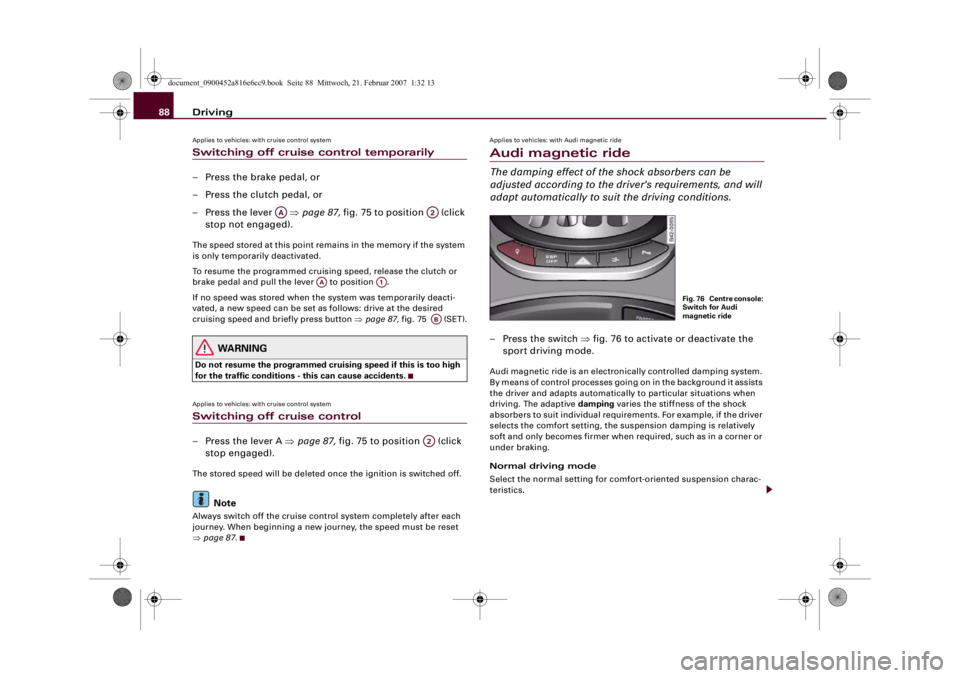
adapt automatically to suit the driving conditions.– Press the switch ⇒fig. 76 to activate or deactivate the
sport driving mode.Audi magnetic ride is an electronically controlled damping system.
By means of control processes going on in the background it assists
the driver and adapts automatically to particular situations when
driving. The adaptive damping varies the stiffness of the shock
absorbers to suit individual requirements. For example, if the driver
selects the comfort setting, the suspension damping is relatively
soft and only becomes firmer when required, such as in a corner or
under braking.
Normal driving mode
Select the normal setting for comfort-oriented suspension charac-
teristics.
AA
A2
AA
A1
ABA2
Fig. 76 Centre console:
Switch for Audi
magnetic ride
document_0900452a816e6cc9.book Seite 88 Mittwoch, 21. Februar 2007 1:32 13
Page 111 of 210
Seat belts109
Controls
Safety
Driving tips
General maintenance
Self-help
Technical data
Seat beltsWhy is it so important to use seat
belts?Seat belts provide effective protection
The common belief that passengers can brace their
weight with their hands in a minor collision is false.It is an established fact that seat belts provide good protection in
accidents. Therefore wearing a seat belt is required by law in most
countries.
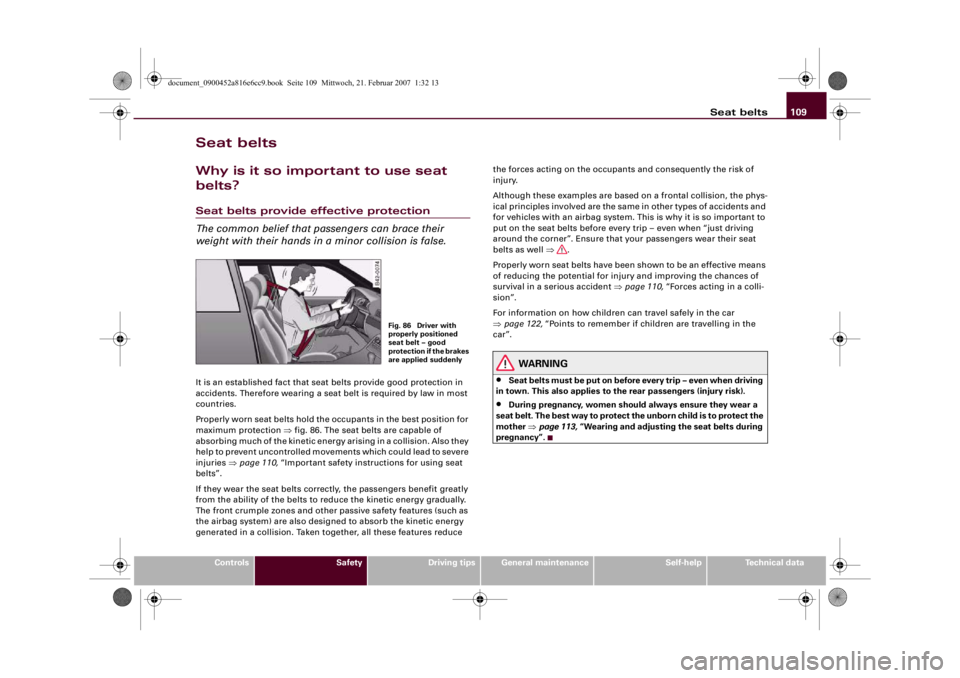
Properly worn seat belts hold the occupants in the best position for
maximum protection ⇒fig. 86. The seat belts are capable of
absorbing much of the kinetic energy arising in a collision. Also they
help to prevent uncontrolled movements which could lead to severe
injuries ⇒page 110, “Important safety instructions for using seat
belts”.
If they wear the seat belts correctly, the passengers benefit greatly
from the ability of the belts to reduce the kinetic energy gradually.
The front crumple zones and other passive safety features (such as
the airbag system) are also designed to absorb the kinetic energy
generated in a collision. Taken together, all these features reduce the forces acting on the occupants and consequently the risk of
injury.
Although these examples are based on a frontal collision, the phys-
ical principles involved are the same in other types of accidents and
for vehicles with an airbag system. This is why it is so important to
put on the seat belts before every trip – even when “just driving
around the corner”. Ensure that your passengers wear their seat
belts as well ⇒.
Properly worn seat belts have been shown to be an effective means
of reducing the potential for injury and improving the chances of
survival in a serious accident ⇒page 110, “Forces acting in a colli-
sion”.
For information on how children can travel safely in the car
⇒page 122, “Points to remember if children are travelling in the
car”.
WARNING
•
Seat belts must be put on before every trip – even when driving
in town. This also applies to the rear passengers (injury risk).
•
During pregnancy, women should always ensure they wear a
seat belt. The best way to protect the unborn child is to protect the
mother ⇒page 113, “Wearing and adjusting the seat belts during
pregnancy”.
Fig. 86 Driver with
properly positioned
seat belt – good
protection if the brakes
are applied suddenly
document_0900452a816e6cc9.book Seite 109 Mittwoch, 21. Februar 2007 1:32 13