2007 AUDI R8 maintenance
[x] Cancel search: maintenancePage 119 of 210
Airbag system117
Controls
Safety
Driving tips
General maintenance
Self-help
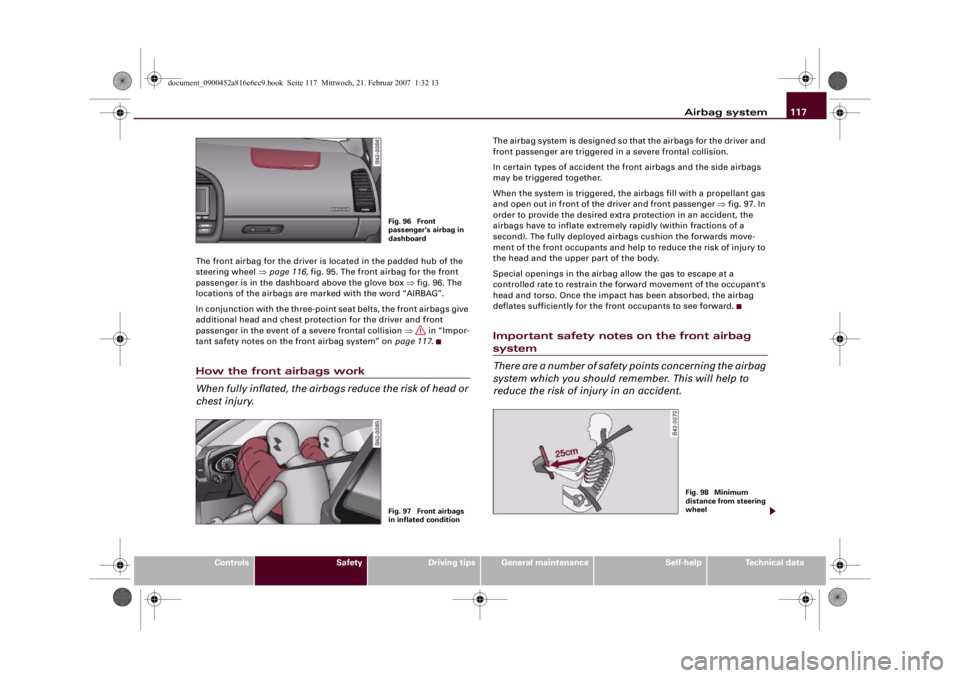
Technical data The front airbag for the driver is located in the padded hub of the
steering wheel ⇒page 116, fig. 95. The front airbag for the front
passenger is in the dashboard above the glove box ⇒fig. 96. The
locations of the airbags are marked with the word “AIRBAG”.
In conjunction with the three-point seat belts, the front airbags give
additional head and chest protection for the driver and front
passenger in the event of a severe frontal collision ⇒ in “Impor-
tant safety notes on the front airbag system” on page 117.
How the front airbags work
When fully inflated, the airbags reduce the risk of head or
chest injury.
The airbag system is designed so that the airbags for the driver and
front passenger are triggered in a severe frontal collision.
In certain types of accident the front airbags and the side airbags
may be triggered together.
When the system is triggered, the airbags fill with a propellant gas
and open out in front of the driver and front passenger ⇒fig. 97. In
order to provide the desired extra protection in an accident, the
airbags have to inflate extremely rapidly (within fractions of a
second). The fully deployed airbags cushion the forwards move-
ment of the front occupants and help to reduce the risk of injury to
the head and the upper part of the body.
Special openings in the airbag allow the gas to escape at a
controlled rate to restrain the forward movement of the occupant's
head and torso. Once the impact has been absorbed, the airbag
deflates sufficiently for the front occupants to see forward.Important safety notes on the front airbag system
There are a number of safety points concerning the airbag
system which you should remember. This will help to
reduce the risk of injury in an accident.
Fig. 96 Front
passenger's airbag in
dashboardFig. 97 Front airbags
in inflated condition
Fig. 98 Minimum
distance from steering
wheel
document_0900452a816e6cc9.book Seite 117 Mittwoch, 21. Februar 2007 1:32 13
Page 121 of 210

Airbag system119
Controls
Safety
Driving tips
General maintenance
Self-help
Technical data collision ⇒ in “Important safety notes on the side airbag system”
on page 119.
In a side collision the side airbags reduce the risk of injury to the
areas of the body facing the impact.
How the side airbags work
When fully inflated, the side airbags reduce the risk of
head or chest injury.In certain types of side collisions the side airbag is triggered on the
impact side of the vehicle ⇒fig. 100.
In certain types of accident the front airbags and the side airbags
may be triggered together.
When the system is triggered, the airbag is filled with propellant
gas.
In order to provide the desired extra protection in an accident, the
airbags have to inflate extremely rapidly (within fractions of a
second). The airbag releases a fine dust when it inflates. This is quite
normal and does not mean there is a fire in the vehicle.
The fully deployed airbags cushion the impact of the occupants and
help to reduce the risk of injury to the head and upper part of the
body on the side facing the door.
Important safety notes on the side airbag system
There are a number of safety points concerning the airbag
system which you should remember. This will help to
reduce the risk of injury in an accident.
WARNING
•
If you do not wear a seat belt, if you lean forward, or are not
seated correctly while the vehicle is in motion, you are at greater
risk of injury should the side airbag system be triggered in an acci-
dent.
•
If children are not seated correctly, they are at greater risk of
injury in an accident. This is particularly the case if the child is
travelling on the front passenger's seat and the airbag system is
triggered in an accident. This could result in serious or potentially
fatal injury ⇒page 122, “Child safety”.
•
It is also important not to attach any accessories (such as cup
holders) to the doors. This would impair the protection offered by
the side airbags.
•
The sensors for the airbags are located in the front doors. You
must therefore not make any modifications to the doors or door
trim (e.g. retrofitting loudspeakers), as this could impair the func-
tion of the side airbags. Any damage to the front doors could lead
to faults in the system. Repairs or any other work on the front
doors must therefore always be carried out by a qualified work-
shop.
•
Do not apply excessive force to the sides of the backrests (such
as hard knocks or kicks), as this could damage parts of the system.
The side airbags could then fail to operate when required.
•
If you intend to fit protective covers over the seats, these must
be of the specific type approved for use on Audi seats with side
airbags. Conventional seat covers would obstruct the side airbag
when it inflates out of the backrest, and seriously reduce the
airbag's effectiveness.
Fig. 100 Side airbag in
inflated condition
document_0900452a816e6cc9.book Seite 119 Mittwoch, 21. Februar 2007 1:32 13
Page 123 of 210

Airbag system121
Controls
Safety
Driving tips
General maintenance
Self-help
Technical data
The key-operated switch for deactivating the front
passenger's airbag is located in the glove box ⇒page 120,
fig. 101.
– To deactivate the front passenger's airbag, insert the
ignition key in the switch and turn it to position .
– The front passenger's airbag can be reactivated by
turning the key to position .If the front passenger's airbag has been deactivated via the key-
operated switch, the indicator lamp “PASSENGER AIRBAG OFF” will
light up constantly as a reminder ⇒page 121, fig. 102. Please refer
also to the description of the AIRBAG warning lamp in the instru-
ment cluster ⇒page 17.
WARNING
•
If you have no alternative but to install a rearward-facing child
seat on the front passenger's seat, the front passenger's airbag
must be deactivated beforehand – otherwise this can result in
potentially fatal injuries to the child.
•
If you have deactivated the front passenger's airbag, reactivate
it as soon as the child seat is no longer needed so that the airbag
can continue to give the required protection.
•
It is the driver's responsibility to ensure that the key-operated
switch is set to the correct position.
Fig. 102 Lamp indi-
cates that front
passenger's airbag has
been deactivated via
key-operated switch
A0
A1
WARNING (continued)
document_0900452a816e6cc9.book Seite 121 Mittwoch, 21. Februar 2007 1:32 13
Page 125 of 210
Child safety123
Controls
Safety
Driving tips
General maintenance
Self-help
Technical data according to the instructions provided by the manufacturer of the
child safety seat. Incorrectly worn seat belts can give rise to inju-
ries even in a minor collision.
•
Never install a rearward-facing child safety seat on the front
passenger's seat unless the front passenger's airbag has been
deactivated.
•
Extra caution is advised if you are installing a child safety seat
using the same mounting bolts as the existing car seat belts. The
bolts must be screwed in all the way to the full depth of the
mounting holes and tightened to a torque of 50 Nm. Failure to
observe this precaution could result in potentially fatal injury. We
recommend having the installation performed by a qualified work-
shop.
•
Do not use a rearward-facing child safety seat on the front
passenger's seat unless the front passenger's airbag has been
deactivated. The child seat would be directly in the path of the
airbag as it inflates, and the child could sustain serious or fatal
injuries if the airbag were to be deployed.
•
However, if you have no alternative but to use a rearward-
facing child seat on the front passenger's seat, the front
passenger's airbag must be deactivated beforehand by means of
the key-operated switch. Failure to observe this precaution could
result in serious or potentially fatal injury.
•
Make sure that the front passenger's airbag is reactivated by
means of the key-operated switch as soon as the child seat is no
longer needed on the front passenger's seat.
•
When using a child safety seat of the type which faces in the
direction of travel, the front passenger's seat must be moved back
to the rearmost position.
Child safety seatsChild seat categories
Only use child restraint systems that are officially
approved and suitable for the child.Child restraint systems are covered by the European standard
ECE R 44 (issued by the Economic Commission of Europe).
The child seats are divided into 5 categories:
Children who are taller than 1.5 metres can use the existing seat
belts without a booster cushion.
Child restraints that have been tested and approved under the ECE
R 44 standard bear the ECE-R 44 test mark on the seat (the letter E
in a circle with the test number below it).
WARNING (continued)
Category
Weight
0
0 - 10 kg
⇒page 124
0+
up to 13 kg
⇒page 124
1
9 - 18 kg
⇒page 124
2
15 - 25 kg
⇒page 125
3
22 - 36 kg
⇒page 125
document_0900452a816e6cc9.book Seite 123 Mittwoch, 21. Februar 2007 1:32 13
Page 127 of 210
Child safety125
Controls
Safety
Driving tips
General maintenance
Self-help
Technical data
Child safety seats: category 2/3
A suitable child safety seat and a correctly worn seat belt
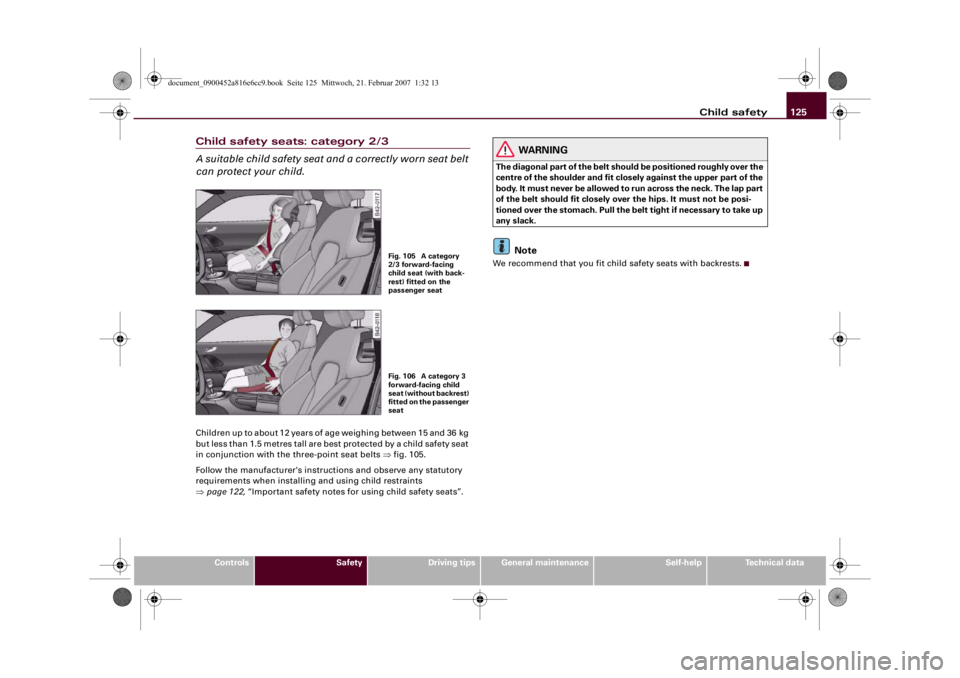
can protect your child.Children up to about 12 years of age weighing between 15 and 36 kg
but less than 1.5 metres tall are best protected by a child safety seat
in conjunction with the three-point seat belts ⇒fig. 105.
Follow the manufacturer's instructions and observe any statutory
requirements when installing and using child restraints
⇒page 122, “Important safety notes for using child safety seats”.
WARNING
The diagonal part of the belt should be positioned roughly over the
centre of the shoulder and fit closely against the upper part of the
body. It must never be allowed to run across the neck. The lap part
of the belt should fit closely over the hips. It must not be posi-
tioned over the stomach. Pull the belt tight if necessary to take up
any slack.
Note
We recommend that you fit child safety seats with backrests.
Fig. 105 A category
2/3 forward-facing
child seat (with back-
rest) fitted on the
passenger seatFig. 106 A category 3
forward-facing child
seat (without backrest)
fitted on the passenger
seat
document_0900452a816e6cc9.book Seite 125 Mittwoch, 21. Februar 2007 1:32 13
Page 129 of 210
Child safety127
Controls
Safety
Driving tips
General maintenance
Self-help
Technical data Extended list of recommended child restraint systems
1)manufacturer details:
Company: FAIR srl
Address: Strada della Cisa 249/251, I- 42040 Sorbolo Levante di Bres-
cello (RE) / Italy.
http://www.fairbimbofix.comPossible alternatives for securing a child safety seat
A child safety seat can be secured on the passenger's
seat.The following alternatives are available for safely securing a child
safety seat on the passenger seat:•
Child safety seats of the categories 0 to 3 can be secured with the
standard three-point seat belts.
•
Child safety seats of the categories 0, 0+ and 1 with the “ISOFIX”
system can be secured without seat belts using the “ISOFIX”
retainers ⇒page 128.
Compatibility of vehicle seat positions for child safety seats
(according to EC directive 77/541):u “universally compatible”
a The front passenger's backrest must be set as far forward as
possible or adapted to the child safety seat as required, and the
seat height must be adjusted to its highest position.
b The front passenger's seat can be equipped with optional
“ISOFIX” retainers (this does not apply to bucket seats).
c The front passenger's airbag must be deactivated if a rearward-
facing child seat is used.
WARNING
While the vehicle is moving, children must always be protected
with a restraint system which is suited to their age, height and
weight. Please refer to the chapter “Child seat categories”.•
Never install a rearward-facing child safety seat on the front
passenger's seat unless the front passenger's airbag has been
Weight class
Identification
Catalogue number
Manufacturer
Model /
Mode of securing seat
Approval number
1
(9 to 18 kg)
ISOFIX FWF
Universal
4590.xx., 4610.xx
1)
4590.xx
1)
FAIR
FAIR
FAIR G0/I ISOFIX
forward-facing with special
platform type SP (FWF)
FAIR G0/I ISOFIX
standard three-point seat
belt
E4 044 43513
E4 034 43416
Weight class
Front passenger's seat
0, 0+
u, a, b, c
1
u, a, b, c
2
u, a
3
u, a
document_0900452a816e6cc9.book Seite 127 Mittwoch, 21. Februar 2007 1:32 13
Page 131 of 210
Child safety129
Controls
Safety
Driving tips
General maintenance
Self-help
Technical data
document_0900452a816e6cc9.book Seite 129 Mittwoch, 21. Februar 2007 1:32 13
Page 135 of 210

Intelligent technology133
Controls
Safety
Driving tips
General maintenance
Self-help
Technical data Switching off the ESP and traction control system
(ASR)
To switch off the ASR and ESP in certain situations (e.g. when
driving with snow chains, in deep snow, or on a loose surface, or
when rocking the car backwards and forwards to free it from mud)
press the button for longer than 3 seconds. The ESP warning
lamp will light up and the message ESP switched off will appear in
the driver information system display. You should only use this
feature if your driving ability and traffic conditions allow you to do
so safely.
Switching on the ESP/traction control system (ASR)
To activate the ASR/ESP, press the button again.
Overheating of the brakes
To prevent the disc brake of a braked wheel from overheating, the
EDL cuts out automatically on the wheel in question if subjected to
excessive loads. The car remains operational and will behave in the
same way as a car without EDL.
The EDL will switch on again automatically when the brake has
cooled down.
WARNING
•
The grip provided by the ESP, ABS, EDL and ASR systems is still
subject to the physical limits of adhesion. Always bear this in
mind, especially on wet or slippery roads. If you notice the
systems cutting in, you should reduce your speed immediately to
suit the road and traffic conditions. Do not let the extra safety
features tempt you into taking any risks when driving – this can
cause accidents.
•
Please remember that the accident risk always increases if you
drive too fast, especially in corners or on a slippery road, or if you
follow too close behind the vehicle in front of you. Please bear in
mind that even ESP, ABS, EDL and ASR cannot compensate for the
increased accident risk.
•
When accelerating on a uniformly slippery surface (for instance
all four wheels on ice or snow), press the accelerator gradually and
carefully. The driven wheels may otherwise start to spin (in spite
of the EDL), which would impair the car's stability and could lead
to an accident.
•
Please note that, when the traction control system (ASR) or
ASR/ESP is switched off, the driven wheels may start to spin,
causing the vehicle to lose grip, in particular on slippery or wet
roads - danger of skidding!Note
•
In the event of a malfunction in the rear spoiler system or in the
Audi magnetic ride, it may not be possible to switch off the traction
control system (ASR) or ASR/ESP, or the ASR/ESP may be reactivated
automatically from the deactivated status.
•
If a malfunction should occur in the EDL, this is indicated by a
warning lamp ⇒page 19.
•
Some racing circuits (e.g. with banked curves) can affect the
behaviour of the ESP.
ESP
ESP
WARNING (continued)
document_0900452a816e6cc9.book Seite 133 Mittwoch, 21. Februar 2007 1:32 13