2007 AUDI R8 tow
[x] Cancel search: towPage 138 of 210

Intelligent technology 136front wheels is not obstructed, otherwise the brakes can overheat. Power steeringThe power steering assists the driver when turning the
steering wheel (with the engine running).The power steering assists the driver by reducing the force needed
to turn the steering wheel.
The power steering does not function when the engine is switched
off. In this case the steering wheel is very hard to turn.
If the steering is held at its turning limit when the car is stationary,
this will place an excessive load on the power steering system. In
this case, the power steering system will make noises. It will also
reduce the idling speed of the engine.
Caution
Do not keep the steering in the full-lock position for longer than
15 seconds when the engine is running – this could cause damage
to the power steering system.
Note
•
If the power steering should fail at any time or the engine is
switched off (for instance when being towed), the car can still be
steered. However, more effort will be required to turn the steering
wheel.
•
If the system is leaking or malfunctioning, please take the car to
a qualified workshop as soon as possible.
•
The power steering requires a special hydraulic fluid. The
container for the fluid is located in the engine compartment. The
correct fluid level in the reservoir is important for the power
steering to function properly. The hydraulic fluid level is checked at
the Inspection Service.
Four-wheel drive (quattro®)On quattro models the engine power is distributed to all
four wheelsGeneral notes
On four-wheel drive vehicles, the engine power is distributed to all
four wheels. The distribution of power is controlled automatically
according to your driving style and the road conditions. Also refer
to ⇒page 132.
Winter tyres
Thanks to its four-wheel drive, your car will have plenty of traction
in winter conditions, even with the standard tyres. Nevertheless, we
still recommend that winter tyres should be fitted on all four wheels
when winter road conditions are expected, mainly because this will
give a better braking response.
Snow chains
On roads where snow chains are mandatory, this also applies to cars
with four-wheel drive ⇒page 171, “Snow chains”.
Replacing tyres
The dimensions of the wheels and tyres used on four-wheel drive
vehicles must comply with the manufacturer's specifications
⇒page 168, “Replacing wheels and tyres”.
WARNING
•
Even with four-wheel drive, you should always adjust your
speed to suit the conditions. Do not let the extra safety provided
tempt you into taking any risks when driving – this can cause acci-
dents.
•
The braking ability of your car is limited by the grip of the tyres.
In this respect, your car is no different from a car without four-
wheel drive. So do not be tempted to drive too fast on icy or slip-
document_0900452a816e6cc9.book Seite 136 Mittwoch, 21. Februar 2007 1:32 13
Page 180 of 210
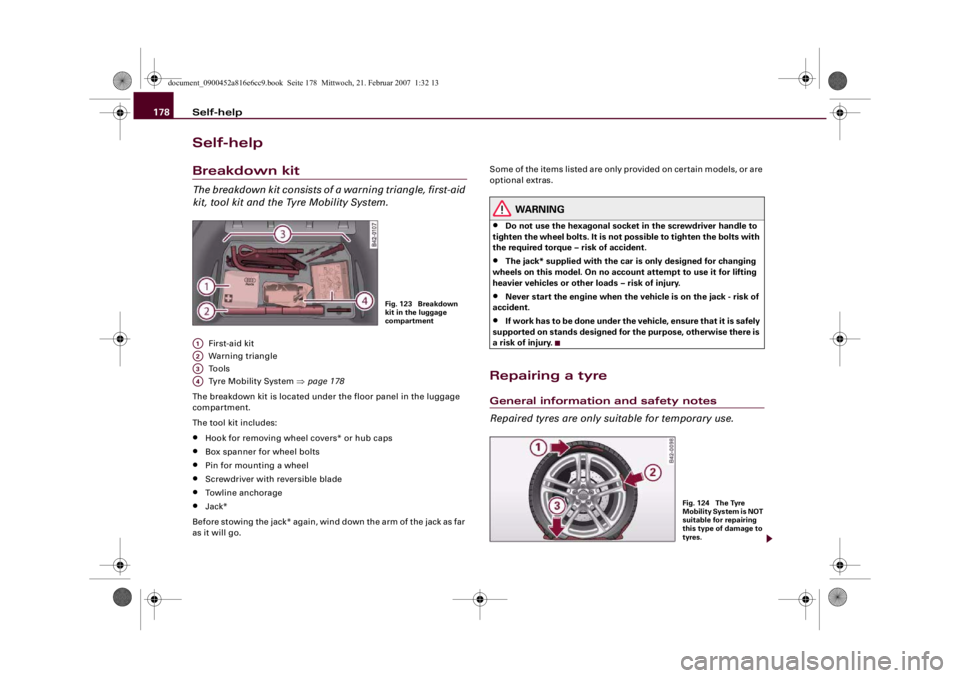
Self-help 178Self-helpBreakdown kitThe breakdown kit consists of a warning triangle, first-aid
kit, tool kit and the Tyre Mobility System.
First-aid kit
Warning triangle
Tools
Tyre Mobility System ⇒page 178
The breakdown kit is located under the floor panel in the luggage
compartment.
The tool kit includes:
•
Hook for removing wheel covers* or hub caps
•
Box spanner for wheel bolts
•
Pin for mounting a wheel
•
Screwdriver with reversible blade
•
Towline anchorage
•
Jack*
Before stowing the jack* again, wind down the arm of the jack as far
as it will go.Some of the items listed are only provided on certain models, or are
optional extras.
WARNING
•
Do not use the hexagonal socket in the screwdriver handle to
tighten the wheel bolts. It is not possible to tighten the bolts with
the required torque – risk of accident.
•
The jack* supplied with the car is only designed for changing
wheels on this model. On no account attempt to use it for lifting
heavier vehicles or other loads – risk of injury.
•
Never start the engine when the vehicle is on the jack - risk of
accident.
•
If work has to be done under the vehicle, ensure that it is safely
supported on stands designed for the purpose, otherwise there is
a risk of injury.
Repairing a tyreGeneral information and safety notes
Repaired tyres are only suitable for temporary use.
Fig. 123 Breakdown
kit in the luggage
compartment
A1A2A3A4
Fig. 124 The Tyre
Mobility System is NOT
suitable for repairing
this type of damage to
tyres.
document_0900452a816e6cc9.book Seite 178 Mittwoch, 21. Februar 2007 1:32 13
Page 189 of 210

Self-help187
Controls
Safety
Driving tips
General maintenance
Self-help
Technical data
Caution
Please note that the described method of connecting the leads is
meant for jump-starting your vehicle. If jump-starting another
vehicle, you should not connect the negative lead (–) to the negative
terminal of the discharged battery ⇒page 186, fig. 131 , but
directly to the engine block or a solid metal part bolted to the engine
block. If the battery of the other vehicle does not have a gas vent,
there is a risk that a mixture of oxygen and hydrogen gas can accu-
mulate and cause an explosion.Tow-starting and towing awayGeneral notes
Points to observe when tow-starting or towing awayIf you use a towrope:
Notes for the driver of the towing vehicle
– The towrope must be taut before driving off.
– Engage the clutch very gently when starting to move
(press the accelerator slowly if you have R tronic).
Notes for the driver of the towed vehicle
– The ignition should be switched on so that the turn
signals, horn, windscreen wipers and washers can be
used. Please ensure that the steering wheel is unlocked
when you switch on the ignition and that it moves freely.
– Put the gear lever in neutral or move the selector lever to
position N.– The brake servo and power steering only work when the
engine is running. Considerably more effort is required
on the brake pedal and steering wheel when the engine
is switched off.
– Ensure that the towrope remains taut at all times when
towing.
Towrope or towbar
It is easier and safer to tow a vehicle with a towbar. You should only
use a towrope if you do not have a towbar.
A towrope should be slightly elastic to reduce the loading on both
vehicles. It is advisable to use a towrope made of synthetic fibre or
similar material.
Attach the towrope or the towbar only to the towing anchorages
provided for this purpose ⇒page 188.
Driving technique
Towing requires some experience – especially when using a
towrope. Both drivers should be familiar with the technique required
for towing. Inexperienced drivers should not attempt to tow-start or
tow away another vehicle.
Do not pull too hard with the towing vehicle and take care to avoid
jerking the towrope. When towing on a loose surface there is always
a risk of overloading and damaging the anchorage points.
Caution
If there is no oil in the gearbox or no lubricant in the automatic
transmission the car may only be towed with the driven wheels
lifted clear of the road, or transported on a special car transporter
or trailer.
Note
•
Note the regulations concerning towing.
A4
document_0900452a816e6cc9.book Seite 187 Mittwoch, 21. Februar 2007 1:32 13
Page 190 of 210

Self-help 188•
The hazard warning lights of both vehicles must normally be
switched on. However, observe any regulations to the contrary.
•
Make sure that the towrope is not twisted, as otherwise the front
towline anchorage on your vehicle could work itself loose.
Front towline anchorage
The front towline anchorage is only mounted if the vehicle
has to be towed.The towline anchorage is screwed anti-clockwise into the
screw connection (left-hand thread) which is located on the
right side of the front bumper behind the air intake grille.
– Take the towline anchorage out of the vehicle's tool kit
⇒page 178.
– Pull the bottom part of the grille out.
– Screw the towline anchorage firmly all the way into the
screw connection ⇒fig. 132.After use, unscrew the towline anchorage and put it back in the
toolbox. The towline anchorage should always be kept in the
vehicle.When refitting the air intake grille, first insert the lugs on the grille
into their mountings in the intake duct. Then press the grille firmly
back into place.
WARNING
If the towline anchorage is not screwed in as far as the stop, there
is a risk of the screw connection shearing off during towing (acci-
dent risk).Tow-starting
As a general rule, tow-starting is not recommended.Vehicles with manual gearbox
– Engage 2nd or 3rd gear before moving off.
– Press the clutch and hold the pedal down.
– Switch on the ignition.
– Once both vehicles are moving, release the clutch.
– As soon as the engine starts: press the clutch and put the
gear lever in neutral.
Vehicles with R tronic
– Switch on the ignition.
– When both vehicles are moving, engage a gear using the
selector lever or the paddle levers. Which gear is selected
will depend on how fast the vehicle is travelling.
– As soon as the engine starts: Put the gear lever in neutral.If the engine will not start, it is best to try starting it using the
battery of another vehicle ⇒page 185 before attempting to tow
start. You should only try to tow-start the engine if jump-starting is
Fig. 132 Detail from
front of vehicle, right
side with air intake
grille removed: Towline
anchorage screwed in
document_0900452a816e6cc9.book Seite 188 Mittwoch, 21. Februar 2007 1:32 13
Page 191 of 210
Self-help189
Controls
Safety
Driving tips
General maintenance
Self-help
Technical data not successful. Tow-starting is an attempt to start the engine via the
movement of the wheels.
When tow-starting a vehicle with a petrol engine, do not tow it more
than a short distance, otherwise unburnt fuel can enter the catalytic
converter and cause damage.
WARNING
There is a high risk of accidents when tow-starting, as the towed
vehicle can easily be driven into the towing vehicle.
Caution
When tow-starting the vehicle, do not tow it further than 50 metres:
otherwise the catalytic converter could be damaged.To w i n g a w a y
Certain restrictions must be observed when towing your
vehicle.Please observe the notes ⇒page 187.
The vehicle can be towed with a towbar or towrope in the normal
way, with all four wheels on the ground. When doing so, please note
the following points:•
Make sure the gear lever is in neutral or the selector lever is in
the N position.
•
The vehicle must not be towed faster than 50 km/h.
•
The vehicle must not be towed further than 50 km. The reason
for this is: when the engine is not running, the gearbox oil pump
does not work and the gearbox is not adequately lubricated for
higher speeds or longer distances.
Caution
The vehicle must not be towed with the wheels lifted at either the
front or rear otherwise the gearbox may be damaged.
Note
If it is not possible to tow the vehicle as described above, or if it has
to be towed further than 50 km, it must be transported on a special
car transporter or trailer.
document_0900452a816e6cc9.book Seite 189 Mittwoch, 21. Februar 2007 1:32 13
Page 204 of 210

Index 202AABS
SeeAnti-lock brake system . . . . . . . . 132
AC mode
Air conditioner . . . . . . . . . . . . . . . . . . . 79
Acceleration figures
SeePerformance, weights and
dimensions . . . . . . . . . . . . . . . . . . . . 198
Accessories . . . . . . . . . . . . . . . . . . . . . . . . 174
acoustic parking system
SeeParking aid . . . . . . . . . . . . . . . . . . . 85
Air conditioner . . . . . . . . . . . . . . . . . . . . . . 75
AC mode . . . . . . . . . . . . . . . . . . . . . . . . . 79
Air distribution . . . . . . . . . . . . . . . . . . . 77
Air recirculation mode . . . . . . . . . . . . . 78
Automatic mode . . . . . . . . . . . . . . . . . . 78
Blower . . . . . . . . . . . . . . . . . . . . . . . . . . 77
Controls . . . . . . . . . . . . . . . . . . . . . . . . . 75
Defrosting . . . . . . . . . . . . . . . . . . . . . . . 78
Dust filter . . . . . . . . . . . . . . . . . . . . . . . . 75
Heating . . . . . . . . . . . . . . . . . . . . . . . . . . 75
Pollen filter . . . . . . . . . . . . . . . . . . . . . . 75
Rear window heating . . . . . . . . . . . . . . 79
Seat heating . . . . . . . . . . . . . . . . . . . . . 80
Switching on/off . . . . . . . . . . . . . . . . . . 77
Temperature . . . . . . . . . . . . . . . . . . . . . 76
Ventilation . . . . . . . . . . . . . . . . . . . . . . . 75
Air distribution
Air conditioner . . . . . . . . . . . . . . . . . . . 77
Air recirculation mode
Vehicles with air conditioner . . . . . . . . 78Airbag . . . . . . . . . . . . . . . . . . . . . . . . . . . . 115
Deactivating . . . . . . . . . . . . . . . . . . . . . 120
Front airbags . . . . . . . . . . . . . . . . . . . . 116
Key-operated switch for front passenger's
airbag . . . . . . . . . . . . . . . . . . . . . . . . . 120
Side airbags . . . . . . . . . . . . . . . . . . . . . 118
Triggering . . . . . . . . . . . . . . . . . . . . . . 116
Warning lamp . . . . . . . . . . . . . . . . . . . . 17
Alterations to the vehicle . . . . . . . . . . . . . 174
Alternator . . . . . . . . . . . . . . . . . . . . . . . . . . 18
Warning lamp . . . . . . . . . . . . . . . . . . . . 18
Anti-dazzle interior mirror . . . . . . . . . . . . . 63
Anti-freeze additive . . . . . . . . . . . . . . . . . 159
Anti-knock properties of petrol . . . . . . . . 152
Anti-lock brake system . . . . . . . . . . . . . . . 132
Warning lamp . . . . . . . . . . . . . . . . . . . . 19
Anti-theft alarm . . . . . . . . . . . . . . . . . . . . . . 48
Interior monitor . . . . . . . . . . . . . . . . . . . 49
Tow-away protection . . . . . . . . . . . . . . 49
Anti-theft wheel bolts . . . . . . . . . . . . . . . . 182
Ashtray . . . . . . . . . . . . . . . . . . . . . . . . . . . . . 72
Audi magnetic ride . . . . . . . . . . . . . . . . 16, 88
Description . . . . . . . . . . . . . . . . . . . . . . . 88
Warning lamp . . . . . . . . . . . . . . . . . . . . 16
Audi parking system . . . . . . . . . . . . . . . . . 85
Automatic car washes
SeeWashing . . . . . . . . . . . . . . . . . . . . 144
Automatic headlight control . . . . . . . . . . . 63
Automatic headlights . . . . . . . . . . . . . . . . . 53
Defective . . . . . . . . . . . . . . . . . . . . . . . . 38
Average fuel consumption . . . . . . . . . . . . 22
Average speed . . . . . . . . . . . . . . . . . . . . . . 22Axle weights
SeePerformance, weights and
dimensions . . . . . . . . . . . . . . . . . . . . 198
BBattery . . . . . . . . . . . . . . . . . . . . . . . . . . . . 162
Charging . . . . . . . . . . . . . . . . . . . . . . . . 164
Disconnecting and connecting . . . . . 162
Long periods of non-use . . . . . . . . . . 162
Replacing . . . . . . . . . . . . . . . . . . . . . . . 162
Testing . . . . . . . . . . . . . . . . . . . . . . . . . 162
Winter conditions . . . . . . . . . . . . . . . . 162
Winter operation . . . . . . . . . . . . . . . . . 162
Battery voltage . . . . . . . . . . . . . . . . . . . . . . 37
Belt tensioners . . . . . . . . . . . . . . . . . . . . . 114
Bioethanol fuel . . . . . . . . . . . . . . . . . . . . . 152
Blower . . . . . . . . . . . . . . . . . . . . . . . . . . . . . 77
Brake system
Brake fluid . . . . . . . . . . . . . . . . . . . . . . 161
Brake light failure . . . . . . . . . . . . . . . . . 38
Brake pads worn . . . . . . . . . . . . . . . . . . 37
Brake servo . . . . . . . . . . . . . . . . . . . . . . 134
Brakes . . . . . . . . . . . . . . . . . . . . . . . . . . 134
Malfunction . . . . . . . . . . . . . . . . . . . . . . 35
Warning lamp . . . . . . . . . . . . . . . . . . . . 18
Bulb monitor . . . . . . . . . . . . . . . . . . . . . . . . 37
Bulbs . . . . . . . . . . . . . . . . . . . . . . . . . . . . . 193
Business equipment . . . . . . . . . . . . . . . . . 175CCapacities . . . . . . . . . . . . . . . . . . . . . . . . . 199
document_0900452a816e6cc9.book Seite 202 Mittwoch, 21. Februar 2007 1:32 13
Page 209 of 210

Index207
Controls
Safety
Driving tips
General maintenance
Self-help
Technical data Radio display . . . . . . . . . . . . . . . . . . . . . . . . 20
Radio transmitters
Fixed installation . . . . . . . . . . . . . . . . . 175
Mobile equipment . . . . . . . . . . . . . . . . 175
Radio-controlled clock . . . . . . . . . . . . . . . . 11
Radio-operated remote control
SeeRemote control keys . . . . . . . . . . . 41
Rain sensor . . . . . . . . . . . . . . . . . . . . . . . . . 59
Rain sensor defective . . . . . . . . . . . . . . . . . 38
Rear fog light . . . . . . . . . . . . . . . . . . . . . . . . 54
Rear lights defective . . . . . . . . . . . . . . . . . . 37
Rear spoiler . . . . . . . . . . . . . . . . . . . . . . . . 134
Rear view mirrors
SeeMirrors . . . . . . . . . . . . . . . . . . . . . . . 63
Rear window heating . . . . . . . . . . . . . . . . . 79
Remote control keys . . . . . . . . . . . . . . . . . . 40
Indicator lamp . . . . . . . . . . . . . . . . . . . . 40
Replacing the battery . . . . . . . . . . . 40, 41
Synchronisation . . . . . . . . . . . . . . . . . . . 41
Unlocking and locking . . . . . . . . . . . . . 43
Repairs . . . . . . . . . . . . . . . . . . . . . . . . . . . . 174
Replacement keys . . . . . . . . . . . . . . . . . . . . 40
Replacement parts . . . . . . . . . . . . . . . . . . 174
Rev counter . . . . . . . . . . . . . . . . . . . . . . . . . 11
Reverse gear
R tronic . . . . . . . . . . . . . . . . . . . . . . . . . . 90
Running in . . . . . . . . . . . . . . . . . . . . . . . . . 138
SSAFE . . . . . . . . . . . . . . . . . . . . . . . . . . . . . . . 42
Safe driving . . . . . . . . . . . . . . . . . . . . . . . . 102Safety . . . . . . . . . . . . . . . . . . . . . . . . . . . . . 103
Safety features . . . . . . . . . . . . . . . . . . . . . 102
Seat adjustment
Bucket seats . . . . . . . . . . . . . . . . . . . . . . 70
Electrically adjustable seat . . . . . . . . . . 68
Manually adjustable seat . . . . . . . . . . . 67
Seat belts . . . . . . . . . . . . . . . . . . . . . . . . . . 109
Adjusting seat belts . . . . . . . . . . . . . . . 112
Belt tensioners . . . . . . . . . . . . . . . . . . . 114
Cleaning . . . . . . . . . . . . . . . . . . . . . . . . 150
During pregnancy . . . . . . . . . . . . . . . . 113
Putting on . . . . . . . . . . . . . . . . . . . . . . . 112
Safety notes . . . . . . . . . . . . . . . . . . . . . 110
Taking off . . . . . . . . . . . . . . . . . . . . . . . 113
Warning lamp . . . . . . . . . . . . . . . . . . . . . 18
Seat heating . . . . . . . . . . . . . . . . . . . . . . . . . 80
Security central locking . . . . . . . . . . . . . . . 46
Selector lever defective . . . . . . . . . . . . . . . 38
Service interval display . . . . . . . . . . . . . . . . 21
Service position for windscreen wipers . . 61
Setting time . . . . . . . . . . . . . . . . . . . . . . . . . 12
Setting time format . . . . . . . . . . . . . . . . . . . 12
Side lights . . . . . . . . . . . . . . . . . . . . . . . . . . 52
Sitting position
Driver . . . . . . . . . . . . . . . . . . . . . . . . . . . 104
Front passenger . . . . . . . . . . . . . . . . . . 105
Incorrect sitting position . . . . . . . . . . 106
Snow chains . . . . . . . . . . . . . . . . . . . . . . . 171
Spare key . . . . . . . . . . . . . . . . . . . . . . . . . . . 40
Speed warning . . . . . . . . . . . . . . . . . . . 31, 37
Speedometer . . . . . . . . . . . . . . . . . . . . . . . . 13
Spoiler . . . . . . . . . . . . . . . . . . . . . . . . . . . . 134Starting the engine . . . . . . . . . . . . . . . . . . . 82
Starting with jump leads . . . . . . . . . . . . . 185
Steering
Locking the steering . . . . . . . . . . . . . . . 81
Steering wheel height adjustment
(manual) . . . . . . . . . . . . . . . . . . . . . . . . 81
Steering lock . . . . . . . . . . . . . . . . . . . . . . . . 81
Stowing luggage safely . . . . . . . . . . . . . . 108
Sun visors . . . . . . . . . . . . . . . . . . . . . . . . . . . 58
Switching off the engine . . . . . . . . . . . . . . 83
Symbols
Red symbols in central display . . . . . . 33
Yellow symbols in central display . . . . 33
TTank capacity . . . . . . . . . . . . . . . . . . . . . . . 199
Temperature . . . . . . . . . . . . . . . . . . . . . . . . 76
Tool kit . . . . . . . . . . . . . . . . . . . . . . . . . . . . 178
Tools . . . . . . . . . . . . . . . . . . . . . . . . . . . . . . 178
Tow-away protection . . . . . . . . . . . . . . . . . 49
Towing away . . . . . . . . . . . . . . . . . . . . . . . 187
Towline anchorage . . . . . . . . . . . . . . . . . . 188
Tow-starting . . . . . . . . . . . . . . . . . . . . . . . . 187
Traction control system . . . . . . . . . . . . . . 132
Tread depth . . . . . . . . . . . . . . . . . . . . . . . . 168
Trip recorder . . . . . . . . . . . . . . . . . . . . . 13, 14
Trips, checklist . . . . . . . . . . . . . . . . . . . . . . 102
Turn signals . . . . . . . . . . . . . . . . . . . . . . . . . 56
Two-way radios . . . . . . . . . . . . . . . . . . . . . 175
Type plate . . . . . . . . . . . . . . . . . . . . . . . . . . 196
Tyre Mobility System . . . . . . . . . . . . . . . . 178
document_0900452a816e6cc9.book Seite 207 Mittwoch, 21. Februar 2007 1:32 13