2007 AUDI R8 tyre pressure
[x] Cancel search: tyre pressurePage 172 of 210

Wheels and tyres 170•
If wheel trims are fitted after the car is purchased, ensure that
there is an adequate flow of air for cooling the brakes.For the sake of the environment
Old tyres must be disposed of according to the laws in the country
concerned.
Note
•
Tyres with the “R0” mark are specially matched to your Audi. We
recommend that you use these tyres only. Your Audi R8 dealer or
specialist retailer will gladly provide you with further information.
•
Never mount used tyres if you are not sure of their previous
history.
•
For technical reasons it is not normally possible to use wheel
rims from other vehicles. In some cases this also applies to rims
from other vehicles of the same model.
Wheel bolts
The wheel bolts are designed to suit the rims on your car.The wheel bolts are matched to the rims. When installing different
wheels (for instance alloy wheels or wheels with winter tyres) it is
important to use the correct wheel bolts with the right length and
correctly shaped bolt heads. This is essential for the secure fit of the
wheels and for the proper function of the brake system.
Audi R8 dealers have full information on the technical requirements
when installing or changing tyres, rims or wheel trims.
The wheel bolts should be clean and turn easily.
A special adapter is required to turn the anti-theft wheel bolts*
⇒page 182.
Winter tyres
Winter tyres will significantly improve the car's handling
in winter road conditions.–Use only radial ply winter tyres.
– Winter tyres must be fitted on all four wheels.
– Only use winter tyres of the correct type approved for
your vehicle.
– Please note that the maximum permissible speed for
winter tyres may be lower than for summer tyres.
– Also note that winter tyres are no longer effective when
the tread is worn down.
– After fitting the wheels you must always check the tyre
pressures. The correct tyre pressures are listed on the
sticker on the driver's door pillar ⇒page 167.In winter road conditions winter tyres will considerably improve the
car's handling. Due to their type of construction (width, rubber
compound, tread pattern), summer tyres give less grip on ice and
snow. This applies particularly to vehicles equipped with wide
section tyres or high speed tyres (code letters H, V or Y on the side-
wall).
Only use winter tyres of the correct type approved for your vehicle.
The sizes of the winter tyres approved for your vehicle are listed in
the vehicle's documents (e.g. EC Certificate of Conformity or COC
document
3)). The vehicle documents vary depending on the
country of residence. Also refer to ⇒page 168.
Winter tyres are no longer fully effective when the tread is worn
down to a depth of 4 mm.
WARNING (continued)
3)COC = Certificate of conformity
document_0900452a816e6cc9.book Seite 170 Mittwoch, 21. Februar 2007 1:32 13
Page 174 of 210

Wheels and tyres 172Remove wheel covers (if fitted) and trim rings before attaching
snow chains. For safety reasons cover caps must then be fitted over
the wheel bolts. These are available from Audi R8 dealers.
Remove the chains when roads are free of snow. Otherwise they will
impair handling, damage the tyres and wear out very quickly.
Four-wheel drive: Where snow chains are compulsory on certain
roads, this normally also applies to cars with four-wheel drive. Snow
chains may only be fitted to the rear wheels (also on vehicles with
four-wheel drive).Tyre pressure monitoring systemApplies to vehicles: with tyre pressure monitoring systemIntroduction
The tyre pressure monitoring system keeps a check on the
inflation pressures of the four road wheels while you are
driving.The system warns the driver in the event of a loss of pressure by
means of symbols and messages in the instrument cluster display.
The system employs sensors on the wheels. The radio signals from
these sensors are transmitted to the tyre pressure monitoring
system.
Please bear in mind that the tyre inflation pressure is also influ-
enced by the temperature of the tyre. For every 10°C increase in the
tyre temperature the pressure will normally increase by about
0.1 bar. The tyre heats up while the vehicle is being driven and the
tyre pressure will rise accordingly. For this reason, you should only
adjust the tyre pressures when they are cold (i.e. approximately at
ambient temperature).
To ensure that the tyre pressure monitoring system works reliably,
you should check and, if necessary, adjust the tyre pressures at
regular intervals.The tyre pressures recommended for your vehicle are given on the
sticker attached to the driver's door pillar.
Initialising the tyre pressure monitoring system
The inflation pressures for two sets of wheels (e.g. with winter and
summer tyres) are stored on your vehicle. You can change between
these two sets of wheels any number of times without re-initialising
the system.
The tyre pressure monitoring system must be re-initialised by your
Audi R8 dealer if a new set of wheels is used or the electronic
sensors are renewed.
Warning lamp
lit
If the tyre pressure is more than 0.5 bar below the reference value,
the display will show the tyre symbol
with a corresponding
message, such as Tyre pressures too low ⇒.
WARNING
•
If the warning lamp
lights up you must slow down immedi-
ately and avoid any severe braking or steering manoeuvres. As
soon as you can do so safely, stop and check the tyres and the tyre
pressures.
•
Never re-adjust the tyre inflation pressure when the tyre is hot.
This can cause serious damage to the tyre or even a blow-out,
which could result in an accident.
•
Under-inflated tyres flex more and can overheat at continuous
high speeds. This can cause tread separation and tyre blow-out,
which could result in an accident.For the sake of the environment
Under-inflated tyres lead to increased fuel consumption and tyre
wear.
document_0900452a816e6cc9.book Seite 172 Mittwoch, 21. Februar 2007 1:32 13
Page 175 of 210

Wheels and tyres173
Controls
Safety
Driving tips
General maintenance
Self-help
Technical data
Note
•
Responsibility for ensuring that the tyres are correctly inflated
remains with the driver; the system can only provide assistance.
•
Only adjust the inflation pressure of the tyres when they are at
approximately ambient temperature.
•
The sensors and valves do not have to be detached or changed
round when fitting new tyres. Only the valve core needs to be
replaced, and if necessary the valve and the electronic components
in the wheel.
•
After using the Tyre Mobility System* the tyre pressure moni-
toring system may malfunction. The sensor for the tyre pressure
monitoring system must therefore be renewed by a qualified
workshop.
Applies to vehicles: with tyre pressure monitoring systemMalfunctionsIf the tyre pressure monitoring system is inoperative, the tyre
symbol or “TPMS” will appear on the display. This can have various
causes:•
One of the wheel sensors or other related components may not
be working.
•
Snow chains can interfere with the signals emitted by the
sensors so that the system cannot function properly.
•
The tyre pressure monitoring system may be inoperative due to
radio interference.
•
Radio systems operating on the same frequency, such as radio
headphones or two-way radios inside the vehicle, produce strong
electromagnetic fields which can cause temporary interference.
•
If the fault persists, take the vehicle to a qualified workshop.
document_0900452a816e6cc9.book Seite 173 Mittwoch, 21. Februar 2007 1:32 13
Page 181 of 210

Self-help179
Controls
Safety
Driving tips
General maintenance
Self-help
Technical data Your vehicle is equipped with a tyre repair kit: the Tyre Mobility
System (TMS).
In the event of a puncture you will find the TMS, which consists of a
sealing compound and an electric compressor, located under the
floor panel in the luggage compartment.
The TMS will reliably seal tyres damaged by foreign bodies,
provided that the cuts or punctures are no larger than approx. 4 mm
in diameter.
It is not necessary to remove the foreign body from the tyre.
The sealing compound must not be used:
•
on cuts and punctures larger than 4 mm ⇒page 178, fig. 124
•
if the wheel rim has been damaged
•
if you have been driving with very low pressure or a completely
flat tyre .
How to use the TMS is described in the section Repairing a tyre
⇒page 180.
The TMS can be used at outside temperatures down to – 20 °C.
WARNING
After repairing a tyre please note the following points:•
Do not drive faster than 80 km/h.
•
Avoid heavy acceleration, hard braking and fast cornering.
•
Vehicle handling could be impaired.
•
Tyres which have been sealed using the TMS are only suitable
for temporary use. Damaged tyres must be renewed. Therefore,
please drive carefully to the next available qualified workshop.
•
The TMS must NOT be used,
−on cuts and punctures larger than 4 mm
−if the wheel rim has been damaged
−if you have been driving with very low pressure or a
completely flat tyre
•
Seek professional assistance if the repair of a tyre puncture is
not possible with the sealing compound.
•
Do not allow the sealant to come into contact with your eyes,
skin or clothing.
•
If you do come into contact with the sealant immediately rinse
the eyes or skin affected with clean water.
•
Change clothing immediately if it becomes soiled with the tyre
sealant.
•
Make sure you do not breathe in the fumes!
•
If any of the tyre sealant is accidentally ingested, immediately
rinse the mouth thoroughly and drink lots of water.
−Do not induce vomiting. Immediately contact a doctor!
•
If any allergic reactions should occur get medical help immedi-
ately.
•
Keep the sealant away from children.For the sake of the environment
Used sealing compound cans should be disposed of at a proper
facility.
Note
•
If sealant should leak out, leave it to dry. When it has dried, you
can pull it off like a piece of foil.
•
Observe the expiry date stated on the sealing compound can.
Have the sealing compound exchanged by a qualified workshop.
A1
A2
A3
WARNING (continued)
document_0900452a816e6cc9.book Seite 179 Mittwoch, 21. Februar 2007 1:32 13
Page 182 of 210
Self-help 180Preparations
Certain steps must be taken before repairing a tyre.– If you have a flat tyre, stop the car well away from moving
traffic.
– Apply the handbrake firmly.
– Engage a gear.
– Check whether a repair is possible using the Tyre
Mobility System ⇒page 178.
– Ensure that all passengers leave the vehicle and move
away from the danger area ⇒.
– Take the tyre sealant can and the electric compressor out
of the holder under the floor panel ⇒page 178, fig. 123.
– Peel the sticker “max. 80 km/h” off the tyre sealant can
and fix it onto the instrument cluster where the driver will
see it.
WARNING
•
If you have a puncture in moving traffic, switch on the hazard
warning lights and place the warning triangle in a visible location.
This is for your own safety and also warns other road users.
•
Make sure your passengers wait in a safe place (for instance
behind the roadside crash barrier).Caution
Take special care if you have to repair a tyre on a gradient.
Note
Please observe the relevant regulations.
Repairing a tyre
The following sections describe the procedures for
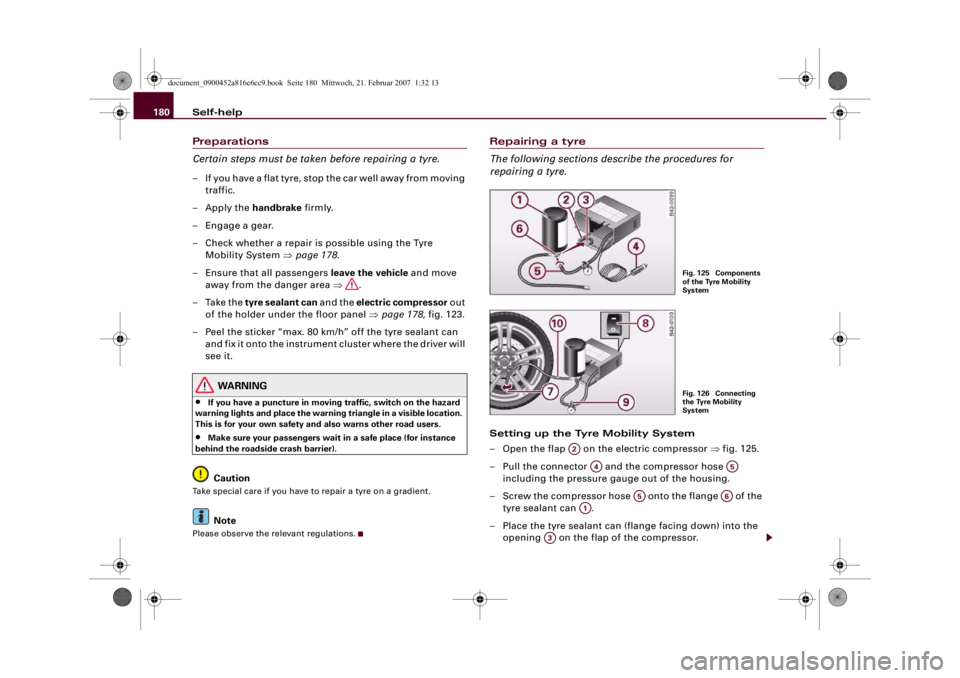
repairing a tyre.Setting up the Tyre Mobility System
– Open the flap on the electric compressor ⇒fig. 125.
– Pull the connector and the compressor hose
including the pressure gauge out of the housing.
– Screw the compressor hose onto the flange of the
tyre sealant can .
– Place the tyre sealant can (flange facing down) into the
opening on the flap of the compressor.
Fig. 125 Components
of the Tyre Mobility
SystemFig. 126 Connecting
the Tyre Mobility
System
A2
A4
A5
A5
A6
A1
A3
document_0900452a816e6cc9.book Seite 180 Mittwoch, 21. Februar 2007 1:32 13
Page 183 of 210
Self-help181
Controls
Safety
Driving tips
General maintenance
Self-help
Technical data
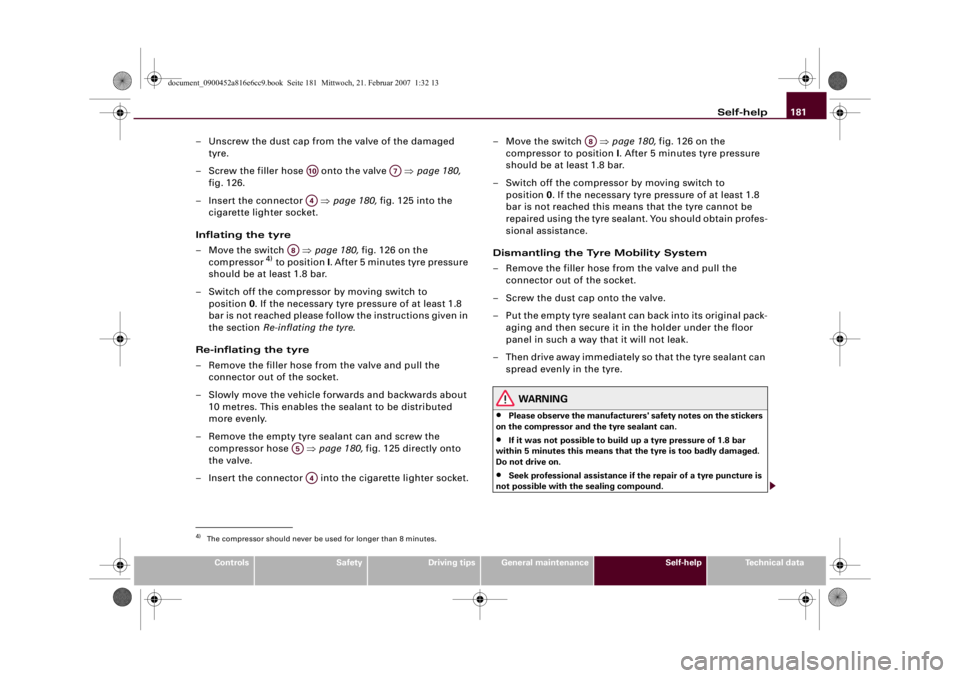
– Unscrew the dust cap from the valve of the damaged
tyre.
– Screw the filler hose onto the valve ⇒page 180,
fig. 126.
– Insert the connector ⇒page 180, fig. 125 into the
cigarette lighter socket.
Inflating the tyre
–Move the switch ⇒page 180, fig. 126 on the
compressor
4) to position I. After 5 minutes tyre pressure
should be at least 1.8 bar.
– Switch off the compressor by moving switch to
position0. If the necessary tyre pressure of at least 1.8
bar is not reached please follow the instructions given in
the section Re-inflating the tyre.
Re-inflating the tyre
– Remove the filler hose from the valve and pull the
connector out of the socket.
– Slowly move the vehicle forwards and backwards about
10 metres. This enables the sealant to be distributed
more evenly.
– Remove the empty tyre sealant can and screw the
compressor hose ⇒page 180, fig. 125 directly onto
the valve.
– Insert the connector into the cigarette lighter socket.– Move the switch ⇒page 180, fig. 126 on the
compressor to position I. After 5 minutes tyre pressure
should be at least 1.8 bar.
– Switch off the compressor by moving switch to
position0. If the necessary tyre pressure of at least 1.8
bar is not reached this means that the tyre cannot be
repaired using the tyre sealant. You should obtain profes-
sional assistance.
Dismantling the Tyre Mobility System
– Remove the filler hose from the valve and pull the
connector out of the socket.
– Screw the dust cap onto the valve.
– Put the empty tyre sealant can back into its original pack-
aging and then secure it in the holder under the floor
panel in such a way that it will not leak.
– Then drive away immediately so that the tyre sealant can
spread evenly in the tyre.
WARNING
•
Please observe the manufacturers' safety notes on the stickers
on the compressor and the tyre sealant can.
•
If it was not possible to build up a tyre pressure of 1.8 bar
within 5 minutes this means that the tyre is too badly damaged.
Do not drive on.
•
Seek professional assistance if the repair of a tyre puncture is
not possible with the sealing compound.
4)The compressor should never be used for longer than 8 minutes.
A10
A7
A4
A8A5A4
A8
document_0900452a816e6cc9.book Seite 181 Mittwoch, 21. Februar 2007 1:32 13
Page 184 of 210

Self-help 182
Note•
Do not use the compressor for longer than 8 minutes at a time,
as it could overheat. When the compressor has cooled down, you
can use it again.
•
If tyre sealant should leak out, leave it to dry and then pull it off
like foil.
Final checkAfter covering a short distance it is necessary to check the
tyre pressure
– After about 10 minutes stop to check the tyre pressure.
– If tyre pressure is still at least 1.3 bar, pump the tyre up
to the pressure specified (see driver's door pillar) and
drive to the nearest workshop to have the tyre and the
tyre sealant can replaced.
– If tyre pressure is less than 1.3 bar, the tyre is too badly
damaged. Do not drive on. You should obtain profes-
sional assistance.
WARNING
If tyre pressure is less than 1.3 bar after driving about 10 minutes,
the tyre is too badly damaged. Do not drive on. You should obtain
professional assistance.
Note
After carrying out repairs to a tyre, have the tyre sealant can
replaced by a qualified dealer. This will ensure that the Tyre Mobility
System is operative again.
Changing a wheelTyres with directional tread pattern
Tyres with directional tread pattern must be mounted so
that they rotate in the correct direction.A directional tread pattern is identified by arrows on the sidewall
pointing in the forward running direction. Always note the direction
of rotation indicated when mounting the wheel. This is important so
that these tyres can give maximum grip and avoid excessive noise,
tread wear and aquaplaning.Applies to vehicles: with anti-theft wheel boltsAnti-theft wheel bolts
A special adapter is required to turn the anti-theft wheel
bolts.– Insert the adapter completely into the anti-theft wheel
bolt .
– F i t t h e b o x s p a n n e r as fa r as i t w i l l g o o v e r t h e a d a p t e r .
– Loosen or tighten the wheel bolt ⇒page 185.
Fig. 127 Anti-theft
wheel bolt with
adapter
A2
A1
A2
document_0900452a816e6cc9.book Seite 182 Mittwoch, 21. Februar 2007 1:32 13
Page 193 of 210

Fuses and bulbs191
Controls
Safety
Driving tips
General maintenance
Self-help
Technical data
The fuse box is located behind the foot rest in the
passenger's footwell ⇒page 190, fig. 134.Row of the fuse box is not used.Row
No
Electrical equipment
amps
1
Mobile phone adapter
5
2
Heated washer jets
5
3
Parking aid (APS)
10
4
Vacant
--
5
Diagnostic interface, light switch,
Airbag OFF warning lamp, selector lever
10
6
Network gateway, diagnostic interface
5
7
Vacant
--
8
Anti-dazzle interior mirror, garage door
opener
10
9
Washer pump
15
10
ESP button
10
11
Pressure sensor, air conditioner
5
12
Airbag
5
Fuse row -B-
AAAB
Row
No
Electrical equipment
amps
1
Radiator fan (1)
40
2
Radiator fan (2)
40
3
Exterior lighting
40
4
Exterior lighting
40
5
Vacant
--
6
Blower control
40
Fuse row -C-Row
No
Electrical equipment
amps
1
Reversing camera
5
2
Tyre pressure monitoring
10
3
Parking aid (APS)
5
4
Phone pre-installation, compensor
5
5
Instrument cluster
5
6
Network gateway
5
7
Switches for steering column
5
8
Diagnostic interface, brake pedal switch,
selector lever
10
9
Rain sensor/light sensor
5
10
Interior lighting
5
11
Sound amplifier
30
12
Radio
20
Fuse row -D-
ACAD
document_0900452a816e6cc9.book Seite 191 Mittwoch, 21. Februar 2007 1:32 13