2006 VOLVO S80 automatic transmission
[x] Cancel search: automatic transmissionPage 58 of 122

If you slow down to a very low speed, the transmission will automatically shift down.
When starting in the (MAN)ual position, 3rd gear is the highest gear that may be selected.
NOTE: Kickdown (see previous page) does not function when the transmission is in the manual shift (geartronic)
mode. The gear selector must be in D (Drive) position.
W Winter/Wet driving mode - enhanced vehicle traction
Mode W will only function if the gear selector is in the (D)rive position.
Press the button at the base of the gear selector to engage/disengage this driving mode. The position of this button
may vary slightly on certain models.
An LED in the button will light up to indicate that W is engaged and this will also be displayed in the instrument
panel (see page 27
).
This mode may be selected for starting/moving off on slippery roads.
pg. 82 Four -C active chassis system
Four-C (option)
Your car can be optionally equipped with the Four-C (Continuously Controlled Chassis Concept) system.
This system is based on a number of sensors that continuously monitor factors such as the car's lateral and vertical
movements, speed, and movements of the wheels. The sensors receive data up to 500 times per second, which is used
to provide extremely fast and precise adjustment of each shock absorber. The system adjusts the stiffness of the shock
absorbers approximately 100 times per second.
The button in the center console (see the illustration on page 31
) can be used at any time to switch between the two
driving modes: Comfort or Sport.
The system then adjusts the stiffness of the shock absorbers accordingly, for example when the type of road changes,
or if the driver wishes to change driving style. This adjustment takes place instantaneously.
Comfort
The Comfort mode chassis setting offers the greatest amount of shock absorption and the softest ride. This mode is
recommended for long-distance driving, or when driving in slippery conditions.
If Comfort mode was selected when the engine was switched off, this mode will be active when the engine is restarted.
Sport
An indicator lamp in the button will come on when this mode has been activated.
In Sport mode, shock absorption is stiffer to reduce the car's body sway during cornering and to provide more
immediate steering response.
ProCarManuals.com
Page 60 of 122

Faults in the system
If a fault should occur in the system, the LED in the button will be switched off and a message will be displayed in the
text window.
Cleaning the sensors
For the system to function properly, the sensors in the front and/or rear bumpers should be kept clean. They can be
cleaned with car washing detergent and a sponge.
WARNING!
These systems are designed to be a supplementary aid when parking the vehicle. They are not, however, intended to
replace the driver's attention and judgement.
pg. 84 Driving economy
Economical driving conserves natural resources
Better driving economy may be obtained by thinking ahead, avoiding rapid starts and stops and adjusting the speed of
your vehicle to immediate traffic conditions. Observe the following rules:
Bring the engine to normal operating temperature as soon as possible by driving with a light foot on the accelerator
pedal for the first few minutes of operation. A cold engine uses more fuel and is subject to increased wear.
Whenever possible, avoid using the car for driving short distances. This does not allow the engine to reach normal
operating temperature.
Drive carefully and avoid rapid acceleration and hard braking.
Do not exceed posted speed limits.
Avoid carrying unnecessary items (extra load) in the car.
Maintain correct tire pressure. Check tire pressure regularly (when tires are cold).
Remove snow tires when threat of snow or ice has ended.
Note that roof racks, ski racks, etc., increase air resistance and also fuel consumption.
Avoid using automatic transmission kickdown feature unless necessary.
Avoid using the air conditioning when it is not required. When engaged, the A/C compressor places an additional
load on the engine. However, at higher driving speeds, fuel consumption will be lower with the air conditioning on and
the windows closed than with the air conditioning off and the windows open.
Using the onboard trip computer's fuel consumption modes can help you learn how to drive more economically.
Other factors that decrease gas mileage are:
Dirty air cleaner
Dirty engine oil and clogged oil filter
Dragging brakes
Incorrect front end alignment
Some of the above mentioned items and others are checked at the standard Maintenance Service intervals.
NOTE : Vehicles equipped with automatic transmissions should use (D)rive as often as possible and avoid using
"kickdown" to help improve fuel economy.
Cooling system
The risk for engine overheating is greatest, especially in hot weather, when:
Towing a trailer up steep inclines for prolonged periods at wide open throttle and low engine rpm.
Stopping the engine suddenly after high speed driving (so-called "after-boiling" can occur).
To avoid overheating, the following rules should be followed:
Do not drive for prolonged periods at engine speeds above 4500 rpm if you are towing a trailer in hilly terrain.
ProCarManuals.com
Page 94 of 122

engine power over that developed by the normally-aspirated engine. The charge air cooler (which resembles a radiator)
is located between the turbo-compressor and inlet manifold.
All specifications are subject to change without prior notice.
pg. 153 Oil/fluid specifications and volumes
Engine oil
Type: Engine oil must meet the minimum ILSAC specification GF-3, API SL, or ACEA A1/B1.
Volume : 5.8 qts (5.5 liters)
Volume between MIN and MAX on dipstick : 1.3 US qts (1.2 liters)
Automatic transmission fluid
AW5: 7.6 US qts (7.2 liters), type: JWS 3309
Cooling system
Type: Positive pressure, closed system. The thermostat begins to open at 194 °F (90 °C).
Coolant: Volvo original coolant/antifreeze.
Volume: 9.5 US qts (9.0 liters)
Power steering fluid
Volvo synthetic power steering fluid (Pentosin CHF 11S) P/N 1161529 or equivalent.
Volume: 0.95 US qt (0.9 liter).
Brake fluid
DOT 4+ boiling point > 536°F (280° C) P/N 9437433
Volume: 0.6 US qt (0.6 liter)
Climate control system - refrigerant (R 134a)
Oil: PAG
Volume: 2.2 lbs (1000 g) R134a.
Fuel
Minimum octane requirement - AKI 87 (RON 91)
Fuel tank volume: 18 US gal. (68 liters) .
Washer fluid reservoir
Volume: 6 cyl: 4.7 US qts. (4.5 liters)
All specifications are subject to change without prior notice.
pg. 154 Fuel system, Distributor Ignition system, Suspension
Fuel system
The engine is equipped with a multiport fuel injection system.
Distributor ignition system
Firing order: 1-2-4-5-3
Distributor ignition setting: Not adjustable
Spark plugs: B 5254 T2: Champion RC8PYP 8 (or equivalent)
Spark plug gap: 0.028-0.032" (0.7-0.8 mm)
Tightening torque: 18.4 ft. lbs. (25 Nm)
ProCarManuals.com
Page 111 of 122
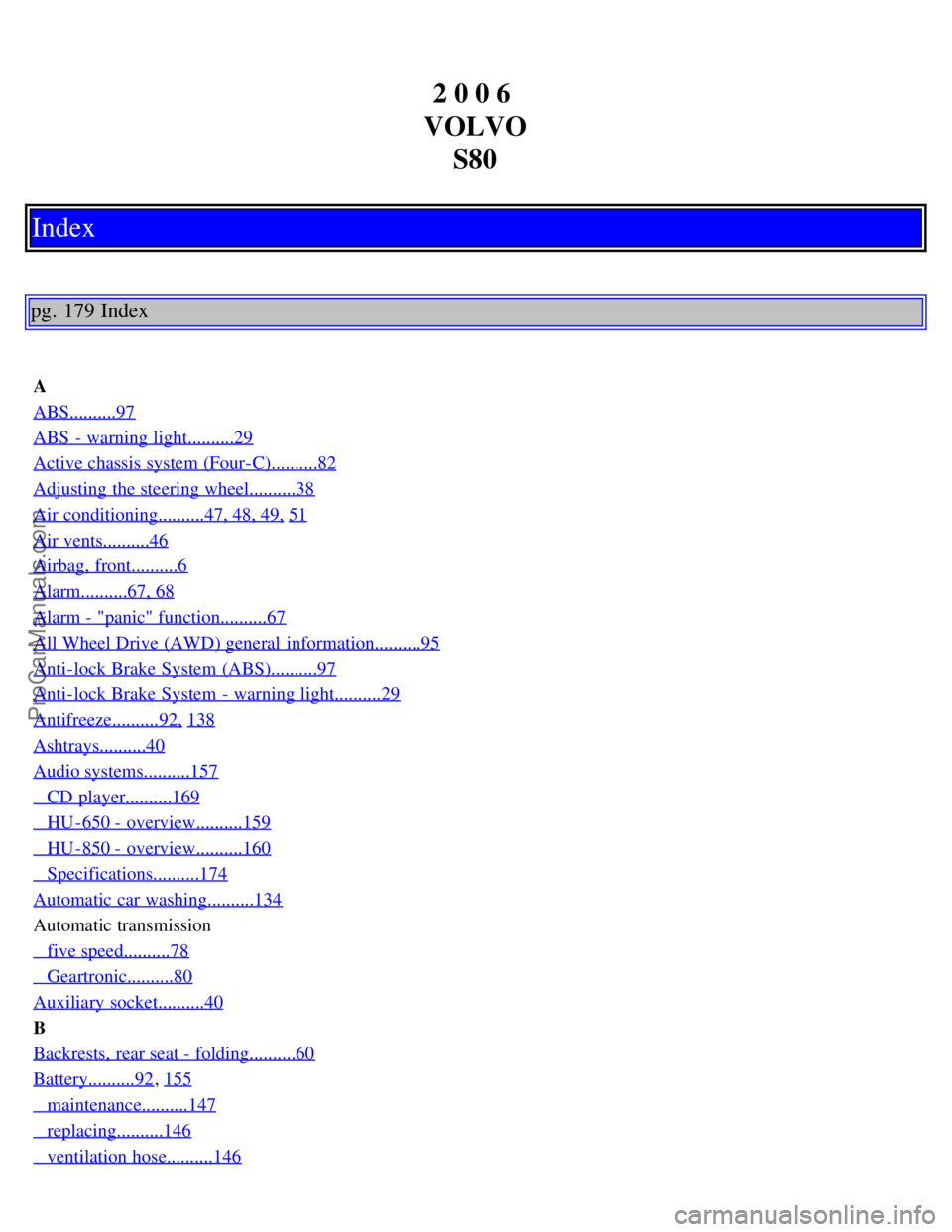
2 0 0 6
VOLVO S80
Index
pg. 179 Index
A
ABS..........97
ABS - warning light..........29
Active chassis system (Four-C)..........82
Adjusting the steering wheel..........38
Air conditioning..........47, 48, 49, 51
Air vents..........46
Airbag, front..........6
Alarm..........67, 68
Alarm - "panic" function..........67
All Wheel Drive (AWD) general information..........95
Anti-lock Brake System (ABS)..........97
Anti-lock Brake System - warning light..........29
Antifreeze..........92, 138
Ashtrays..........40
Audio systems..........157
CD player..........169
HU -650 - overview..........159
HU -850 - overview..........160
Specifications..........174
Automatic car washing..........134
Automatic transmission
five speed..........78
Geartronic..........80
Auxiliary socket..........40
B
Backrests, rear seat - folding..........60
Battery..........92, 155
maintenance..........147
replacing..........146
ventilation hose..........146
ProCarManuals.com
Page 117 of 122

Shiftlock..........77, 78, 80
Side impact airbag system (SIPS)..........12
Side marker lights - replacing..........130
Side turn signals - replacing..........130
Sideview mirrors..........42
Sideview mirrors - heated..........39
Sideview mirrors - memory function..........42
Spare tire.......... 59
Spark plugs..........154
Specifications..........152
Speed -sensitive power steering..........85
SRS..........8
SRS system components, inspecting..........14
Stability Traction Control ..........98, 99
Start inhibitor (immobilizer)..........64, 77
Starting the engine..........77
Steering wheel adjustment ........ 38
Steering wheel lock..........38
Storage compartment in center console..........58
Storage compartments..........57
Sun blinds..........44
Supplemental Restraint System..........29
Supplemental Restraint System (SRS)..........5
Suspension..........154
Switches in center console ........ 31
T
Tachometer..........27
Tail light bulbs - replacing ........ 127
Temperature gauge..........27
Text window..........30
Three-way catalytic converters..........94, 95
Tire Pressure Monitoring System ..........107
102 - 117
Tires - changing..........116, 116
Tool bag..........59
Towing a trailer..........89
Towing eyelet..........87
Towing the car..........87, 88
Trailer hitch, detachable - installing/removing..........90
Trailer towing..........89
Trailer weight - maximum..........151
Transmission - automatic..........81, 82
Transmission fluid (automatic)..........153
Trip computer..........32
ProCarManuals.com