2006 VOLVO C70 trunk
[x] Cancel search: trunkPage 93 of 182

well as decreasing fuel consumption while the engine is warming up. For winter use, 5W -30 oil, particularly the
synthetic type1, is recommended. Be sure to use good quality oil but do not use cold-weather oil for hard driving or in
warm weather. See page 191
for more information.
The load placed on the battery is greater during the winter since the windshield wipers, lighting, etc. are used more
often. Moreover, the capacity of the battery decreases as the temperature drops. In very cold weather, a poorly charged
battery can freeze and be damaged. It is therefore advisable to check the state of charge more frequently and spray an
anti-rust oil on the battery posts.
Volvo recommends the use of snow tires on all four wheels for winter driving - see the chapter "Wheels and tires."
To prevent the washer fluid reservoir from freezing, add washer solvents containing antifreeze (see page 157 for the
location of the washer fluid reservoir). This is important since dirt is often splashed on the windshield during winter
driving, requiring the frequent use of the washers and wipers. Volvo Washer Solvent should be diluted as follows:
Down to 14° F (-10° C): 1 part washer solvent and 4 parts water Down to 5° F (-15° C): 1 part washer solvent and 3
parts water Down to 0° F (-18° C): 1 part washer solvent and 2 parts water Down to -18° F (-28° C): 1 part washer
solvent and 1 part water.
Use Volvo Teflon Lock Spray in the locks.
NOTE: Avoid using de -icing sprays as they can cause damage to the locks.
Conserving electrical current
Keep the following in mind to help minimize battery drain:
When the engine is not running, avoid turning the ignition key to position II. Many electrical systems (the audio
system, the optional navigation system, power windows, etc) will function with the ignition key in position I. This
position reduces drain on the battery.
Please keep in mind that using systems, accessories, etc that consume a great deal of current when the engine is not
1. Synthetic oil is not used when the oil is changed at the normal maintenance intervals except at owner request and at additional charge.
pg. 100 Starting and driving
General information
running could result in the battery being completely drained.
The optional 12 volt socket in the trunk provides electrical current even with the ignition switched off, which drains
the battery.
NOTE: If the ignition is switched on, a warning message will be displayed in the text window in the instrument panel
when the battery charge is low.
An energy conserving function designed into the vehicle's electrical system will switch off certain functions or reduce
the load on the battery by, e.g., reducing the audio system's volume.
Before a long distance trip
It is always worthwhile to have your vehicle checked by a trained and qualified Volvo service technician before
driving long distances. Your retailer will also be able to supply you with bulbs, fuses, spark plugs and wiper blades for
your use in the event that problems occur.
As a minimum, the following items should be checked before any long trip:
Check that engine runs smoothly and that fuel consumption is normal.
Check for fuel, oil, and fluid leakage
Have the transmission oil level checked2.
Check condition of drive belts.
ProCarManuals.com
Page 95 of 182

Ethyl alcohol, or "Gasohol". Ethers - MTBE: Fuels containing up to 15% MTBE may be used.
Fuel Formulations
Do not use gasoline that contains lead as a knock inhibitor, and do not use lead additives. Besides damaging the
exhaust emission control systems on your vehicle, lead has been strongly linked to certain forms of cancer. Many fuels
contain benzene as a solvent. Unburned benzene has been strongly linked to certain forms of cancer. If you live in an
area where you must fill your own gas tank, take precautions.
These may include:
standing upwind away from the filler nozzle while refueling
pg. 102 Starting and driving
Fuel requirements (contd.)
refueling only at gas stations with vapor recovery systems that fully seal the mouth of the filler neck during
refueling
wearing neoprene gloves while handling a fuel filler nozzle.
WARNING!
Carbon monoxide is a poisonous, colorless, and odorless gas. It is present in all exhaust gases. If you ever smell
exhaust fumes inside the vehicle, make sure the passenger compartment is ventilated, and immediately return the
vehicle to your retailer for correction.
Use of Additives
With the exception of fuel line antifreeze during winter months, do not add solvents, thickeners, or other store -bought
additives to your vehicle's fuel, cooling, or lubricating systems. Overuse may damage your engine, and some of these
additives contain organically volatile chemicals. Do not needlessly expose yourself to these chemicals.
Fuel filler door
Press the button on the light switch panel (see the illustration on page 38
) with the ignition switched off to unlock the
fuel filler door. Please note that the fuel filler door will remain unlocked until the vehicle begins to move forward. An
audible click will be heard when the fuel filler door relocks.
If you intend to leave your vehicle while it is being refueled, this feature enables you to lock the doors/trunk while
leaving the fuel filler door unlocked.
You can also keep the vehicle locked if you remain inside it during refueling. The central locking button does not lock
the fuel filler door.
Be sure the fuel filler door is not obstructed and is completely closed after refueling. Open the fuel filler cap slowly
during hot weather .
Refueling
The fuel tank is designed to hold approximately 16.3 US gallons (62 liters) with sufficient volume left over to
accommodate possible expansion of the fuel in hot weather. Be aware that the "usable" tank capacity will be somewhat
less than the specified maximum. When the fuel level is low, such factors as ambient temperature, the fuel's "Reid
vapor pressure" characteristics, and terrain can affect the fuel pump's ability to supply the engine with an adequate
supply of fuel. Therefore, it is advisable to refuel as soon as possible when the needle nears the red zone, or when the
fuel warning light comes on.
pg. 103 Starting and driving
ProCarManuals.com
Page 107 of 182

pg. 116 Starting and driving
Park assist (accessory)
Cleaning the sensors
For the system to function properly, the sensors in the rear bumpers should be kept clean. They can be cleaned with
car washing detergent and a sponge.
Faults in the system
If a fault should occur in the system, the Information symbol will light up and remain on and PARK ASSIST
SERVICE REQUIRED will be displayed.
pg. 117 Starting and driving
Towing
Emergency towing
The towing eyelet is located under the floor of the cargo area. This eyelet must be screwed into the positions provided
on the right sides of either the front or rear bumper (see illustrations).
To attach the towing eyelet:
Take out the towing eyelet, which is either stored under the floor panel in the trunk near the spare tire (if the vehicle
is so equipped), or in the bag holding the temporary cover behind the ski hatch.
Use a coin or screwdriver to pry open the lower edge of the cover (1) to access the hole for the towing eyelet (2).
ProCarManuals.com
Page 112 of 182

Slide the ball holder into the hitch assembly.
Align the hole in the ball holder with the one in the hitch assembly.
Slide the locking bolt through the hitch assembly/ball holder.
Insert the cotter pin in the hole at the end of the locking bolt.
Removing the ball holder
Remove the cotter pin from the locking bolt and slide the locking bolt out of the ball holder/hitch assembly.
Pull the ball holder out of the hitch assembly.
NOTE: A cover for the hitch assembly is also included in the kit.
pg. 123 Starting and driving
Transporting loads
Loading the car Your vehicle's load-carrying capacity is affected by factors such as:
the number of passengers
tire inflation
the amount of optional or accessory equipment installed
the amount of cargo
See the chapter "Wheels and tires"
for more detailed information.
Before loading the car, turn off the engine, and apply the parking brake when loading or unloading long objects. The
gear selector can be inadvertently knocked out of position by long cargo, causing the car to move.
Keep the following in mind when loading the vehicle:
Load the cargo in the trunk against the rear seat backrest.
Load heavy cargo as low as possible.
Center wide loads.
Secure all cargo with restraining straps anchored to the load securing eyelets.
Cover sharp edges on the load.
WARNING!
Remember that an object weighing 44 lbs (20 kg) produces a force of 2,200 lbs (1,000 kg) in a head-on collision at
30 m.p.h. (50 km/h)!
pg. 124 Starting and driving
This page left intentionally blank.
Contents | Top of Page
ProCarManuals.com
Page 124 of 182

the car. The use of different size wheels can seriously damage your car's transmission.
Location of the optional spare wheel and tools
The spare wheel is packed in a storage bag and is located under the panel in the floor of the trunk. On cars with a
spare wheel, the jack and lug wrench are secured in a foam plastic block placed in the center of the wheel. The
retaining straps securing the spare wheel is attached to two eyelets in the floor of the spare wheel's storage
compartment.
WARNING!
Current legislation prohibits the use of the "Temporary Spare" tire other than as a temporary replacement for a
punctured tire. It must be replaced as soon as possible by a standard tire. Road holding and handling may be affected
with the "Temporary Spare" in use. Do not exceed 50 mph (80 km/h). Do not drive farther than 50 miles (80 km) on
a temporary spare tire.
Accessing the spare wheel:
Open the hatch in the floor of the trunk.
Release the retaining straps and lift out the spare wheel in its storage bag.
Open the zipper on the storage bag and lift out the spare wheel.
The wheel that was replaced by the temporary spare tire can then be placed in the storage bag.
pg. 139 Wheels and tires
Changing a wheel
Before raising the car:
Engage the parking brake.
Put the gear selector in (P)ark or in reverse if the car is equipped with a manual transmission.
Block the wheels that are on the ground with wooden blocks or large stones.
Remove the wheel cap (where applicable) using the lug wrench.
With the car still on the ground, use the lug wrench to loosen the wheel nuts 1/2-1 turn by exerting downward
pressure. Turn the nuts counterclockwise to loosen.
pg. 140 Wheels and tires
Changing a wheel
ProCarManuals.com
Page 126 of 182

Your vehicle is equipped with a tire sealing system that enables you to temporarily seal a hole in the tread surface and
re-inflate a flat tire, or to adjust a tire's inflation pressure.
The tire sealing kit is stowed behind the ski hatch in the center of the rear seat backrest.
The jack, and lug wrench are secured in a foam plastic block located under the floor panel in the trunk.
The system consists of an air compressor, an integrated container for the sealing compound, wiring to connect the
system to the vehicle's electrical system via one of the 12-volt sockets, and a hose used to connect the system to the
tire's inflation valve.
NOTE:
The tire sealing system is only intended to seal holes on the tire's tread area, not the sidewall.
Tires with large holes or tears cannot be repaired with the tire sealing system.
WARNING!
After using the tire sealing system, the vehicle should not be driven farther than approximately 120 miles (200
km). Have the tire replaced as soon as possible.
The vehicle should not be driven faster than 50 mph (80 km/h) while using a tire that has been temporarily
repaired with the tire sealing system.
After using the tire sealing system, drive carefully and avoid abrupt steering maneuvers and sudden stops.
pg. 142 Wheels and tires
Tire sealing system
ProCarManuals.com
Page 136 of 182
2 0 0 6
VOLVO C70
Chapter 10 - Maintenance and servicing
pg. 153 Maintenance and servicing
Volvo maintenance 154
Maintaining your car155
Hood and engine compartment157
Engine oil158
Fluids159
Wiper blades161
Battery162
Bulbs164
Replacing front bulbs165
Replacing bulbs in the trunk168
Replacing interior bulbs169
Fuses170
pg. 154 Maintenance and servicing
Volvo maintenance
Volvo advises you to follow the maintenance program outlined in the Warranty and Service Records Information
booklet. This maintenance program contains inspections and services necessary for the proper function of your vehicle.
The maintenance services contain several checks that require special tools and training, and therefore must be
performed by a qualified technician. To keep your Volvo in top condition, specify time-tested and proven Genuine
Volvo Parts and Accessories.
The Federal Clean Air Act - U.S
The Federal Clean Air Act requires vehicle manufacturers to furnish written instructions to the ultimate purchaser to
assure the proper servicing and function of the components that control emissions. These services, which are listed in
the "Warranty and Service Records Information" booklet, are not covered by the warranty. You will be required to pay
for labor and material used.
Maintenance
Your Volvo passed several major inspections before it was delivered to you, in accordance with Volvo specifications.
The maintenance procedures outlined in the Warranty and Service Records Information booklet, many of which will
positively affect your vehicle's emissions, should be performed as indicated. It is recommended that receipts for
vehicle emission maintenance be retained in case questions arise concerning maintenance. Inspection and maintenance
should also be performed anytime a malfunction is observed or suspected.
Applicable warranties - U.S/ Canada
ProCarManuals.com
Page 150 of 182
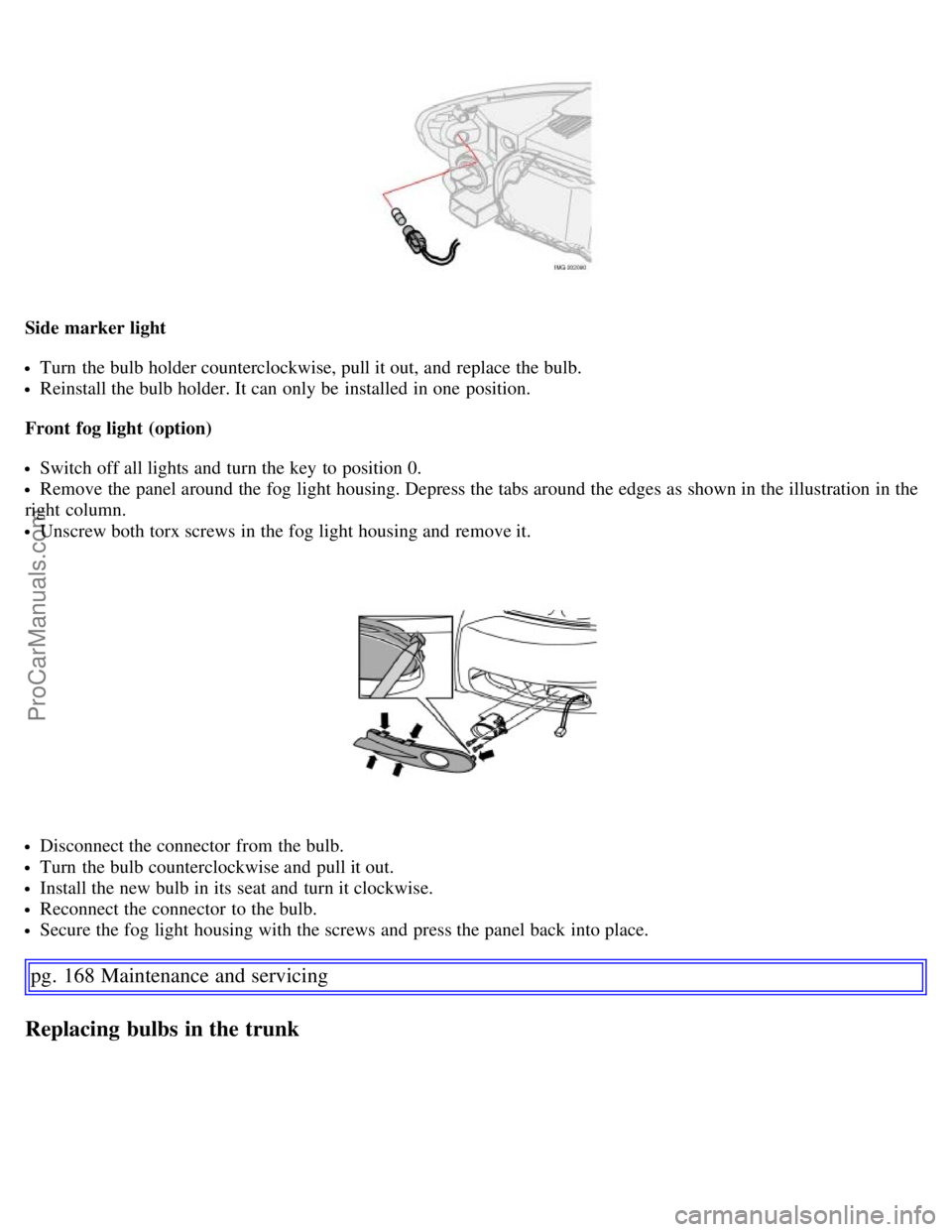
Side marker light
Turn the bulb holder counterclockwise, pull it out, and replace the bulb.
Reinstall the bulb holder. It can only be installed in one position.
Front fog light (option)
Switch off all lights and turn the key to position 0.
Remove the panel around the fog light housing. Depress the tabs around the edges as shown in the illustration in the
right column.
Unscrew both torx screws in the fog light housing and remove it.
Disconnect the connector from the bulb.
Turn the bulb counterclockwise and pull it out.
Install the new bulb in its seat and turn it clockwise.
Reconnect the connector to the bulb.
Secure the fog light housing with the screws and press the panel back into place.
pg. 168 Maintenance and servicing
Replacing bulbs in the trunk
ProCarManuals.com