2006 VOLKSWAGEN GOLF Bec
[x] Cancel search: BecPage 131 of 444
Booklet 2.1 Safety first
A n ai rbag sys te m tha t i s no t func ti o nin g erl y cannot provi de s upplemental pro tec tio n
in a fronta l crash .
th e a ir bag indi cato r
sib lc that th e airb ag
wo rksh op.
o r be seriou sly injure d an d ca n b e kill ed .
Even tho ugh your vehi cle i s with Advance d Air bag make certain
that chil dre n, es pecia lly 12 years yo unge r, always ride on th e back seat p roper ly
res tra ined fo r th eir age and size.
A lways install fo rward o r rea nvard -facing
c hild seats o n th e re a r seat- eve n with an vance d Airbag Sys te m .
a rearward - faci ng chil d scat on the fro nt passenger seat because o f
BAG does not com e on an d stay o n, immedi ate ly
s h op.
A tig ht tethe r or other str a p o n a faci ng ch ild res tra int attach ed t o the fro nt se nger seat ca n put to o much press ure on the
we ight-se nsing mat in the se a t and reg is te r more a weight than is on th e seat. The
h ea vier weig ht regis tere d can make the
sys te m w ork as thou gh an adult were on th e seat a nd dep loy th e Advance d Air bag w he n it
m ust b e s uppresse d causin g se rious o r eve n
fata l inju ry to the c hild .
An imp roperly in sta lled child res tra int can
ou sly in ju re or even child -eve n wit h
a n Advanced Airbag Syste m .
in exce pti onal ci rcums ta nces, you must a fo n vard-faci ng chil d restrai nt on the
f ro nt passenger's seat:
-
Fon vard-faci ng c hild seats o n
th e front passe nge r's scat may inte rfere with the deploym en t of th e a irbag and
ca use serio us perso nal inju ry to the child .
- Always
mak e s ure the fonvard-fac ing seat has been des ig ned and certifi ed by its
m anufact ure r f or use o n a fron t seat with a
passenger fron t a nd side airbag.
- Always
the lllr er's in structi o ns provid ed with the seat o r carrier.
- Never
put the fonva rd-faci ng c hild straint up again st o r v ery near th e ment panel.
- Always move the passenger seat into its rearmos t p osi tion in th e seat's fo re a nd aft adjustm ent ra nge, as fa r away from the airbag as p oss ib le before in sta llin g th e war d-faci ng child restra int. The backrest must b e adjuste d to an upright p os ition.
- Alway s ma ke sure t hat n
oth in g preve nts
th e front passe nger's seat from bei ng
m ove d to th e rearmost p osition in its fore and aft adju stment range.
- Never pl
ace additio nal it e m s o n th e seat
th at
te re d b y the weight-se nsin g m at an d can
ca use inju ry in a cras h.
M ake sure th at th e PASSENGER ligh t comes on and stays on
BA G
wo rksh o p .
Airbag sy ste m 43
Page 137 of 444
flates.
- Alway s
make sure that safety belts are wor n correctly,
- Never le t a nyo ne s itting in the front
seat put th e ir hand o ut of the window.
Always make sure th at the sid e airbag can
inflat e without interferen ce:
- Neve r in stall se
at covers or re p lace ment upholstery over th e front seat back s that
h ave not bee n specifica lly approved by
- Never use additional seat cushi on s that co ver th e areas where th e s ide airbag s flate.
-
Dam age to the original seat covers or to
th e seam in th e area of th e si de airbag
modul e must alwa ys be repaired ate ly by an authorized
betwee n yo u and the airbag can crease th e risk of inju ry in colli sion by fering with the way the airb ag unfold s or by bei ng pushed you as th e a irba g infl ates.
- Neve r pla ce or a
ttach accesso ries or other objec ts (su ch as cup hold ers , phone brac ke ts, or eve n bulky ob-
(continued)
jec ts) on the doors , over or n ear th e area marke d on the seat ba ckre sts.
- Acc esso ries or other objects ca n beco me
dangerou s mi ssiles and cause inju ry
ploy ment space between them and the bags or allo w children or other passengers
to travel in thi s po sition.
Always usc the built-in coat hook s only for ligh tweig ht clothing . Never leave any h eavy or sharp-ed ged obj ec ts in the po cke ts that may
int erfe re w ith side ai rba gdeployment and can cause personal injury in a collisio n.
Always prevent the sid e airbags from being damaged by heavy object s knockin g or hitting the sides of the seat backs.
The ai rb ag syste m can onl y be tri gge re d
once. the airbag has bee n tri ggered, the sys tem mus t b e re placed by an authori zed Volkswagen dealer or qualifi ed work shop.
Always have work invo lv in g th e s ide airbag
syste m, re m ova l a nd installa tion of th e airbag
components, orothcrrep air s p erformed by an authorized Volkswagen dealer or qualified works ho p. Otherwise th e a irbag sys te m may
n ot work correctly.
Neve r attempt to modify any com ponents of the airbag syste m in any wa y
Airbag system 49
Page 138 of 444
with s ide curtain protection oirbogs
Description of
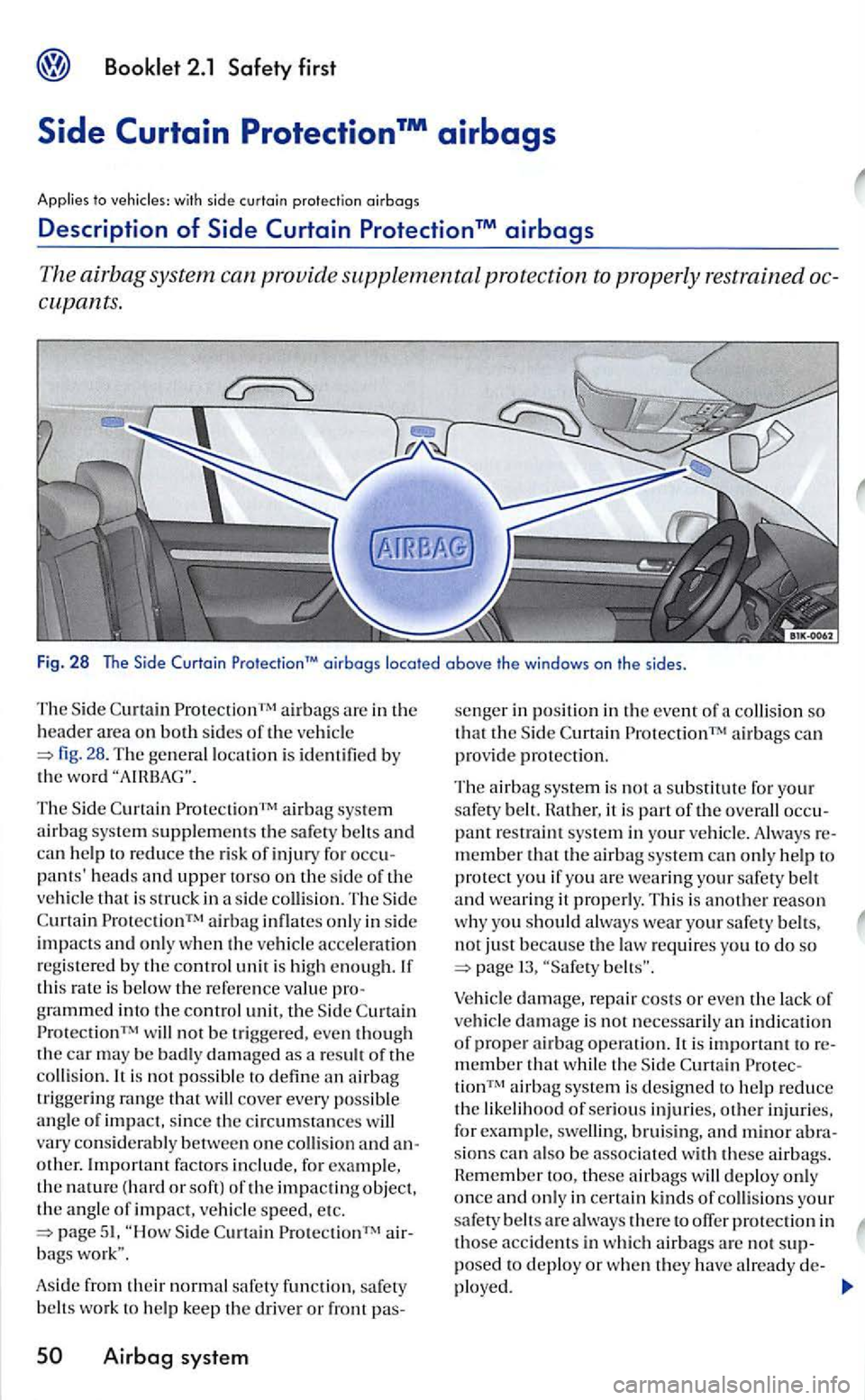
oirbogs located above th e windows on the sides .
T he Side
28 . The general locatio n is identified by the wo rd
T he Side airbag sys tem airbag syste m su ppl em ent s the safety belts and can help to reduce the ris k of injury for heads a n d upper to rso on the side of the th at i s s truck in a side collis io n. Th e S ide
gramm ed into the control unit, the Side w ill not be triggered. even thou g h the car may be badly d am aged as a res ult of the collision.
ot her. Import ant fac tors of the impacting object, the angle of impact, ve hicle speed, etc.
bags
Aside fro m their normal safe ty fun ctio n, sa fety belt s work to help keep th e driver or front pas-
pant restraint syste m in you r ve hicle. Always member that the airbag system can o nl y help
yo u should always wear your safety belt s, not just because the law requires you to do so page
Vehicle damage, repair costs o r even the lack of
ve hicl e damage is no t necessarily an indicati on of proper a irbag operation. It is important member t hat while th e Side
kinds of collis ions your sa fet y belt s are always there offer protect ion in those accid ents in which airbags are not sup-posed deploy or when they have already de-ployed.
Page 141 of 444
The rear seat is generally the safest place in a collision.
The physical principle s of what happens when you r vehicle is in an acc ident apply also to 15. safety belts?". But unlik e adults and teenage rs, their muscle s and bones are not fully deve loped. many respects
d ent s than are adults.
Becau
se c hildr en's bodies oped, they must use restrain t systems especially des igned fo r their size . weight , and b ody ture . Many countries and all sta te s of the United and pro vinces of Canada have law s
tems for infant s and small childr en .
a frontal crash at a speed of20- 35 mph 56 km /h l the forces acting on a 13-pound (6 kg)
infant w ill be more than times th e weig ht of the child . Thi s means th e weight of the chi ld
wo uld suddenl y be more than pounds kg). Under these conditions, only
tions to be s ure the seat is right for your child's page 56, safety instru ctio ns for using child b e s ure to
bags, and th e installation of child restraints in
thi s booklet.
Ther e is a l ot you n ee d to know about the va nced Airba gs in your vehicl e and how they
work when infant s and children in child
in your vehicle and th e very important inform ation about child ren on the front
they are extremel y important fo r your safet y and the safet y o f your passenger s, cially infant s and sm all children .
Acciden t s tati stics have shown that d ren are generally safer in the rear seat area than in the front seating position. Always
All vehicle occupants and especially dren must be restrained properly whenever riding in a vehicle. An unrestrained or properly restrained child could be injure d b y striking the interior or by being ejected from the ve hicle during a sudden maneuver or
strained child is also at greate r risk of injury or death through contact with an infl ati n g
airbag.
s uit abl e child restrai nt properly ins talled and used at one of the rear seating pos itions prov ides th e hig hest degree of protect ion for
infant s and small childre n in most accident situations
Children on the fro nt seat ofanycareven with
Advanced Airbags can be seriously injured or even killed when an airbag inflates.
A child in a rearward-facing child seat be
The infl ating a irbag
safety 53
Page 148 of 444
2.1
seats can help protect toddlers and children ove r
age 1 and and up to
mately lbs. (9 and 18 kg) in a cra sh.
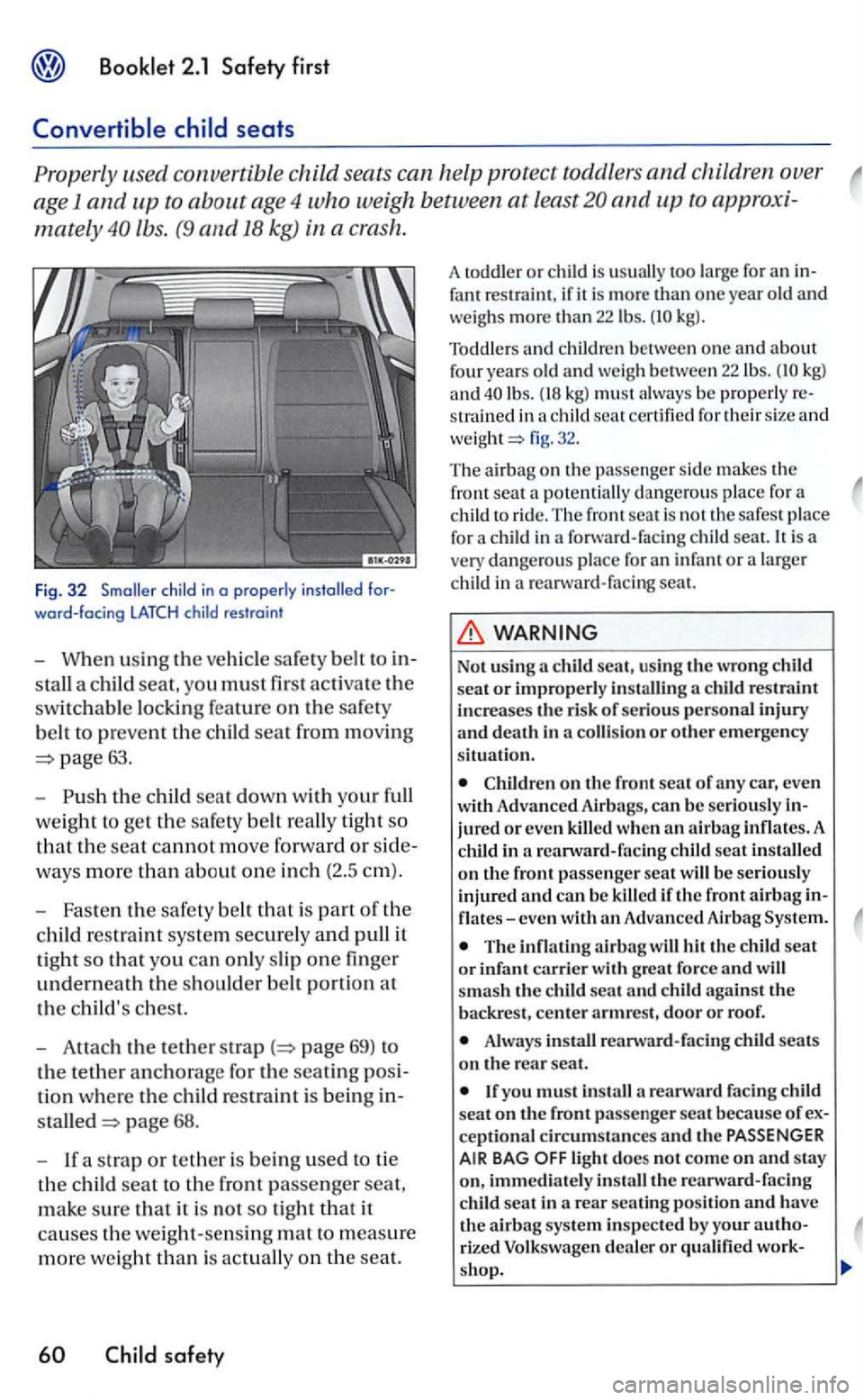
Fig . 32
stall a child seat, yo u must first activ ate the
switchable locki ng feature on the safet y
belt to pre vent the child seat from moving
63.
-the child seat down with your full
weight to get the safety belt re ally tight so
that the seat cannot move fo rw ard or
page 69) to
the tether anchorage for th e seating
tion w here the c hild restra int is being
sta lled page 68.
-
safety
A toddle r or is usuall y too large for fant restraint, if it is m ore than one year and weighs more than 221b s.
and weig h be tween 221bs.
s train ed in seat certified for the ir size and fig. 32.
The airbag on the passenger side m akes the front seat a pot entially dang erous place fo r a to ride. Th e front seat is not the safest place
for a child in a forward-fac ing child seat.
in a re arw ard-facing seat.
WARNING
Not using us ing the wrong seat or improperly installing child restra int
increases the risk of serious personal injury and death in a or other emergency
si tuation.
Children on th e front seat of any car, even
with Advanced Airbags, can be seriously jured or even
be seriousl y
in jured and be if th e front airbag flates-even with an Advanced 1\irbag System .
The inflating airbag will th e child seat or infant carrier with gr eat force and
Always install rearward -facing child seats on the rear seat.
yo u must i.nstall a rearward faci ng sea t on the front passeng er sea t because of ceptional circumstances and th e PASSENGER
immediatel y in stall the r earward-facing
child sea ting position and have
th e airbag system inspected by your rized Volkswagen dealer or qualified work-
shop.
Page 192 of 444
and Equipment
Tips
The
and "Average
Th e display may look diiTerent in you r
vehicle because there are diiTere nt instrument
Applies to
yo u are not sure . ask your authorized Volk swage n dealer or qualified workshop for sistance.
the vehi cle is ling ar very low speeds, the tempera tu re pla yed may be slighLiy higher than the actua l
o u tside temperature as a result of th e heat
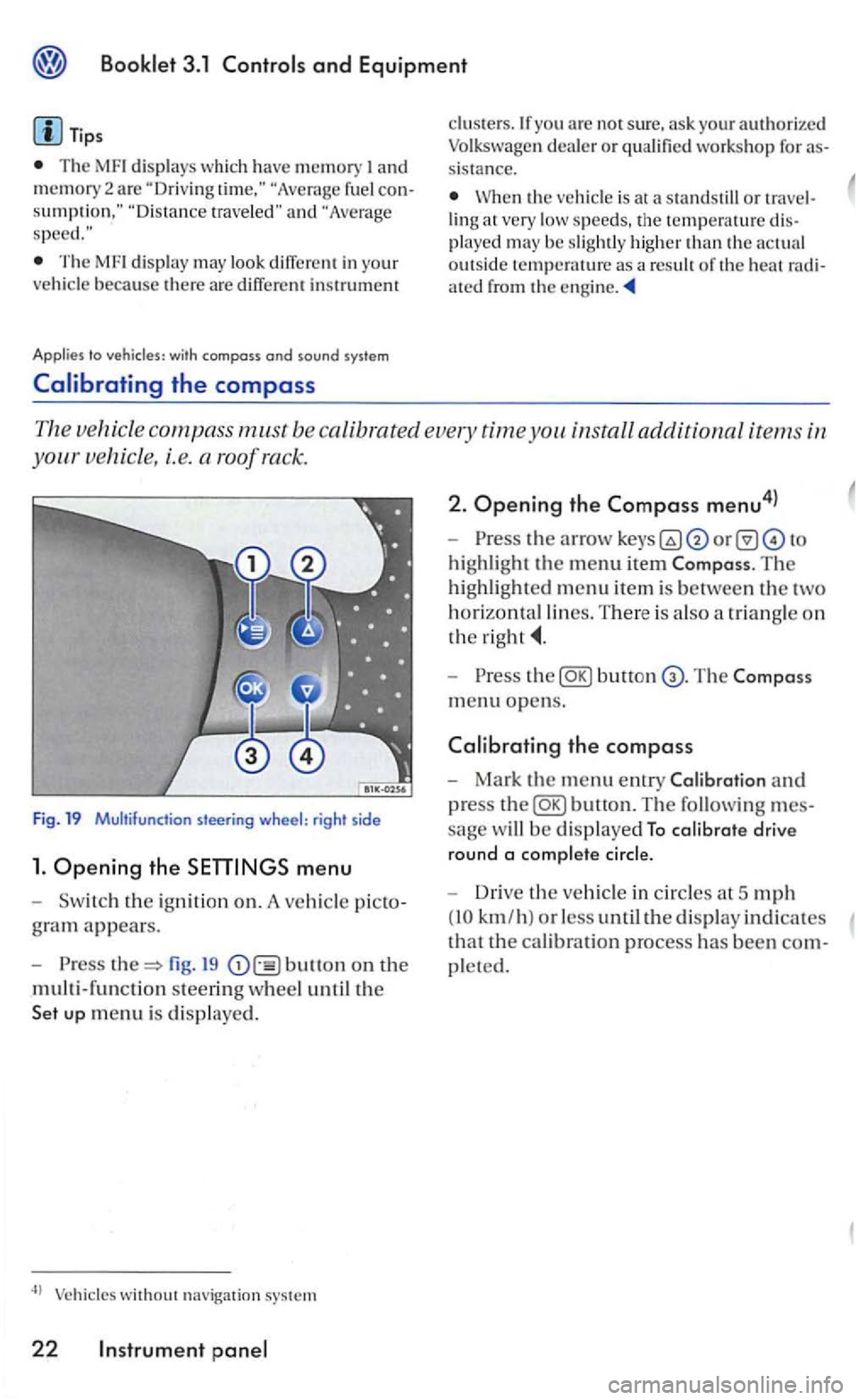
The ve hicle compass m.ust be ca libra ted every time you install additional items in
s teering wheel: rig ht side
1. Ope ning the menu
th e ig niti on on. A vehicl e
fig. 19 bullon on the
multi-functio n steerin g w heel u n til the
without navigation system
22 Instrument
2. Ope ning the Compass menu4l
highlight the menu item The
highlighted m enu item is between the two
horizontal lines. T here is a lso a tr iangle o n
the
Press butt on
m en u o pens.
the compass
Mark the menu entry and
press
sage w ill be d isplaye d To calibrate drive
round a comp lete cir
cle.
Driv e the vehicle in circles a t 5 mph
(10 km/h ) or less until the display indicates
tha t the cal ibration process has been
pleted.
Page 206 of 444
3.1
WARNING
Driving with an open rea r lid can lead to
rious personal injury.
After closing the rear lid , always pull up on
it to make sure that it is properly closed and cannot open suddenly when the ve hicl e is
moving, even though th e key been turned to the locked position .
Alway s keep the rea r lid closed whil e
driv ing to help prevent poisonou s ex haust gas
from begin drawn into the vehicle
Never transport objects larger than tho se
fitting completel y into the
cause the rear lid can not be fully closed.
you absolutel y must drive with the rear lid open, do the fo llowing notes to red uce the ri sk of carbo n monoxide poisoning:
-
all windows,
where applicable
36 Opening and
WARNING (continued)
-th e power
off the air recircu la tion,
-
th e fresh air fan to th e high est s p eed.
Never leave your veh icle unattended or le t
children play around you r ve hicle, especially
with the rear lid left open. A child could
m ent and pull the lid shut becoming trapped and unable to get out. Bein g trapp ed in hicl e can lead to serious personal injury.
ment and lug gage compartment of parked
ve hicl e result in tempera tu res in the hicl e that are much highe r than the o ut side
t emperatu res, particularly in summer. peratures can quickly reach levels that ca n
ca use unconsciou sn ess and death, larly to small
Page 207 of 444
and Equipment
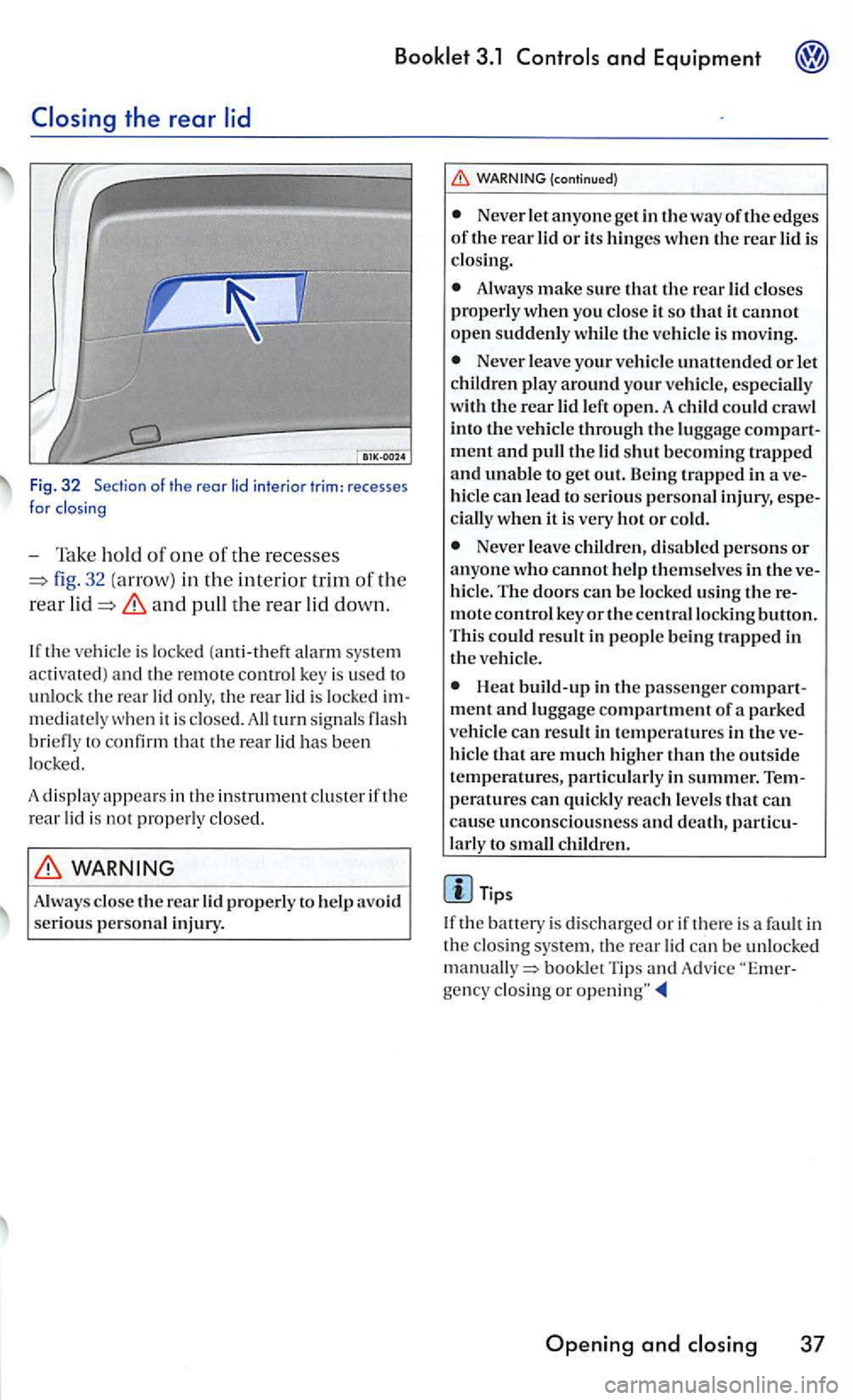
-Take ho ld of one of the recesses
32 (arrow) in the interior trim of th e
rear
and pull the rear lid down.
the vehic le is locke d (anti-theft alarm system activated) and the re mote contro l key is used to unl ock the rea r lid only. th e rear lid is locke d im it is clo sed. All turn s ig n als flas h
bri efly to confirm that the rear lid has been
l ocked.
A dis pla y app e
ars in the instrument clu ster if th e
r ea r lid is no t properly clo sed.
WARNING
Always close th e rear lid properly to he lp avoid seriou s pers o n al injury.
WARN ING (co ntinu ed)
Neve r let anyone get in th e way of the edge s of the rear lid or its hinges when th e rear lid is
clo sin g.
Always make sure that the rear lid closes
properly when you close it so that it cannot open suddenly w hil e the ve hicle is moving.
Neve r leave your vehicle unattended or le t
c hild ren play around your vehicl e, especi ally
w ith the rear lid left open. A child could craw l
int o the vehicl e throu gh the lu ggage compart
m ent and pull the lid shut beco ming trapped and unable to get out. Bein g trapp ed in avehicle can lead to serious person al injury , espe
cially when it i s very hot or cold.
Neve r leave childr en , di sabled p ersons or a nyone w ho cannot help the m se lves in the ve
hicl e. The doors can be locked using there
mot e control key or th e ce ntr a l l ock ing button. Thi s could res ult in people being trapped in
th e ve hicl e.
Heat build-up in the passenger compart
m ent and lu ggage compartment of a parked veh icle can result in temperatures in the ve
hicle that are muc h hi gh er than th e outside temperatures, particularly in summer. Temperatures can qui ckly reach le ve ls that ca n cause unconsciousness and death, particu
larl y to s mall children.
Tip s
bookl et Tip s and Advice gency closing or
Opening and