2006 VOLKSWAGEN GOLF Bec
[x] Cancel search: BecPage 106 of 444
2.1 Safety first
Never strap more than one person, in
cluding c hildren, into any belt.
Never place a safety belt over a child sittin g on your lap.
• Always keep feet in
the footwell in front of the seat while the vehicle is being driven.
Never let any person ride with feet on the instrument panel or sticking out the window or on the seat.
Never remove a safety belt while the ve
hicle is moving. Doing so will increase your
risk of being injured or killed.
Never wear belt s twisted.
Never wear belt s over rigid or breakable
objects in or on your clothing, such as eye
glasses, pens, keys, etc., as these may cause injury.
Never allow safety belts to become damaged by being caught in door or seat hardware.
Never wear the shoulder part of the belt under your arm or othenvise out of position.
Several layers of heavy clothing may inter
fere with correc t positioni11g of belts and reduce the overall effectiveness of the sys tem.
18 Safety
(continu ed)
Always keep belt buckles free of anything
that may preven t the buckle from latch ing se
cure ly.
Neve r use comfort clips or devices that create slack in the sh oulder belt. However,
specia l clips may be required for the correct
use of some c hild restraint systems.
Torn or frayed safety belts can tear and damaged belt hardware can break in an accident.lnspect belts regularly. If webbing, bind
ings, buckles, or retractors are damaged, have
be lts replaced by an authorized Volkswagen
dealer or qualified workshop.
Safety belts that have been worn and loaded in an accident must be replaced with the correc t rep lacement safety belt by an authorized Volkswagen dealer or qualified work
s h op. Replacement may be necessary even if damage cannot be clearly seen. Anchorag es
that were loaded must a lso be inspected.
Never remove, modify, disassem ble, or try
to repair the safety belts yourself.
Alwa ys keep the belts clean. Dirty belts
may not work correct ly and can impair t11e func tion of inertia reel booklet 3.2 and
Page 111 of 444
Safety
sengel:
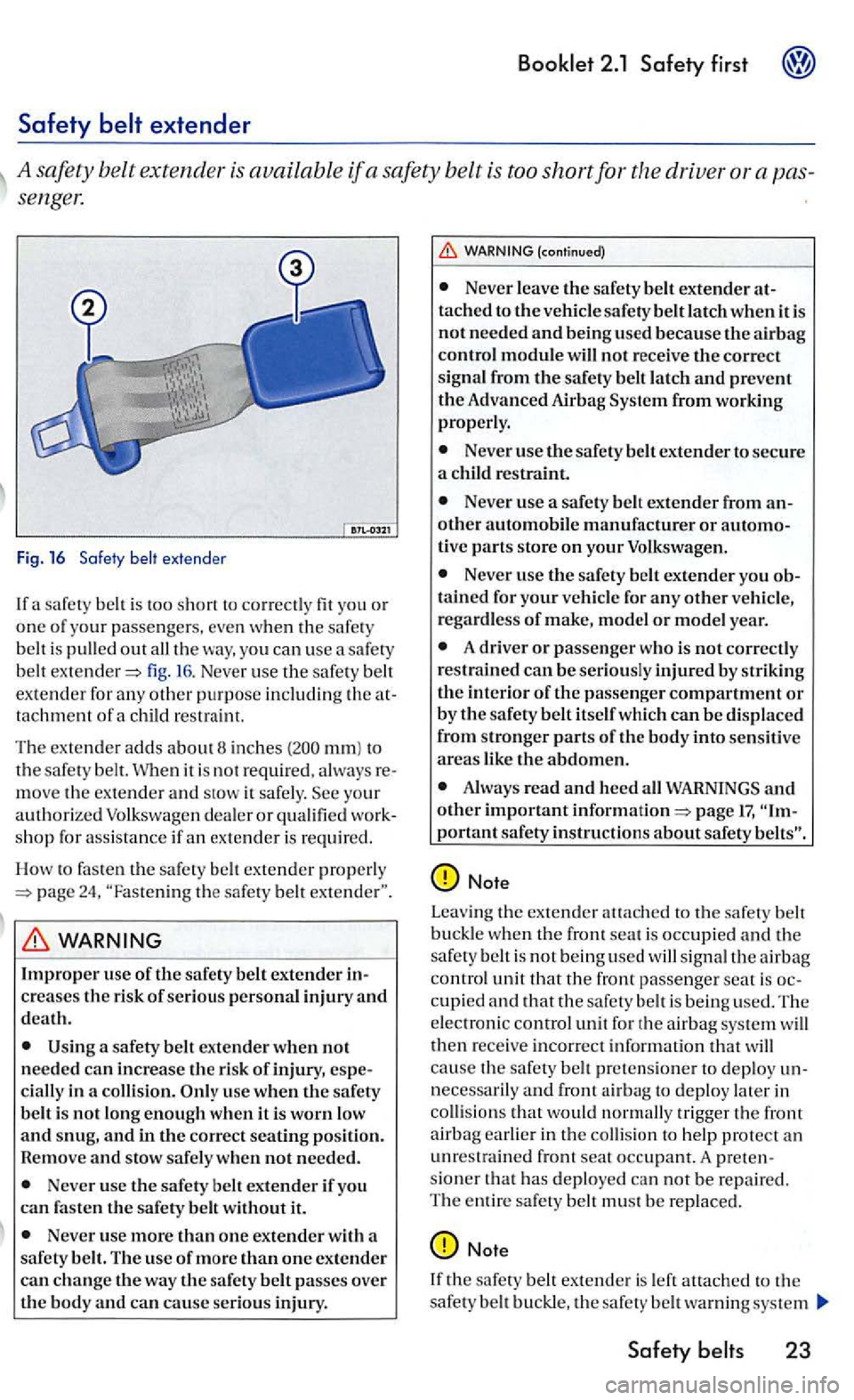
Fig. 16 Safe ty
out fig . 16 . Never use th e safe ty belt
ex tende r for any oth er purpo se includin g th e tachment of a c hild restraint.
Th e
exte nder adds a boutB inches mm) to
the safery belt. Whe n it is not require d , always
s hop for a ss is tan ce if an extende r is requ ired .
H ow to fas te n the s
afety belt extender properly 24, th e sa fe ty belt
crea ses the risk of seriou s personal injury and death.
a safery belt exten de r w hen not needed can increase the risk of injury , cially in a collision. it is worn low
and snug, and in the cor rec t seating position.
R emove and sto w safe ly when not needed.
Never use the safet y belt extender if yo u
ca n fasten the sa fety belt without it.
Never use more than one extender with a
safery be lt. The use of m ore than one extender c a n ch ang e the way the sa fe ty belt passes over
the body and can cause se rious injury .
Never leave the saferybelt extender ta ched to the veh icle safe ty belt latch when it is not needed and being used because th e airbag control module will not re ceive the correc t
s ign al from the safety b elt la tc h and prevent the Advanc ed Airbag from working properly .
Never use the safe ty belt extender to secure
a child restraint.
Never use a safery belt ex tender from
Nev er u se the safery belt extend er yo u tained for your vehicle for any other vehicle,
regardless of make, model or model year.
A driver or pass enger w ho is not correct ly
re strained can be seriously injured b y striki ng the interior of the passe ng er compartment or by the safery b elt its elf whi ch can b e di spla ced
from stronger parts of the body into se nsiti ve areas lik e th e abdomen.
Always read and heed all WARNINGS and other important pa ge
signal th e airbag
co ntrol unit that the front passenge r seat is
ca use the s afery belt prete nsio n er to deploy necessarily and fron t to deplo y la ter in
collision s th at would trigge r the front
a irb ag earlie r in th e to help pro tect an unrestrain ed front seat occ upant. A sioner that has dep loyed can not b e repair ed.
T he entire sa fety belt mu st b e rep laced.
Safety
Page 119 of 444
the elec tronic control page 41, SENGER
Always remember. a child seat or infa nt carrier
in stalled on th e fron t seat may the rapidly pas senger's airbag in a frontal collision. The
airbag could greatly re duce the effectiveness of the c hild restraint and even seriou sly injure th e
c hild during
stro ng ly recommend that children always sit in
th e back page 53,
infant in a seat stall ed on th e front passe nge r seat ously injured and can be killed if the front
airbag inflates eve n with an
System.
The inflating airba g will hit the child seat or infant carrier with great force and will
smas h th e c hild seat and c hild against the backrest, cent e r armre st, door or roof.
Always install r earwa rd-facing child seats on the rear scat.
If you must install a rearward facing child seat on the front passe nger scat becau se of
light docs not com e on and stay on, imme diatel y
your authorized swage n dealer or qualified workshop.
terferc with the ously inju re or even the child -eve n with
a n A irb ag
in exceptio nal circumstances, you must
in stall a fonvard-facing c hild restraint on the front passe nger's sca t:
-
Fon vard-facin g seats install ed on the front passenger's seat may interfer e
with the deplo ym ent of the air bag and cause seriou s personal injury to the child .
2.1 Safety first
turer's instructions provid ed with the c hild
sea t or carrier.
- Neve r
put the fonvard-faci ng c hild
ment panel.
- Always move the passe nge r sca t into its
rearmost pos ition in the scat's fore and aft adjustment range, as far away from the airbag as possi ble before installing ward-facing
scat that can increase the total weight te re d by the weig ht-sensing mat and ca n
ca use injury in a cras h.
Make sure that the BAG light comes on and stays on all the time w henever the igniti on i s switc hed on.
th e BAG light does not com e on and stay on , imm ediately in stall the fonv ard-facing child scat in a rea r seatin g
position and have the airba g sys tem inspec ted
by your authorized Volkswagen dealer or qualified workshop.
To reduce the ris k of se rious injury, make su re that tltc light is on whenever a child restraint is install ed on th e
front passenger scat and the ig niti on is switched on.
the d ocs not stay on, perform th e c hecks descr ibed the Advanc ed
Take the c hild restra int off the front senger seat and in stall it properly at one of the
r ear sea t position s if th e BAG light does not sta y on.
Airbag system 31
Page 121 of 444
Therefore, always wear your safety belts and make sure that everybody in your vehicl e
i s properly re strained.
A person o n the front passenger seat, cially infants and small
Although the Advanced Airbag System in your vehicle is designed to turn orr the front passenger airbag if an in fant or a small child in one of the child restraints used to certify the Advanced Airbag System is on the front
tion s is impossible in all conceivabl e situa-
Applies to vehicles: with advanced front airbag system
Advanced front airbag system
Your vehicl e is equipped with a front Advanced
A irbag System in complia nce with States Federal Motor Vehicle Safety Standard as applicable the time your hicle was manufactured.
The front Advanced AirbagSystem supplemems the s afety belt s to provide additional protection
for the driver's and front passenge r' s head s and upper bodi es in frontal crashes. The airbags
straint system in your vehicle. Always remember that the a irba g system can only help to protect if you are sittin g upright, wearin g your safe ty belt and wearing it properly. This is why
yo u and your passengers must always be erly restrained, not just because the law requi res you to be.
The Adva nced Airbag System in yo ur ve hicl e has been to meet the ment s for 3 and 6 yea r-old childr en (as defined
in the s tandard) on the passenger sid e and very
The Advanced AirbagSyste m can deploy in accordance with the
fant restrained in one of the fonvard facing or rearward facing child seats wit h which
plo yment arc met.
Accident statistic s have shown that
For their own safety, all children, especially 12 years and younger, should always ride in the back properly restrained for their age and
small adult s on the driver side. ployment occurs in those crashes th at tak e place
troni c control unit. The low risk deployment teria are intended to help reduce the ris k of jury through interact ion with th e front airbag
t hat can occur in these collisions, for example.
b y
being too close to the steering wheel and
deplo yme nt to occur. the PASSENGER light mus t be orr "Monito ring the Advanced Airbag
year old. restrained in one of the rearward-facing or forward-facing
child restraims (listed in Federal Motor Vehicle Safety Standard with which the Advanced
A irbag System in yo ur veh icle was the PASSENGER BAG light mayor may not come on. Wh en the PASSENGER light is off, the fron t airbag on the passe nge r side may or may not deploy depending o n the nature
Airbog system 33
Page 122 of 444
a small child that is heavier than a typica l
I ye ar-old infant in one o f th e child restraint s
w ith whi ch th e A dvan ced Airbag was page 55.
a child who has outgrown child res traints is
o n
a small adult or te enage r is on th e front se nger seat.
a passe nge r w ho is not sitting upright with
thei r back against a non -re clined backr est with
th eir feet on th e ve hicl e floor in front of the seat occupant seatin g is on t h e fr o nt passenger seat.
re quir em ent s of th e to turn off the fron t a irb ag
f o r infant s 12 months old and younger w ho are
re strained on the fro nt passenger seat in ch ild
restraint s that are liste d in the Standard re str aint s and Adva nce d
requires the front airb ag on th e passenge r sid e to be turned off if th e tota l weig ht
r eg is tered on th e front passe nger is less
th an a inf ant up to about one year of age is s tra ined on the front passe nger seat in one of the rea rward-faci ng or for wa rd-fa cin g inf ant str aint s listed in Fed eral Moto r Vehicle
page 55
The BAG
light does no t come o n and stay on . th e front airbag on the passen ge r
s id e has not been turned off by th e co ntrol u nit and can deploy if th e control unit se nses an pact that meets th e co nditio ns s tored in its page
Alwa ys remember: Even thoug h yo ur veh icle is equipp ed with Adva nced Airb ags, the sa fest
34 Airbag system
pla ce fo r childr en i s properl y restrained on th e back seat. b e sure to read the important
information in the sections tl1at follo w and be
sure to heed all of th e WARNINGS.
To reduce th e risk of serious injury when an airbag inflates , always wear safety belts erly .
You will also receive serious injuries and could even be killed if you are up against the airbag or too close to it when it infl ates eve n
with an Advance d Airbag
An infant or child in a rearward-facing child
seat installed on the fron t passenger seat will be seriously injure d and can be killed if th e
front airbag inflate s eve n with an Advanc ed
Airbag System.
Although
ment is impossibl e in all conce ivab le tions that may happen during th e usefu l lif e of your ve hicle.
The infl atin g airbag hit the child seat or infant ca rrier with great force and will
s m as h th e child seat and child against backres t, center armrest, door or roof.
straint s in the rear seat.
front passe nge r scat because of ceptional circumstances and the
sh op.
terfer e with the airbag as it deploys and seri -
Page 123 of 444
Forward-facing child seats insta lled on the front passenger's seat may interfere with the
d eployment of the airbag and cause serious
personal injury to the child.
Always make sure the fonvard-facing seat has been designed and certified by it s fa cturer for use on a front scat with a senger front and side airbag.
Alway s carefully follow the manufacturer's instructions provided with the child seat or carrier.
Never put the fonvard-facing child
Always move the passenger seat into its arrnost position in the seat's fore and aft
(cont;nued)
justment range, as far away from the airbag as poss ible before installin g the fonvard-facing
c hild restraint. The backrest must be adjusted to an upright position.
Always make sure that nothing prevents the front passenger's seat from being moved to the rearmost position in its fore and aft justment range.
Never place additional it ems on the seat that can increase the total weight registered b y the weight-sensing mat and can cause injury in a crash.
Advanced Airbag
trolunit whent h e igniti on i s on. The control unit monitors the Advanced AirbagSystem and turns
th e airbag indicato r light on w hen malfunction in the syste m components is detec te d. The tion of the a irbag indicator light is described in
g reater detail below. Because the front
vanced Airbag you must take car e to prevent it from being dam aged. Damage to the seat m ay prevent the Advanced Airb ag for th e
front passenger seat from doing its job in a
crash.
The front
Advanced Airbag System consists of the following:
Cras h sensors in the front of the ve hicl e th at measure ve hicle accelera tion /deceleratio n to
prov ide informatio n t o the Advanced Airbag
Sys tem about the severity of the cras h.
An electronic control unit, with integra ted crash sensors for fr ont and side impacts. The control u nit whethe r to fire just one or b oth stages o f the front a irbags based o n the formation received from the cra sh sensors. The control unit also w hethe r th e safety belt pretensioners should be acti va ted.
A dual -stage Ad vanced Airbag with gas
A dual-stage Adva nced Airb ag and gas
A weight-sensi ng under uphols tery
paddi ng of the front passenger seat c u shion that m eas ure s th e total weight on the seat. The matio n registered is sent continuous ly to regulate deployment of th e front Advanced Airbag on the passenger side.
An airbag monitoring system and indicator light in the in strument page
Airbag system 35
Page 126 of 444
Booklet 2.1 Safety first
More important th ings to know about front airbags
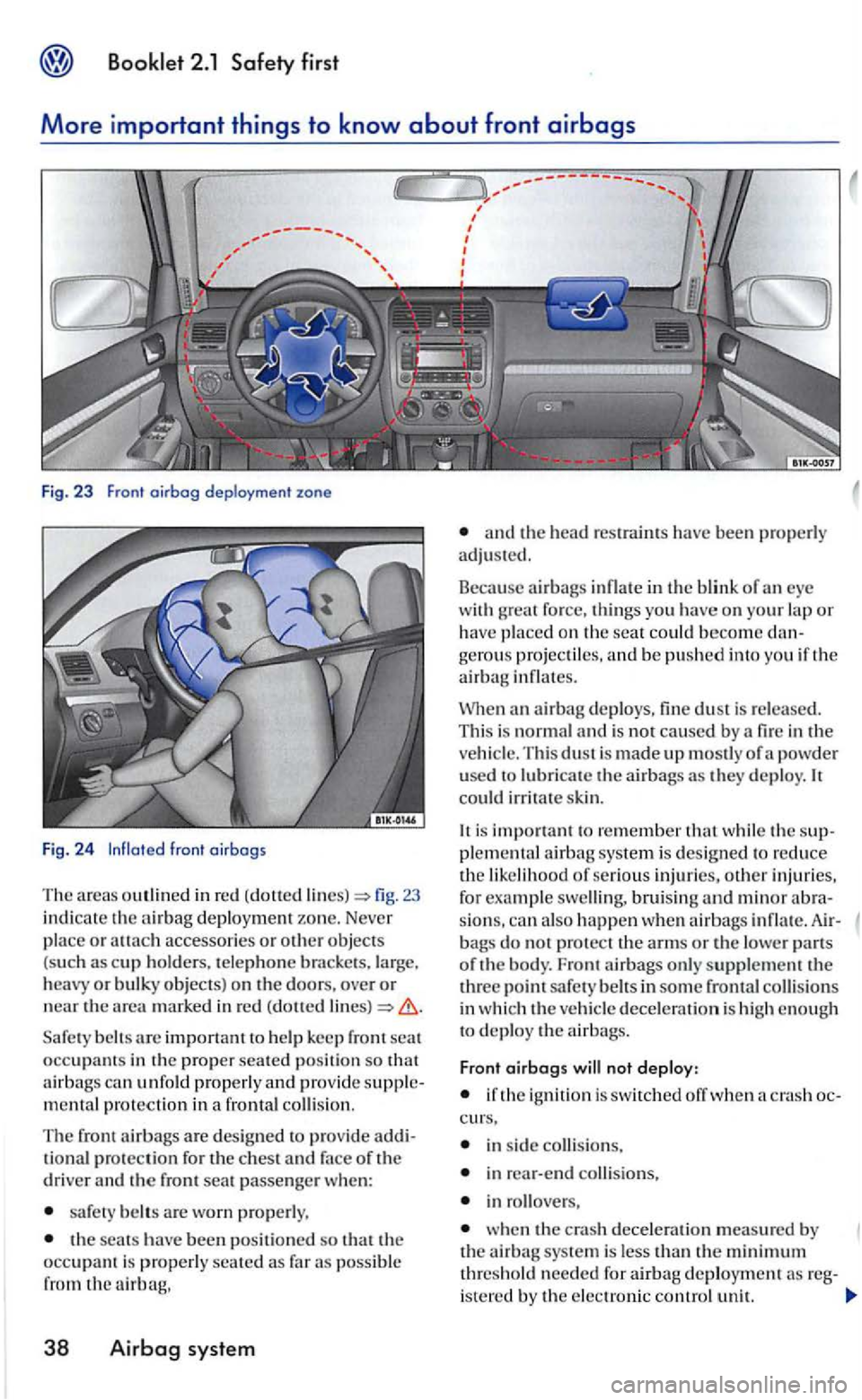
Fig. 23 Front oirbog deployment zone
Fig. 24 lnfloted front oirbogs
The areas in red (dotted fig. 23
indi cate the nirbag d e plo ym en t zone. Never place or a tt ac h accessories or other o bj ects
( s u ch as cup holders. telephone large, heavy or b u lky objects) on the doors, or n ear the area marked in re d (dotted
arc important to help keep front seat
occupants in the proper seated position so that airba gs can properly and prov ide mental protectio n in a fronta l collis io n.
The front airbags are designed to provide tional protecti on the chest and race or the
dri ver and the front seat passenger w hen:
safety belt s are worn properly,
th e scat s have been positi oned so that the occupant is seated as the airbag,
38 Airbag system
and th e head have been properl y adju sted.
Because ai rb ags innate in the blink an eye wit h great force, things you or have on the seat could become gero us proje ctil es, and be pu shed int o yo u
an airbag de pl oys, fine dust is released.
Thi s is no rm al and is not caused by a fire in the ve hicl e. This dust is made up mostly or powder used t o lubri cate th e airbags as they d eploy. could irritate skin.
It is important to remembe r that while the sys tem is desig ned to reduce the like lihood serio us injuries, other inj uries, exampl e swellin g, bruising and minor sio ns, can also happen when airbags ba gs do not pro tect the arms or the lower parts he body. Front airbags only supplement the three p oint safety in som e frontal collisions in whi ch the decele ration is high enough to the airba gs.
Front oirbogs will not deploy:
in sid e
in rear-e nd collis io ns,
in
w hen the c rash decelera tion measured by the sys te m is less than the mi nimum thres ho ld needed airbag deploymen t reg-is ter ed b y the electronic control u nit.
Page 127 of 444
The front passenger airbag
when th e front passe nger pied,
when th e we ight o n th e front p ass en ger seat as sensed by the Advanced Airbag cates that th e front airbag on th e pa sse nge r side has light comes on and stays on).
To reduce the risk of injury w hen the
a lw ays sit in an upright positi on, must n ot
l
ean agai nst o r place part o f th eir body to o
close t o the area w here the airbags a rc locate d.
Occupa n ts who are unbelte d, out o f tion or too close to the a irbag can be seriously injure d b y an air b ag as it unfo lds g reat force in the b link of a n page
A n i nfant or child in a re arward-faci ng c hild seat install ed on the front passenge r scat w ill
b e seri ously injure d can be ki lled if the
front airbag infl ates even with an A dva nced
Airbag
T he i nfl ating a irba g will hit the c hild sea t or infant carrie r with great fo rce and will
s mash the cl1ild scat
Always ins ta ll rearward -facing child seats
o n th e rear seat.
yo u must in stall a rearward faci ng c hild seat o n the fron t passenger seat because o f ceptio nal ci rcums tances and the stay on, imme di ate ly in stall the reanvard-facing c hild seat in
s h o p .
between yo u and the airbag will
(continued)
fering wit h th e
Neve r h o ld things in your h ands o r o n your la p whe n the ve hicl e is in use.
Neve r transport items on o r in the
co me dangerous projecti les that can cause rious personal injury if the a irbags in flate.
Never place or auach accessori es or other
obj ects (s uch
page
crash, especiall y w hen the airbags infla te .
Neve r recline t he fro nt passenger's scat tra n sp ort objects. o f th e sid e airbag or th e fro nt during braking o r in a sudden m aneu ve r. jects ncar th e airbags can becom e pro jectiles and cause in ju ry , p artic ul arl y w hen the scat is
r eclined.
Always make sure that nothing is on the
fr ont passenger scat that w ill cause th e
weigh t-sensing mat in the seat to sense that the scat is occupied or is occu pied by
A lw ays make su re that n othing is on th e
front p asse nger seat whe n the backrest i s
f olded forward . Eve n
Always make sure tha t the statu s sig naled
b y the light is rect for the way that the fron t passenger scat is bcinguscd.
Airbag system 39