140
(e) Parking1. Bring the vehicle to a complete stop.
2. Pull the parking brake lever up fully to securely apply the parking brake.
3. With the brake pedal pressed down, shift the selector lever to the “P” posi-
tion.
If the four–wheel drive control is in the
“N” position while the selector lever is in
the “P” position, the transmission will
damage and the wheels will not lock.
CAUTION
While the vehicle is moving, never
attempt to move the selector lever
into “P” position under any circum-
stances. Serious mechanical damage
and loss of vehicle control may re-
sult.
(f) Good driving practice
�If the transmission repeatedly shifts up
and down between fourth gear and ov-
erdrive gears when climbing a gentle
slope, shift the selector lever to the “4”
position. Be sure to shift the selector
lever to the “D” position immediately
afterward.
�When towing a trailer, in order to main-
tain engine braking efficiency, do not
use overdrive.
CAUTION
Always keep your foot on the brake
pedal while stopped with the engine
running. This prevents the vehicle
from creeping.
NOTICE
Always use the brake pedal or the
parking brake to hold the vehicle on
an upgrade. Do not attempt to hold
the vehicle using the accelerator ped-
al, as this can cause the transmission
to overheat.
(g) Driving in “PWR” (Power) mode
In the “PWR” mode, the transmission is
shifted up and down at a higher vehicle
speed than in the Normal mode and a
more powerful acceleration is achieved. To
set the “PWR” mode, push in the driving
pattern selector button. The “PWR” mode
indicator light comes on.
For ordinary driving, Toyota recommends
using the Normal mode to improve fuel
economy.
(h) Driving in “2nd STRT” (second start) mode
In the “2nd STRT” (Second start) mode,
the transmission system shifts up from
second gear. Use this mode when starting
your vehicle in sand, mud, ice or snow.
To set the “2nd STRT” mode, push the
“2nd” button. In the “2nd STRT” mode, the
“2nd STRT” indicator light comes on.
The “PWR” mode is automatically can-
celled when you push the “2nd” button.
318
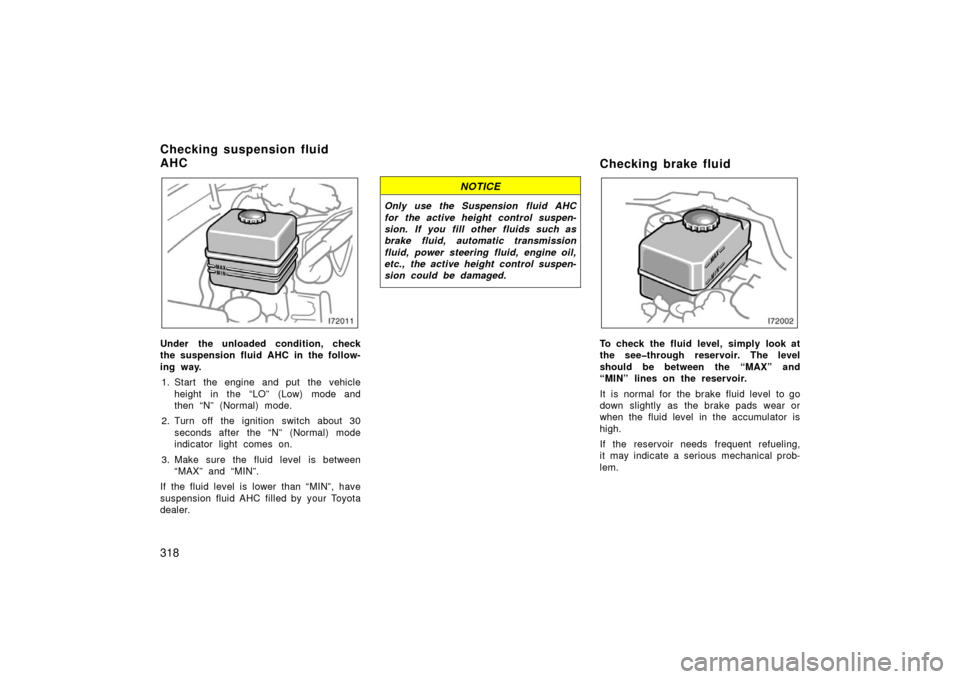
Under the unloaded condition, check
the suspension fluid AHC in the follow-
ing way.1. Start the engine and put the vehicle height in the “LO” (Low) mode and
then “N” (Normal) mode.
2. Turn off the ignition switch about 30 seconds after the “N” (Normal) mode
indicator light comes on.
3. Make sure the fluid level is between “MAX” and “MIN”.
If the fluid level is lower than “MIN”, have
suspension fluid AHC f illed by your Toyota
dealer.
NOTICE
Only use the Suspension fluid AHC
for the active height control suspen-
sion. If you fill other fluids such as
brake fluid, automatic transmission
fluid, power steering fluid, engine oil,
etc., the active height control suspen-
sion could be damaged.
Checking brake fluid
To check the fluid level, simply look at
the seethrough reservoir. The level
should be between the “MAX” and
“MIN” lines on the reservoir.
It is normal for the brake fluid level to go
down slightly as the brake pads wear or
when the fluid level in the accumulator is
high.
If the reservoir needs frequent refueling,
it may indicate a serious mechanical prob-
lem.
Checking suspension fluid
AHC