2006 TOYOTA AVALON headlights
[x] Cancel search: headlightsPage 136 of 398
’06 AVALON_U (L/O 0508)
128
If you replace the rear suspension and/or
the vehicle height changes, contact your
Toyota dealer to check the automatic
headlight leveling system and headlight
beam level.
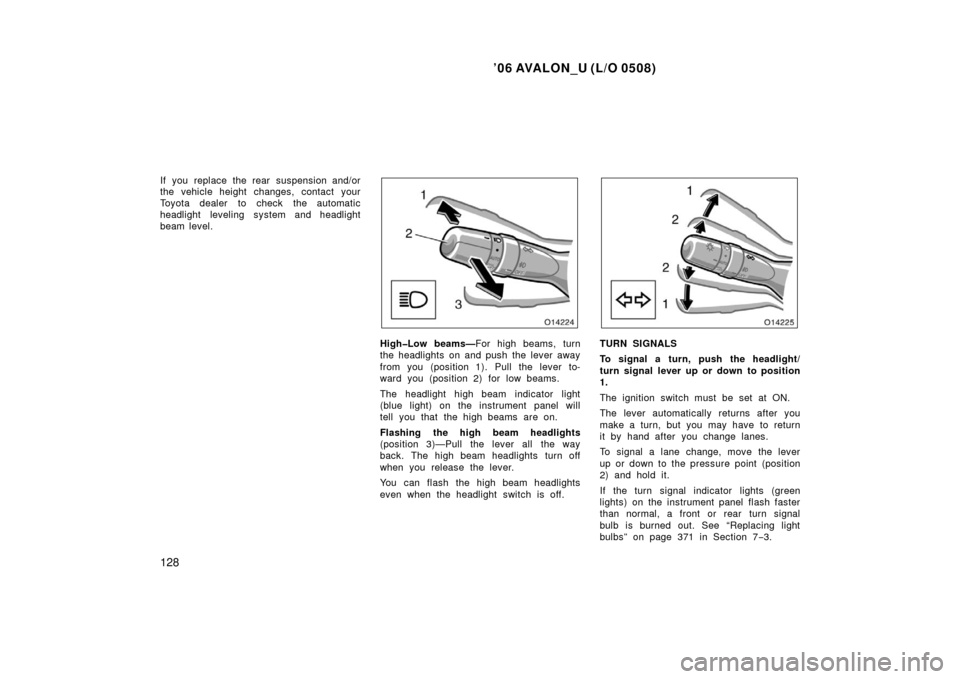
HighLow beams—For high beams, turn
the headlights on and push the lever away
from you (position 1). Pull the lever to-
ward you (position 2) for low beams.
The headlight high beam indicator light
(blue light) on the instrument panel will
tell you that the high beams are on.
Flashing the high beam headlights
(position 3)—Pull the lever all the way
back. The high beam headlights turn off
when you release the lever.
You can flash the high beam headlights
even when the headlight switch is off.TURN SIGNALS
To signal a turn, push the headlight/
turn signal lever up or down to position
1.
The ignition switch must be set at ON.
The lever automatically returns after you
make a turn, but you may have to return
it by hand after you change lanes.
To signal a lane change, move the lever
up or down to the pressure point (position
2) and hold it.
If the turn signal indicator lights (green
lights) on the instrument panel flash faster
than normal, a front or rear turn signal
bulb is burned out. See “Replacing light
bulbs” on page 371 in Section 7 −3.
Page 137 of 398

’06 AVALON_U (L/O 0508)
129
HEADLIGHTS
Manual operation—
To turn on the following lights: Twist
the headlight/turn signal lever knob.
Position 1—Parking, tail, license plate and
instrument panel lights
The tail light indicator (green light) on the
instrument panel will tell you that the tail
lights are on.
Position 2—Headlights and all of the
aboveAutomatic operation—
To turn on or off the lights automatical-
ly, twist the headlight/turn signal lever
knob to the position 3 (“AUTO”) when
the ignition switch is set at ON.
The headlights and/or all of the lights in
position 1 automatically turn on or off de-
pending on the darkness of the surround-
ings.
Manually twist the knob to the position 2
to turn on the headlights if they are need-
ed immediately when entering a dark tun-
nel, parking structure, etc.The automatic light control sensor is on
the top of the center instrument panel.
Do not place anything on the instrument
panel, and/or do not affix anything on the
windshield to block this sensor.
If you feel that the automatic light control
comes into operation too early or too late,
have the sensor adjusted by your Toyota
dealer.
Automatic light cut off system
Position 1 or position 3 with the tail
lights on—
The lights automatically turn off when the
driver ’s door is opened with the engine
off.
Headlights and turn signals
(for Canada)
Page 138 of 398
’06 AVALON_U (L/O 0508)
130
Position 2 or position 3 with the head-
lights on—
The lights automatically turn off after 30
seconds when any of the door or trunk lid
is opened and closed with the engine off.
The lights can be turned off immediately
by pushing the lock switch on the wireless
remote control transmitter with all the
doors locked and the trunk lid closed.
If any of the door or trunk lid is kept
opened, the lights automatically turn off
after 20 minutes.
To turn on the lights again, turn the igni-
tion switch is set at ON or actuate the
headlight switch. If you are going to park
for over one week, make sure the head-
light switch is off.
NOTICE
To prevent the battery from being dis-
charged, do not leave the lights on
for a long period when the engine is
not running.
Daytime Running Light (DRL) system
The headlights turn on when the parking
brake is released with the engine started,
even with the light switch in the “OFF”
position. They will not go off until the
ignition switch is turned off.
To turn on the other exterior lights and
instrument panel lights, twist the knob to
position 1.
Twist the knob to the position 2 to turn
the headlights to full intensity for night
driving.
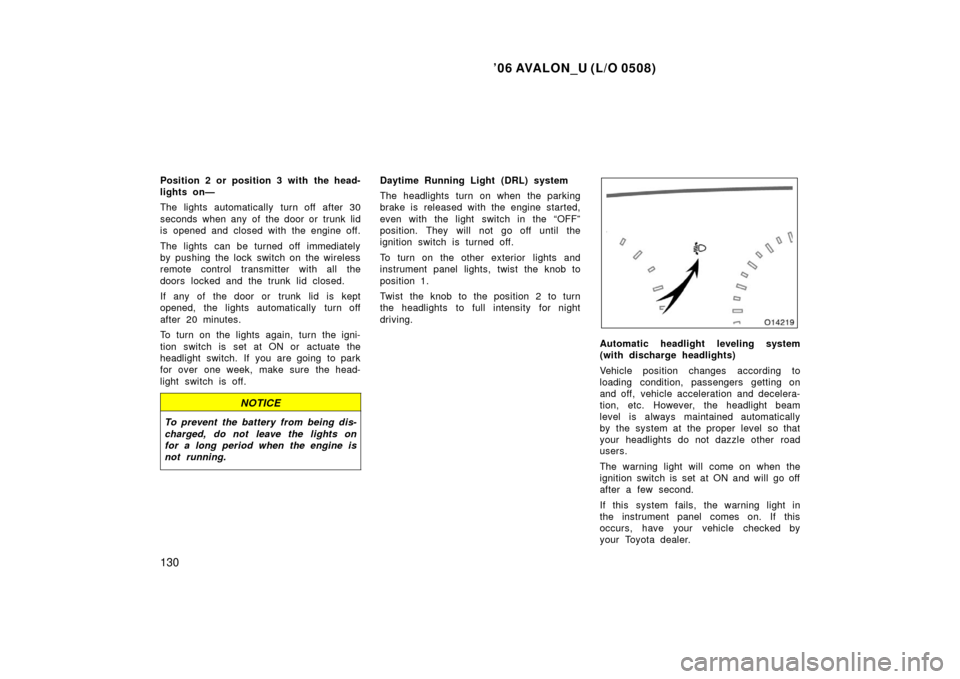
Automatic headlight leveling system
(with discharge headlights)
Vehicle position changes according to
loading condition, passengers getting on
and off, vehicle acceleration and decelera-
tion, etc. However, the headlight beam
level is always maintained automatically
by the system at the proper level so that
your headlights do not dazzle other road
users.
The warning light will come on when the
ignition switch is set at ON and will go off
after a few second.
If this system fails, the warning light in
the instrument panel comes on. If this
occurs, have your vehicle checked by
your Toyota dealer.
Page 139 of 398
’06 AVALON_U (L/O 0508)
131
If you replace the rear suspension and/or
the vehicle height changes, contact your
Toyota dealer to check the automatic
headlight leveling system and headlight
beam level.
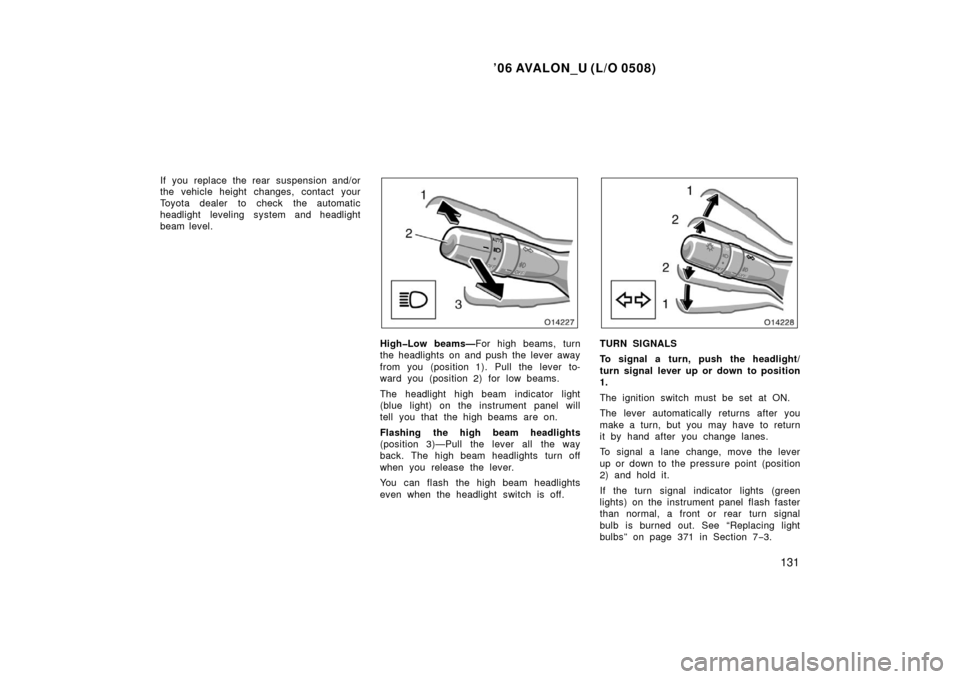
HighLow beams—For high beams, turn
the headlights on and push the lever away
from you (position 1). Pull the lever to-
ward you (position 2) for low beams.
The headlight high beam indicator light
(blue light) on the instrument panel will
tell you that the high beams are on.
Flashing the high beam headlights
(position 3)—Pull the lever all the way
back. The high beam headlights turn off
when you release the lever.
You can flash the high beam headlights
even when the headlight switch is off.TURN SIGNALS
To signal a turn, push the headlight/
turn signal lever up or down to position
1.
The ignition switch must be set at ON.
The lever automatically returns after you
make a turn, but you may have to return
it by hand after you change lanes.
To signal a lane change, move the lever
up or down to the pressure point (position
2) and hold it.
If the turn signal indicator lights (green
lights) on the instrument panel flash faster
than normal, a front or rear turn signal
bulb is burned out. See “Replacing light
bulbs” on page 371 in Section 7 −3.
Page 140 of 398
’06 AVALON_U (L/O 0508)
132
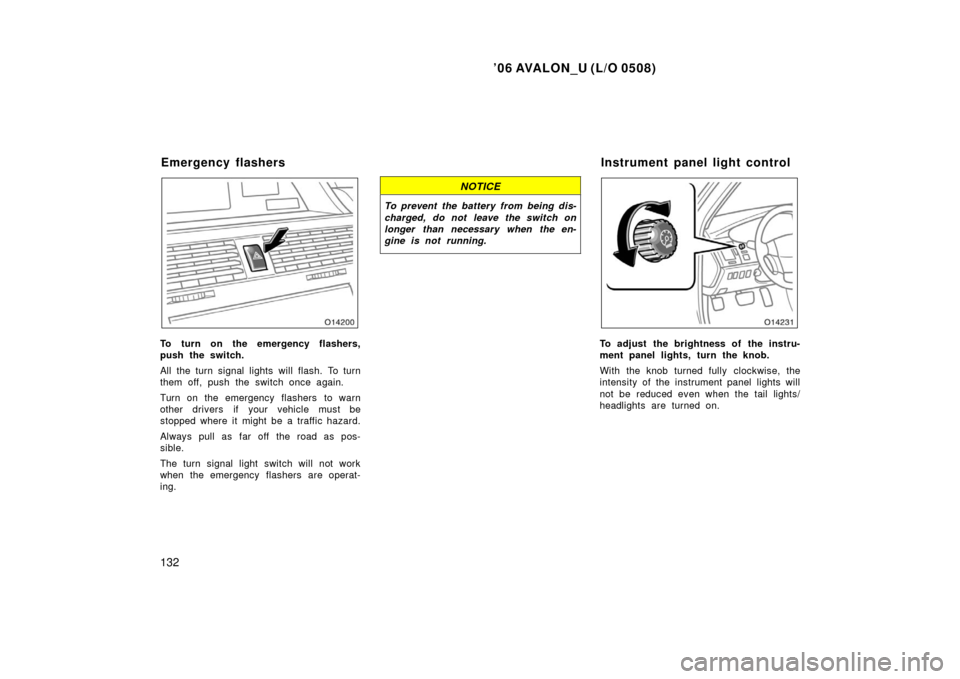
To turn on the emergency flashers,
push the switch.
All the turn signal lights will flash. To turn
them off, push the switch once again.
Turn on the emergency flashers to warn
other drivers if your vehicle must be
stopped where it might be a traffic hazard.
Always pull as far off the road as pos-
sible.
The turn signal light switch will not work
when the emergency flashers are operat-
ing.
NOTICE
To prevent the battery from being dis-
charged, do not leave the switch on
longer than necessary when the en-
gine is not running.
To adjust the brightness of the instru-
ment panel lights, turn the knob.
With the knob turned fully clockwise, the
intensity of the instrument panel lights will
not be reduced even when the tail lights/
headlights are turned on.
Emergency flashersInstrument panel light control
Page 141 of 398
’06 AVALON_U (L/O 0508)
133
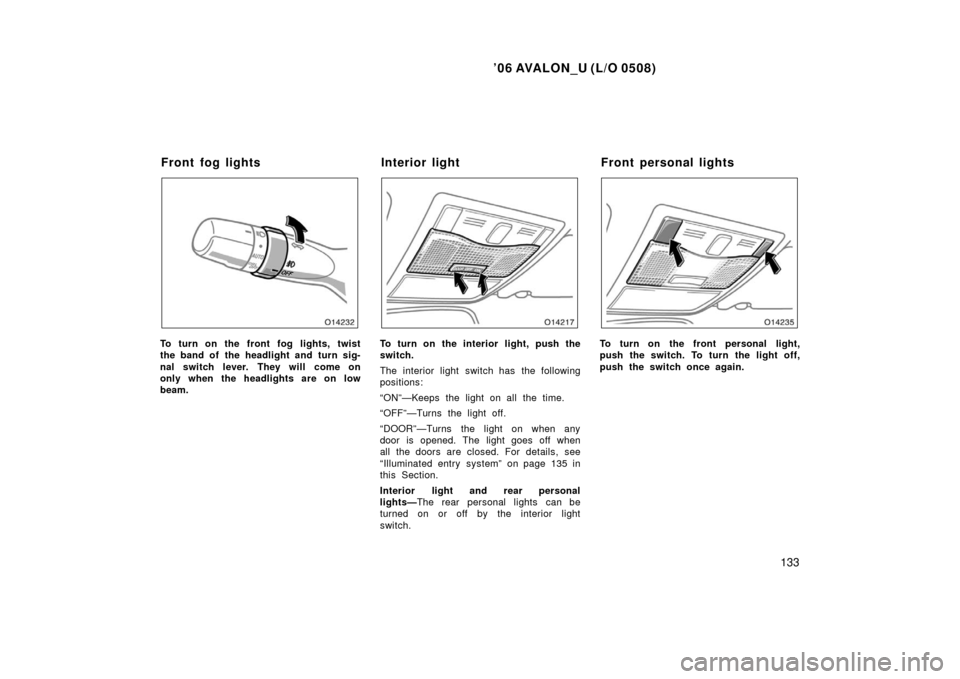
To turn on the front fog lights, twist
the band of the headlight and turn sig-
nal switch lever. They will come on
only when the headlights are on low
beam.To turn on the interior light, push the
switch.
The interior light switch has the following
positions:
“ON”—Keeps the light on all the time.
“OFF”—Turns the light off.
“DOOR”—Turns the light on when any
door is opened. The light goes off when
all the doors are closed. For details, see
“Illuminated entry system” on page 135 in
this Section.
Interior light and rear personal
lights—The rear personal lights can be
turned on or off by the interior light
switch.To turn on the front personal light,
push the switch. To turn the light off,
push the switch once again.
Front fog lights Interior lightFront personal lights
Page 346 of 398

’06 AVALON_U (L/O 0508)
338
Exhaust system
If you notice any change in the sound of
the exhaust or smell exhaust fumes, have
the cause located and corrected immedi-
ately. (See “Engine exhaust cautions” on
page 264 in Section 2.)
INSIDE THE VEHICLE
Items listed below should be checked
regularly, e.g. while performing periodic
services, cleaning the vehicle, etc.
Lights
Make sure the headlights, stop lights, tail
lights, turn signal lights, and other lights
are all working. Check headlight aim.
Service reminder indicators and warning
buzzers
Check that all service reminder indicators
and warning buzzers function properly.
Steering wheel
Check that it has the specified free play.
Be alert for changes in steering condition,
such as hard steering or strange noise.
Seats
Check that all front seat controls such as
seat adjusters, seatback recliner, etc. op-
erate smoothly and that all latches lock
securely in any position. Check that the
head restraints move up and down
smoothly and that the locks hold securely
in any latched position.Seat belts
Check that the seat belt system such as
buckles, retractors and anchors operate
properly and smoothly. Make sure the belt
webbing is not cut, frayed, worn or dam-
aged.
Accelerator pedal
Check the pedal for smooth operation and
uneven pedal effort or catching.
Brake pedal
Check the pedal for smooth operation and
that the pedal has the proper clearance.
Check the brake booster function.
Brakes
In a safe place, check that the brakes do
not pull to one side when applied.
Parking brake
Check that the pedal has the proper travel
and that, on a safe incline, your vehicle
is held securely with only the parking
brake applied.
Automatic transmission “Park” mecha-
nism
Check the lock release button of the se-
lector lever for proper and smooth opera-
tion. On a safe incline, check that your
vehicle is held securely with the selector
lever in “P” position and all brakes re-
leased.
OUTSIDE THE VEHICLE
Items listed below should be performed
from time to time, unless otherwise
specified.
Wiper blades
Check for wear or cracks whenever they
do not wipe cleanly. See page 369 in
Section 7
−3 for additional information.
Fluid leaks
Check underneath for leaking fuel, oil, wa-
ter or other fluid after the vehicle has
been parked for a while. If you smell fuel
fumes or notice any leak, have the cause
found and corrected immediately.
Doors and engine hood
Check that all doors including trunk lid
operate smoothly and all latches lock se-
curely. Make sure the engine hood sec-
ondary latch secures the hood from open-
ing when the primary latch is released.
Tire inflation pressure
Check the pressure with a gauge ev-
ery two weeks, or at least once a
month. See page 355 in Section 7 −2
for additional information.
Page 376 of 398

’06 AVALON_U (L/O 0508)
368
GoodBlown
Ty p e A
Good Blown
Ty p e B
If the headlights or other electrical
components do not work, check the
fuses. If any of the fuses are blown,
they must be replaced.
See “Fuse locations” on page 343 in Sec-
tion 7 −1 for locations of the fuses.
Turn the ignition switch and inoperative
component off. Pull the suspected fuse
straight out and check it.
Determine which fuse may be causing the
problem. The lid of the fuse box shows
the name of the circuit for each fuse. See
page 381 in Section 8 for the functions
controlled by each circuit. Type B fuses—When any of the fuses are
blown, contact your Toyota dealer.
Type A fuses can be pulled out by the
pull
−out tool. The location of the pull −out
tool is shown in the illustration.
If you are not sure whether the fuse has
blown, try replacing the suspected fuse
with one that you know is good.
If the fuse has blown, push a new fuse
into the clip.
Only install a fuse with the amperage rat-
ing designated on the fuse box lid.
If you do not have a spare fuse, in an
emergency you can pull out the “MIR
HTR”, “CIG” or “A/C” fuse, which may be
dispensable for normal driving, and use it
if its amperage rating is the same.
If you cannot use one of the same amper-
age, use one that is lower, but as close
to the rating as possible. If the amperage
is lower than that specified, the fuse
might blow out again but this does not
indicate anything wrong. Be sure to get
the correct fuse as soon as possible and
return the substitute to its original clip.
It is a good idea to purchase a set of
spare fuses and keep them in your ve-
hicle for emergencies.
Checking and replacing fuses