2006 SUBARU TRIBECA tire pressure
[x] Cancel search: tire pressurePage 138 of 377

Instruments and controls 3-17
– CONTINUED –
warning light illuminate simultaneously,
take the following steps:
1. Stop the vehicle in the nearest safe, flat
place.
2. Shut down the engine, then restart it.
3. Release the parking brake. If both
warning lights go out, the EBD system
may be faulty.
Drive carefully to the nearest SUBARU
dealer and have the system inspected.
4. If both warning lights come on again
and stay illuminated after the engine has
been restarted, shut down the engine
again, apply the parking brake, and check
the brake fluid level.
5. If the brake fluid level is not below the
“MIN” mark, the EBD system may be
faulty. Drive carefully to the nearest
SUBARU dealer and have the system in-
spected.
6. If the brake fluid level is below the
“MIN” mark, DO NOT drive the vehicle. In-
stead, have the vehicle towed to the near-
est SUBARU dealer for repair. „
Low fuel warning light
The low fuel warning light comes on when
the tank is nearly empty approximately 2.6
US gal (10 liters, or 2.2 Imp gal). It only op-
erates when the ignition switch is in the
“ON” position.
NOTE
This light does not go out unless the
tank is replenished up to an internal
fuel quantity of approximately 4.0 US
gal (15 liters, 3.3 Imp gal). „ Door open warning light
The indicators are located in the center
portion of the dashboard.
When any of the doors or the rear gate is
not fully closed, it is indicated by the corre-
sponding part of the door warning light.
Always make sure this light is out before
you start to drive. „
Windshield washer fluid
warning light
This light comes on when the fluid level in
the windshield washer fluid tank falls to
the lower limit (approximately 0.6 US qt,
0.6 liter, 0.5 Imp qt). „ All-Wheel Drive warn-
ing light
The All-Wheel Drive warning light comes
on when the ignition switch is turned to the
“ON” position and goes out after the en-
gine has started.
This light flashes if the vehicle is driven
with tires of different diameters fitted on its
wheels or with the air pressure excessive-
ly low in any of its tires.
300505
Continued driving with the AWD
warning light flashing can lead to
powertrain damage. If the AWD
warning light flashes, promptly park
in a safe place then check whether
all four tires are the same diameter
and whether any of the tires has a
puncture or has lost air pressure for
some other reason.
Page 216 of 377

7
Starting and operating
Fuel ...................................................................... 7-2 Fuel requirements .................................................. 7-2
Fuel filler lid and cap .............................................. 7-3
State emission testing (U.S. only) .................... 7-5
Preparing to drive .............................................. 7-6
Starting the engine ............................................. 7-7
Stopping the engine ........................................... 7-8
Automatic transmission .................................... 7-8 Selector lever .......................................................... 7-9
Selector lever reverse inhibiting function ............ 7-10
Selection of manual mode ..................................... 7-11
Maximum speeds .................................................... 7-12
Driving tips .............................................................. 7-13
SPORT mode ........................................................... 7-13
Shift lock release .................................................... 7-14
Power steering ................................................... 7-15
Braking ................................................................ 7-15 Braking tips ............................................................. 7-15
Brake system .......................................................... 7-15
Disc brake pad wear warning indicators .............. 7-16
ABS (Anti-lock Brake System) .......................... 7-16 ABS system self-check .......................................... 7-17
ABS warning light ................................................... 7-17
Electronic Brake Force Distribution (EBD) system .............................................................. 7-18Steps to take if EBD system fails .......................... 7-18
Vehicle Dynamics Control system ................... 7-19 Vehicle Dynamics Control system monitor .......... 7-21 Traction Control system OFF switch .................... 7-23
Tire pressure monitoring system (TPMS) ........ 7-24
Parking your vehicle .......................................... 7-25
Cruise control ..................................................... 7-27 To set cruise control .............................................. 7-27
To temporarily cancel the cruise control ............. 7-28
To turn off the cruise control ................................. 7-28
To change the cruising speed ............................... 7-28
Cruise control indicator light ................................. 7-29
Cruise control set indicator light .......................... 7-30
Page 235 of 377

7-20 Starting and operating
In the event of wheelspin and/or skidding
on a slippery road surface and/or during
cornering and/or an evasive maneuver,
the Vehicle Dynamics Control system ad-
justs the engine’s output and the wheels’
respective braking forces to help maintain
traction and directional control. yTraction Control Function
The traction control function is designed to
prevent spinning of the driving wheels on
slippery road surfaces, thereby helping to
maintain traction and directional control.
Activation of this function is shown by
steady illumination of the Vehicle Dynam-
ics Control operation indicator light. y Skid Suppression Function
The skid suppression function is designed
to help maintain directional stability by
suppressing the wheels’ tendency to slide
sideways during steering operations. Acti-
vation of this function is shown by flashing
of the Vehicle Dynamics Control operation
indicator light.
NOTE y Slight twitching of the brake pedal may be felt when the Vehicle Dynamics
Control system operates; a small de-
gree of vehicle or steering wheel shak-
ing may also be noticed in this situa-
tion. These are normal characteristics
of Vehicle Dynamics Control operation
and are no cause for alarm. y
When driving off immediately after
starting the engine, a short-lived oper-
ation noise may be noticed coming
from the engine compartment. This
noise is generated as a result of a
check being performed on the Vehicle
Dynamics Control system and is nor- mal.y Depending on the timing of activa-
tion of the brakes, certain situations
may occur just after driving off where
the brake pedal seems to exhibit a jolt-
ing motion. This too is a consequence
of the Vehicle Dynamics Control opera-
tional check and is normal.y In the circumstances listed in the fol-
lowing, the vehicle may be more unsta-
ble than it feels to the driver. The Vehi-
cle Dynamics Control System may
therefore operate. Such operation does
not indicate a system fault.
yon gravel-covered or rutted roads
y on unfinished roads
y when the vehicle is towing a trailer
y when the vehicle is fitted with
y
Activation of the Vehicle Dynam-
ics Control system is an indica-
tion that the road being travelled
on has a slippery surface; since
having Vehicle Dynamics Control
is no guarantee that full vehicle
control will be maintained at all
times and under all conditions, its
activation should be seen as a
sign that the speed of the vehicle
should be reduced considerably.
y Whenever suspension compo-
nents, steering components, or an
axle are removed from a vehicle
equipped with Vehicle Dynamics
Control, have an authorized
SUBARU dealer perform an in-
spection of that system.
y The following precautions should
be observed in order to ensure
that the Vehicle Dynamics Control
system is operating properly:
– All four wheels should be fitted
with tires of the same size, type,
and brand. Furthermore, the
amount of wear should be the
same for all four tires.
– Keep the tire pressure at theproper level as shown on the
vehicle placard attached to the
driver’s side door pillar.
Page 239 of 377

7-24 Starting and operating
Tire pressure monitoring
system (TPMS)
The tire pressure monitoring system pro-
vides the driver with a warning message
by sending a signal from a sensor that is
installed in each wheel when tire pressure
is severely low.
The tire pressure monitoring system will
activate only when the vehicle is driven at
speeds above 20 mph (32 km/h). Also,
this system may not react immediately to
a sudden drop in tire pressure (for exam-
ple, a blow-out caused by running over a
sharp object).
700318
If the low tire pressure warning light
comes on while driving, never brake
suddenly and keep driving straight
ahead while gradually reducing
speed. Then slowly pull off the road
to a safe place. Otherwise an acci-
dent involving serious vehicle dam-
age and serious personal injury
could occur.
Check the pressure for all four tires
and adjust the pressure to the COLD
tire pressure shown on the tire plac-
ard on the door pillar on the driver’s
side.
Even when the vehicle is driven a
very short distance, the tires get
warm and their pressures increase
accordingly. Be sure to let the tires
cool thoroughly before adjusting
their pressures to the standard val-
ues shown on the tire placard. (Re-
fer to the “Tires and wheels” section
in chapter 11.) The tire pressure
monitoring system does not func-
tion when the vehicle is stationary.
After adjusting the tire pressures,
increase the vehicle speed to at
least 20 mph (32 km/h) to start the
TPMS re-checking of the tire infla-
tion pressures. If the tire pressures
are now above the severe low pres-
sure threshold, the low tire pressure
warning light should go off a few minutes later.
Page 240 of 377

Starting and operating 7-25
– CONTINUED –
NOTE
This device complies with Part 15 of
the FCC Rules and with RSS-210 of In-
dustry Canada. Operation is subject to
the following two conditions: (1) This
device may not cause harmful interfer-
ence, and (2) this device must accept
any interference received, including in-
terference that may cause undesired
operation.
Changes or modifications not express-
ly approved by the party responsible
for compliance could void the user’s
authority to operate the equipment.
Parking your vehicleIf this light still comes on while driv-
ing after adjusting the tire pressure,
a tire may have significant damage
and a fast leak that causes the tire to
lose air rapidly. If you have a flat tire,
replace it with a spare tire as soon
as possible. When a spare tire is
mounted or a wheel rim is replaced
without the original pressure sen-
sor/transmitter being transferred,
the low tire pressure warning light
will flash. This indicates the TPMS is unable to monitor all four road
wheels. Contact your SUBARU deal-
er as soon as possible for tire and
sensor replacement and/or system resetting.
Do not inject any tire liquid or aero-
sol tire sealant into the tires, as this
may cause a malfunction of the tire
pressure sensors. If the light flash-
es, promptly contact a SUBARU
dealer to have the system inspect-
ed.
Do not place metal film or any metal
parts under the driver’s seat. This
may cause poor reception of the sig-
nals from the tire pressure sensors,
and the tire pressure monitoring
system will not function properly.
yNever leave unattended children
or pets in the vehicle. They could
accidentally injure themselves or
others through inadvertent opera-
tion of the vehicle. Also, on hot or
sunny days, the temperature in a
closed vehicle could quickly be-
come high enough to cause se-
vere or possibly fatal injuries to them.
yDo not park the vehicle over flam-
mable materials such as dry
grass, waste paper or rags, as
they may burn easily if they come
near hot engine or exhaust sys-
tem parts.
yBe sure to stop the engine if you
take a nap in the vehicle. If engine
exhaust gas enters the passenger
compartment, occupants in the
vehicle could die from carbon
monoxide (CO) contained in the
exhaust gas.
Page 247 of 377

8-2 Driving tips
Driving tipsNew vehicle break-in driving – the first 1,000 miles (1,600
km)
The performance and long life of your ve-
hicle are dependent on how you handle
and care for your vehicle while it is new.
Follow these instructions during the first
1,000 miles (1,600 km):yDo not race the engine. And do not al-
low engine speed to exceed 4,000 rpm ex-
cept in an emergency.y Do not drive at one constant engine or
vehicle speed for a long time, either fast orslow.y Avoid starting suddenly and rapid accel-
eration, except in an emergency.y Avoid hard braking, except in an emer-
gency.
The same break-in procedures should be
applied to a newly installed or overhauled
engine or when brake pads or brake lin-
ings are replaced with new ones.
Fuel economy hints
The following suggestions will help to save your fuel. y Select the proper gear position for the
speed and road conditions. y Avoid sudden acceleration or decelera-
tion. Always accelerate gently until you
reach the desired speed. Then try to main-
tain that speed for as long as possible. y Do not pump the accelerator and avoid
racing the engine. y Avoid unnecessary engine idling.
y Keep the engine properly tuned.
y Keep the tires inflated to the correct
pressure shown on the tire placard, which
is located under the door latch on the driv-
er’s side. Low pressure will increase tire
wear and fuel consumption. y Use the air conditioner only when nec-
essary. y Keep the front and rear wheels in prop-
er alignment.y Avoid carrying unnecessary luggage or
cargo. Engine exhaust gas (Carbon
monoxide)
y
Never inhale engine exhaust gas.
Engine exhaust gas contains car-
bon monoxide, a colorless and
odorless gas which is dangerous,
or even lethal, if inhaled.
yAlways properly maintain the en-
gine exhaust system to prevent
engine exhaust gas from entering
the vehicle.
yNever run the engine in a closed
space, such as a garage, except
for the brief time needed to drive
the vehicle in or out of it.
yAvoid remaining in a parked vehi-
cle for a lengthy time while the en-
gine is running. If that is unavoid-able, then use the ventilation fan
to force fresh air into the vehicle.
yAlways keep the front ventilator
inlet grille free from snow, leaves
or other obstructions to ensure
that the ventilation system always
works properly.
Page 250 of 377

Driving tips 8-5
– CONTINUED –
provide better traction when driving on
slippery, wet or snow-covered roads and
when moving out of mud, dirt and sand. By
shifting power between the front and rear
wheels, SUBARU AWD can also provide
added traction during acceleration, and
added engine braking force during decel-
eration.
Therefore, your SUBARU AWD vehicle
may handle differently than an ordinary
two wheel drive vehicle and it contains
some features unique to AWD. For safety
purposes as well as to avoid damaging
the AWD system, you should keep the fol-
lowing tips in mind: y
An AWD vehicle is better able to climb
steeper roads under snowy or slippery
conditions than a two wheel drive vehicle.
There is little difference in handling, how-
ever, during extremely sharp turns or sud-
den braking. Therefore, when driving
down a slope or turning corners, be sure
to reduce your speed and maintain an am-
ple distance from other vehicles. y When replacing a tire, make sure you
use only the same size, circumference,
construction, brand, and load range as the
original tires listed on the tire placard. Us-
ing other sizes, circumferences or con- struction may result in severe mechanical
damage to the drive train of your vehicle
and may affect ride, handling, braking, speedometer/odometer calibration, and
clearance between the body and tires. It
also may be dangerous and lead to loss ofvehicle control. y
If you use a temporary spare tire to re-
place a flat tire, be sure to use the original
temporary spare tire stored in the vehicle.
Using other sizes may result in severe
mechanical damage to the drive train ofyour vehicle. y Always check the cold tire pressure be-
fore starting to drive. The recommended
tire pressure is provided on the tire plac-
ard, which is located under the door latch
on the driver’s side.y Tire chains should always be placed on
the front wheels only.y There are some precautions that you
must observe when towing your vehicle.
For detail information, see “Towing” sec-
tion in chapter 9. On-pavement and off road
driving
y
In a rollover crash, an unbelted
person is significantly more likely
to die than a person wearing a
seat belt. You the driver and all
your passengers should fasten
the seatbelts before starting to
drive in order to minimize the
chance of serious injury or death.
yDo not make sharp turns and
quick maneuvers unless abso-
lutely unavoidable. Such actions
are dangerous as you may lose
control, possibly resulting in a
rollover which could cause death
or serious injury.
yAlways maintain a safe driving
speed according to the road and
weather conditions in order to
avoid having an accident on a
sharp turn, during sudden braking
or under other similar conditions.
Page 268 of 377
Driving tips 8-23
– CONTINUED –
T
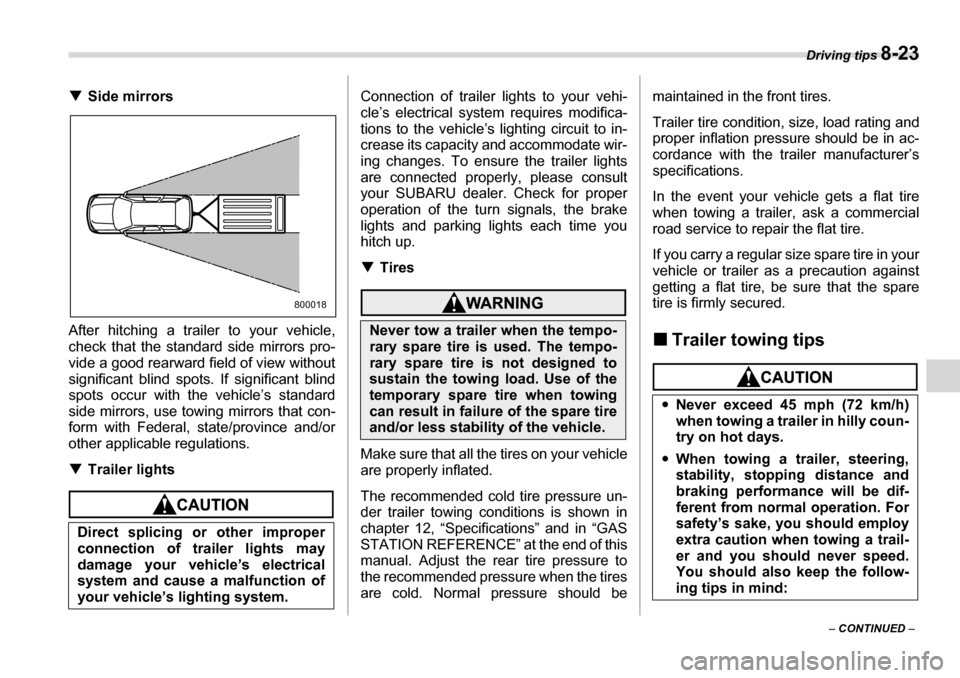
Side mirrors
After hitching a trailer to your vehicle,
check that the standard side mirrors pro-
vide a good rearward field of view without
significant blind spots. If significant blind
spots occur with the vehicle’s standard
side mirrors, use towing mirrors that con-
form with Federal, state/province and/or
other applicable regulations. T Trailer lights
Connection of trailer lights to your vehi-
cle’s electrical system requires modifica-
tions to the vehicle’s lighting circuit to in-
crease its capacity and accommodate wir-
ing changes. To ensure the trailer lights
are connected properly, please consult
your SUBARU dealer. Check for proper
operation of the turn signals, the brake
lights and parking lights each time you
hitch up. TTires
Make sure that all the tires on your vehicle
are properly inflated.
The recommended cold tire pressure un-
der trailer towing conditions is shown in
chapter 12, “Specifications” and in “GAS
STATION REFERENCE” at the end of this
manual. Adjust the rear tire pressure to
the recommended pressure when the tires
are cold. Normal pressure should be maintained in the front tires.
Trailer tire condition, size, load rating and
proper inflation pressure should be in ac-
cordance with the trailer manufacturer’s
specifications.
In the event your vehicle gets a flat tire
when towing a trailer, ask a commercial
road service to repair the flat tire.
If you carry a regular size spare tire in your
vehicle or trailer as a precaution against
getting a flat tire, be sure that the spare
tire is firmly secured. „
Trailer towing tips
Direct splicing or other improper
connection of trailer lights may
damage your vehicle’s electrical
system and cause a malfunction of
your vehicle’s lighting system.
800018
Never tow a trailer when the tempo-
rary spare tire is used. The tempo-
rary spare tire is not designed to
sustain the towing load. Use of the
temporary spare tire when towing
can result in failure of the spare tire
and/or less stability of the vehicle.
yNever exceed 45 mph (72 km/h)
when towing a trailer in hilly coun-
try on hot days.
y When towing a trailer, steering,
stability, stopping distance and
braking performance will be dif-
ferent from normal operation. For
safety’s sake, you should employ
extra caution when towing a trail-
er and you should never speed.
You should also keep the follow-
ing tips in mind: