2006 SUBARU OUTBACK tow
[x] Cancel search: towPage 258 of 425
Starting and operating
7-19
– CONTINUED –transmission is neutral; the vehicle will roll
freely, even on the slightest incline unless
the parking brake or foot brake is on.
Avoid coasting with the transmission neu-
tral.
During coasting, there is no engine brak-
ing effect.
NOTE (3.0-liter models only) To protect the engine while the “N” po-
sition is selected, the engine is con-
trolled such that the engine speed
does not become too high even if the
accelerator pedal is pressed hard.
NOTE If the selector lever is in the “N” posi-
tion when you stop the engine for park-
ing, you may not subsequently be able
to move it to the “R” and “P” positions.
If this happens, turn the ignition switch
to the “ON” position. You will then be
able to move the selector lever to the
“P” position. T D (Drive)
This position is for normal driving.
The transmission automatically shifts into
a suitable gear from 1st to 5th according to
the vehicle speed and the acceleration
you require.
When more acceleration is required in this
position, press the accelerator pedal fully
to the floor and hold that position. The
transmission will automatically downshift
to 4th, 3rd, 2nd or 1st gear. When you re-
lease the pedal, the transmission will re-
turn to the original gear position.
To use the SPORT mode, move the lever
from this position into the manual gate.
To use the manual mode, move the lever
from this position into the manual gate
then move it toward the “+” and “–” ends.
V While climbing a grade
When driving up a hill, undesired upshift to
4th or 5th gear is prevented from taking
place when the accelerator is released.
This minimizes the chance of subsequent
downshifting to a lower gear when accel-
erating again. This prevents repeated up-
shifting and downshifting resulting in a
smoother operation of the vehicle.
NOTE The transmission may downshift to
2nd or 1st gear, depending on the way the accelerator pedal is pressed to ac-
celerate the vehicle again.
V While going down a hill
When you are descending a hill or any
other slope while braking with the
“SPORT” mode selected, the transmis-
sion may downshift to 4th or 3rd gear de-
pending on how hard you depress the
brake pedal, causing engine braking to
work. Reacceleration for a short time will
cause the transmission to upshift normal-
ly.
NOTE y A 5th-to-4th automa tic downshift will
not occur at speeds above 78 mph (126
km/h) and a 4th-to-3rd automatic down-
shift will not occur at speeds above 53
mph (86 km/h).
y Automatic down shifts to 4th or 3rd
may occur even when driving on a level
road depending on conditions, such as
how hard you depress the brake pedal.
„ Selector lever reverse inhibit-
ing function This function prevents accidental move-
ment of the selector lever to the “R” posi-
tion while the vehicle is moving.
The function becomes operational when
the vehicle reaches a speed of approxi-Do not drive the vehicle with the se-
lector lever in the “N” (neutral) posi-
tion. Engine braking has no effect in
this condition and the risk of an ac-
cident is consequently increased.
Page 260 of 425
Starting and operating
7-21
– CONTINUED –1) Upshift indicator
2) Downshift indicator
3) Gear position indicator
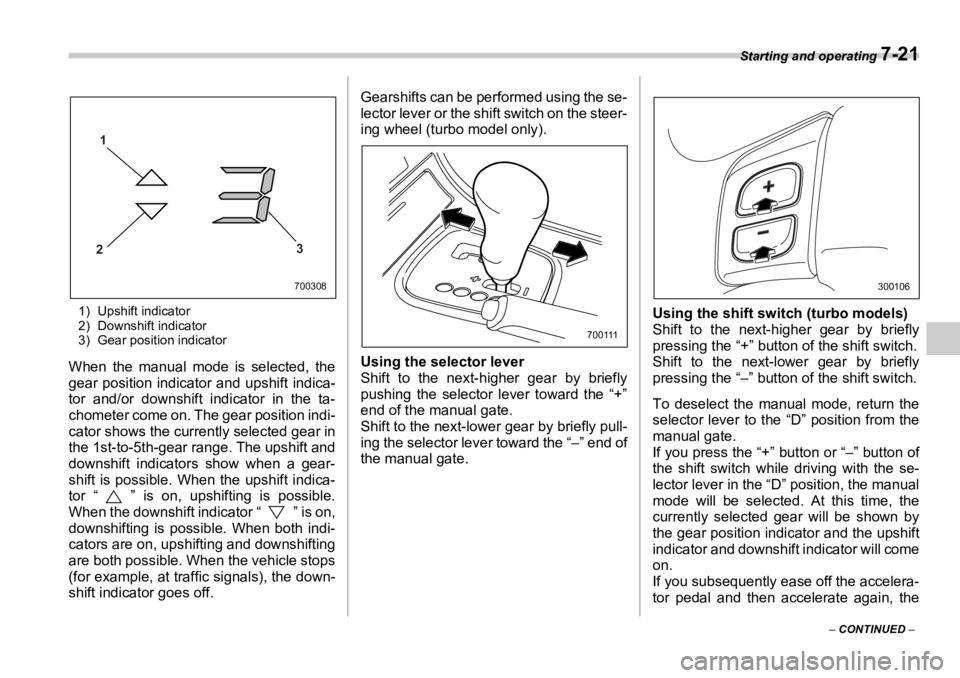
When the manual mode is selected, the
gear position indicator and upshift indica-
tor and/or downshift indicator in the ta-
chometer come on. The gear position indi-
cator shows the currently selected gear in
the 1st-to-5th-gear range. The upshift and
downshift indicators show when a gear-
shift is possible. When the upshift indica-
tor “ ” is on, upshifting is possible.
When the downshift indicator “ ” is on,
downshifting is possible. When both indi-
cators are on, upshifting and downshifting
are both possible. When the vehicle stops
(for example, at traffic signals), the down-
shift indicator goes off. Gearshifts can be performed using the se-
lector lever or the sh ift switch on the steer-
ing wheel (turbo model only).
Using the selector lever
Shift to the next-higher gear by briefly
pushing the selector lever toward the “+”
end of the manual gate.
Shift to the next-lower gear by briefly pull-
ing the selector lever toward the “–” end of
the manual gate. Using the shift swit ch (turbo models)
Shift to the next-higher gear by briefly
pressing the “+” button of the shift switch.
Shift to the next-lower gear by briefly
pressing the “–” button of the shift switch.
To deselect the manual mode, return the
selector lever to the “D” position from the
manual gate.
If you press the “+” button or “–” button of
the shift switch while driving with the se-
lector lever in the “D” position, the manual
mode will be selected. At this time, the
currently selected gear will be shown by
the gear position indicator and the upshift
indicator and downshift indicator will come
on.
If you subsequently ease off the accelera-
tor pedal and then accelerate again, the1
2 3 700308
700111 300106
Page 267 of 425
7-28 Starting and operating
Electronic Br ake Force Dis-
tribution (EBD) system The EBD system maximizes the effective-
ness of the brakes by allowing the rear
brakes to supply a greater proportion of
the braking force. It functions by adjusting
the distribution of brak ing force to the rear
wheels in accordance with the vehicle’s
loading condition and speed.
The EBD system is an integral part of the
ABS system and uses some of the ABS
system’s components to perform its func-
tion of optimizing the distribution of brak-
ing force. If any of the ABS components
used by the EBD function fails, the EBD
system also stops working.
When the EBD system is operating, you
may hear a chattering noise or feel a slight
vibration in the brake pedal. This is normal
and does not indicate a malfunction. „ Steps to take if EBD system
fails
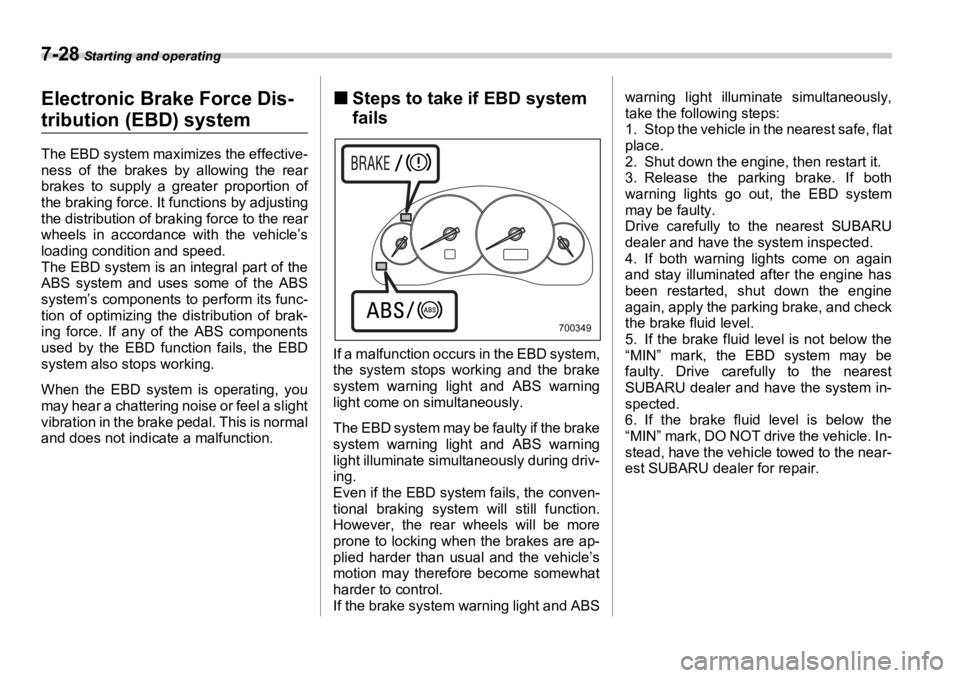
If a malfunction occu rs in the EBD system,
the system stops working and the brake
system warning light and ABS warning
light come on simultaneously.
The EBD system may be faulty if the brake
system warning light and ABS warning
light illuminate simultaneously during driv-
ing.
Even if the EBD system fails, the conven-
tional braking system will still function.
However, the rear wheels will be more
prone to locking when the brakes are ap-
plied harder than usual and the vehicle’s
motion may therefore become somewhat
harder to control.
If the brake system warning light and ABS warning light illuminate simultaneously,
take the following steps:
1. Stop the vehicle in the nearest safe, flat
place.
2. Shut down the engine, then restart it.
3. Release the parking brake. If both
warning lights go out, the EBD system
may be faulty.
Drive carefully to the nearest SUBARU
dealer and have the system inspected.
4. If both warning lights come on again
and stay illuminated after the engine has
been restarted, shut down the engine
again, apply the parking brake, and check
the brake fluid level.
5. If the brake fluid level is not below the
“MIN” mark, the EBD system may be
faulty. Drive carefully to the nearest
SUBARU dealer and have the system in-
spected.
6. If the brake fluid level is below the
“MIN” mark, DO NOT drive the vehicle. In-
stead, have the vehicle towed to the near-
est SUBARU dealer for repair. 700349
Page 268 of 425
Starting and operating
7-29
– CONTINUED –Vehicle Dynamics Control
system (if equipped)y Driving with the brake system
warning light on is dangerous.
This indicates your brake system
may not be working properly. If
the light remains on, have the
brakes inspected by a SUBARU
dealer immediately.
y If at all in doubt about whether the
brakes are operating properly, do
not drive the vehicle. Have your
vehicle towed to the nearest
SUBARU dealer for repair. Always use the utmost care in driv-
ing – overconfidence because you
are driving with a Vehicle Dynamics
Control system equipped vehicle
could easily lead to a serious acci-
dent.
y Even if your vehicle is equipped
with Vehicle Dynamics Control,
winter tires or snow chains
should be used when driving on
snow-covered or icy roads; in ad-
dition, vehicle speed should be re-
duced considerably. Simply hav-
ing a Vehicle Dynamics Control
system does not guarantee that
the vehicle will be able to avoid
accidents in any situation. y Activation of the Vehicle Dynam-
ics Control system is an indica-
tion that the ro ad being travelled
on has a slippery surface; since
having Vehicle Dynamics Control
is no guarantee that full vehicle
control will be maintained at all
times and under all conditions, its
activation should be seen as a
sign that the speed of the vehicle
should be reduced considerably.
y Whenever suspension compo-
nents, steering components, or an
axle are removed from a vehicle
equipped with Vehicle Dynamics
Control, have an authorized
SUBARU dealer perform an in-
spection of that system.
y The following precautions should
be observed in order to ensure
that the Vehicle Dynamics Control
system is operating properly:
– All four wheels should be fitted
with tires of the same size, type,
and brand. Furthermore, the
amount of wear should be the
same for all four tires.
Page 269 of 425

7-30 Starting and operating
In the event of wheelspin and/or skidding
on a slippery road surface and/or during
cornering and/or an evasive maneuver,
the Vehicle Dynamics Control system ad-
justs the engine’s output and the wheels’
respective braking forces to help maintain
traction and directional control.
y Traction Control Function
The traction control function is designed to
prevent spinning of the driving wheels on
slippery road surfaces, thereby helping to
maintain traction and directional control.
Activation of this function is shown by
steady illumination of the Vehicle Dynam-
ics Control operation indicator light.
y Skid Suppression Function
The skid suppression function is designed
to help maintain directional stability by
suppressing the wheels’ tendency to slide
sideways during steering operations. Acti-
vation of this function is shown by flashing
of the Vehicle Dynamics Control operation
indicator light.
NOTE
y Slight twitching of the brake pedal may be felt when the Vehicle Dynamics
Control system operates; a small de-
gree of vehicle or st eering wheel shak-
ing may also be noticed in this situa-
tion. These are normal characteristics
of Vehicle Dynamics Control operation
and are no cause for alarm.
y When driving off immediately after
starting the engine, a short-lived oper-
ation noise may be noticed coming
from the engine compartment. This
noise is generated as a result of a
check being performed on the Vehicle
Dynamics Control system and is nor-
mal.
y Depending on the timing of activa-
tion of the brakes, certain situations
may occur just after driving off where
the brake pedal seems to exhibit a jolt-
ing motion. This too is a consequence
of the Vehicle Dynamics Control opera-
tional check and is normal.
y In the circumstances listed in the fol-
lowing, the vehicle may be more unsta-
ble than it feels to the driver. The Vehi-
cle Dynamics Control System may
therefore operate. Such operation does
not indicate a system fault.
y on gravel-covered or rutted roads
y on unfinished roads
y when the vehicle is towing a trailer
y when the vehicle is fitted with snow tires or winter tires
y Activation of the Vehicle Dynamics
Control system will cause operation of
the steering wheel to feel slightly dif-
ferent compared to that for normal con-
ditions.
y Even if the vehicle is equipped with a
Vehicle Dynamics Control system, it is
important that winter tires be used
when driving on snow-covered or icy
roads. (All four wheels should be fitted
with tires of the same size and brand).
Furthermore, if snow chains are to be
used, they should be fitted on the front
wheels. When a vehicle is fitted with
snow chains, however, the effective-
ness of the Vehicle Dynamics Control
system is reduced and this should be
taken into account when driving the ve-
hicle in such a condition.
y It is always important to reduce
speed when approaching a corner,
even if the vehicle is equipped with Ve-
hicle Dynamics Control.
y All four wheels shou ld be fitted with
tires of the same size, type, and brand;
furthermore, the amount of wear
should be the same for all four tires. If
these precautions are not observed
and non-matching tires are used, it is
quite possible that the Vehicle Dynam-
ics Control system will be unable to op-– Keep the tire pressure at the
proper level as shown on the
vehicle placard attached to the
driver’s side door pillar.
Page 280 of 425

8Driving tipsNew vehicle break-in driving – the first 1,000
miles (1,600 km) ............. ................................. 8-2
Fuel economy hints ............. .......................... .... 8-2
Engine exhaust gas (Carbon monoxide) ......... 8-2
Catalytic converter ............................................. 8-3
Periodic inspections .......................................... 8-4
Driving in foreign countries .............................. 8-4
Driving tips for AWD vehicles ........................... 8-5
Off road driving .................................................. 8-6
Winter driving ..................................................... 8-7 Operation during cold weather .............................. 8-7
Driving on snowy and icy roads ............................ 8-9
Corrosion protection .............................................. 8-10
Snow tires ............................................................... 8-10
Tire chains ............................................................... 8-11
Rocking the vehicle ................................................ 8-12
Loading your vehicle ......................................... 8-12 Vehicle capacity weight ......................................... 8-13
GVWR and GAWR (Gross Vehicle Weight Rating
and Gross Axle Weight Rating) ........................... 8-14
Roof rail and crossbar (if equipped) ..................... 8-14
Trailer hitch (if equipped) .................................. 8-18
Connecting a trailer ................................................ 8-19
When you do not tow a trailer ............................... 8-20
Trailer towing ...................................................... 8-20
Warranties and maintenance ................................. 8-20
Maximum load limits .............................................. 8-21 Trailer hitches ......................................................... 8-24
Connecting a trailer ................................................ 8-25
Trailer towing tips ................................................... 8-26
Page 284 of 425
Driving tips
8-5
Driving tips for AWD vehicles
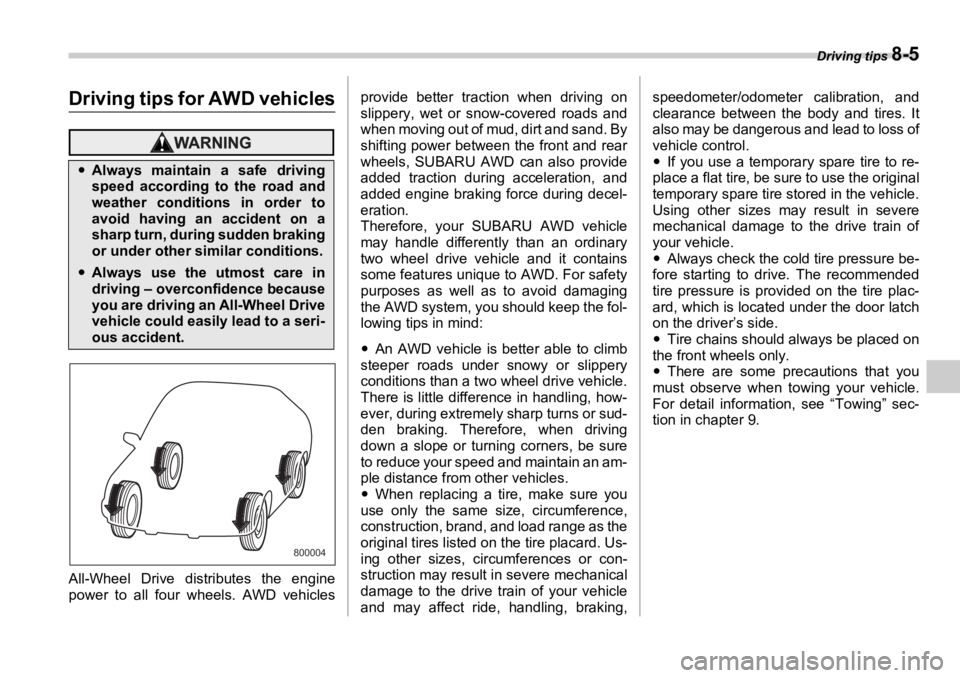
All-Wheel Drive distributes the engine
power to all four wheels. AWD vehicles provide better traction when driving on
slippery, wet or snow-covered roads and
when moving out of mud, dirt and sand. By
shifting power between the front and rear
wheels, SUBARU AWD can also provide
added traction during acceleration, and
added engine braking force during decel-
eration.
Therefore, your SUBARU AWD vehicle
may handle differently than an ordinary
two wheel drive vehicle and it contains
some features unique to AWD. For safety
purposes as well as to avoid damaging
the AWD system, you should keep the fol-
lowing tips in mind:
y An AWD vehicle is better able to climb
steeper roads under snowy or slippery
conditions than a two wheel drive vehicle.
There is little difference in handling, how-
ever, during extremely sharp turns or sud-
den braking. Therefore, when driving
down a slope or turning corners, be sure
to reduce your speed and maintain an am-
ple distance from other vehicles.
y When replacing a ti re, make sure you
use only the same si ze, circumference,
construction, brand, and load range as the
original tires listed on the tire placard. Us-
ing other sizes, circumferences or con-
struction may result in severe mechanical
damage to the drive train of your vehicle
and may affect ride, handling, braking, speedometer/odometer calibration, and
clearance between the body and tires. It
also may be dangerous and lead to loss of
vehicle control.
y If you use a temporary spare tire to re-
place a flat tire, be sure to use the original
temporary spare tire stored in the vehicle.
Using other sizes may result in severe
mechanical damage to the drive train of
your vehicle.
y Always check the cold tire pressure be-
fore starting to drive. The recommended
tire pressure is provided on the tire plac-
ard, which is located under the door latch
on the driver’s side.
y Tire chains should always be placed on
the front wheels only.
y There are some precautions that you
must observe when towing your vehicle.
For detail information, see “Towing” sec-
tion in chapter 9.y Always maintain a safe driving
speed according to the road and
weather conditions in order to
avoid having an accident on a
sharp turn, during sudden braking
or under other similar conditions.
y Always use the utmost care in
driving – overconfidence because
you are driving an All-Wheel Drive
vehicle could easily lead to a seri-
ous accident.
800004
Page 285 of 425
8-6 Driving tips
Off road driving
T All AWD models except OUTBACK
Your AWD vehicle is neither a convention-
al off-road vehicle nor an all terrain vehi-
cle. It is a passenger car designed prima-
rily for on-road use. The AWD feature
gives it some limited off-road capabilities
in situations in which driving surfaces a
relatively level, obstruction-free and other-
wise similar to on-road driving conditions.
Operating it under other than those condi-
tions could subject the vehicle to exces-
sive stress which might result in damage
not eligible for repair under warranty. If
you do take your SUBARU off road, you
should review the common sense precau- tions in the next section (applicable to the
OUTBACK) for general guidance. But
please keep in mind that your vehicle’s
off-road capabilities are more limited than
those of the OUTBACK.
Never attempt to drive through pools and
puddles, or roads flooded with water. Wa-
ter entering the engine air intake or the ex-
haust pipe or water splashing onto electri-
cal parts may damage your vehicle and
may cause it to stall.
T OUTBACK
Because of the AWD feature and higher
ground clearance, your SUBARU can be
driven on ordinary roads or off-road. But
please keep in mind that an AWD
SUBARU is a passenger car and is nei-
ther a conventional off-road vehicle nor an
all-terrain vehicle. If you do take your
SUBARU off-road, ce rtain common sense
precautions such as the following should
be taken:
y Make certain that you and all of your
passengers are wearing seatbelts.
y Carry some emergency equipment,
such as a towing rope or chain, a shovel,
wheel blocks, first aid kit and cell phone or
citizens band radio.
y Drive carefully. Do not take unneces-
sary risks by driving in dangerous areas or
over rough terrain. y Slow down and employ extra caution at
all times. When driving off-road, you will
not have the benefit of marked traffic
lanes, banked curves, traffic signs and the
like.
y Do not drive across steep slopes. In-
stead, drive either st raight up or straight
down the slopes. A vehicle can much
more easily tip over sideways than it can
end over end. Avoid driving straight up or
down slopes that are too steep.
y Avoid sharp turning maneuvers, espe-
cially at higher speeds.
y Do not grip the inside or spokes of the
steering wheel. A bad bump could jerk the
wheel and injure your hands. Instead drive
with your fingers and thumbs on the out-
side of the rim.
y If driving through water, such as when
crossing shallow streams, first check the
depth of the water and the bottom of the
stream bed for firmness and ensure that
the bed of the stream is flat. Drive slowly
and completely through the stream. The
water should be shallow enough that it
does not reach the vehicle’s undercar-
riage. Water entering the engine air intake
or the exhaust pipe or water splashing
onto electrical parts may damage your ve-
hicle and may cause it to stall. Never at-
tempt to drive through rushing water; re-
gardless of its depth, it can wash away they Always maintain a safe driving
speed according to the road and
weather conditions in order to
avoid having an accident on a
sharp turn, during sudden braking
or under other similar conditions.
y Always use the utmost care in
driving – overconfidence because
you are driving an All-Wheel Drive
vehicle could easily lead to a seri-
ous accident.