2006 SUBARU IMPREZA light
[x] Cancel search: lightPage 281 of 365

Maintenance and service
Tires and wheels ................................................ 11-30
Types of tires .................................... ...................... 11-30
Tire inspection ................................... ..................... 11-30
Tire pressures and wear ........................... ............. 11-30
Wheel balance ..................................... ................... 11-32
Wear indicators ................................... .................... 11-33
Tire rotation ..................................... ........................ 11-33
Tire replacement .................................. ................... 11-33
Wheel replacement ................................. ................ 11-34
Aluminum wheels ................................... ............ 11-35
Intercooler water spray (WRX-STI) ................. .. 11-35
Windshield washer fluid ........................... ......... 11-36
Replacement of wiper blades ....................... ..... 11-37
Windshield wiper blades assembly .................. .... 11-37
Windshield wiper blade rubber ..................... ........ 11-38
Rear window wiper blade assembly .................. ... 11-38
Rear window wiper blade rubber .................... ...... 11-39
Battery ........................................... ...................... 11-40
Fuses ............................................. ...................... 11-41
Main fuse ......................................... .................... 11-43
Installation of accessories ....................... ......... 11-43
Replacing bulbs ................................... ............... 11-44
Headlights (WRX-STI) .............................. ............... 11-45
Headlights (Except WRX-STI) ....................... ......... 11-46
Front turn signal light bulbs ..................... ............. 11-48
Parking light ..................................... ....................... 11-48
Front fog light ................................... ...................... 11-48
Rear combination lights ........................... .............. 11-48
License plate light ............................... ................... 11-50
Dome light, map light and cargo area light ........ .. 11-50Trunk light .......................................
........................ 11-51
High mount stop light ............................. ............... 11-51
Page 284 of 365
Maintenance and service 11-5
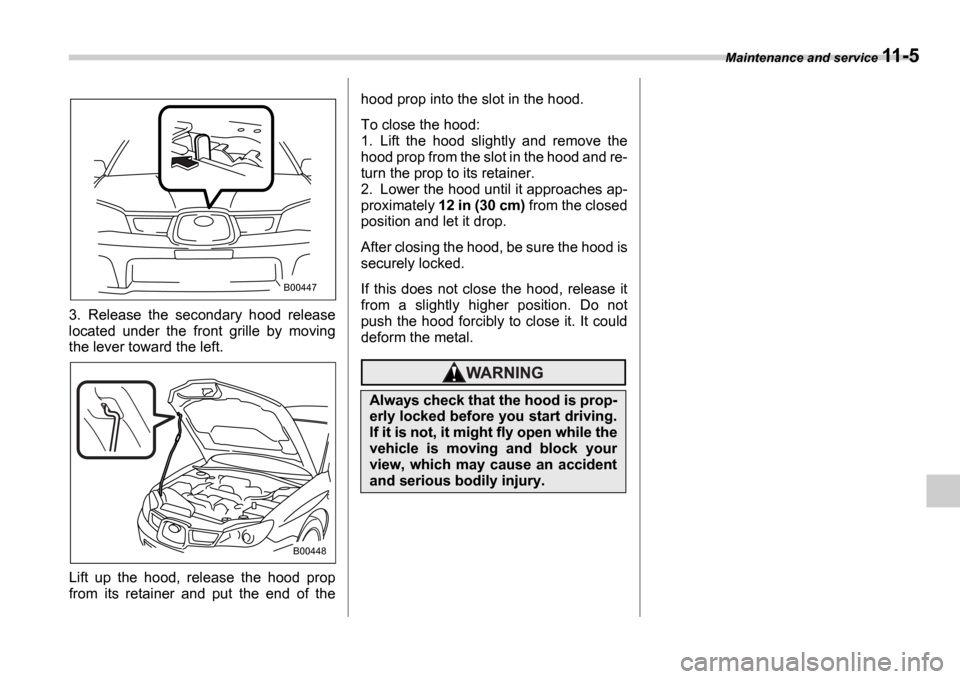
3. Release the secondary hood release
located under the front grille by moving
the lever toward the left.
Lift up the hood, release the hood prop
from its retainer and put the end of the hood prop into the slot in the hood.
To close the hood:
1. Lift the hood slightly and remove the
hood prop from the slot in the hood and re-
turn the prop to its retainer.
2. Lower the hood until it approaches ap-
proximately
12 in (30 cm) from the closed
position and let it drop.
After closing the hood, be sure the hood is
securely locked.
If this does not close the hood, release it
from a slightly higher position. Do not
push the hood forcibly to close it. It could
deform the metal.
B00447
B00448
Always check that the hood is prop-
erly locked before you start driving.
If it is not, it might fly open while the
vehicle is moving and block your
view, which may cause an accident
and serious bodily injury.
Page 289 of 365
11-10 Maintenance and service
11.Reinstall under cover.
12.Pour engine oil through the filler neck.
Oil capacity (guideline):
4.2 US qt (4.0 liters, 3.5 Imp qt)
The oil quantity indicated above is only
guideline.
The necessary quantity of oil depends on
the quantity of oil that has been drained.
The quantity of drained oil differs slightly
depending on the temperature of the oil
and the time the oil is left flowing out. After refilling the engine with oil, therefore, you
must the dipstick to confirm that the level
is correct.
13.Start the engine and make sure that no
oil leaks appear around the filter
s rubber
seal and drain plug.
14.Run the engine until it reaches the nor-
mal operating temperature. Then stop the
engine and wait a few minutes to allow the
oil drain back. Check the oil level again
and if necessary, add more engine oil.
Recommended grade and
viscosity
Oil grade:
ILSAC GF-4, which can be identified
with the ILSAC certification mark
(Starburst mark)
or API classification SM with the
words ENERGY CONSERVING
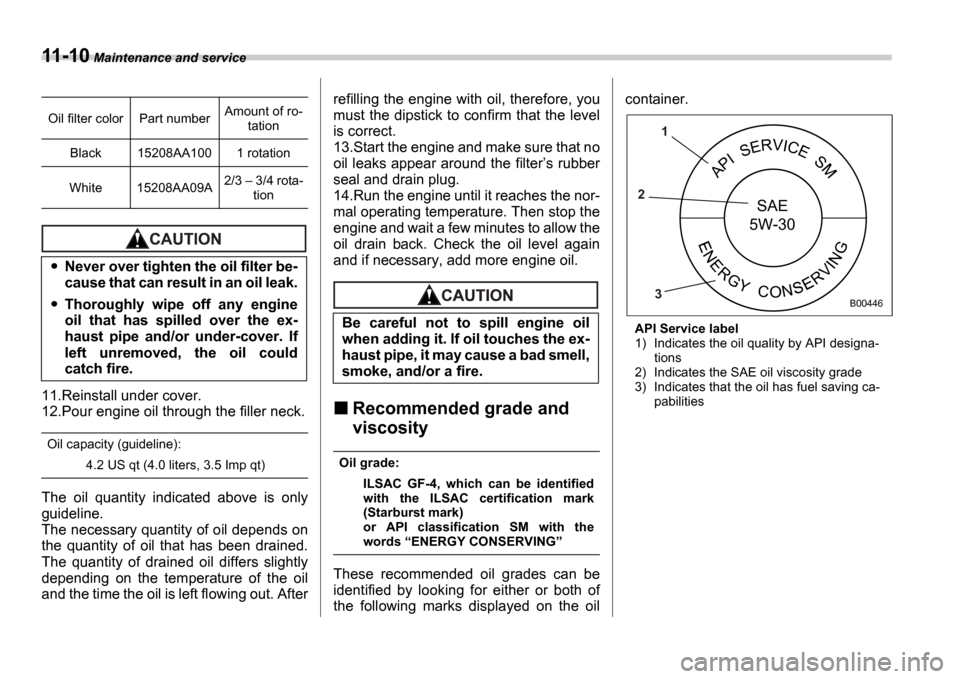
These recommended oil grades can be
identified by looking for either or both of
the following marks displayed on the oil container.
API Service label
1) Indicates the oil quality by API designa-
tions
2) Indicates the SAE oil viscosity grade
3) Indicates that the oil has fuel saving ca- pabilities
Oil filter color Part number
Amount of ro-
tation
Black 15208AA100 1 rotation
White 15208AA09A 2/3
3/4 rota-
tion
Never over tighten the oil filter be-
cause that can result in an oil leak.
Thoroughly wipe off any engine
oil that has spilled over the ex-
haust pipe and/or under-cover. If
left unremoved, the oil could
catch fire.
Be careful not to spill engine oil
when adding it. If oil touches the ex-
haust pipe, it may cause a bad smell,
smoke, and/or a fire.
APISERVICES
NERGYCONRVING
SAE
5W-30
1
2
3
B00446
Page 306 of 365
Maintenance and service 11-27
Brake booster
If the brake booster does not operate as
described in the following, have it checked
by your SUBARU dealer.
1. With the engine off, depress the brake
pedal several times, applying the same
pedal force each time. The distance the
pedal travels should not vary.
2. With the brake pedal depressed, start
the engine. The pedal should move slight-
ly down to the floor.
3. With the brake pedal depressed, stop
the engine and keep the pedal depressed
for 30 seconds. The pedal height should
not change.
4. Start the engine again and run for ap-
proximately one minute then turn it off.
Depress the brake pedal several times to
check the brake booster. The brake boost-
er operates properly if the pedal stroke de-
creases with each depression.
Brake pedal
Check the brake pedal free play and re-
serve distance according to the mainte-
nance schedule in the Warranty and
Maintenance Booklet .
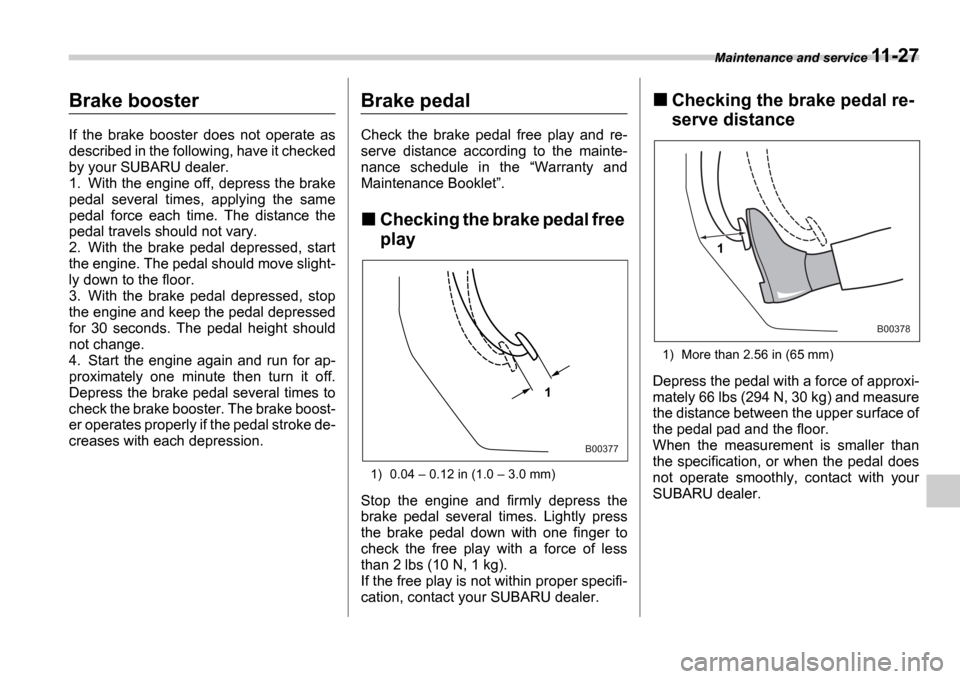
Checking the brake pedal free
play
1) 0.04 0.12 in (1.0 3.0 mm)
Stop the engine and firmly depress the
brake pedal several times. Lightly press
the brake pedal down with one finger to
check the free play with a force of less
than 2 lbs (10 N, 1 kg).
If the free play is not within proper specifi-
cation, contact your SUBARU dealer.
Checking the brake pedal re-
serve distance
1) More than 2.56 in (65 mm)
Depress the pedal with a force of approxi-
mately 66 lbs (294 N, 30 kg) and measure
the distance between the upper surface of
the pedal pad and the floor.
When the measurement is smaller than
the specification, or when the pedal does
not operate smoothly, contact with your
SUBARU dealer.1
B00377
1
B00378
Page 307 of 365
11-28 Maintenance and service
Clutch pedal (MT vehicles)
Check the clutch pedal free play and re-
serve distance according to the mainte-
nance schedule in the Warranty and
Maintenance Booklet .
Checking the clutch function
Check the clutch engagement and disen-
gagement.
1. With the engine idling, check that there
are no abnormal noises when the clutch
pedal is depressed, and that shifting into
1st or reverse feels smooth.
2. Start the vehicle by releasing the pedal
slowly to check that the engine and trans-
mission smoothly couple without any sign
of slippage.
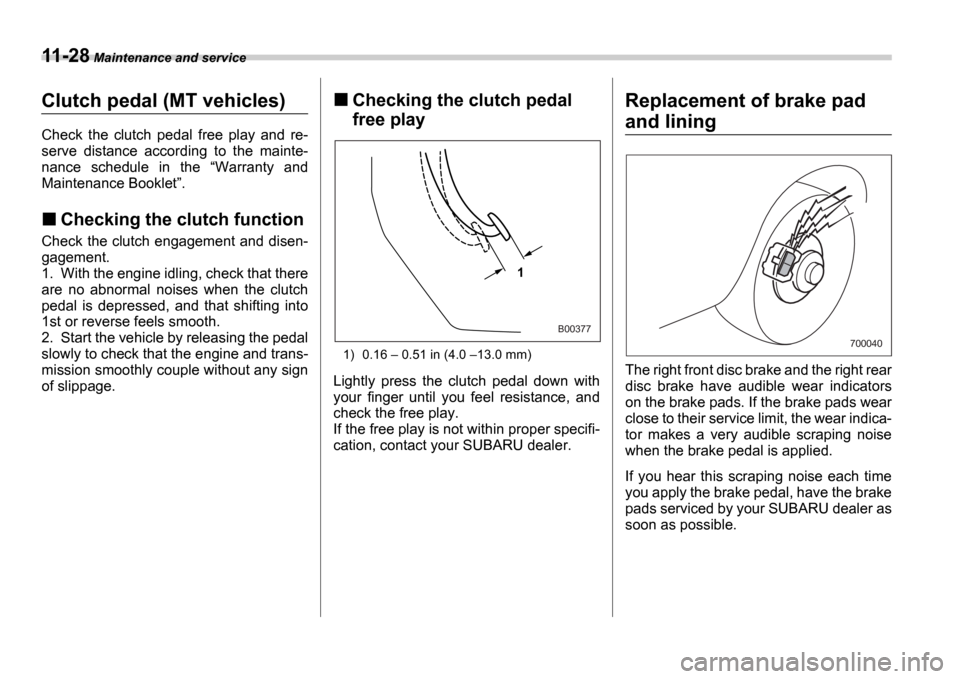
Checking the clutch pedal
free play
1) 0.16 0.51 in (4.0 13.0 mm)
Lightly press the clutch pedal down with
your finger until you feel resistance, and
check the free play.
If the free play is not within proper specifi-
cation, contact your SUBARU dealer.
Replacement of brake pad
and lining
The right front disc brake and the right rear
disc brake have audible wear indicators
on the brake pads. If the brake pads wear
close to their service limit, the wear indica-
tor makes a very audible scraping noise
when the brake pedal is applied.
If you hear this scraping noise each time
you apply the brake pedal, have the brake
pads serviced by your SUBARU dealer as
soon as possible.
1
B00377
700040
Page 308 of 365
Maintenance and service 11-29
Breaking-in of new brake
pads and linings
When replacing the brake pad or lining,
use only genuine SUBARU parts. After re-
placement, the new parts must be broken
in as follows:
Brake pad and lining
While maintaining a speed of 30 to 40 mph
(50 to 65 km/h), step on the brake pedal
lightly. Repeat this five or more times.
Parking brake lining
1. Drive the vehicle at a speed of approx-
imately 22 mph (35 km/h).
2. With the parking brake release button
pushed in, pull the parking brake lever
SLOWLY and GENTLY. (Pulling with a
force of approximately 33 lbs [147 N, 15
kg].)
3. Drive the vehicle for approximately 220
yards (200 meters) in this condition.
4. Wait 5 to 10 minutes for the parking brake to cool down. Repeat this proce-
dure.
5. Check the parking brake stroke. If the
parking brake stroke is out of the specified
range, adjust it by turning the adjusting nut
located on the parking brake lever.
Parking brake stroke:
7
8 notches / 44 lbs (196 N, 20 kg)
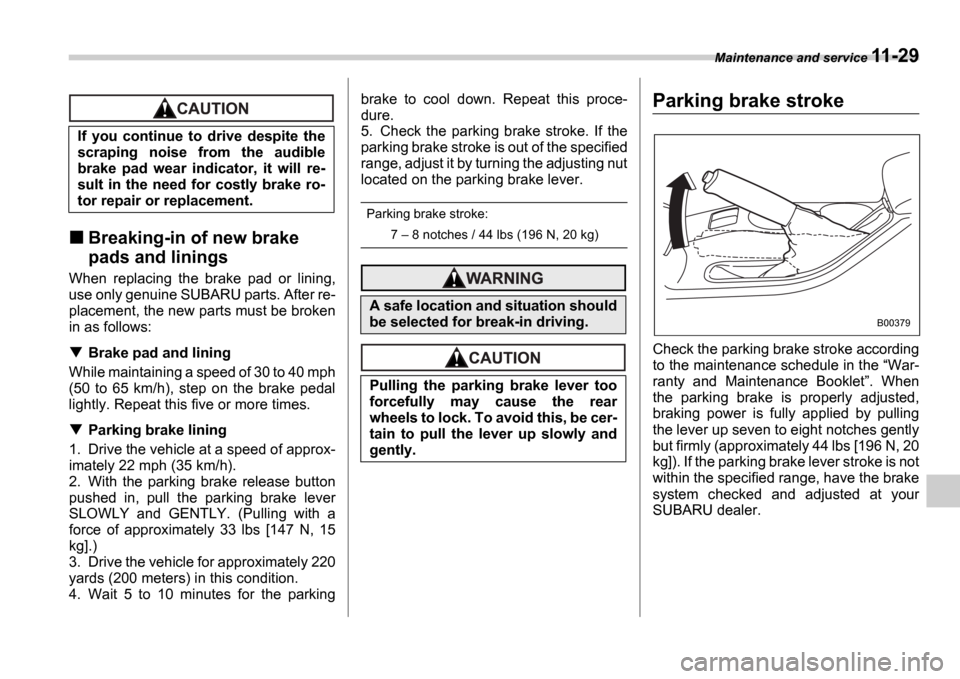
Parking brake stroke
Check the parking brake stroke according
to the maintenance schedule in the War-
ranty and Maintenance Booklet . When
the parking brake is properly adjusted,
braking power is fully applied by pulling
the lever up seven to eight notches gently
but firmly (approximately 44 lbs [196 N, 20
kg]). If the parking brake lever stroke is not
within the specified range, have the brake
system checked and adjusted at your
SUBARU dealer.
If you continue to drive despite the
scraping noise from the audible
brake pad wear indicator, it will re-
sult in the need for costly brake ro-
tor repair or replacement.
A safe location and situation should
be selected for break-in driving.
Pulling the parking brake lever too
forcefully may cause the rear
wheels to lock. To avoid this, be cer-
tain to pull the lever up slowly and
gently.
B00379
Page 311 of 365
11-32 Maintenance and service
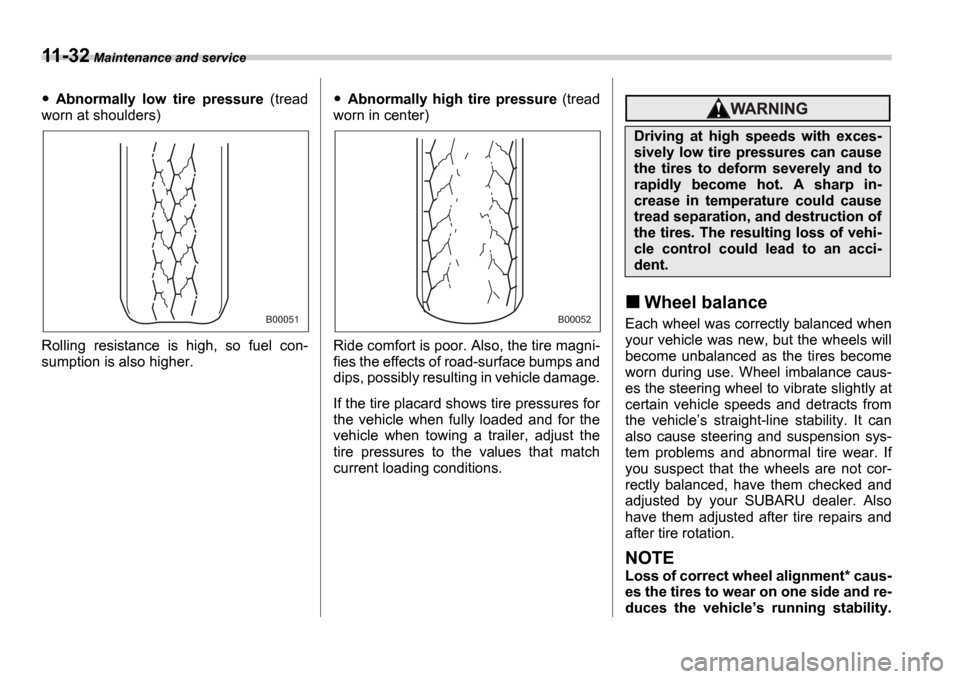
Abnormally low tire pressure (tread
worn at shoulders)
Rolling resistance is high, so fuel con-
sumption is also higher.Abnormally high tire pressure (tread
worn in center)
Ride comfort is poor. Also, the tire magni-
fies the effects of road-surface bumps and
dips, possibly resulting in vehicle damage.
If the tire placard shows tire pressures for
the vehicle when fully loaded and for the
vehicle when towing a trailer, adjust the
tire pressures to the values that match
current loading conditions.
Wheel balance
Each wheel was correctly balanced when
your vehicle was new, but the wheels will
become unbalanced as the tires become
worn during use. Wheel imbalance caus-
es the steering wheel to vibrate slightly at
certain vehicle speeds and detracts from
the vehicle s straight-line stability. It can
also cause steering and suspension sys-
tem problems and abnormal tire wear. If
you suspect that the wheels are not cor-
rectly balanced, have them checked and
adjusted by your SUBARU dealer. Also
have them adjusted after tire repairs and
after tire rotation.
NOTE
Loss of correct wheel alignment* caus-
es the tires to wear on one side and re-
duces the vehicle s running stability.
B00051B00052
Driving at high speeds with exces-
sively low tire pressures can cause
the tires to deform severely and to
rapidly become hot. A sharp in-
crease in temperature could cause
tread separation, and destruction of
the tires. The resulting loss of vehi-
cle control could lead to an acci-
dent.
Page 314 of 365
Maintenance and service 11-35
Aluminum wheels
Aluminum wheels can be scratched and
damaged easily. Handle them carefully to
maintain their appearance, performance,
and safety.
When any of the wheels is removed and
replaced for tire rotation or to change a
flat, always check the tightness of the
wheel nuts after driving approximately 600
miles (1,000 km). If any nut is loose, tight-
en it to the specified torque.
Never apply oil to the threaded parts,
wheel nuts, or tapered surface of the
wheel.
Never let the wheel rub against sharp
protrusions or curbs.
Be sure to fit tire chains on uniformly
and completely around the tire, otherwise
the chains may scratch the wheel.
When wheel nuts, balance weights, or
the center cap is replaced, be sure to re-
place them with genuine SUBARU parts
designed for aluminum wheels.
Intercooler water spray
(WRX-STI)
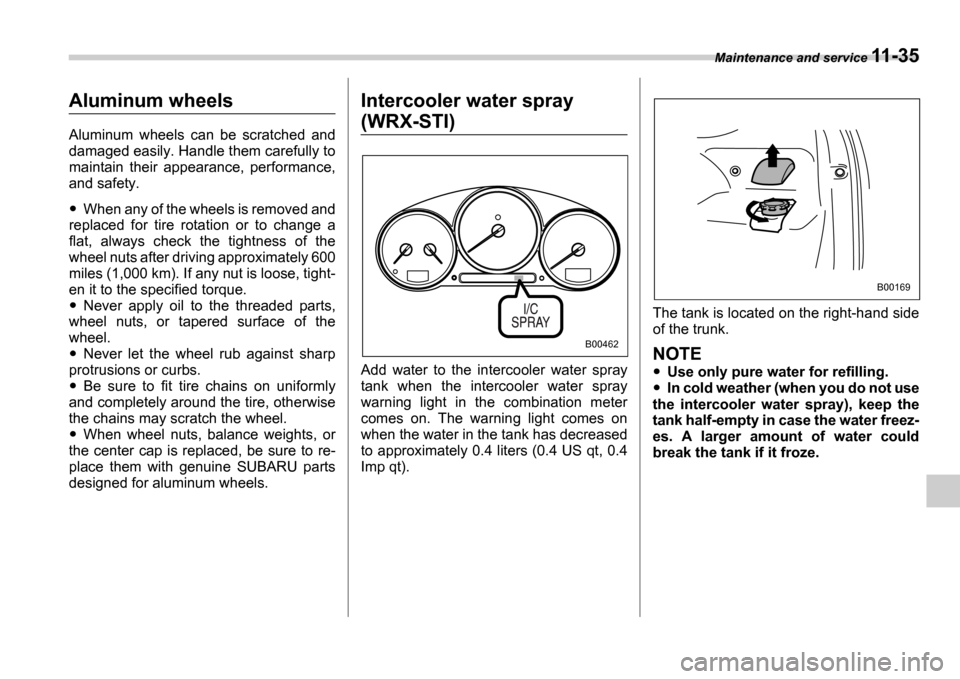
Add water to the intercooler water spray
tank when the intercooler water spray
warning light in the combination meter
comes on. The warning light comes on
when the water in the tank has decreased
to approximately 0.4 liters (0.4 US qt, 0.4
Imp qt). The tank is located on the right-hand side
of the trunk.
NOTE
Use only pure water for refilling.
In cold weather (when you do not use
the intercooler water spray), keep the
tank half-empty in case the water freez-
es. A larger amount of water could
break the tank if it froze.
B00462
B00169