2006 SUBARU FORESTER check engine light
[x] Cancel search: check engine lightPage 213 of 355

7-18
Starting and operating
Electronic Brake Force Dis-
tribution (EBD) system (if equipped)The EBD system maximizes the effective-
ness of the brakes by allowing the rear
brakes to supply a greater proportion of
the braking force. It functions by adjusting
the distribution of braking force to the rear
wheels in accordance with the vehicle’s
loading condition and speed.
The EBD system is an integral part of the
ABS system and uses some of the ABS
system’s components to perform its func-
tion of optimizing the distribution of brak-
ing force. If any of the ABS components
used by the EBD function fails, the EBD
system also stops working.
When the EBD system is operating, you
may hear a chattering noise or feel a slight
vibration in the brake pedal. This is normal
and does not indicate a malfunction.
„Steps to take if EBD system
fails1) U.S.-spec. models
2) Canada-spec. modelsIf a malfunction occurs in the EBD system,
the system stops working and the brake
system warning light and ABS warning
light come on simultaneously.
The EBD system may be faulty if the brake
system warning light and ABS warning
light illuminate simultaneously during driv-
ing.
Even if the EBD system fails, the conven-
tional braking system will still function.
However, the rear wheels will be more
prone to locking when the brakes are ap-
plied harder than usual and the vehicle’s motion may therefore become somewhat
harder to control.
If the brake system warning light and ABS
warning light illuminate simultaneously,
take the following steps:
1. Stop the vehicle in the nearest safe, flat
place.
2. Shut down the engine, then restart it.
3. Release the parking brake. If both
warning lights go out, the EBD system
may be faulty.
Drive carefully to the nearest SUBARU
dealer and have the system inspected.
4. If both warning lights come on again
and stay illuminated after the engine has
been restarted, shut down the engine
again, apply the parking brake, and check
the brake fluid level.
5. If the brake fluid level is not below the
“MIN” mark, the EBD system may be
faulty. Drive carefully to the nearest
SUBARU dealer and have the system in-
spected.
6. If the brake fluid level is below the
“MIN” mark, DO NOT drive the vehicle. In-
stead, have the vehicle towed to the near-
est SUBARU dealer for repair.
1
2 1
2
700334
ProCarManuals.com
Page 215 of 355

7-20
Starting and operating
In the event of wheelspin and/or skidding
on a slippery road surface and/or during
cornering and/or an evasive maneuver,
the Vehicle Dynamics Control system ad-
justs the engine’s output and the wheels’
respective braking forces to help maintain
traction and directional control.
yTraction Control Function
The traction control function is designed to
prevent spinning of the driving wheels on
slippery road surfaces, thereby helping to
maintain traction and directional control.
Activation of this function is shown by
steady illumination of the Vehicle Dynam-
ics Control operation indicator light.
y Skid Suppression Function
The skid suppression function is designed
to help maintain directional stability by suppressing the wheels’ tendency to slide
sideways during steering operations. Acti-
vation of this function is shown by flashing
of the Vehicle Dynamics Control operation
indicator light.
NOTEy
Slight twitching of the brake pedal
may be felt when the Vehicle Dynamics
Control system operates; a small de-
gree of vehicle or steering wheel shak-
ing may also be noticed in this situa-
tion. These are normal characteristics
of Vehicle Dynamics Control operation
and are no cause for alarm.
y When driving off immediately after
starting the engine, a short-lived oper-
ation noise may be noticed coming
from the engine compartment. This
noise is generated as a result of a
check being performed on the Vehicle
Dynamics Control system and is nor-
mal.
y Depending on the timing of activa-
tion of the brakes, certain situations
may occur just after driving off where
the brake pedal seems to exhibit a jolt-
ing motion. This too is a consequence
of the Vehicle Dynamics Control opera-
tional check and is normal.
y In the circumstances listed in the fol-
lowing, the vehicle may be more unsta- ble than it feels to the driver. The Vehi-
cle Dynamics Control System may
therefore operate. Such operation does
not indicate a system fault.
y on gravel-covered or rutted roads
y on unfinished roads
y when the vehicle is towing a trailer
y when the vehicle is fitted with
snow tires or winter tires
y Activation of the Vehicle Dynamics
Control system will cause operation of
the steering wheel to feel slightly dif-
ferent compared to that for normal con-
ditions.
y Even if the vehicle is equipped with a
Vehicle Dynamics Control system, it is
important that winter tires be used
when driving on snow-covered or icy
roads. (All four wheels should be fitted
with tires of the same size and brand).
Furthermore, if snow chains are to be
used, they should be fitted on the front
wheels. When a vehicle is fitted with
snow chains, however, the effective-
ness of the Vehicle Dynamics Control
system is reduced and this should be
taken into account when driving the ve-
hicle in such a condition.
y It is always important to reduce
speed when approaching a corner,
even if the vehicle is equipped with Ve-
hicle Dynamics Control.
– Keep the tire pressure at the
proper level as shown on the
placard attached to the vehi-
cle’s door pillar.
– Use only the special temporary spare tire to replace a flat tire.
With a temporary spare tire, the
effectiveness of the Vehicle Dy-
namics Control system is re-
duced and this should be taken
into account when driving the
vehicle in such a condition.
ProCarManuals.com
Page 231 of 355

8-6
Driving tips
Off road drivingBecause of the AWD feature and higher
ground clearance, your SUBARU can be
driven on ordinary roads or off-road. But
please keep in mind that an AWD
SUBARU is a passenger car and is nei-
ther a conventional off-road vehicle nor an
all-terrain vehicle. If you do take your
SUBARU off-road, certain common sense
precautions such as the following should
be taken:
yMake certain that you and all of your
passengers are wearing seatbelts.
y Carry some emergency equipment,
such as a towing rope or chain, a shovel,
wheel blocks, first aid kit and cell phone or
citizens band radio.
y Drive carefully. Do not take unneces-
sary risks by driving in dangerous areas or
over rough terrain.
y Slow down and employ extra caution at
all times. When driving off-road, you will
not have the benefit of marked traffic
lanes, banked curves, traffic signs and the
like.
y Do not drive across steep slopes. In-
stead, drive either straight up or straight
down the slopes. A vehicle can much
more easily tip over sideways than it can
end over end. Avoid driving straight up or down slopes that are too steep.
y
Avoid sharp turning maneuvers, espe-
cially at higher speeds.
y Do not grip the inside or spokes of the
steering wheel. A bad bump could jerk the
wheel and injure your hands. Instead drive
with your fingers and thumbs on the out-
side of the rim.
y If driving through water, such as when
crossing shallow streams, first check the
depth of the water and the bottom of the
stream bed for firmness and ensure that
the bed of the stream is flat. Drive slowly
and completely through the stream. The
water should be shallow enough that it
does not reach the vehicle’s undercar-
riage. Water entering the engine air intake
or the exhaust pipe or water splashing
onto electrical parts may damage your ve-
hicle and may cause it to stall. Never at-
tempt to drive through rushing water; re-
gardless of its depth, it can wash away the
ground from under your tires, resulting in
possible loss of traction and even vehicle
rollover.
y Always check your brakes for effective-
ness immediately after driving in sand,
mud or water. Do this by driving slowly
and stepping on the brake pedal. Repeat
that process several times to dry out the
brake discs and brake pads.
y Do not drive or park over or near flam- mable materials such as dry grass or fall-
en leaves, as they may burn easily. The
exhaust system is very hot while the en-
gine is running and right after the engine
stops. This could create a fire hazard.
y
After driving through tall grass, mud,
rocks, sand, rivers, etc., check that there
is no grass, bush, paper, rags, stones,
sand, etc. adhering to or trapped on the
underbody. Clear off any such matter from
the underbody. If the vehicle is used with
these materials trapped or adhering to the
underbody, a mechanical breakdown or
fire could occur.
y Secure all cargo carried inside the vehi-
cle and make certain that it is not piled
higher than the seatbacks. During sudden
stops or jolts, unsecured cargo could be
thrown around in the vehicle and cause in-
jury. Do not pile heavy loads on the roof.
Those loads raise the vehicle’s center of
gravity and make it more prone to tip over.
y If you must rock the vehicle to free it
from sand or mud, depress the accelera-
tor pedal slightly and move the selector le-
ver back and forth between “D” and “R” re-
peatedly. Do not race the engine. For the
best possible traction, avoid spinning the
wheels when trying to free the vehicle.
When the road surface is extremely slip-
pery, you can obtain better traction by
starting the vehicle with the transmission
ProCarManuals.com
Page 248 of 355
Driving tips
8-23
– CONTINUED –
lights and parking lights each time you
hitch up.TTires
Make sure that all the tires on your vehicle
are properly inflated to the pressure spec-
ified on the tire placard located on the driv-
er’s side center pillar.
Trailer tire condition, size, load rating and
proper inflation pressure should be in ac-
cordance with the trailer manufacturer’s
specifications.„ Trailer towing tips
T Before starting out on a trip
y Check that the vehicle and vehicle-to-
hitch mounting are in good condition. If
any problems are apparent, do not tow the
trailer.
y Check that the vehicle sits horizontally
with the trailer attached. If the vehicle is
tipped sharply up at the front and down at
the rear, check the total trailer weight,
GVW, GAWs and tongue load again, then
confirm that the load and its distribution
are acceptable.
y Check that the tire pressures are cor-
rect.
y Check that the vehicle and trailer are
connected properly. Confirm that – the trailer tongue is connected prop-
erly to the hitch ball.
– the trailer lights connector is connect-
ed properly and trailer’s brake lights illu-
minate when the vehicle’s brake pedal
is pressed, and that the trailer’s turn sig- nal lights flash when the vehicle’s turn
signal lever is operated.
– the safety chains are connected prop-
erly.
– all cargo in the trailer is secured safe-
ty in position.
– the side mirrors provide a good rear-
ward field of view without a significant
blind spot.
y Sufficient time should be taken to learn
the “feel” of the vehicle/trailer combination
before starting out on a trip. In an area free
of traffic, practice turning, stopping and
backing up.
T Driving with a trailer
y You should allow for considerably more
stopping distance when towing a trailer.
Avoid sudden braking because it may re-
sult in skidding or jackknifing and loss of
control.
y Avoid abrupt starts and sudden acceler-
ations. If your vehicle has a manual trans-
mission, always start out in first gear and
release the clutch at moderate engine rev-
olution.
y Avoid uneven steering, sharp turns and
rapid lane changes.
y Slow down before turning. Make a long-
er than normal turning radius because the
trailer wheels will be closer than the vehi-
cle wheels to the inside of the turn. In a
Direct splicing or other improper
connection of trailer lights may
damage your vehicle’s electrical
system and cause a malfunction of
your vehicle’s lighting system.
y
Never exceed 45 mph (72 km/h)
when towing a trailer in hilly coun-
try on hot days.yWhen towing a trailer, steering,
stability, stopping distance and
braking performance will be dif-
ferent from normal operation. For
safety’s sake, you should employ
extra caution when towing a trail-
er and you should never speed.
You should also keep the follow-
ing tips in mind:
ProCarManuals.com
Page 283 of 355
11 - 1 0
Maintenance and service
The oil quantity indicated above is only a
guideline. The necessary quantity of oil
depends on the quantity of oil that has
been drained. The quantity of drained oil
differs slightly depending on the tempera-
ture of the oil and the time the oil is left
flowing out. After pouring oil into the en-
gine, therefore, you must use the dipstick
to confirm that the level is correct.
13.Start the engine and make sure that no
oil leaks appear around the filter’s rubber
seal.
14.Run the engine until it reaches the nor-
mal operating temperature. Then stop the
engine and wait a few minutes to allow the
oil drain back. Check the oil level again
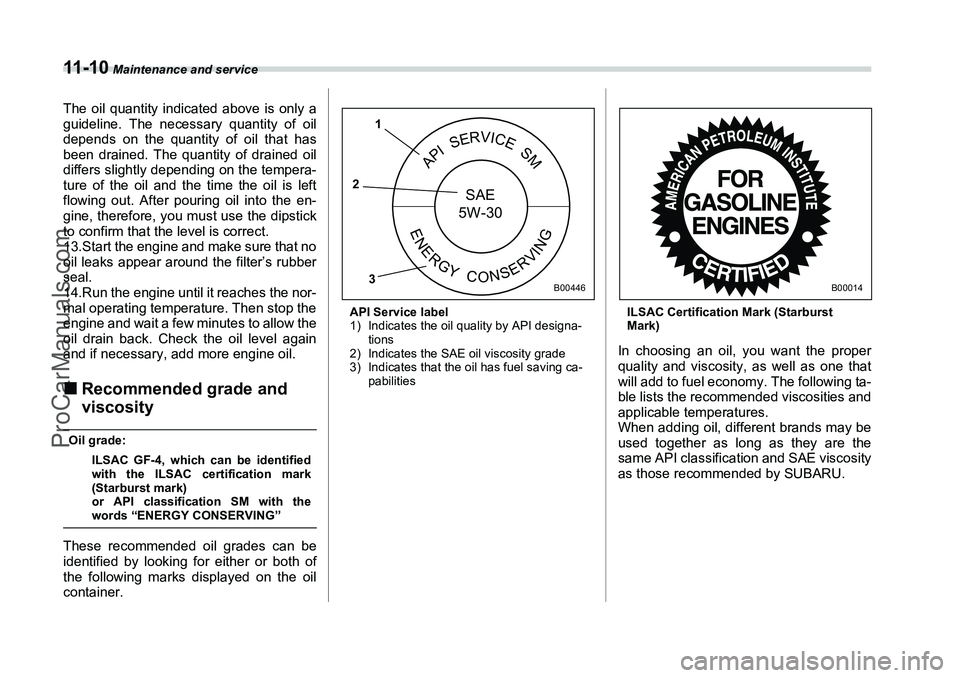
and if necessary, add more engine oil.„Recommended grade and
viscosityOil grade:
ILSAC GF-4, which can be identified
with the ILSAC certification mark
(Starburst mark)
or API classification SM with the
words “ENERGY CONSERVING”
These recommended oil grades can be
identified by looking for either or both of
the following marks displayed on the oil
container.
API Service label
1) Indicates the oil quality by API designa-tions
2) Indicates the SAE oil viscosity grade
3) Indicates that the oil has fuel saving ca- pabilities ILSAC Certification Mark (Starburst
Mark)
In choosing an oil, you want the proper
quality and viscosity, as well as one that
will add to fuel economy. The following ta-
ble lists the recommended viscosities and
applicable temperatures.
When adding oil, different brands may be
used together as long as they are the
same API classification and SAE viscosity
as those recommended by SUBARU.
APISERVICESM
ENERGY
CONSERVING
SAE
5W-30
1
2
3
B00446
B00014
ProCarManuals.com
Page 299 of 355

11 - 2 6
Maintenance and service
„Recommended clutch fluidFMVSS No. 116, fresh DOT 3 or DOT 4brake fluid
Brake boosterIf the brake booster does not operate as
described in the following, have it checked
by your SUBARU dealer.
1. With the engine off, depress the brake
pedal several times, applying the same
pedal force each time. The distance the
pedal travels should not vary.
2. With the brake pedal depressed, start
the engine. The pedal should move slight-
ly down to the floor.
3. With the brake pedal depressed, stop
the engine and keep the pedal depressed
for 30 seconds. The pedal height should
not change.
4. Start the engine again and run for ap-
proximately one minute then turn it off.
Depress the brake pedal several times to
check the brake booster. The brake boost-
er operates properly if the pedal stroke de-
creases with each depression.
Brake pedalCheck the brake pedal free play and re-
serve distance according to the mainte-
nance schedule in the “Warranty and
Maintenance Booklet”.„Checking the brake pedal free
play1) 0.02 – 0.08 in (0.5 – 2.0 mm)Stop the engine and firmly depress the
brake pedal several times. Lightly press
the brake pedal down with one finger to
check the free play with a force of less
than 2 lbs (10 N, 1 kg).
If the free play is not within proper specifi-
cation, contact your SUBARU dealer.
y
Never splash the clutch fluid over
painted surfaces or rubber parts.
Alcohol contained in the clutch
fluid may damage them.
y Be careful not to spill clutch fluid
when adding it. If clutch fluid
touches the exhaust pipe, it may
cause a bad smell, smoke, and/or
a fire. If clutch fluid gets on the ex-
haust pipe, be sure to wipe it off.
Avoid mixing DOT 3 and DOT 4
brake fluids even if they are of the
same brand.
1
B00377
ProCarManuals.com
Page 300 of 355

Maintenance and service
11 - 2 7
„Checking the brake pedal re-
serve distance1) More than 2.56 in (65 mm)Depress the pedal with a force of approxi-
mately 66 lbs (294 N, 30 kg) and measure
the distance between the upper surface of
the pedal pad and the floor.
When the measurement is smaller than
the specification, or when the pedal does
not operate smoothly, contact with your
SUBARU dealer.
Clutch pedal (MT vehicles)Check the clutch pedal free play and re-
serve distance according to the mainte-
nance schedule in the “Warranty and
Maintenance Booklet”.„Checking the clutch functionCheck the clutch engagement and disen-
gagement.
1. With the engine idling, check that there
are no abnormal noises when the clutch
pedal is depressed, and that shifting into
1st or reverse feels smooth.
2. Start the vehicle by releasing the pedal
slowly to check that the engine and trans-
mission smoothly couple without any sign
of slippage.
„Checking the clutch pedal
free play1) Non-turbo models: 0.39 – 0.79 in (10 –
20 mm)
Turbo models: 0.12 – 0.51 in (3 – 13
mm)Lightly press the clutch pedal down with
your finger until you feel resistance, and
check the free play.
If the free play is not within proper specifi-
cation, contact your SUBARU dealer.
1
B00378
1
B00377
ProCarManuals.com
Page 314 of 355

Maintenance and service
11 - 4 1
in the main fuse box cover in the engine
compartment.1) Good
2) BlownIf any lights, accessories or other electri-
cal controls do not operate, inspect the
corresponding fuse. If a fuse has blown,
replace it.
1. Turn the ignition switch to the “LOCK”
position and turn off all electrical accesso-
ries.
2. Remove the cover.
3. Determine which fuse may be blown.
The back side of each fuse box cover and
the “Fuses and circuits” section in chapter
12 in this manual show the circuit for each
fuse.4. Pull out the fuse with the fuse puller.
5. Inspect the fuse. If it has blown, re-
place it with a spare fuse of the same rat-
ing.
6. If the same fuse blows again, this indi-
cates that its system has a problem. Con-
tact your SUBARU dealer for repairs.
Main fuseMain fuse boxThe main fuses are designed to melt dur-
ing an overload to prevent damage to the
wiring harness and electrical equipment.
Check the main fuses if any electrical
component fails to operate (except the
starter motor) and other fuses are good. A
melted main fuse must be replaced. Use
only replacements with the same speci-
fied rating as the melted main fuse. If a
main fuse blows after it is replaced, have
the electrical system checked by your
nearest SUBARU dealer.
12
B00338
600160
600444
ProCarManuals.com