2006 SKODA FABIA engine oil
[x] Cancel search: engine oilPage 203 of 258

Inspecting and Replenishing202
The warning light in the instrument cluster* will indicate ⇒page 31 whether the oil level is too low. In this case, check the oil level as soon as possible. Top up with an appropriate quantity of oil.
WARNING
Read and observe the warning notes ⇒page 198, “Working in the engine compartment” before working in the engine compartment.
Caution
•Always check the oil level on vehicles with engine 1.2 l/47 kW when the engine is warm. Otherwise the measuring result is incorrect und oil could be incorrectly replenished - risk of engine damage!
•The oil level must on no account ex tend beyond the range . Danger of damaging the catalytic converter.
•Do not continue your journey if for some reason it is not possible under the conditions prevailing to top up with oil. Switch the engine off and obtain professional assistance from a specialist garage, otherwise it could lead to severe engine damage.
Replenishing engine oil
– Inspect the oil level ⇒page 201.
– Unscrew the cap of the engine oil filler opening.
– Pour in a suitable grade of oil in portions of 0.5 litres ⇒page 200,
“Engine oil specifications”.
– Inspect the oil level ⇒page 201.
– Carefully screw on the cap of the filler opening and push the
dipstick in fully.
WARNING
•Avoid dripping oil onto hot parts of the engine when topping up will oil - a risk of fire!
•Read and observe the warning notes ⇒page 198, “Working in the engine compartment” before work ing in the engine compartment.
For the sake of the environment
The oil level must on no account be above the range ⇒page 201. Oil will otherwise be drawn in through the cran kcase ventilation and may pass through the exhaust system to atmosphere. The oil may combust in the catalytic converter and damage it.
Changing engine oil
The engine oil must be changed at the intervals stated in the Service schedule or according to the service interval indicator ⇒page 16.
WARNING
•Only carry out the engine oil change, if you have the required profes- sional knowledge!
•Read and observe the warning notes ⇒page 198, “Working in the engine compartment” before work ing in the engine compartment.
•Let the engine cool down - risk of burning from hot oil.
•Wear an eye protection - risk of caustic burns due to oil splashes.
Aa
Aa
NKO A05Fabia 20.book Page 202 Tuesday, September 26, 2006 8:38 AM
Page 204 of 258

Inspecting and Replenishing203
Using the systemSafetyDriving TipsGeneral MaintenanceBreakdown assistanceTechnical Data
•Oil is toxic! Store old oil in a safe place out of the reach of children and unauthorized persons until you dispose of it properly.
Caution
You must not pour any additives into th e engine oil - risk of engine damage! Damage, which results from such product, are excluded from the warranty.
For the sake of the environment
•You must on no account pour oil into the ground or into the sewage system.
•In view of the problems involved in properly disposing of old oil, the mate- rial, equipment and the knowledge required for such work, we recommend that you have the oil and oil filter change ca rried out by your Škoda Service Partner.
Note
After your skin has come in contact with the oil, you must thoroughly wash your skin.
Cooling system
Coolant
The job of the coolant is to cool the engine.
The cooling system does not require an y maintenance under normal operating conditions. The coolan t consists of water with a concentration of coolant addi- tive of 40 %. This mixture not only provid es antifreeze protection down to -25°C but also protects the cooling and heat ing system from corrosion. It also
prevents the formation of scale and significantly increases the boiling point of the coolant.
You must therefore not reduce the concentration of antifreeze agent in the coolant by adding water, also not duri ng the summer months or in countries with a warm climate. The concentration of coolant additive in the coolant must be at least 40%.
You can increase the amount of antifreeze in the coolant if a higher concentra- tion of antifreeze is necessary for clim atic reasons but only up to 60% (anti- freeze protection down to approx. -40° C). The antifreeze protection tails off above that concentration.
Vehicles exported to co untries with a cold climate (e.g. Sweden, Norway, Finland) are already factory-filled with a coolant which offers antifreeze protec-tion down to about -35°C. In these countries the concentration of coolant addi- tive should be at least 50 %.
Coolant
The cooling system is filled at the works with coolant (purple in colour), which complies with the specification TL-VW 774 F.
We recommend that you use the antifreeze agent - G12 PLUS (purple in colour).
We recommend that you contact your Šk oda Service Partner if you have any questions regarding the coolant or if you wish to fill up with a different coolant.
Your Škoda Service Partner can also supp ly you with the correct coolant addi- tives.
Caution
•Other coolant additives may cause operational problems which, in particular, involves significantly reducing the anticorrosion effect.
•Any faults or problems resulting from corrosion may cause a loss of coolant and, as a consequence of th is, result in major engine damage.
WARNING (continued)
NKO A05Fabia 20.book Page 203 Tuesday, September 26, 2006 8:38 AM
Page 205 of 258
Inspecting and Replenishing204
Inspecting the coolant level
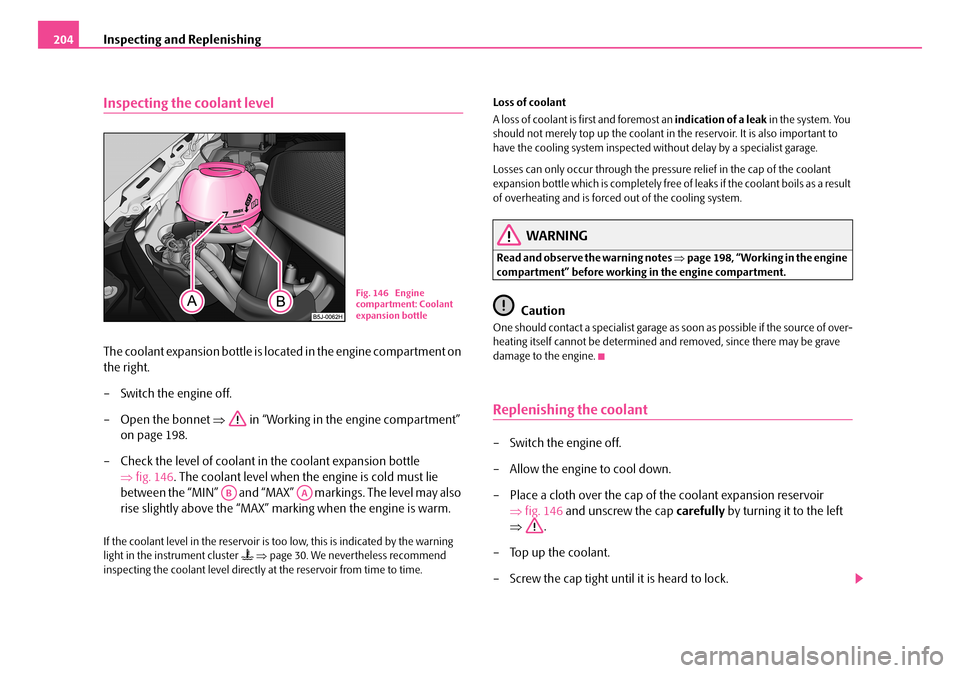
The coolant expansion bottle is located in the engine compartment on
the right.
– Switch the engine off.
– Open the bonnet ⇒ in “Working in the engine compartment”
on page 198.
– Check the level of coolant in the coolant expansion bottle
⇒ fig. 146. The coolant level when the engine is cold must lie
between the “MIN” and “MAX” markings. The level may also
rise slightly above the “MAX” ma rking when the engine is warm.
If the coolant level in the reservoir is too low, this is indicated by the warning light in the instrument cluster ⇒page 30. We nevertheless recommend inspecting the coolant level directly at the reservoir from time to time.
Loss of coolant
A loss of coolant is first and foremost an indication of a leak in the system. You should not merely top up the coolant in the reservoir. It is also important to have the cooling system inspected without delay by a specialist garage.
Losses can only occur through the pressure relief in the cap of the coolant expansion bottle which is completely free of leaks if the coolant boils as a result of overheating and is forced out of the cooling system.
WARNING
Read and observe the warning notes ⇒page 198, “Working in the engine compartment” before working in the engine compartment.
Caution
One should contact a specialist garage as soon as possible if the source of over- heating itself cannot be determined an d removed, since there may be grave damage to the engine.
Replenishing the coolant
– Switch the engine off.
– Allow the engine to cool down.
– Place a cloth over the cap of the coolant expansion reservoir
⇒ fig. 146 and unscrew the cap carefully by turning it to the left
⇒ .
– Top up the coolant.
– Screw the cap tight until it is heard to lock.
Fig. 146 Engine compartment: Coolant expansion bottle
ABAA
NKO A05Fabia 20.book Page 204 Tuesday, September 26, 2006 8:38 AM
Page 207 of 258

Inspecting and Replenishing206
Brake fluid
Inspecting the brake fluid level
The brake fluid reservoir is located on the left of the engine compart-
ment. The brake fluid reservoir on right-hand steering models is posi-
tioned on the other side of the engine compartment.
– Switch the engine off.
– Open the bonnet ⇒ in “Working in the engine compartment”
on page 198.
– Inspect the brake fluid level in the reservoir ⇒fig. 147. The level
must be between the “MIN” and “MAX” markings.
A slight drop in the fluid level results when driving due to normal wear-and-tear and automatic adjustment of the br ake pads, and is perfectly normal.
There may be an indication of a leak in the brake system, however, if the fluid level drops significantly within a short time or if it drops below the “MIN” marking. A situation where the brake flui d level is too low is indicated by the warning light lighting up in th e instrument cluster ⇒page 34. In this case stop the car immediately and do not drive any further! Contact a Škoda Dealer to obtain professional assistance.
WARNING
•Read and observe the warning notes ⇒page 198, “Working in the engine compartment” before work ing in the engine compartment.
•If the fluid level has dropped below the MIN marking, do not drive any further - risk of accident! Contact a Škoda dealer to obtain profes- sional assistance.
Replacing brake fluid
Brake fluid absorbs moisture. This causes the fluid to absorb moisture from the surrounding air over a period of time. Excessive water in the brake fluid may be the cause of corrosion in the brake syst em. The water content also lowers the boiling point of the brake fluid. This is why brake fluid must be replaced every two years.
One may only use new genuine brake fluid from Škoda Auto a.s. The specifica- tion for the brake fluid is “FMVSS 116 DOT 4”.
We recommend that you have th e brake fluid replaced by a Škoda Service Par tner as part of an Inspection Service.
Fig. 147 Engine compartment: Brake fluid reservoir
NKO A05Fabia 20.book Page 206 Tuesday, September 26, 2006 8:38 AM
Page 225 of 258

Breakdown assistance224
–Engage 1st gear or if your vehicle is fitted with an automatic
gearbox, position the selector lever into position P.
– If a trailer is coupled, uncouple it.
– Take the vehicle tool kit and the spare wheel ⇒page 222 out of
the luggage compartment.
WARNING
•If you find yourself in flowing traffic switch on the hazard warning lights system and place the warning tria ngle on the side of the road at the prescribed distance from your vehicl e while observing all national legal provisions. In this way you are protecting not only yourself but also other road users.
•Never start the engine with the vehi cle sitting on the raised jack - danger of suffering injury!
Caution
If you have to change a wheel on a slope first block the opposite wheel with a stone or similar object in order to secure the vehicle from unexpectedly rolling away.
Note
Comply with the national legal regulations.
Changing a wheel
Always change a wheel on a level surface as far as possible.
– Take off the full wheel trim* ⇒page 225 or the caps ⇒page 226.
– In the case of light alloy wheels remove the wheel trim cap
⇒ page 226.
– Slacken the wheel bolts ⇒page 227.
– Jack up the vehicle until the wheel to be changed is clear of the
ground ⇒page 227.
– Unscrew the wheel bolts and place them on a clean surface (cloth,
paper etc.).
– Take off the wheel.
– Fit on the spare wheel and tighten the wheel bolts slightly.
– Lower the car.
– Tighten the wheel bolts firmly, alternately and diagonally using the
wheel wrench ⇒page 227.
– Mount the full wheel trim/wh eel trim cap or the caps.
Note
•All bolts must be clean and must turn easily.
•You must never grease or oil the wheel bolts!
•When fitting on unidirectional tyres, ensure that the tyres rotate in the correct direction ⇒page 213.
Subsequent steps
After changing the wheel, you must perform the following steps.
NKO A05Fabia 20.book Page 224 Tuesday, September 26, 2006 8:38 AM
Page 232 of 258
Breakdown assistance231
Using the systemSafetyDriving TipsGeneral MaintenanceBreakdown assistanceTechnical Data
•Do not bend over the batteries - risk of caustic burns!
•The vent screws of the battery cells must be tightened firmly.
•Keep any sources of ignition (naked flame, smouldering cigarettes etc.) away from the battery - risk of an explosion!
Tow-starting and towing vehicle
General
Please pay attention to the following instructions if you are going to
use a tow rope:
Driver of the towing vehicle
– Do not drive off until the tow rope is taught.
– Release the clutch particularly gently when starting off.
Driver of the towed vehicle
– Switch the ignition on so that th e steering wheel is not blocked and
you can also operate the turn signal lights, the headlight flasher,
the windscreen wipers and windscreen washer system.
– Take the vehicle out of gear or move the selector lever into position
N if your vehicle is fitted with an automatic gearbox.
– Note that the brake servo unit and power steering only operate if
the engine is running. You will requ ire significantly greater physical
force to depress the brake pedal and to steer the vehicle if the
engine is not running.
– Ensure that the tow rope is always kept taught.
Tow rope or tow bar
A tow bar is safest way of towing a vehicle and also minimizes any shocks. You can use a tow rope only if a suitable tow bar is not available.
The tow rope must be elastic to protect the vehicle. Thus one should only use plastic fibre rope or a rope made out of a similarly elastic material.
Attach the tow rope or the tow bar only to the towing eyes provided for this purpose ⇒page 232, “Front towing eye” and ⇒page 233, “Rear towing eye”.
Driving style
Towing another vehicle requires a cert ain amount of practice. Both drivers should be familiar with the particular points about towing a vehicle. Unskilled drivers should not attempt to tow in another vehicle or to be towed in.
One should be constantly vigilant not to allow impermissibly high towing forces or jerky loadings. There is always a risk of excessive stresses and damage resulting at the points to which you a ttach the tow rope or tow bar when you attempt to tow a vehicle which is not standing on a paved road.
Caution
If the gearbox of yo ur vehicle no longer contains any oil because of a defect, your vehicle must only be towed in with the driven wheels raised clear of the ground, or on a special vehicle transporter or trailer.
WARNING (continued)
NKO A05Fabia 20.book Page 231 Tuesday, September 26, 2006 8:38 AM
Page 235 of 258

Breakdown assistance234
•The maximum towing speed is 50 km/h.
•The maximum permissible towing distance is 50 km. The gear oil pump does not operate when the engine is not running; the gearbox would not be adequately lubricated at higher spee ds and over longer towing distance.
Caution
If the vehicle is towed in by a recovery vehicle, it should only be towed in with the front wheels raised. If the vehicle is raised at rear, the automatic gearbox is damaged!
Note
The vehicle must be transported on a special vehicle or trailer if it is not possible to tow in the vehicle in the way described or if the towing distance is greater than 50 km.
NKO A05Fabia 20.book Page 234 Tuesday, September 26, 2006 8:38 AM
Page 250 of 258

Index249
Index
A
Abroad . . . . . . . . . . . . . . . . . . . . . . . . . . . . . . . . . . . . . 179
ABS . . . . . . . . . . . . . . . . . . . . . . . . . . . . . . . . . . . . . . . . . 169
Warning light . . . . . . . . . . . . . . . . . . . . . . . . . . . . . 34
Accessories . . . . . . . . . . . . . . . . . . . . . . . . . . . . . . . . . 220
Adjusting seats . . . . . . . . . . . . . . . . . . . . . . . . . . . 70, 135
Adjusting the steering wheel . . . . . . . . . . . . . . . . . . 103
Air conditioning system . . . . . . . . . . . . . . . . . . . . . . . 94
Air outlet vents . . . . . . . . . . . . . . . . . . . . . . . . . . . . . . . 97
Airbag . . . . . . . . . . . . . . . . . . . . . . . . . . . . . . . . . . . . . . 144
Deployment . . . . . . . . . . . . . . . . . . . . . . . . . . . . . 145
Front airbag . . . . . . . . . . . . . . . . . . . . . . . . . . . . . 146
Head airbag . . . . . . . . . . . . . . . . . . . . . . . . . . . . . 150
Side airbag . . . . . . . . . . . . . . . . . . . . . . . . . . . . . . 148
Warning light . . . . . . . . . . . . . . . . . . . . . . . . . . . . . 35
Airbag system . . . . . . . . . . . . . . . . . . . . . . . . . . . . . . . 144
Warning light . . . . . . . . . . . . . . . . . . . . . . . . . . . . . 35
Alarm . . . . . . . . . . . . . . . . . . . . . . . . . . . . . . . . . . . . . . . . 48
Alternator
Warning light . . . . . . . . . . . . . . . . . . . . . . . . . . . . . 28
Antilock brake system . . . . . . . . . . . . . . . . . . . . . . . . 169
Antilock brake system - ABS
Warning light . . . . . . . . . . . . . . . . . . . . . . . . . . . . . 34
Anti-theft alarm system . . . . . . . . . . . . . . . . . . . . . . . 48
Ashtray . . . . . . . . . . . . . . . . . . . . . . . . . . . . . . . . . . . . . . 82
Auto Check Control . . . . . . . . . . . . . . . . . . . . . . . . . . . 23
Auto Computer . . . . . . . . . . . . . . . . . . . . . . . . . . . . . . . 17
Automatic gearbox . . . . . . . . . . . . . . . . . . . . . . . . . . 112
Emergency programme . . . . . . . . . . . . . . . . . . 116
Kickdown . . . . . . . . . . . . . . . . . . . . . . . . . . . . . . . 115
Tiptronic . . . . . . . . . . . . . . . . . . . . . . . . . . . . . . . . 116
Automatic vehicle wash systems . . . . . . . . . . . . . . 186
Automatic wiper/washer system . . . . . . . . . . . . . . . 64
Avoiding damage to your vehicle . . . . . . . . . . . . . 180
B
B rake booster . . . . . . . . . . . . . . . . . . . . . . . . . . . . . . 169
Battery . . . . . . . . . . . . . . . . . . . . . . . . . . . . . . . . . . 28, 207
change . . . . . . . . . . . . . . . . . . . . . . . . . . . . . . . . . . 211
Charge . . . . . . . . . . . . . . . . . . . . . . . . . . . . . . . . . . 210
Inspecting the electrolyte level . . . . . . . . . . . . 209
Operation in winter . . . . . . . . . . . . . . . . . . . . . . 209
Before setting off . . . . . . . . . . . . . . . . . . . . . . . . . . . . 134
Belt tensioner . . . . . . . . . . . . . . . . . . . . . . . . . . . . . . . 143
Belt tensioners . . . . . . . . . . . . . . . . . . . . . . . . . . . . . . 143
Belts . . . . . . . . . . . . . . . . . . . . . . . . . . . . . . . . . . . . . . . . 138
Biodiesel . . . . . . . . . . . . . . . . . . . . . . . . . . . . . . . . . . . . 193
Bluetooth™ . . . . . . . . . . . . . . . . . . . . . . . . . . . . . . . . . 128
Bonnet . . . . . . . . . . . . . . . . . . . . . . . . . . . . . . . . . . . . . 197
Brake
Handbrake . . . . . . . . . . . . . . . . . . . . . . . . . . . . . . 107
Brake booster . . . . . . . . . . . . . . . . . . . . . . . . . . . . . . . 169
Brake fluid . . . . . . . . . . . . . . . . . . . . . . . . . . . . . . . . . . 206
Brake pads
Warning light . . . . . . . . . . . . . . . . . . . . . . . . . . . . . 32
Brake system
Warning light . . . . . . . . . . . . . . . . . . . . . . . . . . . . . 34
Brakes . . . . . . . . . . . . . . . . . . . . . . . . . . . . . . . . . . . . . . 168
Bulbs . . . . . . . . . . . . . . . . . . . . . . . . . . . . . . . . . . . . . . . 239
Button on the driver's door
Central locking system . . . . . . . . . . . . . . . . . . . . 44
C
Car jack . . . . . . . . . . . . . . . . . . . . . . . . . . . . . . . . . . . . . 222
Car state . . . . . . . . . . . . . . . . . . . . . . . . . . . . . . . . . . . . . 23
Catalytic converter . . . . . . . . . . . . . . . . . . . . . . . . . . 174
CD changer . . . . . . . . . . . . . . . . . . . . . . . . . . . . . . . . . 131
Central locking system . . . . . . . . . . . . . . . . . . . . . . . . 41
lock . . . . . . . . . . . . . . . . . . . . . . . . . . . . . . . . . . . . . . 43
unlock . . . . . . . . . . . . . . . . . . . . . . . . . . . . . . . . . . . 43
Changing a wheel . . . . . . . . . . . . . . . . . . . . . . . . . . . 223
Changing the engine oil . . . . . . . . . . . . . . . . . . . . . . 202
Changing wheels around . . . . . . . . . . . . . . . . . . . . . 215
Charging the battery . . . . . . . . . . . . . . . . . . . . . . . . . 210
Warning light . . . . . . . . . . . . . . . . . . . . . . . . . . . . . 28
Check engine oil level . . . . . . . . . . . . . . . . . . . . . . . . 201
Child safety . . . . . . . . . . . . . . . . . . . . . . . . . . . . . . . . . 155
Side airbag . . . . . . . . . . . . . . . . . . . . . . . . . . . . . . 158
Child safety lock . . . . . . . . . . . . . . . . . . . . . . . . . . . . . . 41
NKO A05Fabia 20.book Page 249 Tuesday, September 26, 2006 8:38 AM