2006 SKODA FABIA open bonnet
[x] Cancel search: open bonnetPage 50 of 258

Unlocking and locking49
Using the systemSafetyDriving TipsGeneral MaintenanceBreakdown assistanceTechnical Data
How is the alarm system switched on?
The anti-theft alarm system is activated automatically when the vehicle is locked with the key on the closed driver's door or by using the remote control. It is activated 30 seconds after closing the door.
How is the alarm sy stem switched off?
The anti-theft alarm system is switched off if the vehicle is unlocked by only using the remote control. The vehicle is automatically locked again if the vehicle is not opened within 30 seconds after reactivating the anti-theft alarm system.
Once you unlock the vehicle by inserting the key into the driver door you then have to insert the key into the ignition lock and switch the ignition on within 15 seconds after unlocking the door in order to deactivate the anti-theft alarm system. The alarm will be triggered if you do not switch on the ignition within 15 seconds.
When is the alarm triggered?
The following security areas of the locked vehicle are monitored:
•Bonnet,
•Tailgate,
•Doors,
•Ignition lock,
•Vehicle interior* ⇒page 49,
•Angle of the vehicle*,
•A drop in voltage of the on-board power supply.
An alarm is immediately triggered if either of the two battery terminals is disconnected while the anti-theft alarm system is activated.
How is the alarm switched off?
You switch the alarm off if you unlock th e car with the radio remote control in the key or if you switch the ignition on.
Note
•The working life of the alarm siren is 5 years. More detailed information is available from your Škoda Service Partner.
•Before leaving the car, check that all the doors, windows and the electric sliding/tilting roof* are properly closed in order to ensure that the anti-theft alarm system is fully operational.
•Coding of the radio remote control and the receptor part precludes the use of the radio remote control from other vehicles.
Interior monitor* and Towing
protection*
The interior monitor and the to wing protection detect move-
ments inside the vehicle interi or and then trigger the alarm.
Fig. 28 Interior monitor pushbutton
NKO A05Fabia 20.book Page 49 Tuesday, September 26, 2006 8:38 AM
Page 115 of 258

Automatic gearbox114
When the ignition is switched on and the selector lever is in position R, the reverse lights will come on.
N - Neutral
The transmission is in Neutral in this position.
The brake pedal must be depressed (if the lever is in its position for longer than 2 seconds) in order to move the se lector lever out of the position N into the position D, with the ignition switched on, on a vehicle travelling at less than 5 km/hour or on a stationary vehicle.
The brake pedal must be depressed (if the lever is in its position for longer than 2 seconds) in order to move the se lector lever out of the position N into the position R, with the ignition switched on, on a vehicle travelling at less than 5 km/hour or on a stationary vehicle.
D - Drive, position for driving forward
When the selector lever is in this position, the forward gears are shifted up and down automatically in line with engi ne load, vehicle speed and the dynamic shift programme.
You must depress the brake pedal ⇒ if you wish to move the selector lever into position D from N when the vehicle is travelling at less than 5 km/hour or is stationary.
In certain circumstances (e.g. when driving in mountainous regions or when towing a trailer) it may be beneficial to select the manual shift programme ⇒ page 116 for a short time in order to adapt the gearbox ratios manually to the driving situations.
S - Position for sporty style of driving
Shifting up later into a higher gear make s it possible to fully exploit the power potential of the engine. The gearbox also then shifts down at higher engine speeds as in the position D.
The gearbox does not shift into the 6th gear in the position S, because the maximum speed is achieved with the 5th gear.
The Shiftlock on the selector lever grip must be pressed when moving the selector lever out of the position D into the position S.
WARNING
•Never move the selector lever into position R or P when driving - risk of an accident!
•When the engine is running and the vehicle is stationary, it is neces- sary to hold the car with the brak e pedal in all the positions of the selector lever (except P and N) since the power transmission is never completely interrupted, also not when the engine is idling - the vehicle "creeps".
•You must on no account unintentionally operate the throttle (e.g. by hand from the engine compartment) if a drive position is engaged when the car is stationary. The vehicle wo uld otherwise immediately start off - also when the handbrake is firmly applied - risk of an accident!
•You must move the selector lever into position P and firmly apply the handbrake first before you or any other person opens the bonnet and starts working on the engine when it is running - risk of accident! It is also essential to observe all warnings ⇒page 198, “Working in the engine compartment”.
Selector lever lock
Automatic selector lever lock
With the ignition on, the selector lever is locked when it is in the positions P and N . You must first of all depress the brake pedal in order to move the selector lever out of this position. The warning light ⇒page 33 lights up in the instru- ment cluster as a reminder for the driver when the selector lever is in position P and N:
A time delay element ensures that the selector lever is not blocked when rapidly switching over the position N (e.g. from R to D). This does, for example, allow
NKO A05Fabia 20.book Page 114 Tuesday, September 26, 2006 8:38 AM
Page 190 of 258

Taking care of your vehicle and cleaning the vehicle189
Using the systemSafetyDriving TipsGeneral MaintenanceBreakdown assistanceTechnical Data
The headlight lenses
Please do not use any aggressive cleaning or chemical solvent products - risk of damage to the plastic lenses Please use soap and clean warm water.
Caution
Never wipe the headlights dry and do not use any sharp objects for cleaning the plastic lenses, this may result in da mage to the protective paintwork and consequently in formation of cracks on the headlight lenses, e.g through effect of chemical products.
Door and window seals
The rubber seals on the doors, boot lid, bonnet and windows remain supple and last longer if you trea t them from time to time with a rubber care product (e.g. with a silicone-free oil in the spray). You also avoid premature wear of the seals and prevent leakages in this way. It is also easier to open the doors. Rubber seals which are well cared for also do not stick together in cold winter weather.
Locks
We recommend that you use the spray fr om Škoda original accessories with regreasing and anticorrosive effect for de-icing locks.
Note
When washing your vehicle, ensure that as little water as possible gets into the locks.
Wheels
Steel wheels
You should also thoroughly wash the wheels and wheel trims when giving your vehicle its regular wash. This prevents an y brake dust, dirt and road salt from sticking to the wheel hubs. You can remo ve stubborn brake abrasion adhering to the wheels with an industrial cleane r. Touch up any damage to the paintwork on the wheels before rust is able to form.
Light alloy wheels
Regular care of light alloy wheels is necessary in order to retain their decorative appearance over long periods. It is particularly important to remove any road salt and brake abrasion from light alloy wheels every two weeks, otherwise the surface will suffer. Wash thoroughly and th en treat the wheels with a protective product for light alloy wheels which does not contain any acidic components. You should provide the wheel hubs with a hard wax layer every three months. You must not use any products which ca use abrasion when treating the wheel hubs. Any damage to the paint layer on the wheel hubs must be touched up immediately.
We recommend using a preservative fr om Škoda genuine accessories offered by your Škoda dealer.
WARNING
One should remember when cleaning the wheels that moisture, ice and road salt may adversely affect brakin g efficiency - risk of an accident!
Note
Severe layers of dirt on the wheels can also result in wheel imbalance. This may show itself in the form of a wheel vibrat ion which is transmitted to the steering wheel which, in certain circumstance s, can cause premature wear of the steering. This means it is necessary to remove the dirt.
NKO A05Fabia 20.book Page 189 Tuesday, September 26, 2006 8:38 AM
Page 198 of 258

Inspecting and Replenishing197
Using the systemSafetyDriving TipsGeneral MaintenanceBreakdown assistanceTechnical Data
Inspecting and Replenishing
Engine compartment
Bonnet remote release
Bonnet remote release
– Pull the unlocking lever on the left below the dash panel
⇒ fig. 141.
The bonnet jumps out of its lock as a result of the spring force.
Opening and closing the bonnet.
Fig. 141 Bonnet release lever
Fig. 142 Radiator grille: Fuse
Fig. 143 Securing the bonnet with the bonnet support
NKO A05Fabia 20.book Page 197 Tuesday, September 26, 2006 8:38 AM
Page 199 of 258

Inspecting and Replenishing198
Opening the bonnet
– Unlock the bonnet ⇒page 197, fig. 141.
– Ensure that the arms of the windscreen wipers are correctly in
place against the windscreen before opening the bonnet other-
wise damage could occur to the paintwork.
– Press the locking button ⇒page 197, fig. 142, the bonnet unlocks
itself.
– Grip the bonnet and lift it up.
– Take the bonnet support out of its holder and set it in the opening
designed for it ⇒page 197, fig. 143.
Closing the bonnet
– Lift the bonnet slightly and unhook the bonnet support. Press the
bonnet support into the holder designed to hold it.
– Allow the bonnet to drop from a height of about 30 cm into the lock
- bonnet do not press down on it!
WARNING
•Never open the bonnet if you see that steam or coolant is flowing out of the engine compartment - risk of scalding! Wait long enough until the steam or coolant has stopped escaping.
•For safety reasons, the bonnet must always be properly closed when driving. One should therefore check that the lock has in fact engaged properly after closing the bonnet.
•Stop your vehicle immediately whil e driving if you notice that the lock is not properly engaged and close the bonnet properly - risk of an accident!
Caution
•Before opening the bonnet, ensure that the arms of the windscreen wipers are correctly in place against the windscreen. Otherwise, there is a risk of damage to the paintwork.
Working in the engine compartment
Particular care is required when carrying out any work in the
engine compartment!
There is a risk of injuries, scalding, accidents and fire when working in the engine compartment, e.g. inspecting and replenishing oil and other fluids. For this reason, it is essential to comply with the warning instructions stated below and with the general appl icable rules of safety. The engine compartment of your car is a hazardous area ⇒.
WARNING
•Never open the bonnet if you see that steam or coolant is flowing out of the engine compartment - risk of scalding! Wait long enough until the steam or coolant has stopped escaping.
•Switch off the engine and pull out the ignition key.
•Apply the handbrake firmly.
•If your vehicle is fitted with a manual gearbox, move the gearshift lever into Neutral, or if it is fitted with automatic gearbox, move the selector lever into position P.
•Allow the engine to cool down.
•Keep children clear of the engine compartment.
•Do not touch any hot engine parts - risk of burns!
NKO A05Fabia 20.book Page 198 Tuesday, September 26, 2006 8:38 AM
Page 202 of 258

Inspecting and Replenishing201
Using the systemSafetyDriving TipsGeneral MaintenanceBreakdown assistanceTechnical Data
Note
•Before a long drive we recommend that you purchase and carry with you engine oil which complies with the specif ication for your vehicle. Consequently, you will always have the correct engine oil for refilling.
•We recommend using a preservative fr om the Škoda original accessories offered by your Škoda dealer.
•For further information - see Service shedule.
Check engine oil level
The dipstick indicates the level of oil in the engine.
Checking the oil level
– Park the vehicle on a horizontal surface.
– Switch the engine off.
– Open the bonnet ⇒ in “Working in the engine compartment”
on page 198.
– Wait a few minutes and pull out the oil dipstick ⇒.
– Wipe off the dipstick with a clean cloth and insert it again fully.
– Then withdraw the dipstick again and read off the oil level.
Oil level within range
– You must not top up the oil.
Oil level within range
– You may top up the oil. It is possible that the oil level may then be
within range after doing this.
Oil level within range
– You must top up the oil. It is sufficient, once this is done, to keep
the oil level is within range .
It is normal for the engine to consume oil. The oil consumption may be as much as 0.5 l/1 000 km depending on your style of driving and the conditions under which you operate your vehicle. The oi l consumption may be slightly higher than this during the first 5 000 kilometres.
One should therefore check the oil level at regular intervals, preferably every time after the fuel tank is filled or after driving for long stretches.
We recommend maintaining the oil level within the range if the engine has been operating at high loads, for ex ample during a lengthy motorway trip during the summer months, towing a tr ailer or negotiating a high mountain pass, but not above this.
Fig. 145 Dipstick
Aa
Ab
Aa
Ac
Ab
Ab
NKO A05Fabia 20.book Page 201 Tuesday, September 26, 2006 8:38 AM
Page 205 of 258
Inspecting and Replenishing204
Inspecting the coolant level
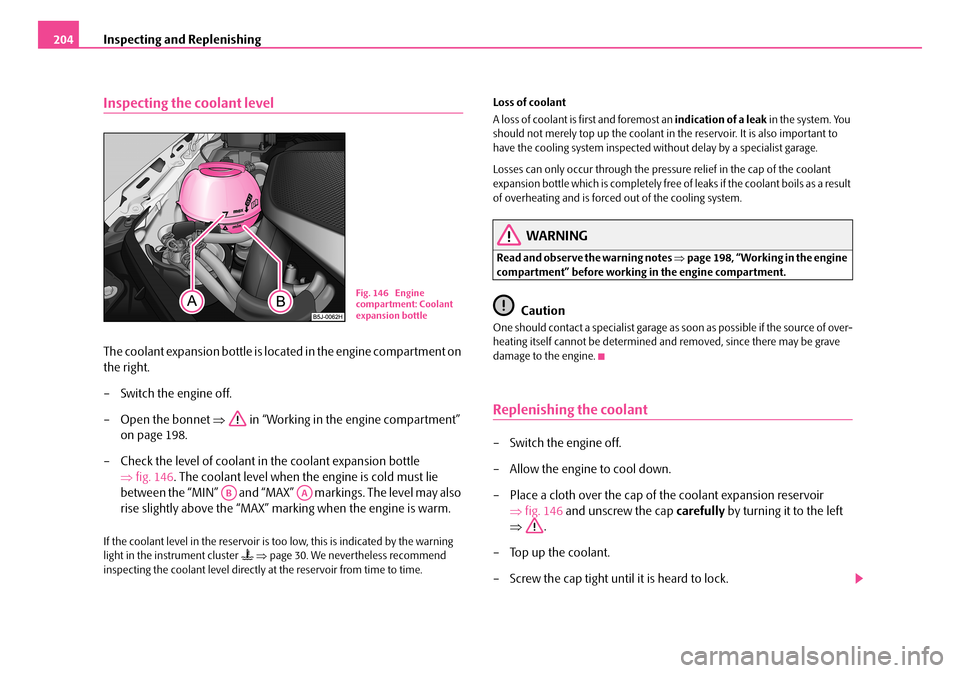
The coolant expansion bottle is located in the engine compartment on
the right.
– Switch the engine off.
– Open the bonnet ⇒ in “Working in the engine compartment”
on page 198.
– Check the level of coolant in the coolant expansion bottle
⇒ fig. 146. The coolant level when the engine is cold must lie
between the “MIN” and “MAX” markings. The level may also
rise slightly above the “MAX” ma rking when the engine is warm.
If the coolant level in the reservoir is too low, this is indicated by the warning light in the instrument cluster ⇒page 30. We nevertheless recommend inspecting the coolant level directly at the reservoir from time to time.
Loss of coolant
A loss of coolant is first and foremost an indication of a leak in the system. You should not merely top up the coolant in the reservoir. It is also important to have the cooling system inspected without delay by a specialist garage.
Losses can only occur through the pressure relief in the cap of the coolant expansion bottle which is completely free of leaks if the coolant boils as a result of overheating and is forced out of the cooling system.
WARNING
Read and observe the warning notes ⇒page 198, “Working in the engine compartment” before working in the engine compartment.
Caution
One should contact a specialist garage as soon as possible if the source of over- heating itself cannot be determined an d removed, since there may be grave damage to the engine.
Replenishing the coolant
– Switch the engine off.
– Allow the engine to cool down.
– Place a cloth over the cap of the coolant expansion reservoir
⇒ fig. 146 and unscrew the cap carefully by turning it to the left
⇒ .
– Top up the coolant.
– Screw the cap tight until it is heard to lock.
Fig. 146 Engine compartment: Coolant expansion bottle
ABAA
NKO A05Fabia 20.book Page 204 Tuesday, September 26, 2006 8:38 AM
Page 207 of 258

Inspecting and Replenishing206
Brake fluid
Inspecting the brake fluid level
The brake fluid reservoir is located on the left of the engine compart-
ment. The brake fluid reservoir on right-hand steering models is posi-
tioned on the other side of the engine compartment.
– Switch the engine off.
– Open the bonnet ⇒ in “Working in the engine compartment”
on page 198.
– Inspect the brake fluid level in the reservoir ⇒fig. 147. The level
must be between the “MIN” and “MAX” markings.
A slight drop in the fluid level results when driving due to normal wear-and-tear and automatic adjustment of the br ake pads, and is perfectly normal.
There may be an indication of a leak in the brake system, however, if the fluid level drops significantly within a short time or if it drops below the “MIN” marking. A situation where the brake flui d level is too low is indicated by the warning light lighting up in th e instrument cluster ⇒page 34. In this case stop the car immediately and do not drive any further! Contact a Škoda Dealer to obtain professional assistance.
WARNING
•Read and observe the warning notes ⇒page 198, “Working in the engine compartment” before work ing in the engine compartment.
•If the fluid level has dropped below the MIN marking, do not drive any further - risk of accident! Contact a Škoda dealer to obtain profes- sional assistance.
Replacing brake fluid
Brake fluid absorbs moisture. This causes the fluid to absorb moisture from the surrounding air over a period of time. Excessive water in the brake fluid may be the cause of corrosion in the brake syst em. The water content also lowers the boiling point of the brake fluid. This is why brake fluid must be replaced every two years.
One may only use new genuine brake fluid from Škoda Auto a.s. The specifica- tion for the brake fluid is “FMVSS 116 DOT 4”.
We recommend that you have th e brake fluid replaced by a Škoda Service Par tner as part of an Inspection Service.
Fig. 147 Engine compartment: Brake fluid reservoir
NKO A05Fabia 20.book Page 206 Tuesday, September 26, 2006 8:38 AM