2006 Seat Cordoba heating
[x] Cancel search: heatingPage 100 of 255

Lights and visibility
98
– Place the control in position L or R once the mirrors have demisted to prevent unnecessary use of the battery.
Folding in exterior mirrors*
– Turn the control ⇒ page 97, fig. 67 to position
to fold in the
exterior mirrors. You should always fold in the exterior mirrors if
you are driving through an automa tic car wash. This will help
prevent damage.
Folding exterior mirrors back out to the extended position*
– Turn the knob to position L or R to fold the exterior mirrors back out ⇒ .
S y
nchronised wing mirror adjustment*
1. Turn the control to the position L ( left exterior mirror ).
2. Turn the rotary knob to position the mirror so that you have a good view to the rear of the vehicle. The right wing mirror will be
adjusted at the same time (synchronised).
WARNING
•
The rear view convex or aspheric mirror increase the field of vision
however the objects in the mirror appear smaller and further away . If you
use these mirrors to estimate the distance to vehicles behind you when
changing lane, you could make a mistake. Risk of accident.
•
If possible, use the interior mirror to estimate distances to vehicles
behind you.
•
Make sure that you do not get your finger trapped between the mirror
and the mirror base when folding back the mirrors. Risk of injury!
For the sake of the environment
The exterior mirror heating should be switched off when it is no longer
needed. Fuel is wasted otherwise.
Note
•
If the electrical adjustment ever fails to operate, the mirrors can be
adjusted by hand by lightly pressing the edge of the mirror glass.
•
The following guideline applies to vehicles with electric wing mirrors: If
the mirror housing is moved as a result of exterior force (e.g. knocked when
parking the vehicle), the mi rrors must be folded in electrically to the final
position. Do not readjust the mirror h ousing by hand, as this will interfere
with the mirror adjuster function.
•
The rear view mirrors can be adjusted separately or simultaneously, as
described before.
cordoba_ingles Seite 98 Freitag, 7. Oktober 2005 6:00 18
Page 105 of 255

Seats and stowage103
Safety First
Operating instructions
Tips and Maintenance
Te c h n i c a l D a t a
WARNING
•
Never adjust the driver or front pass enger seat while the vehicle is in
motion. While adjusting your seat, you will assume an incorrect sitting
position. Risk of fatal accidents. Adjust the driver or front passenger seat
only when the vehicle is stationary.
•
To reduce the risk of injury to the driver and front passenger during
sudden braking manoeuvres or an accident, never drive with the backrest
tilted far to the rear. The maximum pr otection of the seat belt can be
achieved only when the backrests are in an upright position and the driver
and front passenger have properly adjusted their seat belts. The further
the backrests are tilted to the rear, the greater the risk of injury due to
improper positioning of the belt web!
•
Exercise caution when adjusting the seat height or forwards/back-
wards position. Injuries can be caused if the backrest is tilted without due
care and attention.
Heated seats*
The front seat cushions and backrests can be heated electri-
cally.
– Turn the appropriate thumb wheel ⇒ fig. 72 to switch on the seat
heating. The seat heating is switched off in the 0 position.The seat heating only works when the ignition is switched on. The left thumb
wheel controls the left seat and the right thumb wheel the right seat.
Caution
To avoid damaging the heating elements, please do not kneel on the seat or
apply sharp pressure at a single point to the seat cushion and backrest.
Fig. 72 Thumb wheel for
the front seat heating
cordoba_ingles Seite 103 Freitag, 7. Oktober 2005 6:00 18
Page 112 of 255
Seats and stowage
110
CautionHard objects on the shelf could chafe against the wires of the heating
element in the rear window and cause damage.
Note
The ventilation slots in front of the rear side windows must not be covered as
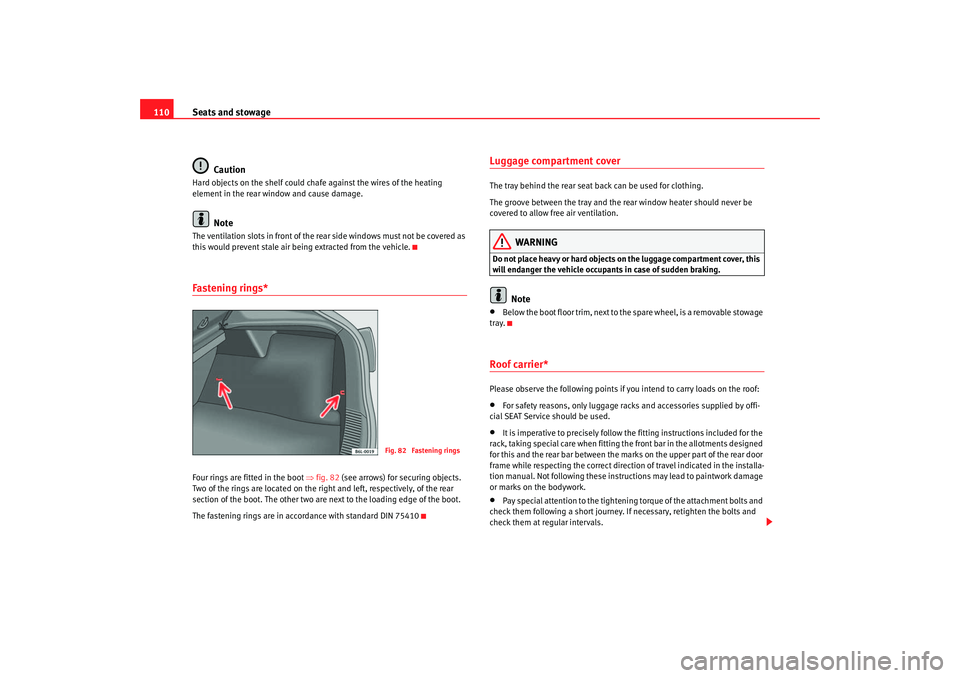
this would prevent stale air being extracted from the vehicle.Fastening rings*Four rings are fitted in the boot ⇒fig. 82 (see arrows) for securing objects.
Two of the rings are located on the right and left, respectively, of the rear
section of the boot. The other two are next to the loading edge of the boot.
The fastening rings are in accordance with standard DIN 75410
Luggage compartment coverThe tray behind the rear seat back can be used for clothing.
The groove between the tray and the re ar window heater should never be
covered to allow free air ventilation.
WARNING
Do not place heavy or hard objects on the luggage compartment cover, this
will endanger the vehicle occupants in case of sudden braking.
Note
•
Below the boot floor trim, next to the spare wheel, is a removable stowage
tray.
Roof carrier*Please observe the following points if you intend to carry loads on the roof:•
For safety reasons, only luggage racks and accessories supplied by offi-
cial SEAT Service should be used.
•
It is imperative to precisely follow the fitting instructions included for the
rack, taking special care when fitting th e front bar in the allotments designed
for this and the rear bar between the marks on the upper part of the rear door
frame while respecting the correct direction of travel indicated in the installa-
tion manual. Not following these instr uctions may lead to paintwork damage
or marks on the bodywork.
•
Pay special attention to the tightening torque of the attachment bolts and
check them following a short journey. If necessary, retighten the bolts and
check them at regular intervals.
Fig. 82 Fastening rings
cordoba_ingles Seite 110 Freitag, 7. Oktober 2005 6:00 18
Page 114 of 255

Air conditioning
112Air conditioningHeatingControls– Using the controls ⇒fig. 83 and and with the switch
you can set the temperature, air distribution and the blower
speed.
– Press the button to switch air recirculation mode on or off. A button is illuminated by a yellow lamp for as long as the function
is switched on.Temperature
Switch sets the temperature. The required temperature inside the vehicle
cannot be lower than the ambient temp erature. Maximum heat output, which is needed to defrost the windows quickly, is only available when the engine
has reached its operating temperature.
Blower
The air flow can be set at four speeds with switch . The blower should
always be set at the lowest speed when driving slowly.
Air distribution
Control for setting the flow of
air in the required direction.
– Air distribution towards the windsc reen. Air recirculation is, for safety
reasons, not possible in this position. – Air distribution to the upper body. – Air distribution to footwell – Air distribution to the windscreen and the footwell.
Air recirculation mode
Air recirculation on (button symbol lights up) prevents strong odours
in the outside air from entering the vehicle interior, for example when driving
through a tunnel or queuing in traffic ⇒.
When the outside temperature is low, us ing air recirculation mode provides
more effective heating by heating air from the vehicle interior instead of cold
air from outside.
WARNING
•
For your safety, the windows should never be fogged up or covered with
snow or ice. This is essential to ensure good visibility. Please familiarize
yourself with the correct operation of the heating and ventilation system,
including the demist/defrost functions for the windows.
Fig. 83 On the dash
panel: Heater controls
AA
AC
AB
AD
AA
AB
AC
AD
cordoba_ingles Seite 112 Freitag, 7. Oktober 2005 6:00 18
Page 115 of 255

Air conditioning113
Safety First
Operating instructions
Tips and Maintenance
Te c h n i c a l D a t a
•
In air recirculation mode, no air enters the vehicle interior from outside.
The windows can quickly fog over if the heating is switched off. Therefore,
you should never leave the air recirculation mode switched on for longer
periods, as this increases the risk of an accident.Note
•
Please observe the general notes ⇒page 120.
Vehicle ventilation or heatingVentilating the passenger compartment
– Turn the temperature selector ⇒ fig. 84 anti-clockwise.
– Turn blower switch to speed settings 1 -4. – Set the airflow to the desired direction using air distribution
control .
– Open the relevant air outlets.
Heating the interior
– Turn the temperature selector ⇒ fig. 84 clockwise to select
the required temperature.
– Turn blower switch to speed settings 1-4.
– Set the airflow to the desired direction using air distribution control .
– Open the relevant air outlets.
Defrosting the windscreen
– Turn the temperature selector ⇒ fig. 84 clockwise to the
maximum temperature.
– Turn the blower switch to setting 4.
– Set air distribution to
.
–Close outlet .
– Open and turn ou tlet towards side w indows.
De mi
sting the windscreen and the side windows
– Turn the temperature selector ⇒ fig. 84 to the heating zone.
– Turn blower swit ch to
speed settings 2-3.
– Set a
ir distribution to
.
WARNING (continued)
Fig. 84 On the dash
panel: Heater controls
A1
A7
AC
AA
A7
AC
AA
AB
A3
A4
AA
A7
cordoba_ingles Seite 113 Freitag, 7. Oktober 2005 6:00 18
Page 116 of 255

Air conditioning
114
–Close outlets 3 .
– Open and turn outlets towards side windowsWhen the windows are demisted and as a preventive measure, the switch
can be set in position
, thus obtaining geater comfort while preventing the
windows from misting again. Heating system
Maximum heat output, which is needed to defrost the windows quickly, is
only available when the engine has reached its operating temperature.
Note
Remember that the temperature of the engine coolant should be optimum to
ensure that the heating system functions correctly ( except in vehicles fitted
with additional heating*)
Air outlets
A3
A4
AC
Fig. 85 Air vent
cordoba_ingles Seite 114 Freitag, 7. Oktober 2005 6:00 18
Page 118 of 255

Air conditioning
116
Air distribution control ⇒page 116
Air recirculation button ⇒page 117
Button – Coolant on button ⇒page 116WARNING
For your safety, the windows should never be fogged up or covered with
snow or ice. This is essential to ensure good visibility. Please familiarize
yourself with the correct operation of the heating and ventilation system,
including the demist/defrost functions for the windows.
Note
Please observe the general notes .Vehicle interior heating or cooling system
Heating of the vehicle interior
– Disconnect the cooling system using button ⇒fig. 87 (the
button light goes off).
– Turn the temperature selector to set the desired temperature. We recommend 22°C .
– Turn the blower switch to one of the settings 1-4.
– Use the air distribution control to guide the flow of air in the required direction: (to the windscreen), (to the upper
body), (to the footwell) and (to the windscreen and to the
footwell).
Cooling the passenger compartment
– Connect the cooling system with button (the button light
should light up).
– Turn the temperature control switch until the desired interior temperature is obtained.
– Turn the blower switch to one of the settings 1-4.
– Use the air distribution control to guide the flow of air in the required direction: (to the windscreen), (to the upper
body), (to the footwell) and (to the windscreen and to the
footwell).Heating system
Maximum heat output, which is needed to defrost the windows quickly, is
only available when the engine has reached its operating temperature.
ACAD
AE
AC
Fig. 87 On the instru-
ment panel: air condi-
tioner controls
AC
AAAC
AC
cordoba_ingles Seite 116 Freitag, 7. Oktober 2005 6:00 18
Page 119 of 255

Air conditioning117
Safety First
Operating instructions
Tips and Maintenance
Te c h n i c a l D a t a
Cooling system
When the cooling system is switched on
, not only the temperature, but also
the air humidity in the vehicle interior is reduced. This improves comfort for
the vehicle occupants and prevents misting of the windows when the outside
air humidity is high.
If the cooling system cannot be switched on this may be due to the following
reasons:
•
the engine is not running.
•
The blower is switched off.
•
The outside temperature is lower than approx. +5°C.
•
the cooling system compressor has been temporarily switched off
because the engine coolant temperature is too high.
•
The air conditioner fuse is faulty.
•
Another fault in the vehicle. Have th e air conditioner checked by a quali-
fied workshop.
Air recirculation
Air recirculation mode prevents fumes or unpleasant smells
from entering the vehicle.When air recirculation mode is switched on (button ⇒page 116, fig. 87
with warning lamp) strong odours in the outside air do not enter the vehicle
interior, for example when passing thro ugh a tunnel or in queuing traffic.
When the outside temperature is low, using air recirculation mode provides
more effective heating by heating air from the vehicle interior instead of cold
air from outside.
When the outside temperature is high, using air recirculation mode provides
more effective cooling by cooling air fr om the vehicle interior instead of warm
air from outside. For reasons of safety, air recirculation is
not possible when the control for air
distribution is set to the windscreen setting
.
WARNING
In air recirculation mode, no air enters the vehicle interior from outside. If
the air conditioning system is switched off, the windows can quickly mist
over. Therefore, you should never leav e the air recirculation mode switched
on for longer periods, as this increases the risk of an accident.
Note
When reverse gear is engaged the air recirculation connects automatically to
prevent the entrance of exhaust fumes in the vehicle on travelling backwards.
The control light on the bu tton does not light up.Economic use of the air conditioningWhen the air conditioning is switched on, the compressor consumes engine
power and has an effect on fuel consumption. Observe the following points
in order to have the equipment operating for a short a time as possible.•
If the vehicle interior has overheated due to excessive solar radiation, it is
best to open the windows or doors to allow the hot air to escape.
•
When travelling the air conditioning should not be switched on if the
windows or sun roof are open.*
cordoba_ingles Seite 117 Freitag, 7. Oktober 2005 6:00 18