2006 Seat Alhambra maintenance
[x] Cancel search: maintenancePage 51 of 299

Child safety49
Safety FirstOperating instructionsTips and MaintenanceTe c h n i c a l D a t a
WARNING
•The shoulder part of the seat belt must lie approximately on the centre
of the shoulder, never across the neck or the arm. The seat belt must lie
close to the torso. The lap belt part must lie across the pelvis, not across
the stomach, and always fit closely. Pull the belt tight if necessary to take
up any slack Ÿpage 22, “Seat belts”.
•Read and always observe information and warnings concerning the use
of child seats Ÿpage 45.
Installation of child seats in vehicle seats
General notes
The correct fitting of child seats in the different seats is described below.
Child restraint systems that have been checked according to ECE-R 44 are
suitable for installation on the front passenger seat or on the rear seats.
Note
The passenger seat and the rear seats comply with directive 77/541 EEC for
the installation of child restraint systems .
Front passenger seat
Only the use of an officially approved child seat corre-
sponding to the weight and height of the child is permitted.
Universal seats for children in groups 0, 0+, 1, 2, or 3 (Ÿpage 52) Ÿ can
be fitted in the passenger seat.
To fit a child seat, position the seat in the upright position and move the
passenger seat as far back as possible. The seat must be in the highest posi-
tion
3) on vehicles with a height-adjustableŸ front passenger seat.
WARNING
•Never fit a child seat in the passenger seat, where the child faces back-
wards to the direction of travel and the frontal airbag has not been deacti-
vated. This is highly dangerous for the child. If it is necessary in excep-
tional cases to transport a child on the front passenger seat, you must
always disable the front and side passenger airbags Ÿpage 43
•Children must travel in a child seat appropriate to their weight and
height.
•The vehicle seat must always be fitted in the direction of travel when
securing child restraint systems in weight class 0 or 0+.
•Read and always observe information and warnings concerning the use
of child seats Ÿ in “Safety notes on using child seats” on page 45.
•Please always read and follow the information and warnings provided
by the child seat manufacturer.
3)Optional equipment
Page 53 of 299

Child safety51
Safety FirstOperating instructionsTips and MaintenanceTe c h n i c a l D a t a
ISOFIX child seat mounting system
ISOFIX child seats can be mounted in the second and third
row seats quickly, safely and easily.When removing or fitting the child seat, please be sure to follow the
manufacturer's instructions.
– Press the child seat onto the ISOFIX retaining rings Ÿfig. 33
(arrows) until the child seat can be heard to engage securely.
– Pull on both sides of the child seat to ensure that it is secure.
When a child seat is mounted in seats equipped with the “ISOFIX” system,
the backrest should be fitted in one of two positions Ÿfig. 34 or .
Two ISOFIX retaining rings are secured to the body behind the seats in the
second and third rows. The ISOFIX retaining rings are attached to the seat
frames.
Child seats with ISOFIX mountings are available from Authorised SEAT Service
Centres.
WARNING
•The retaining rings are designed only for use with ISOFIX child seats.
•Never secure retaining belts, objects or non-ISOFIX child seats to the
fastening rings. Risk of fatal accidents.
Fig. 33 Retaining rings
for ISOFIX child seats in
the frames of the outer
seats in the second row of
seats
Fig. 34 Backrest adjust-
ment when using ISOFIX
child seats
A1A2
Page 55 of 299
Child safety53
Safety FirstOperating instructionsTips and MaintenanceTe c h n i c a l D a t a
– Pull the loop in the direction of the arrow and push the seat
cushion down until it engages.
Fitting the slumber roll
– Remove the head restraint.
– Fit the head restraint onto the slumber roll
– Reinsert the head restraint and push down until it can be heard
to engage.
Removing the slumber roll
– Remove the head restraint.
– Pull the slumber roll off the head restraint.
– Reinsert the head restraint and push down until it can be heard
to engage.
For safety reasons, we recommend that the child seat for children in Group 1
is installed facing against the direction of travel.
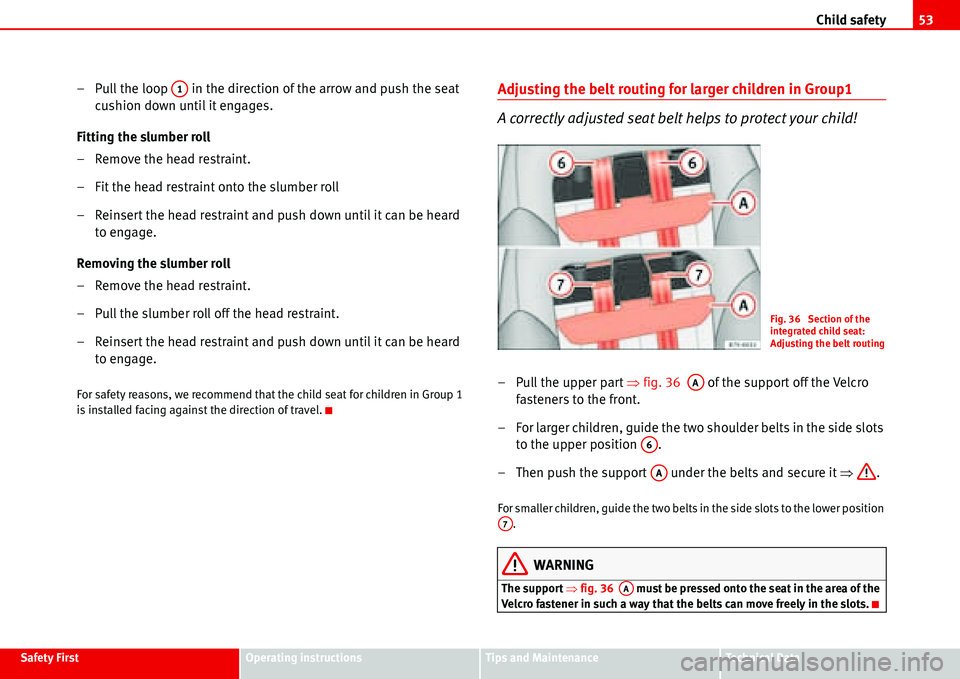
Adjusting the belt routing for larger children in Group1
A correctly adjusted seat belt helps to protect your child!
– Pull the upper part Ÿfig. 36 of the support off the Velcro
fasteners to the front.
– For larger children, guide the two shoulder belts in the side slots
to the upper position .
– Then push the support under the belts and secure it Ÿ.
For smaller children, guide the two belts in the side slots to the lower position
.
WARNING
The support Ÿfig. 36 must be pressed onto the seat in the area of the
Velcro fastener in such a way that the belts can move freely in the slots.
A1
Fig. 36 Section of the
integrated child seat:
Adjusting the belt routing
AA
A6
AA
A7
AA
Page 57 of 299
Child safety55
Safety FirstOperating instructionsTips and MaintenanceTe c h n i c a l D a t a
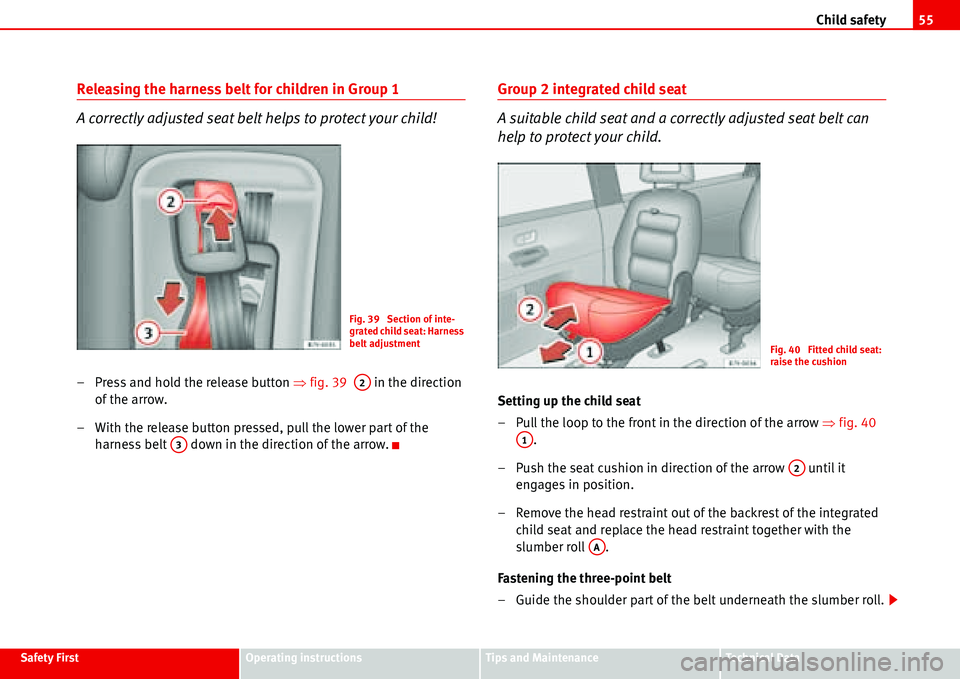
Releasing the harness belt for children in Group 1
A correctly adjusted seat belt helps to protect your child!
– Press and hold the release button Ÿfig. 39 in the direction
of the arrow.
– With the release button pressed, pull the lower part of the
harness belt down in the direction of the arrow.
Group 2 integrated child seat
A suitable child seat and a correctly adjusted seat belt can
help to protect your child.
Setting up the child seat
– Pull the loop to the front in the direction of the arrow Ÿfig. 40
.
– Push the seat cushion in direction of the arrow until it
engages in position.
– Remove the head restraint out of the backrest of the integrated
child seat and replace the head restraint together with the
slumber roll .
Fastening the three-point belt
– Guide the shoulder part of the belt underneath the slumber roll.
Fig. 39 Section of inte-
grated child seat: Harness
belt adjustment
A2
A3
Fig. 40 Fitted child seat:
raise the cushion
A1
A2
AA
Page 59 of 299
Child safety57
Safety FirstOperating instructionsTips and MaintenanceTe c h n i c a l D a t a
– Push the seat cushion in direction of the arrow until it
engages in position.
Fastening the three-point belt
– To fasten the three-point belt, take hold of the tongue and pull it
slowly across the chest and lap.
– Push the tongue of the belt into the lock for that seat so that it
engages audibly (pull to check!)
– Adjust the three-point belt to suit body size Ÿ.
Restoring the normal seat
– Pull the loop in the direction of the arrow and push the seat
cushion down until it engages.
Use the following measures to guarantee the proper routing of the shoulder
belt:
•Seatbelt height setting
•Adjustment of the seat forwards and backwards
•Backrest angle adjustment
WARNING
•For safety reasons, the seat for children in Group 3 may only be fitted in
the direction of travel and in one of the outer positions (not on the centre
seat).
•The risk of injury is increased if the belt is not correctly routed .
•The shoulder part of the belt should be positioned roughly over the
centre of the shoulder, never across the neck, and fit closely against the
upper part of the body.
•The lap belt part must lie across the pelvis, not across the stomach, and
always fit closely. Tighten the lap belt as necessary.
Cleaning the child seat
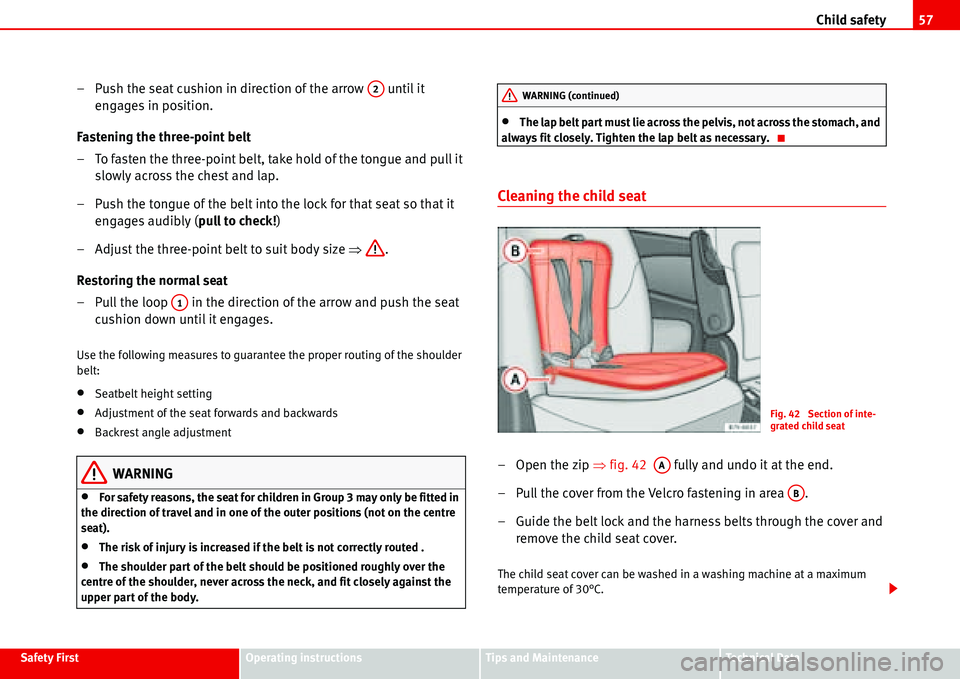
– Open the zip Ÿfig. 42 fully and undo it at the end.
– Pull the cover from the Velcro fastening in area .
– Guide the belt lock and the harness belts through the cover and
remove the child seat cover.
The child seat cover can be washed in a washing machine at a maximum
temperature of 30°C.
A2
A1
WARNING (continued)
Fig. 42 Section of inte-
grated child seat
AA
AB
Page 61 of 299
59
Safety FirstOperating instructionsTips and MaintenanceTe c h n i c a l D a t a
Page 63 of 299

Cockpit61
Safety FirstOperating instructionsTips and MaintenanceTe c h n i c a l D a t a
Operating instructions
Cockpit
Overview
Overview of the instrument panel
This overview will help you to familiarise yourself with the
controls and displays.
Door release lever . . . . . . . . . . . . . . . . . . . . . . . . . . . . . . . . . . .
Electric wing mirror adjustment control . . . . . . . . . . . . . . . . . . .
Electric window control . . . . . . . . . . . . . . . . . . . . . . . . . . . . . . . .
Light switch . . . . . . . . . . . . . . . . . . . . . . . . . . . . . . . . . . . . . . . . .
Instrument lighting control / Headlamp range control . . . . . . .
Air outlets
Main beam and turn signal light lever/ Cruise control* . . . . .
Instrument panel / warning lights . . . . . . . . . . . . . . . . . . . . . .
Horn / Driver's airbag* . . . . . . . . . . . . . . . . . . . . . . . . . . . . . . . .
Ignition lock . . . . . . . . . . . . . . . . . . . . . . . . . . . . . . . . . . . . . . . . .
Windscreen wiper lever . . . . . . . . . . . . . . . . . . . . . . . . . . . . . . . .
Switches for:
−rear window heater . . . . . . . . . . . . . . . . . . . . . . . . . . . . . . . . .
−windscreen heater* . . . . . . . . . . . . . . . . . . . . . . . . . . . . . . . .
−left seat heating* . . . . . . . . . . . . . . . . . . . . . . . . . . . . . . . . . .
−ESP* . . . . . . . . . . . . . . . . . . . . . . . . . . . . . . . . . . . . . . . . . . . . .
Climatronic . . . . . . . . . . . . . . . . . . . . . . . . . . . . . . . . . . . . . . . . .
RadioCup holder* . . . . . . . . . . . . . . . . . . . . . . . . . . . . . . . . . . . . . . . . .
Central upper stowage compartment . . . . . . . . . . . . . . . . . . . .
Switches for:
−hazard warning light switch . . . . . . . . . . . . . . . . . . . . . . . . . .
−PDC* (parking distance control) . . . . . . . . . . . . . . . . . . . . . .
−right seat heating* . . . . . . . . . . . . . . . . . . . . . . . . . . . . . . . . .
−cover for supplementary switch
Glove box/Stowage compartment . . . . . . . . . . . . . . . . . . . . . . .
Passenger airbag* . . . . . . . . . . . . . . . . . . . . . . . . . . . . . . . . . . .
Passenger side upper stowage compartment . . . . . . . . . . . . . .
Gear lever . . . . . . . . . . . . . . . . . . . . . . . . . . . . . . . . . . . . . . . . . . .
Ash tray/ lighter . . . . . . . . . . . . . . . . . . . . . . . . . . . . . . . . . . . . .
Electric side window controls* . . . . . . . . . . . . . . . . . . . . . . . . . .
Handbrake . . . . . . . . . . . . . . . . . . . . . . . . . . . . . . . . . . . . . . . . . .
Pedals
Steering control adjustment lever* . . . . . . . . . . . . . . . . . . . . . .
Fusebox cover . . . . . . . . . . . . . . . . . . . . . . . . . . . . . . . . . . . . . . .
Unlock bonnet lever . . . . . . . . . . . . . . . . . . . . . . . . . . . . . . . . . .
Note
•Some of the items of equipment listed here are fitted only on certain
models/model years or are optional extras.
•In versions with the steering wheel on the right, the layout of the control
elements is somewhat different. But the symbols assigned to the controls
A191
A2119
A3100
A4109
A5109
A6
A7 111,175
A862, 70
A936
A10161
A11116
A12
115
115
125
182
A13151
A14
A15136
A16134
A17
110
173
125
A18134
A1936
A20133
A21165
A22139
A23100
A24172
A25
A26159
A27241
A28211
Page 65 of 299

Cockpit63
Safety FirstOperating instructionsTips and MaintenanceTe c h n i c a l D a t a
Rev counter
The rev. counter displays the engine speed in revolutions per
minute.
If, for example, the needle is directly over the 2, this corresponds to an engine
speed of 2000 rpm (revolutions per minute) Ÿpage 62, fig. 44 .
The start of the red zone on the dial indicates the maximum engine speed
which may be used briefly when the engine is warm and after it has been run
in properly. However, it is advisable to change up a gear or move the selector
lever to D (or lift your foot off the accelerator) before the needle reaches the
red zone.
Caution
The rev counter needle must never enter the red zone on the scale. Risk of
engine damage.
For the sake of the environment
Changing up a gear early will help you to save fuel and minimise engine
noise.
Engine coolant temperature display v
This gauge shows the engine coolant temperature.
The display only works when the ignition is switched on. The symbol
v will also light up in the display for some seconds as a function
check.
Needle in cold zone
Avoid high engine speeds and heavy engine loads Ÿfig. 45 .
Needle in normal zone
In normal driving conditions, the needle should be in the middle section of
the scale. The temperature may also rise when the engine is working hard,
especially at high outside temperatures. This is no cause for concern, as long
as the warning lamp does not light up Ÿpage 70.
Needle in warning zone
The warning lamp v will light up if the needle is in the warning zone. The
warning text
5) STOP CHECK COOLANT SERVICE MANUAL may also appear in
A1
Fig. 45 Details of the
instrument panel: Engine
coolant temperature
gauge
AA
A2
AB
AC
AC
A9