2006 PORSCHE CAYENNE TURBO seats
[x] Cancel search: seatsPage 49 of 387

Controls, Safety, Instruments
49
Safety belt height adjustmentThe heights of the belt deflectors for the driver’s
seat, passenger’s seat and the outer rear seats
can be adjusted.
Adjust the height of the safety belt so that it runs
across the middle of the shoulder, not against the
neck.
Adjusting belt height manually
fUpward – push belt deflector up.
fDownward – press button A and move belt de-
flector.Adjusting belt height electrically
fOperate rocker switch B in the desired
direction until the optimal belt adjustment is
reached.
On vehicles with comfort memory, seat belt height
adjustment can be stored on the person buttons
and vehicle keys and recalled with these.
fPlease observe the chapter “FRONT SEAT
WITH MEMORY” on Page 37.
Page 50 of 387

50
Controls, Safety, Instruments
Airbag SystemsThe airbags in combination with the safety belts
make up a safety system which offers the driver
and the passenger the greatest known protection
from injuries in case of accident.
Your vehicle is equipped with weight sensing for
the passenger's seat in accordance with U.S. Fed-
eral/Canadian Motor Vehicle Safety Standard
208.
Even if your vehicle is equipped with airbags, the
safety belts must be worn at all times,
because the front airbag system is only actuated
by frontal collisions with an impact of sufficient se-
verity.
Seatbelts always provide the primary protection to
occupants in the event of collision, when correctly
worn. This is particularly the case in collisions be-
low airbag actuation thresholds.
Therefore, all persons within the vehicle
must wear safety belts at all times (in many
states, state law requires the use of safety belts).
fPlease observe the chapter “SAFETY BELTS”
on Page 46.
The front airbags are located under the padded
steering wheel panel on the driver’s side and, on
the passenger's side, in the dashboard.
The side airbags for the front seats are installed
on the side in the seat backrests.
The head airbags are installed above the doors
in the roof area.
Page 51 of 387

Controls, Safety, Instruments
51
Danger!
To provide optimal occupant protection, air-
bags must inflate at very high speed. If you
are not wearing your safety belt or are too
close to the airbag when it is deployed, inflat-
ing airbags can result in serious personal in-
jury or death.
Improper handling of weight sensing can un-
intentionally impair switching the passen-
ger's airbag off and on.
fMake sure there are no people, animals or ob-
jects between the driver or passenger and the
area into which the airbag inflates.
fSit back as far from the dashboard or steering
wheel as is practical, while still maintaining full
vehicle control.
fAlways hold the steering wheel by the outer
rim. Never rest your hands on the airbag panel.
fAlways fasten seat belts because triggering
of the airbag system depends on the force and
angle of impact.
fDo not transport heavy objects on or in front of
the passenger seat. These could impair the
function of the airbag, the seat belts, and
weight sensing.
fDo not hang objects (e.g., jackets, coats, coat
hangers) over the backrest.fAlways keep the lid of the door storage com-
partment closed. Objects must not protrude
out of the door storage compartment.
fNo changes must be made to the wiring or
components of the airbag system.
fDo not add any additional coverings or stickers
to the steering wheel or in the area of the pas-
senger airbag and side airbags. Doing so may
adversely affect the functioning of the airbag
system or cause harm to the occupants if the
airbag system should deploy.
fDo not modify the seat coverings. Do not at-
tach additional cushions, protective coverings,
or pillows to the passenger's seat. Do not affix
things to the passenger's seat or cover it with
other materials. Do not cover the back of the
backrest. Do not make changes to the passen-
ger's seat and to the seat base frame.
fDo not undertake any wiring for electrical ac-
cessory equipment in the vicinity of the airbag
wiring harnesses. Doing so may disable the air-
bag system or cause inadvertent inflation.
fIf the warning light comes on, the airbag sys-
tem should be repaired immediately by your
authorized Porsche dealer.
fAlways keep feet in the footwell while driving.
Do not put feet on the dashboard or the seat
area. Do not lean against the inside of the door
or outside the window while the vehicle is mov-
ing.fUsing accessories not approved by Porsche
can cause the weight sensing to be impaired.
fDo not squeeze objects, such as the fire extin-
guisher, or first aid kit under the seat.
fOnly have seats removed and installed by an
authorized Porsche dealer so that weight sens-
ing components will not be damaged.
fGive your passenger all of the information in
this chapter.
Note
Airbag components (e.g. steering wheel, seats)
may be disassembled only by an authorized
Porsche dealer.
When disposing of a used airbag unit, our safety
instructions must be followed. These instructions
can be obtained at any authorized Porsche dealer.
Page 55 of 387

Controls, Safety, Instruments
55
Child Restraint SystemsPorsche recommends that all infants and children
be restrained in child restraint systems at all times
while the vehicle is in motion in accordance with
applicable laws.
Use only child restraint systems with the LATCH-
system recommended by Porsche. These sys-
tems have been tested and adjusted to the interior
of your Porsche and the appropriate child age
groups. Other systems have not been tested and
could entail an increased risk of injury.
You can obtain child seats that are LATCH compat-
ible at your authorized Porsche dealer.
fAlways observe the separate installation in-
structions for your child seat.
The use of infant or child restraints is required by
law in all 50 US states and the Canadian provinc-
es. The child restraint system should be one that
complies with U.S. Federal/Canadian Motor Vehi-
cle Safety Standards and should be secured by a
lap belt or lap belt portion of a lap-shoulder belt or
for child seats equipped with the LATCH sytem
(Lower Anchorage and Tether for Children, also
known as ISOFIX) to the LATCH anchorages.
A statement by the seat manufacturer of compli-
ance with this standard can be found on the in-
struction label on the restraint and in the instruc-
tion manual provided with the restraint.
Danger!
Risk of serious personal injury or death to the
child.
fFollow all child restraint instructions and warnings in this manual.
– When using an infant or child restraint system,
be sure to follow all manufacturer's instruc-
tions on installation and use.
– Infants and small children should neither be
held on the lap, nor should they share a safety
belt with another occupant while the vehicle is
in motion.
– Children too big for child restraint systems
should use regular safety belts. A shoulder belt
can be used providing it does not cross the
face or the neck of the child.
– Choose a child restraint system according to
the age and size of the child.
– Child restraint systems that are damaged or
have been heavily stressed in an accident must
be replaced immediately.
– Do not affix objects to child restraint systems
or cover them with other materials.
– For maximum safety and protection, do not
use a child restraint system in the front passen-
ger seat.
Direction of installation for child restraint
systemsUnder all normal circumstances, the child seat
must be placed in the rear.
fDo not use a child restraint system in the front
passenger seat.
Children up to an age of 9 months old
Children of this age must be carried in a restraint
system which is fitted facing backwards.
Children in ages between an age of 9 months
up to 3 years
Children of this age are transported in child re-
straint systems facing forward.
Children in ages from 3 to 6 years
Children of this age are transported in child re-
straint systems facing forward.
Children in ages from 6 to 12 years
Children of this age are transported in child re-
straint systems facing forward.
Page 58 of 387

58
Controls, Safety, Instruments
Automatic locking retractorThe safety belts for the front passenger and rear
seats are equipped with an automatic locking re-
tractor for securing the child restraint system.
When activated, this retractor allows you to se-
curely fasten the child restraint system in place so
that inadvertent movements will not occur.
Danger!
The use of a child restraint system on the
front passenger seat can result in serious
personal injury or death to the child from an
airbag deployment.
To reduce risk of injury from an inflating air-
bag in an accident, Porsche strongly recom-
mends:
fUnder all normal circumstances, the child seat
must be placed in the rear.
Do not use a child restraint system on the front passenger seat.However, there may be serious situations where it
might be necassary to place a child in the front
seat so that he/she can be kept under direct ob-
servation to prevent an immediate risk to the child
(for example, while driving to the doctor or hospi-
tal). The following instructions are provided to you
solely for that purpose.
fSeek appropriate advice from your authorized
Porsche dealer about the possible installation
of a Porsche child restraint system.
fIf a child restraint system must be fastened to
the passenger's seat, adjust the passenger's
seat as far away from the airbag as possible.
Before transporting a child on the passenger seat:
fPlease observe the chapter “CHILD RES-
TRAINT SYSTEMS” on Page 55.
fIf emergency or other serious conditions re-
quire a child to be placed in the front seat, ex-
ercise extreme caution and defensive driving
of your vehicle. You must recognize that any
substantial frontal impact could result in the
deployment of the passenger airbag, which
coluld lead to serious injury or death of the
child.
A- PASSENGER AIRBAG OFF indicator lamp
Danger!
Risk of serious personal injury or death to the
child, when excessive force is acting on the
passenger's seat due to the seat belt and the
passenger's airbag is switched on uninten-
tionally.
fAfter fastening the child restraint system, do
not adjust the seat.
fCheck the condition of the passenger airbag
system shown by the indicator lamp A in the central console.
Page 60 of 387
60
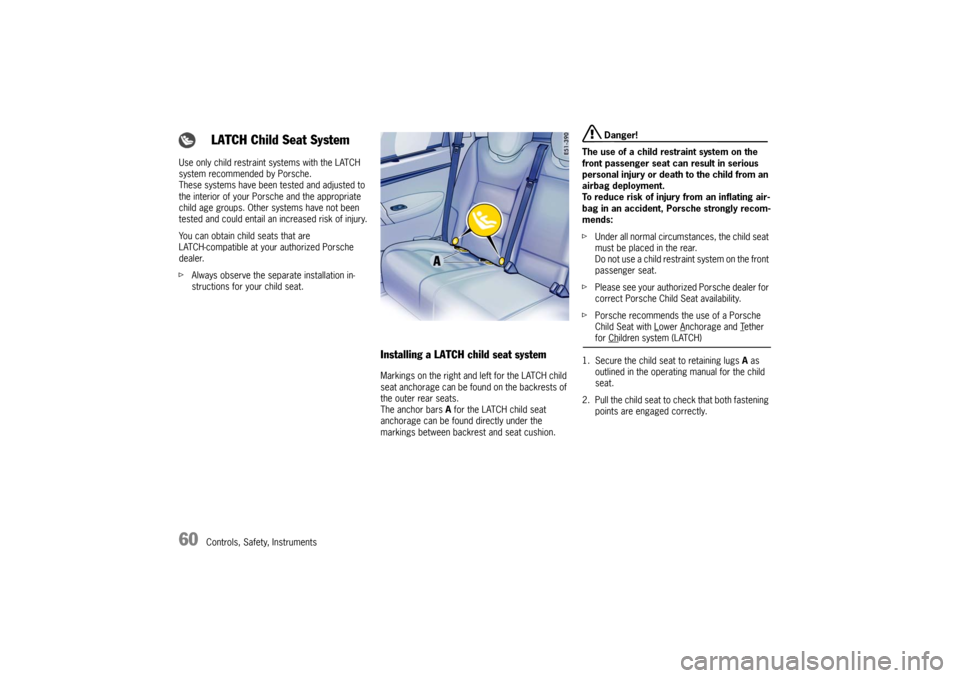
Controls, Safety, Instruments Use only child restraint systems with the LATCH
system recommended by Porsche.
These systems have been tested and adjusted to
the interior of your Porsche and the appropriate
child age groups. Other systems have not been
tested and could entail an increased risk of injury.
You can obtain child seats that are
LATCH-compatible at your authorized Porsche
dealer.
fAlways observe the separate installation in-
structions for your child seat.
Installing a LATCH child seat systemMarkings on the right and left for the LATCH child
seat anchorage can be found on the backrests of
the outer rear seats.
The anchor bars A for the LATCH child seat
anchorage can be found directly under the
markings between backrest and seat cushion.
Danger!
The use of a child restraint system on the
front passenger seat can result in serious
personal injury or death to the child from an
airbag deployment.
To reduce risk of injury from an inflating air-
bag in an accident, Porsche strongly recom-
mends:
fUnder all normal circumstances, the child seat
must be placed in the rear.
Do not use a child restraint system on the front
passenger seat.
fPlease see your authorized Porsche dealer for
correct Porsche Child Seat availability.
fPorsche recommends the use of a Porsche
Child Seat with L
ower A
nchorage and T
ether
for Ch
ildren system (LATCH)
1. Secure the child seat to retaining lugs A as
outlined in the operating manual for the child
seat.
2. Pull the child seat to check that both fastening
points are engaged correctly.
LATCH Child Seat System
Page 61 of 387

Controls, Safety, Instruments
61
Child Restraint AnchoragesfPlease observe the chapter “AUTOMATIC LO-
CKING RETRACTOR” on Page 58.
If your child restraint seat or seats require the use
of a tether strap, you will want to use the anchor
points A provided behind the rear seat backrests.
To ensure proper installation, see your authorized
Porsche dealer.
Warning!
Child restraint anchorages are designed to
withstand only those loads imposed by cor-
rectly fitted child restraints. Under no cir-
cumstances are they to be used for adults
safety belts or harnesses. Such use could re-
sult in serious personal injury or death.
fDo not misuse the child restraint anchorages.
Only attach one child seat tether per anchor-
age.
fThey are not designed to withstand loads im-posed by adults.
Page 188 of 387

188
Controls, Safety, Instruments
Storage
Warning!
Unsecured luggage and heavy objects may
come loose during braking, rapid directional
changes or in an accident and cause serious
personal injury or death.
fDo not carry items of luggage or objects in the
passenger compartment unsecured.
fDo not transport any heavy objects in open
storage trays.
fAlways keep the storage trays closed while
driving.
fAlways protect the passenger compartment
with a safety net and a luggage compartment cover.
An unsecured or incorrectly positioned load can
slip out of place or endanger the vehicle occu-
pants during braking, direction changes or in acci-
dents:
fPlease observe the chapter “LOADING INFOR-
MATION” on Page 207.
Storage options– In the glasses case in the roof console
– In the glove compartment, pen holder
– In the front and rear armrests
– In the drawer underneath the passenger’s seat
– In the storage compartments at the sides of
the luggage compartment
– In the door trim panels
– In the center console, front and rear
– On the back of the front seats
– Coat hook on the rear grab handles
– Under the load compartment floor
– In the front and rear cupholders
Glasses case in the roof consoleSunglasses (for example) can be stored in this
storage compartment.
Opening
fPress button (arrow).
Closing
fClose the lid until it clicks audibly into place.