2006 PORSCHE BOXSTER tow
[x] Cancel search: towPage 207 of 296

Maintenance, Car Care
207
Power Steering
Warning!
Risk of accident.
When the engine is stopped (e.g. when on
tow) or the power steering has failed there is
no steering assistance.
Therefore, substantially more force will have
to be exerted in order to steer.
fExercise great care when being towed.
fHave the fault remedied at your nearest autho-rized Porsche dealer. Note
The flow noise heard at full steering lock is design-
related and does not indicate a defect in the stee-
ring system.
Checking hydraulic fluid fPlease observe the chapter “EXERCISE EXTRE-
ME CAUTION WHEN WORKING ON YOUR VE-
HICLE” on Page 184.
The hydraulic fluid reservoir is located in the engi-
ne compartment.
fOnly use hydraulic fluid authorized by Porsche.
fPlease observe the chapter “CAPACITIES” on
Page 286.
fCheck the fluid level with the engine stopped
and cold (approximately 68°F/20°C).
1. Open the engine compartment lid.
Please observe the chapter “OPENING ENGINE
COMPARTMENT LID” on Page 203.
2. Open the reservoir cap.
3. Wipe measuring rod.
Close lid and reopen. The fluid level should lie
in the area below the ”Cold“ marking.
Add hydraulic fluid if necessary.
4. Close cap carefully.
Close engine compartment lid.
Noticeable loss of fluid indicates leakage in the
system.
The cause should be remedied immediately at an
authorized Porsche dealer.
Page 208 of 296

208
Maintenance, Car Care
Air Filter The air filter is on the left-hand side of the engine
compartment.
A dirty air filter not only reduces engine perfor-
mance, but can lead to premature engine wear.
Regular filter replacement is part of the routine
maintenance service.
fIn dusty conditions, check the filter element
more frequently and replace if necessary. Combination filterThe fresh air passing through the combination
filter into the passenger compartment is virtually
free of dust, pollen, and unpleasant odours.
fIf the outside air is polluted by exhaust fumes,
press the circulating-air button.
A dirty filter can be the cause of reduced air
throughput:
fHave the filter replaced by an authorized
Porsche dealer.
Regular filter replacement is part of servicing.
Automatic Transmission Fluid The torque converter and the transmission are lu-
bricated with Automatic Transmission Fluid (ATF).
The final drive requires transmission oil.
fPlease observe the chapter “CAPACITIES” on
Page 286.
Do not tow the car or run the engine without ATF
in the transmission. The automatic transmission
may be damaged by even a tiny speck of dirt, only
a clean funnel or spout must be used when adding
AT F.
The ATF and transmission oil has to be checked
and changed at the intervals listed in your Mainte-
nance Schedule.
We recommend that you have the ATF and trans-
mission oil changed at your Porsche dealer, who
has the required lubricants and the necessary fil-
ling equipment.
If you suspect an oil leak in the transmission, have
your authorized Porsche dealer check it out imme-
diately.
Manual Transmission Oil The transmission oil has to be checked and chan-
ged at the intervals listed in your Maintenance
Schedule.
fPlease observe the chapter “CAPACITIES” on
Page 286.
We recommend that you have the transmission oil
changed at your Porsche dealer, who has the re-
quired lubricants and the necessary filling equip-
ment.
If you suspect an oil leak in the transmission, have
your authorized Porsche dealer check it out imme-
diately.
Page 219 of 296

Practical Tips, Emergency Service
219 Practical Tips, Emergency Service
Exercise Extreme Caution when
Working on your Vehicle ............................. 220
Tires/Wheels ............................................ 221
Loading Information ................................... 235
Lifting the Vehicle with a Lifting Platform
or Garage Lift ........................................... 237
Flat Tire .................................................... 238
Wheel Bolts ............................................. 241
Spacers ................................................... 244
Electrical System ..................................... 246
Battery .................................................... 249
Jump lead starting .................................... 256
Replacing bulbs ......................................... 258
Headlights ................................................ 261
Turn signal light ......................................... 265
Side marker light ....................................... 268
Tail light .................................................... 269
Additional brake light ................................. 270
Luggage compartment/footwell lights ......... 270
Interior light .............................................. 271
Adjusting Headlights .................................. 272
Towing ..................................................... 274
Page 221 of 296

Practical Tips, Emergency Service
221
Tires/Wheels The original equipment tires and wheel rims on
your Porsche comply with all applicable Federal
Motor Vehicle Safety Standards.
For your safety remember the following:
– Wheel rims and wheel bolts are matched to fit
your Porsche.
– If you intend to use other than original equip-
ment wheels, be sure that they conform to
Porsche specifications for your model.
Only tires with the same make and with the
same specification code (e.g. “N0”, “N1”...)
can be mounted.
– The use of wheel rims and wheel bolts that do
not meet specifications of the original factory
installed equipment will affect the safe opera-
tion of your vehicle.
– Before you plan on exchanging wheels, or
snow tires already mounted on the wheel rims,
consult your authorized Porsche dealer. Your
dealer has the technical information necessary
to advise you which wheel rims and wheel bolts
are compatible with the original factory instal-
lations.
Danger!
Risk of loss of control and serious personal
injury or death.
fIf while driving, your vehicle experiences a sud-
den vibration or ride disturbance, and/or you
suspect that possible damage to your tires or
vehicle has occurred, you should immediately
reduce your speed without excessive use of
the brakes.
fStop the vehicle as soon as possible, and in-
spect the tires.
If you cannot determine the cause for the dis-
turbance, have your vehicle towed to the near-
est Porsche or tire dealer to have your vehicle
or tire(s) inspected.
fContinuing to operate the vehicle without cor-
rection could result in a loss of control and se-rious personal injury.
Page 226 of 296
226
Practical Tips, Emergency Service
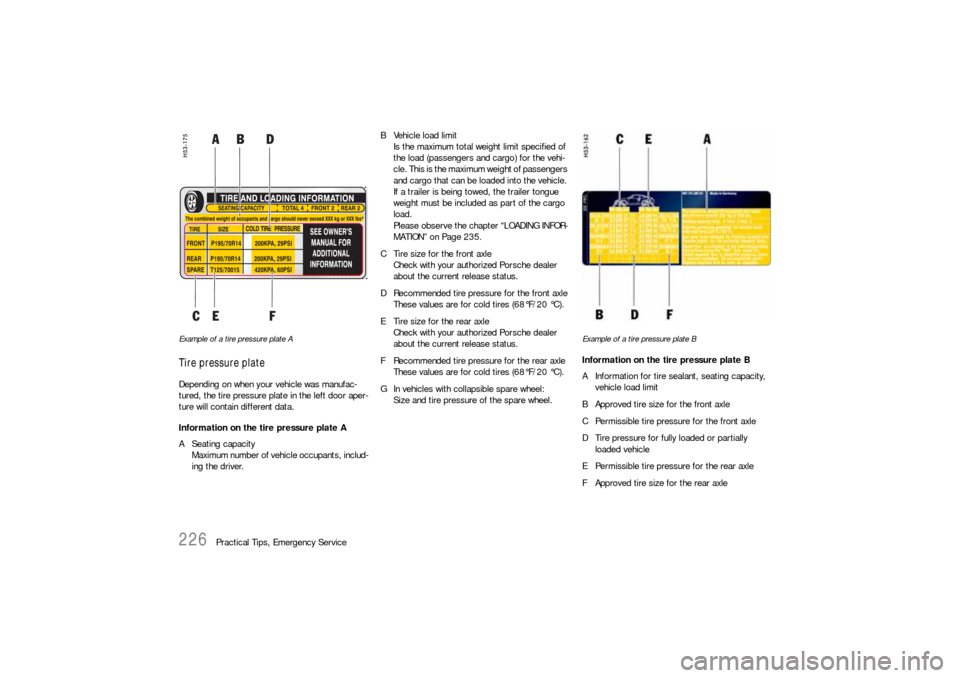
Example of a tire pressure plate ATire pressure plateDepending on when your vehicle was manufac-
tured, the tire pressure plate in the left door aper-
ture will contain different data.
Information on the tire pressure plate A
A Seating capacity
Maximum number of vehicle occupants, includ-
ing the driver.B Vehicle load limit
Is the maximum total weight limit specified of
the load (passengers and cargo) for the vehi-
cle. This is the maximum weight of passengers
and cargo that can be loaded into the vehicle.
If a trailer is being towed, the trailer tongue
weight must be included as part of the cargo
load.
Please observe the chapter “LOADING INFOR-
MATION” on Page 235.
C Tire size for the front axle
Check with your authorized Porsche dealer
about the current release status.
D Recommended tire pressure for the front axle
These values are for cold tires (68°F/20 °C).
E Tire size for the rear axle
Check with your authorized Porsche dealer
about the current release status.
F Recommended tire pressure for the rear axle
These values are for cold tires (68°F/20 °C).
G In vehicles with collapsible spare wheel:
Size and tire pressure of the spare wheel.
Example of a tire pressure plate BInformation on the tire pressure plate B
A Information for tire sealant, seating capacity,
vehicle load limit
B Approved tire size for the front axle
C Permissible tire pressure for the front axle
D Tire pressure for fully loaded or partially
loaded vehicle
E Permissible tire pressure for the rear axle
F Approved tire size for the rear axle
Page 266 of 296
266
Practical Tips, Emergency Service
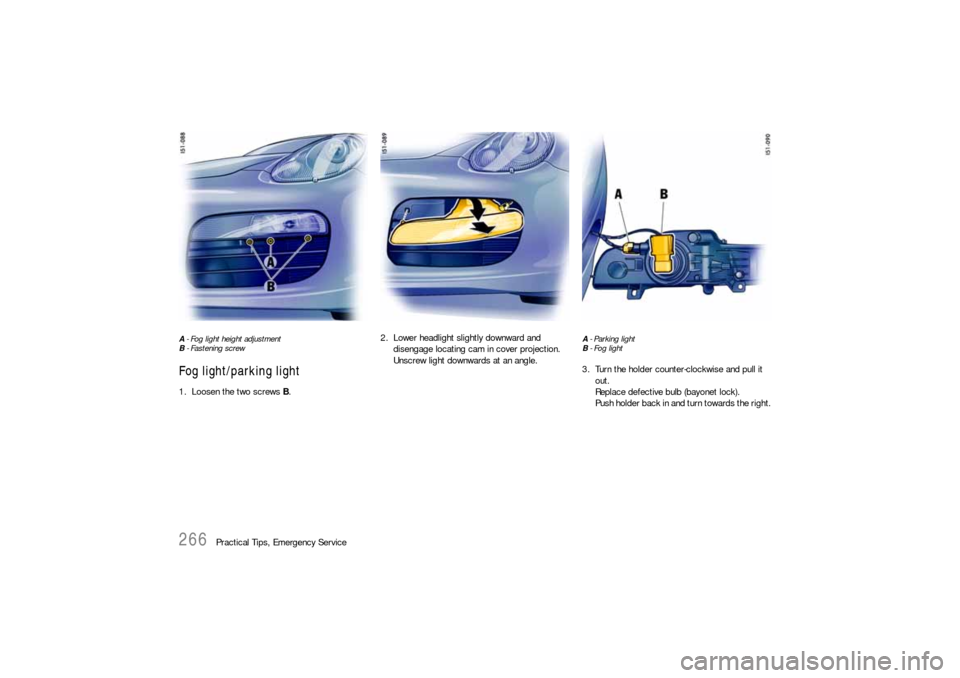
A - Fog light height adjustment
B - Fastening screwFog light/parking light1. Loosen the two screws B.2. Lower headlight slightly downward and
disengage locating cam in cover projection.
Unscrew light downwards at an angle.
A - Parking light
B - Fog light3. Turn the holder counter-clockwise and pull it
out.
Replace defective bulb (bayonet lock).
Push holder back in and turn towards the right.
Page 274 of 296

274
Practical Tips, Emergency Service
Towing Certain state statutes and local ordinances prohib-
it towing with a chain, rope or even a tow bar.
In addition, damage to your vehicle may result
from improper procedures.
Consult your authorized Porsche dealer for de-
tails. Vehicle towing Flat bed towing is the preferred type of towing to
be used on Porsche vehicles.
Under certain circumstances, wheel lifts may be
used when the vehicle will not roll.
The vehicle must be towed with all four
wheels off the ground, otherwise damage to
the vehicle may result. Towing hook The towing hook is contained in the tool box.
Caution!
Risk of damage to the vehicle.
fUse the towing hook only for an emergency to
remove the vehicle off the road. The towing
hook is to be used only to pull the vehicle onto
the flat bed, tractor or towing aparatus if the
vehicle will roll freely. Under no circumstances
is the vehicle to be secured using the towing
hook. fNever use the towing hook to tow this or any
other vehicle.
fBear in mind the limited ground clearence of
your car on uneven surfaces.
Front mounting
The towing hook is stored in the tool box in the
luggage compartment.
1. Press the lower edge of the appropriate
plastic cover into the bumper until the cover
disengages.
2. Pull cover out of the bumper and let it hang by
its thread.
3. Completely screw in the towing hook.Rear mounting
1. Remove license plate.
2. Unscrew the towing hook.
3. Insert plastic cover at the lower edge of the
opening.
4. Fold the cover up and press on its upper edge
to engage it in the bumper.
5. Completely screw in the towing hook.
Page 275 of 296
Practical Tips, Emergency Service
275
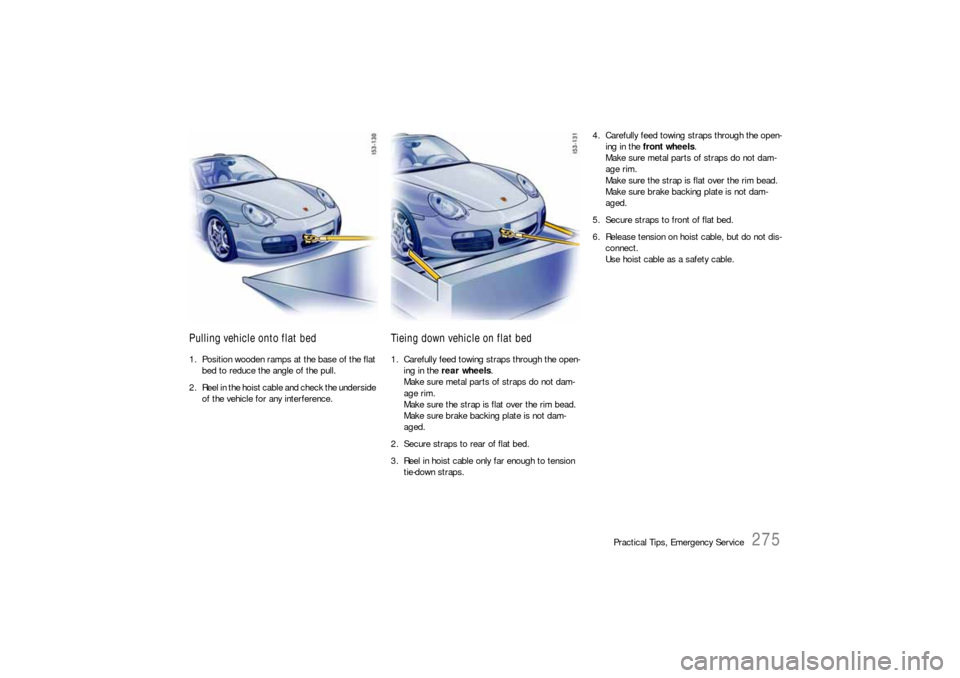
Pulling vehicle onto flat bed 1. Position wooden ramps at the base of the flat
bed to reduce the angle of the pull.
2. Reel in the hoist cable and check the underside
of the vehicle for any interference.
Tieing down vehicle on flat bed 1. Carefully feed towing straps through the open-
ing in the rear wheels.
Make sure metal parts of straps do not dam-
age rim.
Make sure the strap is flat over the rim bead.
Make sure brake backing plate is not dam-
aged.
2. Secure straps to rear of flat bed.
3. Reel in hoist cable only far enough to tension
tie-down straps. 4. Carefully feed towing straps through the open-
ing in the front wheels.
Make sure metal parts of straps do not dam-
age rim.
Make sure the strap is flat over the rim bead.
Make sure brake backing plate is not dam-
aged.
5. Secure straps to front of flat bed.
6. Release tension on hoist cable, but do not dis-
connect.
Use hoist cable as a safety cable.