2006 PONTIAC SOLSTICE brakes
[x] Cancel search: brakesPage 246 of 328

If you must replace your vehicle’s tires with those that
do not have a TPC Spec number, make sure they
are the same size, load range, speed rating, and
construction type (radial and bias-belted tires) as your
vehicle’s original tires.
Your vehicle’s original equipment tires are listed on the
Tire and Loading Information Label. This label is
attached to the vehicle’s center pillar (B-pillar). See
Loading Your Vehicle on page 4-29, for more information
about the Tire and Loading Information Label.
Different Size Tires and Wheels
If you add wheels or tires that are a different size than
your original equipment wheels and tires, this may
affect the way your vehicle performs, including its
braking, ride and handling characteristics, stability and
resistance to rollover. Additionally, if your vehicle
has electronic systems such as, antilock brakes; traction
control; and electronic stability control, the performance
of these systems can be affected.
{CAUTION:
If you add different sized wheels, your vehicle
may not provide an acceptable level of
performance and safety if tires not
recommended for those wheels are selected.
You may increase the chance that you will
crash and suffer serious injury. Only use
GM specic wheel and tire systems developed
for your vehicle, and have them properly
installed by a GM certied technician.
SeeBuying New Tires on page 5-53andAccessories
and Modications on page 5-3for additional information.
5-54
Page 251 of 328

Tire Chains
{CAUTION:
Do not use tire chains. There is not enough
clearance. Tire chains used on a vehicle
without the proper amount of clearance can
cause damage to the brakes, suspension or
other vehicle parts. The area damaged by the
tire chains could cause you to lose control of
your vehicle and you or others may be injured
in a crash. Use another type of traction device
only if its manufacturer recommends it for use
on your vehicle and tire size combination and
road conditions. Follow that manufacturer’s
instructions. To help avoid damage to your
vehicle, drive slowly, re-adjust or remove the
device if it is contacting your vehicle, and
do not spin your wheels. If you do nd
traction devices that will t, install them on
the rear tires.
If a Tire Goes Flat
Your vehicle has a tire inator kit. There is no spare
tire, no tire changing equipment, and no place to store
a tire.
It is unusual for a tire to blow out while you are driving,
especially if you maintain your tires properly. See
Tires on page 5-44. If air goes out of a tire, it is much
more likely to leak out slowly. But, if you should
ever have a blow out, here are a few tips about what to
expect and what to do:
If a front tire fails, the at tire will create a drag that
pulls the vehicle toward that side. Take your foot off the
accelerator pedal and grip the steering wheel rmly.
Steer to maintain lane position, and then gently brake to
a stop well out of the traffic lane.
A rear blow out, particularly on a curve, acts much like
a skid and may require the same correction you
would use in a skid. In any rear blow out, remove your
foot from the accelerator pedal. Get the vehicle
under control by steering the way you want the vehicle
to go. It may be very bumpy and noisy, but you can
still steer. Gently brake to a stop, well off the road
if possible.
5-59
Page 279 of 328

Footnotes
†The U.S. Environmental Protection Agency or the
California Air Resources Board has determined that the
failure to perform this maintenance item will not nullify
the emission warranty or limit recall liability prior to
the completion of the vehicle’s useful life. We, however,
urge that all recommended maintenance services be
performed at the indicated intervals and the
maintenance be recorded.
*If your vehicle has a Driver Information Center (DIC),
it also has the GM Oil Life System, a computer system
that lets you know when to change the oil and lter. This
is based on engine revolutions and engine temperature
and not on mileage. Based on driving conditions, the
mileage at which an oil change will be indicated can vary
considerably. For the oil life system to work properly, you
must reset the system every time the oil is changed.When the system has calculated that oil life has been
diminished, it will indicate that an oil change is
necessary. A CHANGE OIL SOON message on the
Driver Information Center (DIC) will come on. See DIC
Warnings and Messages on page 3-38.Change
your oil as soon as possible within the next two times
you stop for fuel. See Engine Oil on page 5-13.It
is possible that, if you are driving under the best
conditions, the oil life system may not indicate that an
oil change is necessary for over a year. However,
your engine oil and lter must be changed at least once
a year and at this time the system must be reset. It is
also important to check your oil regularly and keep it at
the proper level.
If the system is ever reset accidentally, you must
change your oil at 3,000 miles (5 000 km) since your
last oil change. Remember to reset the oil life system
whenever the oil is changed. See Engine Oil Life System
on page 5-16 for information on resetting the system.
+A good time to check your brakes is during tire
rotation. See Brake System Inspection on page 6-20.
6-5
Page 294 of 328

Engine Cooling System Inspection
Inspect the hoses and have them replaced if they
are cracked, swollen or deteriorated. Inspect all pipes,
ttings and clamps; replace as needed. Clean the
outside of the radiator and air conditioning condenser.
To help ensure proper operation, a pressure test of
the cooling system and pressure cap is recommended
at least once a year.
Throttle System Inspection
Inspect the throttle system for interference or binding,
and for damaged or missing parts. Replace parts
as needed. Replace any components that have high
effort or excessive wear. Do not lubricate accelerator
and cruise control cables.
Brake System Inspection
Inspect the complete system. Inspect brake lines and
hoses for proper hook-up, binding, leaks, cracks, chang,
etc. Inspect disc brake pads for wear and rotors for
surface condition. Inspect other brake parts, including
calipers, parking brake, etc. You may need to have your
brakes inspected more often if your driving habits or
conditions result in frequent braking.
6-20
Page 315 of 328

Reporting Safety Defects to
General Motors
In addition to notifying NHTSA (or Transport Canada)
in a situation like this, we certainly hope you’ll notify us.
Please call us at 1-800-762-2737, or write:
Pontiac Customer Assistance Center
P.O. Box 33172
Detroit, MI 48232-5172
In Canada, please call us at 1-800-263-3777 (English)
or 1-800-263-7854 (French). Or, write:
General Motors of Canada Limited
Customer Communication Centre, 163-005
1908 Colonel Sam Drive
Oshawa, Ontario L1H 8P7
Service Publications Ordering
Information
Service Manuals
Service Manuals have the diagnosis and repair
information on engines, transmission, axle suspension,
brakes, electrical, steering, body, etc.
Transmission, Transaxle, Transfer
Case Unit Repair Manual
This manual provides information on unit repair service
procedures, adjustments, and specications for GM
transmissions, transaxles, and transfer cases.
7-15
Page 318 of 328
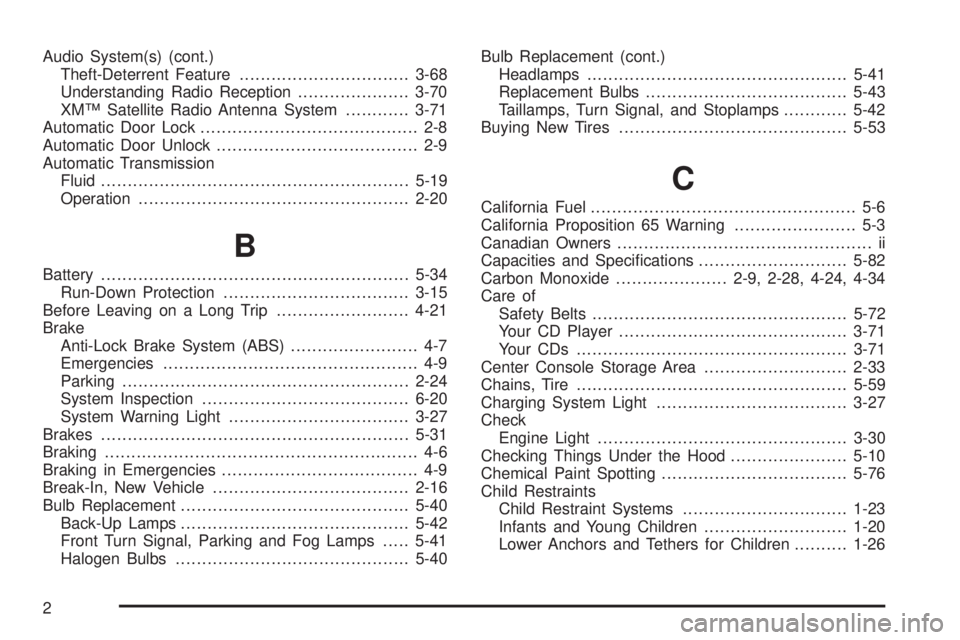
Audio System(s) (cont.)
Theft-Deterrent Feature................................3-68
Understanding Radio Reception.....................3-70
XM™ Satellite Radio Antenna System............3-71
Automatic Door Lock......................................... 2-8
Automatic Door Unlock...................................... 2-9
Automatic Transmission
Fluid..........................................................5-19
Operation...................................................2-20
B
Battery..........................................................5-34
Run-Down Protection...................................3-15
Before Leaving on a Long Trip.........................4-21
Brake
Anti-Lock Brake System (ABS)........................ 4-7
Emergencies................................................ 4-9
Parking......................................................2-24
System Inspection.......................................6-20
System Warning Light..................................3-27
Brakes..........................................................5-31
Braking........................................................... 4-6
Braking in Emergencies..................................... 4-9
Break-In, New Vehicle.....................................2-16
Bulb Replacement...........................................5-40
Back-Up Lamps...........................................5-42
Front Turn Signal, Parking and Fog Lamps.....5-41
Halogen Bulbs............................................5-40Bulb Replacement (cont.)
Headlamps.................................................5-41
Replacement Bulbs......................................5-43
Taillamps, Turn Signal, and Stoplamps............5-42
Buying New Tires...........................................5-53
C
California Fuel.................................................. 5-6
California Proposition 65 Warning....................... 5-3
Canadian Owners................................................ ii
Capacities and Specications............................5-82
Carbon Monoxide.....................2-9, 2-28, 4-24, 4-34
Care of
Safety Belts................................................5-72
Your CD Player...........................................3-71
Your CDs ...................................................3-71
Center Console Storage Area...........................2-33
Chains, Tire...................................................5-59
Charging System Light....................................3-27
Check
Engine Light...............................................3-30
Checking Things Under the Hood......................5-10
Chemical Paint Spotting...................................5-76
Child Restraints
Child Restraint Systems...............................1-23
Infants and Young Children...........................1-20
Lower Anchors and Tethers for Children..........1-26
2