2006 PONTIAC GTO spare tire
[x] Cancel search: spare tirePage 192 of 326

Tire Chains..................................................5-69
If a Tire Goes Flat........................................5-69
Changing a Flat Tire.....................................5-70
Removing the Spare Tire and Tools................5-71
Removing the Flat Tire and Installing the
Spare Tire................................................5-72
Storing a Flat or Spare Tire and Tools............5-77
Compact Spare Tire......................................5-78
Appearance Care............................................5-78
Cleaning the Inside of Your Vehicle.................5-78
Fabric/Carpet...............................................5-80
Leather.......................................................5-80
Instrument Panel, Vinyl, and Other Plastic
Surfaces..................................................5-81
Care of Safety Belts......................................5-81
Weatherstrips...............................................5-82
Washing Your Vehicle...................................5-82
Cleaning Exterior Lamps/Lenses.....................5-82
Finish Care..................................................5-82Windshield and Wiper Blades.........................5-83
Aluminum Wheels.........................................5-83
Tires...........................................................5-84
Sheet Metal Damage.....................................5-84
Finish Damage.............................................5-84
Underbody Maintenance................................5-85
Chemical Paint Spotting.................................5-85
Vehicle Care/Appearance Materials..................5-86
Vehicle Identi®cation......................................5-87
Vehicle Identi®cation Number (VIN).................5-87
Service Parts Identi®cation Label.....................5-87
Electrical System............................................5-87
Add-On Electrical Equipment..........................5-87
Fuses and Circuit Breakers............................5-88
Instrument Panel Fuse Block..........................5-88
Engine Compartment Fuse Block....................5-90
Capacities and Speci®cations..........................5-91
Section 5 Service and Appearance Care
5-2
2006 - Pontiac GTO Owner Manual
Page 233 of 326

Headlamp Aiming
The vehicle has a visual optical headlamp aiming
system. The aim has been preset at the factory and
should need no further adjustment
However, if the vehicle is damaged in an accident, the
headlamp aim may be affected and adjustment may
be necessary.
If oncoming vehicles ¯ash their high beams at you, this
may also mean the vertical aim needs to be adjusted.
It is recommended that the vehicle is taken to your
dealer for service if the headlamps need to be re-aimed.
It is possible however, to re-aim the headlamps as
described in the following procedure.
The vehicle should be properly prepared as follows:
·The vehicle should be placed so the headlamps
are 15 ft. (4.6 m) from a light colored wall or
other ¯at surface.
·The vehicle must have all four tires on a perfectly
level surface which is level all the way to the wall
or other ¯at surface.
·The vehicle should be placed so it is perpendicular
to the wall or other ¯at surface.
·The vehicle should not have any snow, ice, or mud
on it.
·The vehicle should be fully assembled and all other
work stopped while headlamp aiming is being
performed.
·The vehicle should be normally loaded with a full
tank of fuel and one person or 160 lbs (75 kg)
sitting on the driver's seat.
·Tires should be properly in¯ated.
·The spare tire is in its original location in
the vehicle.
Headlamp aiming is done with the vehicle's low-beam
headlamps. The high-beam headlamps will be correctly
aimed if the low-beam headlamps are aimed properly.
5-43
2006 - Pontiac GTO Owner Manual
Page 243 of 326

Tire Sidewall Labeling
Useful information about a tire is molded into its
sidewall. The examples below show a typical passenger
vehicle tire and a compact spare tire sidewall.
(A) Tire Size:The tire size is a combination of letters
and numbers used to de®ne a particular tire's width,
height, aspect ratio, construction type, and service
description. See the ªTire Sizeº illustration later in this
section for more detail.(B) TPC Spec (Tire Performance Criteria
Speci®cation):Original equipment tires designed to
GM's speci®c tire performance criteria have a TPC
speci®cation code molded onto the sidewall. GM's TPC
speci®cations meet or exceed all federal safety
guidelines.
(C) DOT (Department of Transportation):The
Department of Transportation (DOT) code indicates that
the tire is in compliance with the U.S. Department of
Transportation Motor Vehicle Safety Standards.
(D) Tire Identi®cation Number (TIN):The letters and
numbers following DOT (Department of Transportation)
code is the Tire Identi®cation Number (TIN). The
TIN shows the manufacturer and plant code, tire size,
and date the tire was manufactured. The TIN is molded
onto both sides of the tire, although only one side
may have the date of manufacture.
(E) Tire Ply Material:The type of cord and number of
plies in the sidewall and under the tread.
(F) Uniform Tire Quality Grading (UTQG):Tire
manufacturers are required to grade tires based on three
performance factors: treadwear, traction, and
temperature resistance. For more information see
Uniform Tire Quality Grading on page 5-64.
(G) Maximum Cold In¯ation Load Limit:Maximum
load that can be carried and the maximum pressure
needed to support that load. Passenger (P-Metric) Tire Example
5-53
2006 - Pontiac GTO Owner Manual
Page 244 of 326

(A) Temporary Use Only:The compact spare tire or
temporary use tire has a tread life of approximately
3,000 miles (5 000 km) and should not be driven
at speeds over 65 mph (105 km/h). The compact spare
tire is for emergency use when a regular road tire
has lost air and gone ¯at. If your vehicle has a compact
spare tire, see
Compact Spare Tire on page 5-76andIf a Tire Goes Flat on page 5-68.
(B) Tire Ply Material:The type of cord and number of
plies in the sidewall and under the tread.(C) Tire Identi®cation Number (TIN):The letters and
numbers following the DOT (Department of
Transportation) code is the Tire Identi®cation Number
(TIN). The TIN shows the manufacturer and plant code,
tire size, and date the tire was manufactured. The
TIN is molded onto both sides of the tire, although only
one side may have the date of manufacture.
(D) Maximum Cold In¯ation Load Limit:Maximum
load that can be carried and the maximum pressure
needed to support that load.
(E) Tire In¯ation:The temporary use tire or compact
spare tire should be in¯ated to 60 psi (420 kPa).
For more information on tire pressure and in¯ation see
In¯ation - Tire Pressure on page 5-58.
(F) Tire Size:A combination of letters and numbers
de®ne a tire's width, height, aspect ratio, construction
type and service description. The letter T as the
®rst character in the tire size means the tire is for
temporary use only.
(G) TPC Spec (Tire Performance Criteria
Speci®cation):Original equipment tires designed to
GM's speci®c tire performance criteria have a TPC
speci®cation code molded onto the sidewall. GM's TPC
speci®cations meet or exceed all federal safety
guidelines. Compact Spare Tire Example
5-54
2006 - Pontiac GTO Owner Manual
Page 249 of 326

How you load your vehicle affects vehicle handling and ride comfort. When driving with less than the maximum load
capacity allowed for your vehicle, you can set tire in¯ation pressure to the recommended amounts shown in the
following chart. Never load your vehicle with more weight than it was designed to carry.
Tire SizeRecommended Cold Tire In¯ation
Occupant and Cargo Weight:
470 lbs (210 kg) or LessOccupant and Cargo Weight:
Up to 740 lbs (330 kg)
(Vehicle Capacity Weight)
Front Tires Rear Tires Front Tires Rear Tires
245/45ZR17 95W 30 psi (210 kPa) 30 psi (210 kPa) 35 psi (240 kPa) 35 psi (240 kPa)
235/40ZR18 91W 33 psi (230 kPa) 33 psi (230 kPa) 33 psi (230 kPa) 39 psi (270 kPa)
T145/70R17 96M
(Compact Spare)60 psi (420 kPa) 60 psi (420 kPa) 60 psi (420 kPa) 60 psi (420 kPa)
When to Check
Check your tires once a month or more.
Do not forget your compact spare tire. It should be at
60 psi (420 kPa). For more information about your
vehicle's compact spare tire, see
Compact Spare Tire
on page 5-76.
How to Check
Use a good quality pocket-type gage to check tire
pressure. You can't tell if your tires are properly in¯ated
simply by looking at them. Radial tires may look
properly in¯ated even when they're underin¯ated. Check
the tire's in¯ation pressure when the tires are cold.
Cold means your vehicle has been sitting for at least
three hours or driven no more than 1 mile (1.6 km).Remove the valve cap from the tire valve stem. Press
the tire gage ®rmly onto the valve to get a pressure
measurement. If the cold tire in¯ation pressure matches
the recommended pressure on the Tire and Loading
Information label, no further adjustment is necessary. If
the in¯ation pressure is low, add air until you reach
the recommended amount.
If you over®ll the tire, release air by pushing on the
metal stem in the center of the tire valve. Recheck the
tire pressure with the tire gage.
Be sure to put the valve caps back on the valve stems.
They help prevent leaks by keeping out dirt and
moisture.
5-59
2006 - Pontiac GTO Owner Manual
Page 251 of 326
Tire Inspection and Rotation
Tires should be rotated every 5,000 to 8,000 miles
(8 000 to 13 000 km).
Any time you notice unusual wear, rotate your tires as
soon as possible and check wheel alignment. Also
check for damaged tires or wheels. See
When It Is Time
for New Tires on page 5-62andWheel Replacement
on page 5-66for more information.
The purpose of regular rotation is to achieve more
uniform wear for all tires on the vehicle. The ®rst rotation
is the most important. See
Scheduled Maintenance
on page 6-4.
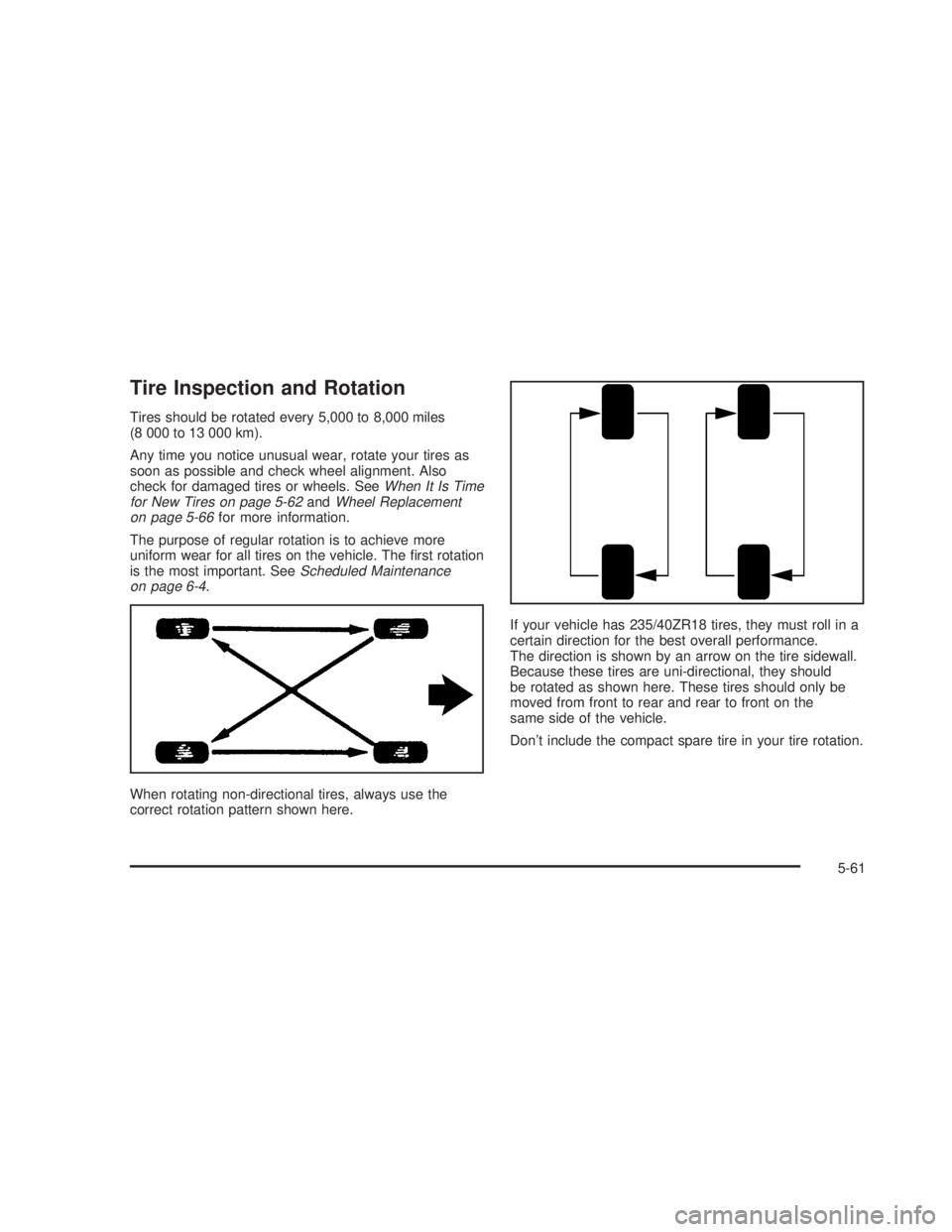
When rotating non-directional tires, always use the
correct rotation pattern shown here.If your vehicle has 235/40ZR18 tires, they must roll in a
certain direction for the best overall performance.
The direction is shown by an arrow on the tire sidewall.
Because these tires are uni-directional, they should
be rotated as shown here. These tires should only be
moved from front to rear and rear to front on the
same side of the vehicle.
Don't include the compact spare tire in your tire rotation.
5-61
2006 - Pontiac GTO Owner Manual
Page 253 of 326

Buying New Tires
GM has developed and matched speci®c tires for your
vehicle. The original equipment tires installed on
your vehicle, when it was new, were designed to meet
General Motors tire performance criteria. GM's tire
performance criteria considers over a dozen critical
speci®cations that impact the overall performance
of your vehicle, including brake system performance,
ride and handling, and traction control. If you need
replacement tires, GM strongly recommends that you
replace your vehicle's tires with the same size, load
range, speed rating, and construction type (radial and
bias-belted tires) as your vehicle's original tires.
This way, your vehicle will continue to have tires that
are designed to give the same performance and vehicle
safety, during normal use, as the original tires.
{CAUTION:
Mixing tires could cause you to lose control
while driving. If you mix tires of different sizes,
brands, or types (radial and bias-belted tires),
the vehicle may not handle properly, and you
could have a crash.
CAUTION: (Continued)
CAUTION: (Continued)
Using tires of different sizes, brands, or types
may also cause damage to your vehicle. Be
sure to use the correct size, brand, and type of
tires on all wheels. It is all right to drive with
your compact spare temporarily, as it was
developed for use on your vehicle. See
Compact Spare Tire on page 5-76.
{CAUTION:
If you use bias-ply tires on your vehicle, the
wheel rim ¯anges could develop cracks after
many miles of driving. A tire and/or wheel
could fail suddenly, causing a crash. Use only
radial-ply tires with the wheels on your vehicle.
Your vehicle's original equipment tires are listed on the
Tire and Loading Information Label. This label is
attached to the vehicle's center pillar (B-pillar). See
Loading Your Vehicle on page 4-29, for more information
about the Tire and Loading Information Label and its
location on your vehicle.
5-63
2006 - Pontiac GTO Owner Manual
Page 254 of 326

Different Size Tires and Wheels
If you add wheels or tires that are a different size than
your original equipment wheels and tires, this may
affect the way your vehicle performs, including its
braking, ride and handling characteristics, stability and
resistance to rollover. Additionally, if your vehicle
has electronic systems such as, anti-lock brakes,
traction control, and electronic stability control, the
performance of these systems can be affected.
{CAUTION:
If you add different sized wheels, your vehicle
may not provide an acceptable level of
performance and safety if tires not
recommended for those wheels are selected.
You may increase the chance that you will
crash and suffer serious injury. Only use GM
speci®c wheel and tire systems developed for
your vehicle, and have them properly installed
by a GM certi®ed technician.
See
Buying New Tires on page 5-63andAccessories
and Modi®cations on page 5-3for additional information.
Uniform Tire Quality Grading
Quality grades can be found where applicable on the
tire sidewall between tread shoulder and maximum
section width. For example:
Treadwear 200 Traction AA Temperature A
The following information relates to the system
developed by the United States National Highway
Traffic Safety Administration (NHTSA), which grades
tires by treadwear, traction, and temperature
performance. This applies only to vehicles sold in the
United States. The grades are molded on the sidewalls
of most passenger car tires. The Uniform Tire Quality
Grading (UTQG) system does not apply to deep
tread, winter-type snow tires, space-saver, or temporary
use spare tires, tires with nominal rim diameters of
10 to 12 inches (25 to 30 cm), or to some
limited-production tires.
While the tires available on General Motors passenger
cars and light trucks may vary with respect to these
grades, they must also conform to federal safety
requirements and additional General Motors Tire
Performance Criteria (TPC) standards.
5-64
2006 - Pontiac GTO Owner Manual