2006 PONTIAC GTO power steering
[x] Cancel search: power steeringPage 77 of 326

The key can only be turned to this position if the
vehicle's automatic transmission is in PARK (P). To help
guard against theft, your vehicle's engine is
automatically disabled shortly after turning the key to
this position. A ¯ashing padlock symbol on the bottom
left corner of the instrument panel indicates this.
The steering column is automatically locked when the
key is removed. To release the steering wheel, insert the
key again and turn it towards the front of the vehicle.
Notice:Using a tool to force the key from the
ignition switch could cause damage or break the
key. Use the correct key and turn the key only with
your hand. Make sure the key is all the way in. If
it is, turn the steering wheel left and right while you
turn the key hard. If none of this works, then
your vehicle needs service.
B (ON):This position is where the key returns to after
you start your engine and release the key. The
ignition switch stays in ON when the engine is running.
But even when the engine is not running, you can
use ON to operate your electrical accessories and to
display some instrument panel warning lights.
C (START):This position starts the engine. When the
engine starts, release the key. The ignition switch
will return to ON for normal driving.
Retained Accessory Power (RAP)
Your vehicle is equipped with a Retained Accessory
Power (RAP) feature that enables the radio, power
windows, windshield wipers, and accessory power outlet
to continue to work after the ignition key has been
turned to LOCK and removed from the ignition.
The radio, wipers and accessory power outlet will turn
off when the ignition key is turned to LOCK and
removed. By turning the radio back on, you will be able
to operate it, the windshield wipers, and the accessory
power outlet for up to one hour or until:
·The radio is turned off
·Either door is opened
The windows will also operate for 15 minutes or until
either door is opened.
2-17
2006 - Pontiac GTO Owner Manual
Page 103 of 326

The main components of the instrument panel are the following:
A. Side Outlets. See
Outlet Adjustment on page 3-21.
B. Exterior Lamp Controls. See
Instrument Panel
Brightness on page 3-15andExterior Lamps on
page 3-13.
C. Instrument Panel Cluster. See
Instrument Panel
Cluster on page 3-23.
D. Windshield Wiper Lever. See
Windshield Wipers on
page 3-9.
E. Trip Computer Control. See
Trip Computer on
page 3-33.
F. Outlets. See
Outlet Adjustment on page 3-21.
G. Hazard Warning Flasher Button. See
Hazard
Warning Flashers on page 3-6.
H. Climate Controls. See
Climate Control System on
page 3-19.
I. Audio System Controls. See
Audio System(s) on
page 3-44.J. Cruise Control Lever. See
Cruise Control on
page 3-10.
K. Audio Steering Wheel Controls. See
Audio Steering
Wheel Controls on page 3-56.
L. Tilt Wheel. See
Tilt Wheel on page 3-6.
M. Horn. See
Horn on page 3-6.
N. Ignition Switch. See
Ignition Positions on page 2-16.
O. Shift Lever. See
Automatic Transmission Operation
on page 2-19orManual Transmission Operation
on page 2-21.
P. Cupholders. See
Cupholder(s) on page 2-30.
Q. Traction Control System and Power Door Lock
Buttons. See
Traction Control System (TCS)
on page 4-9andDoor Locks on page 2-7.
R. Parking Brake. See
Parking Brake on page 2-24.
S. Glove Box. See
Glove Box on page 2-30.
3-5
2006 - Pontiac GTO Owner Manual
Page 107 of 326

Flash-to-Pass
This feature lets you use your high-beam headlamps to
signal a driver in front of you that you want to pass,
even if the headlamps and ignition are turned off.
To use it, pull the turn signal/multifunction lever toward
you until the high-beam headlamps come on, then
release the lever to turn them off.
If ¯ash-to-pass is activated, then the headlamp
high/low-beam changer indicator will display on the
instrument panel cluster. The fog lamps are turned off
while this feature is active.
Windshield Wipers
The lever on the right side of the steering column
operates the windshield wipers and washer.These functions operate when the ignition is turned to
ON, LOCK, or when the Retained Accessory Power is in
operation. See
Retained Accessory Power (RAP) on
page 2-17.
INT (Intermittent):Push the lever up to turn on the
wipers. Put the lever in the ®rst position for intermittent
wiping cycles. The delay will change as your vehicle's
speed changes. The delay will decrease as you go
faster and increase as you go slower.
1 (Low Speed):Put the lever in the second position for
slow, steady wiping cycles.
2 (High Speed):Put the lever in the third position for
rapid wiping cycles.
L(Mist):Move the lever to this position for a single
wiping cycle. Hold it there until the windshield wipers
start; then let go. The windshield wipers will stop after
one wipe. If you want more wipes, hold the lever
down longer.
0 (Off):Turn the lever to this position to turn off the
wipers.
Be sure to clear ice and snow from the wiper blades
before using them. If they're frozen to the windshield,
gently loosen or thaw them. If the blades do become
damaged, install new blades or blade inserts.
Heavy snow or ice can overload the wiper motor. A
circuit breaker will stop the motor until it cools down.
Clear away snow or ice to prevent an overload.
3-9
2006 - Pontiac GTO Owner Manual
Page 165 of 326

Using ABS
Do not pump the brakes. Just hold the brake pedal
down ®rmly and let anti-lock work for you. You may
hear the anti-lock pump or motor operate, and feel the
brake pedal pulsate, but this is normal.
Braking in Emergencies
With ABS, you can steer and brake at the same time.
In many emergencies, steering can help you more
than even the very best braking.
Traction Control System (TCS)
Your vehicle has a Traction Control System (TCS) that
limits wheel spin. This is especially useful in slippery
road conditions. The system operates only if it senses
that one or both of the rear wheels are spinning or
beginning to lose traction. When this happens,
the system reduces engine power and applies the
brakes, as necessary.Traction control helps you to keep control of the
vehicle and reminds you to match your speed to the
road conditions.
You may feel or hear the system working, but this is
normal. The TCS is automatically turned on whenever
the ignition is turned from off to on. A Low Traction
message is displayed on the trip computer, indicating
traction control is limiting wheel spin, until the MODE
button on the trip computer is pressed. The message
then goes back to the original trip computer display with
a small low traction symbol on the left. The symbol
will remain as long as the low traction situation exists.
To limit wheel spin, especially in slippery road
conditions, you should always leave the TCS on. But
you can turn the system off if you prefer.
4-9
2006 - Pontiac GTO Owner Manual
Page 166 of 326

To turn the system off,
press the T/C button. On
manual transmission
vehicles, the button is
located on the driver's side
of the center console. On
automatic transmission
vehicles, the button is
located on the passenger's
side of the shift lever.
When you turn the system off, a Traction Ctrl Off
message is displayed on the trip computer. After
two seconds, the display goes back to the original trip
computer display with a small TRAC OFF message
on the right.
If the Traction Ctrl Off message does not display when
the button is pressed, or if it comes on during driving,
a problem is indicated in the system and traction
control is no longer operational. You should contact
your dealer for service.
Pressing the T/C button again or the next time the
ignition is turned on, will turn the system back on. The
Traction Ctrl On message is displayed on the trip
computer. After two seconds, the display goes back to
the original trip computer display. See
Trip Computer
on page 3-33for more information.Adding non-GM accessories can affect your vehicle's
performance. See
Accessories and Modi®cations
on page 5-3for more information.
Steering
Power Steering
If you lose power steering assist because the engine
stops or the system is not functioning, you can steer but
it will take much more effort.
Steering Tips
It is important to take curves at a reasonable speed.
A lot of the ªdriver lost controlº accidents mentioned on
the news happen on curves. Here is why:
Experienced driver or beginner, each of us is subject to
the same laws of physics when driving on curves.
The traction of the tires against the road surface makes
it possible for the vehicle to change its path when
you turn the front wheels. If there is no traction, inertia
will keep the vehicle going in the same direction. If
you have ever tried to steer a vehicle on wet ice, you
will understand this.
The traction you can get in a curve depends on the
condition of your tires and the road surface, the angle
at which the curve is banked, and your speed. While you
are in a curve, speed is the one factor you can control.
4-10
2006 - Pontiac GTO Owner Manual
Page 191 of 326

Service............................................................5-3
Accessories and Modi®cations..........................5-3
California Proposition 65 Warning.....................5-3
Doing Your Own Service Work.........................5-4
Adding Equipment to the Outside of Your
Vehicle......................................................5-5
Fuel................................................................5-5
Gasoline Octane............................................5-5
Gasoline Speci®cations....................................5-5
California Fuel...............................................5-6
Additives.......................................................5-6
Fuels in Foreign Countries...............................5-7
Filling the Tank..............................................5-8
Filling a Portable Fuel Container.....................5-10
Checking Things Under the Hood....................5-10
Hood Release..............................................5-11
Engine Compartment Overview.......................5-12
Engine Oil...................................................5-13
Engine Oil Life System..................................5-16
Engine Air Cleaner/Filter................................5-18
Automatic Transmission Fluid.........................5-19
Manual Transmission Fluid.............................5-21
Hydraulic Clutch...........................................5-22
Engine Coolant.............................................5-23
Radiator Pressure Cap..................................5-26
Engine Overheating.......................................5-26Cooling System............................................5-29
Power Steering Fluid.....................................5-33
Windshield Washer Fluid................................5-34
Brakes........................................................5-35
Battery........................................................5-38
Jump Starting...............................................5-39
Headlamp Aiming...........................................5-44
Bulb Replacement..........................................5-46
Halogen Bulbs..............................................5-46
Headlamps..................................................5-46
Front Turn Signal and Parking Lamps..............5-48
Taillamps, Turn Signal, Stoplamps and
Back-up Lamps.........................................5-49
Replacement Bulbs.......................................5-50
Windshield Wiper Blade Replacement..............5-51
Tires..............................................................5-52
Tire Sidewall Labeling...................................5-54
Tire Terminology and De®nitions.....................5-56
In¯ation - Tire Pressure.................................5-59
Tire Inspection and Rotation...........................5-62
When It Is Time for New Tires.......................5-63
Buying New Tires.........................................5-64
Different Size Tires and Wheels......................5-65
Uniform Tire Quality Grading..........................5-66
Wheel Alignment and Tire Balance..................5-67
Wheel Replacement......................................5-67
Section 5 Service and Appearance Care
5-1
2006 - Pontiac GTO Owner Manual
Page 203 of 326
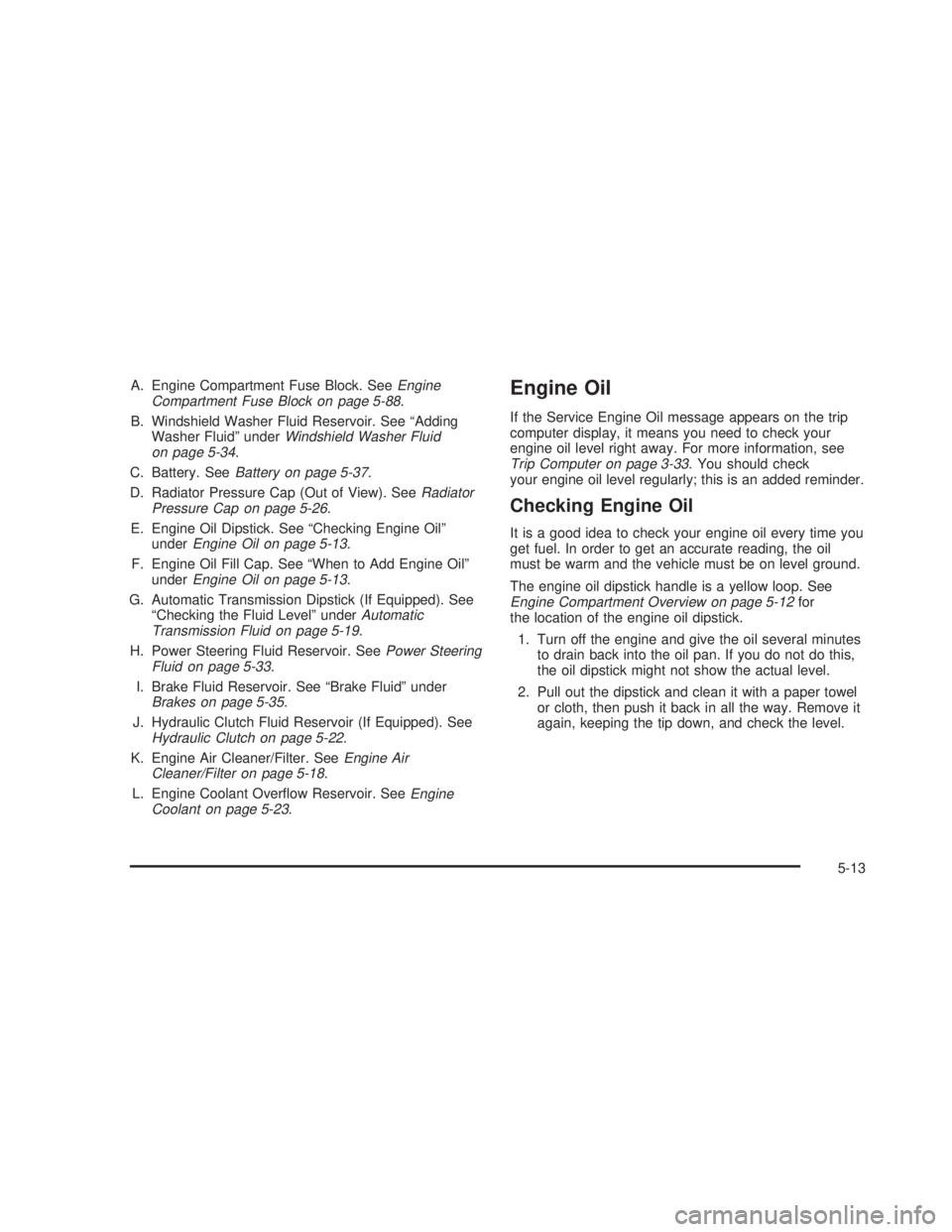
A. Engine Compartment Fuse Block. SeeEngine
Compartment Fuse Block on page 5-88.
B. Windshield Washer Fluid Reservoir. See ªAdding
Washer Fluidº under
Windshield Washer Fluid
on page 5-34.
C. Battery. See
Battery on page 5-37.
D. Radiator Pressure Cap (Out of View). See
Radiator
Pressure Cap on page 5-26.
E. Engine Oil Dipstick. See ªChecking Engine Oilº
under
Engine Oil on page 5-13.
F. Engine Oil Fill Cap. See ªWhen to Add Engine Oilº
under
Engine Oil on page 5-13.
G. Automatic Transmission Dipstick (If Equipped). See
ªChecking the Fluid Levelº under
Automatic
Transmission Fluid on page 5-19.
H. Power Steering Fluid Reservoir. See
Power Steering
Fluid on page 5-33.
I. Brake Fluid Reservoir. See ªBrake Fluidº under
Brakes on page 5-35.
J. Hydraulic Clutch Fluid Reservoir (If Equipped). See
Hydraulic Clutch on page 5-22.
K. Engine Air Cleaner/Filter. See
Engine Air
Cleaner/Filter on page 5-18.
L. Engine Coolant Over¯ow Reservoir. See
Engine
Coolant on page 5-23.
Engine Oil
If the Service Engine Oil message appears on the trip
computer display, it means you need to check your
engine oil level right away. For more information, see
Trip Computer on page 3-33. You should check
your engine oil level regularly; this is an added reminder.
Checking Engine Oil
It is a good idea to check your engine oil every time you
get fuel. In order to get an accurate reading, the oil
must be warm and the vehicle must be on level ground.
The engine oil dipstick handle is a yellow loop. See
Engine Compartment Overview on page 5-12for
the location of the engine oil dipstick.
1. Turn off the engine and give the oil several minutes
to drain back into the oil pan. If you do not do this,
the oil dipstick might not show the actual level.
2. Pull out the dipstick and clean it with a paper towel
or cloth, then push it back in all the way. Remove it
again, keeping the tip down, and check the level.
5-13
2006 - Pontiac GTO Owner Manual
Page 223 of 326

Power Steering Fluid
The power steering ¯uid reservoir is located toward the
front of the engine compartment on the driver's side
of the vehicle. See
Engine Compartment Overview on
page 5-12for reservoir location.
When to Check Power Steering Fluid
It is not necessary to regularly check power steering ¯uid
unless you suspect there is a leak in the system or
you hear an unusual noise. A ¯uid loss in this system
could indicate a problem. Have the system inspected
and repaired.
How to Check Power Steering Fluid
The ¯uid level should be checked after the vehicle has
been driven for at least 20 minutes, so that the ¯uid
is warm. A cold level check can be done after the engine
has been off for at least ®ve hours. However, the hot
level check is recommended.
The ¯uid level can be viewed through the reservoir. The
level markings are next to the ¯uid window. When the
¯uid is cold, the level should be between the COLD MIN
(Minimum) and MAX (Maximum) marks. When the
vehicle has been driven for at least 20 minutes and the
¯uid is hot, the level should be between the HOT
MIN and MAX marks.
If ¯uid must be added, turn the cap counterclockwise to
the stop; then the cap can be lifted off. Do not over®ll
the reservoir and remember to replace the cap
tightly when you are ®nished and clean up any
spilled ¯uid.
If you often need to add ¯uid, you should see
your dealer.
What to Use
To determine what kind of ¯uid to use, seeRecommended Fluids and Lubricants on page 6-12.
Always use the proper ¯uid. Failure to use the proper
¯uid can cause leaks and damage hoses and seals.
5-33
2006 - Pontiac GTO Owner Manual