2006 NISSAN ALTIMA steering
[x] Cancel search: steeringPage 270 of 304
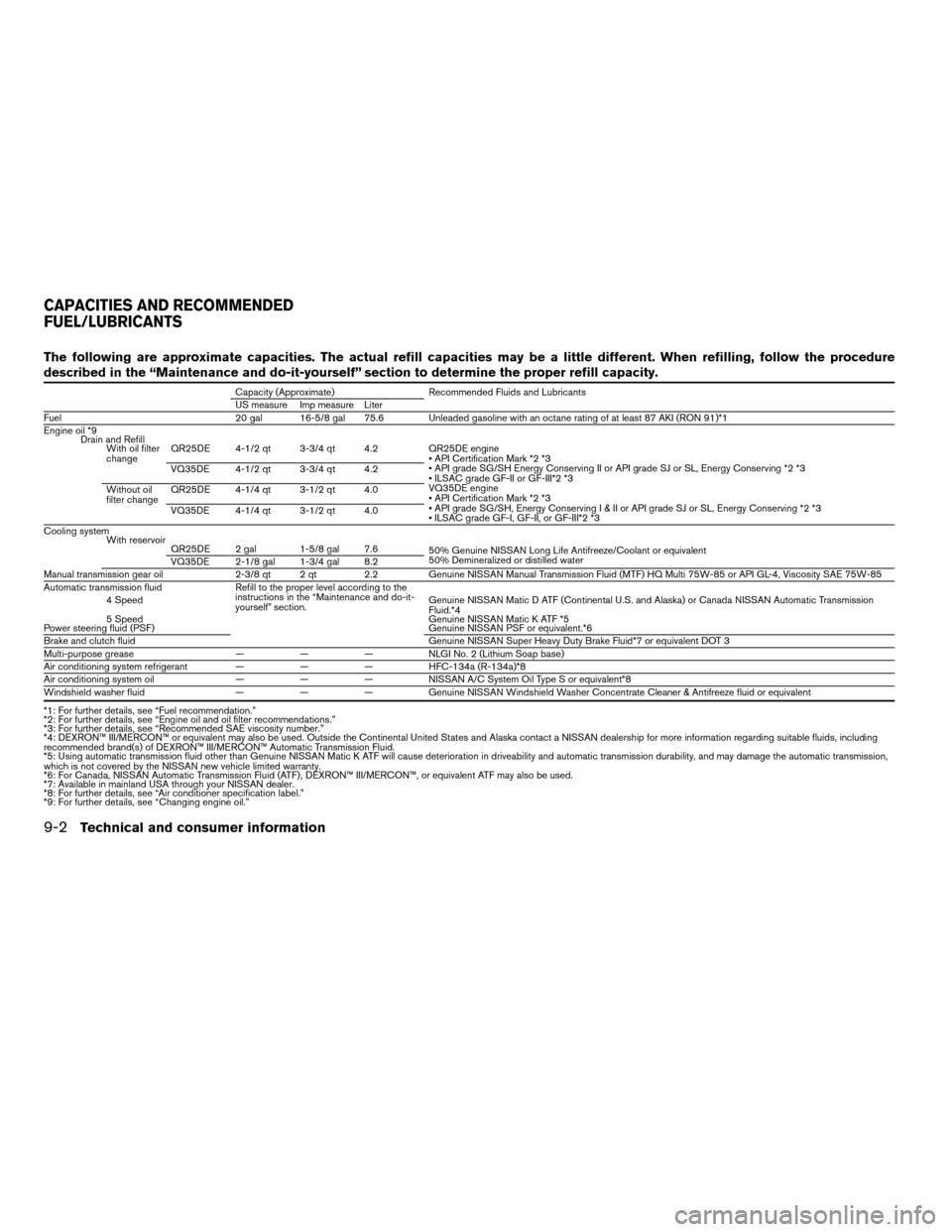
The following are approximate capacities. The actual refill capacities may be a little different. When refilling, follow the procedure
described in the “Maintenance and do-it-yourself” section to determine the proper refill capacity.
Capacity (Approximate) Recommended Fluids and Lubricants
US measure Imp measure Liter
Fuel 20 gal 16-5/8 gal 75.6 Unleaded gasoline with an octane rating of at least 87 AKI (RON 91)*1
Engine oil *9
Drain and Refill
With oil filter
changeQR25DE 4-1/2 qt 3-3/4 qt 4.2 QR25DE engine
• API Certification Mark *2 *3
• API grade SG/SH Energy Conserving II or API grade SJ or SL, Energy Conserving *2 *3
• ILSAC grade GF-II or GF-III*2 *3
VQ35DE engine
• API Certification Mark *2 *3
• API grade SG/SH, Energy ConservingI&IIorAPIgrade SJ or SL, Energy Conserving *2 *3
• ILSAC grade GF-I, GF-II, or GF-III*2 *3 VQ35DE 4-1/2 qt 3-3/4 qt 4.2
Without oil
filter changeQR25DE 4-1/4 qt 3-1/2 qt 4.0
VQ35DE 4-1/4 qt 3-1/2 qt 4.0
Cooling system
With reservoir
QR25DE 2 gal 1-5/8 gal 7.6
50% Genuine NISSAN Long Life Antifreeze/Coolant or equivalent
50% Demineralized or distilled water
VQ35DE 2-1/8 gal 1-3/4 gal 8.2
Manual transmission gear oil 2-3/8 qt 2 qt 2.2 Genuine NISSAN Manual Transmission Fluid (MTF) HQ Multi 75W-85 or API GL-4, Viscosity SAE 75W-85
Automatic transmission fluid Refill to the proper level according to the
instructions in the “Maintenance and do-it-
yourself” section. 4 Speed Genuine NISSAN Matic D ATF (Continental U.S. and Alaska) or Canada NISSAN Automatic Transmission
Fluid.*4
5 Speed Genuine NISSAN Matic K ATF *5
Power steering fluid (PSF) Genuine NISSAN PSF or equivalent.*6
Brake and clutch fluid Genuine NISSAN Super Heavy Duty Brake Fluid*7 or equivalent DOT 3
Multi-purpose grease———NLGINo.2(Lithium Soap base)
Air conditioning system refrigerant— — — HFC-134a (R-134a)*8
Air conditioning system oil— — — NISSAN A/C System Oil Type S or equivalent*8
Windshield washer fluid— — — Genuine NISSAN Windshield Washer Concentrate Cleaner & Antifreeze fluid or equivalent
*1: For further details, see “Fuel recommendation.”
*2: For further details, see “Engine oil and oil filter recommendations.”
*3: For further details, see “Recommended SAE viscosity number.”
*4: DEXRON™ III/MERCON™ or equivalent may also be used. Outside the Continental United States and Alaska contact a NISSAN dealership for more information regarding suitable fluids, including
recommended brand(s) of DEXRON™ III/MERCON™ Automatic Transmission Fluid.
*5: Using automatic transmission fluid other than Genuine NISSAN Matic K ATF will cause deterioration in driveability and automatic transmission durability, and may damage the automatic transmission,
which is not covered by the NISSAN new vehicle limited warranty.
*6: For Canada, NISSAN Automatic Transmission Fluid (ATF) , DEXRON™ III/MERCON™, or equivalent ATF may also be used.
*7: Available in mainland USA through your NISSAN dealer.
*8: For further details, see “Air conditioner specification label.”
*9: For further details, see “Changing engine oil.”
CAPACITIES AND RECOMMENDED
FUEL/LUBRICANTS
9-2Technical and consumer information
ZREVIEW COPYÐ2006 Altima(l30)
Owners ManualÐUSA_English(nna)
09/20/05Ðbetty
X
Page 284 of 304
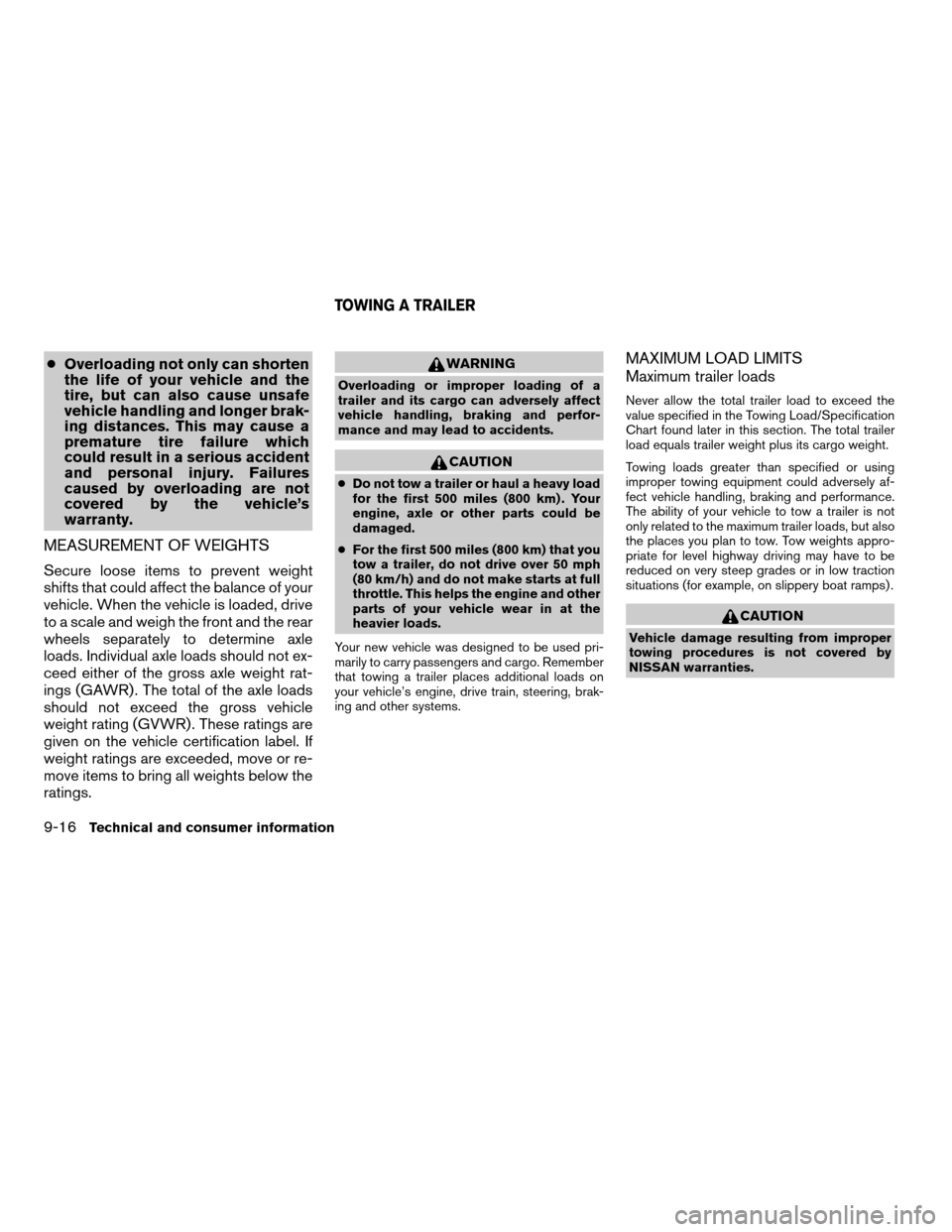
cOverloading not only can shorten
the life of your vehicle and the
tire, but can also cause unsafe
vehicle handling and longer brak-
ing distances. This may cause a
premature tire failure which
could result in a serious accident
and personal injury. Failures
caused by overloading are not
covered by the vehicle’s
warranty.
MEASUREMENT OF WEIGHTS
Secure loose items to prevent weight
shifts that could affect the balance of your
vehicle. When the vehicle is loaded, drive
to a scale and weigh the front and the rear
wheels separately to determine axle
loads. Individual axle loads should not ex-
ceed either of the gross axle weight rat-
ings (GAWR) . The total of the axle loads
should not exceed the gross vehicle
weight rating (GVWR) . These ratings are
given on the vehicle certification label. If
weight ratings are exceeded, move or re-
move items to bring all weights below the
ratings.
WARNING
Overloading or improper loading of a
trailer and its cargo can adversely affect
vehicle handling, braking and perfor-
mance and may lead to accidents.
CAUTION
cDo not tow a trailer or haul a heavy load
for the first 500 miles (800 km) . Your
engine, axle or other parts could be
damaged.
cFor the first 500 miles (800 km) that you
tow a trailer, do not drive over 50 mph
(80 km/h) and do not make starts at full
throttle. This helps the engine and other
parts of your vehicle wear in at the
heavier loads.
Your new vehicle was designed to be used pri-
marily to carry passengers and cargo. Remember
that towing a trailer places additional loads on
your vehicle’s engine, drive train, steering, brak-
ing and other systems.
MAXIMUM LOAD LIMITS
Maximum trailer loads
Never allow the total trailer load to exceed the
value specified in the Towing Load/Specification
Chart found later in this section. The total trailer
load equals trailer weight plus its cargo weight.
Towing loads greater than specified or using
improper towing equipment could adversely af-
fect vehicle handling, braking and performance.
The ability of your vehicle to tow a trailer is not
only related to the maximum trailer loads, but also
the places you plan to tow. Tow weights appro-
priate for level highway driving may have to be
reduced on very steep grades or in low traction
situations (for example, on slippery boat ramps) .
CAUTION
Vehicle damage resulting from improper
towing procedures is not covered by
NISSAN warranties.
TOWING A TRAILER
9-16Technical and consumer information
ZREVIEW COPYÐ2006 Altima(l30)
Owners ManualÐUSA_English(nna)
09/08/05Ðdebbie
X
Page 287 of 304
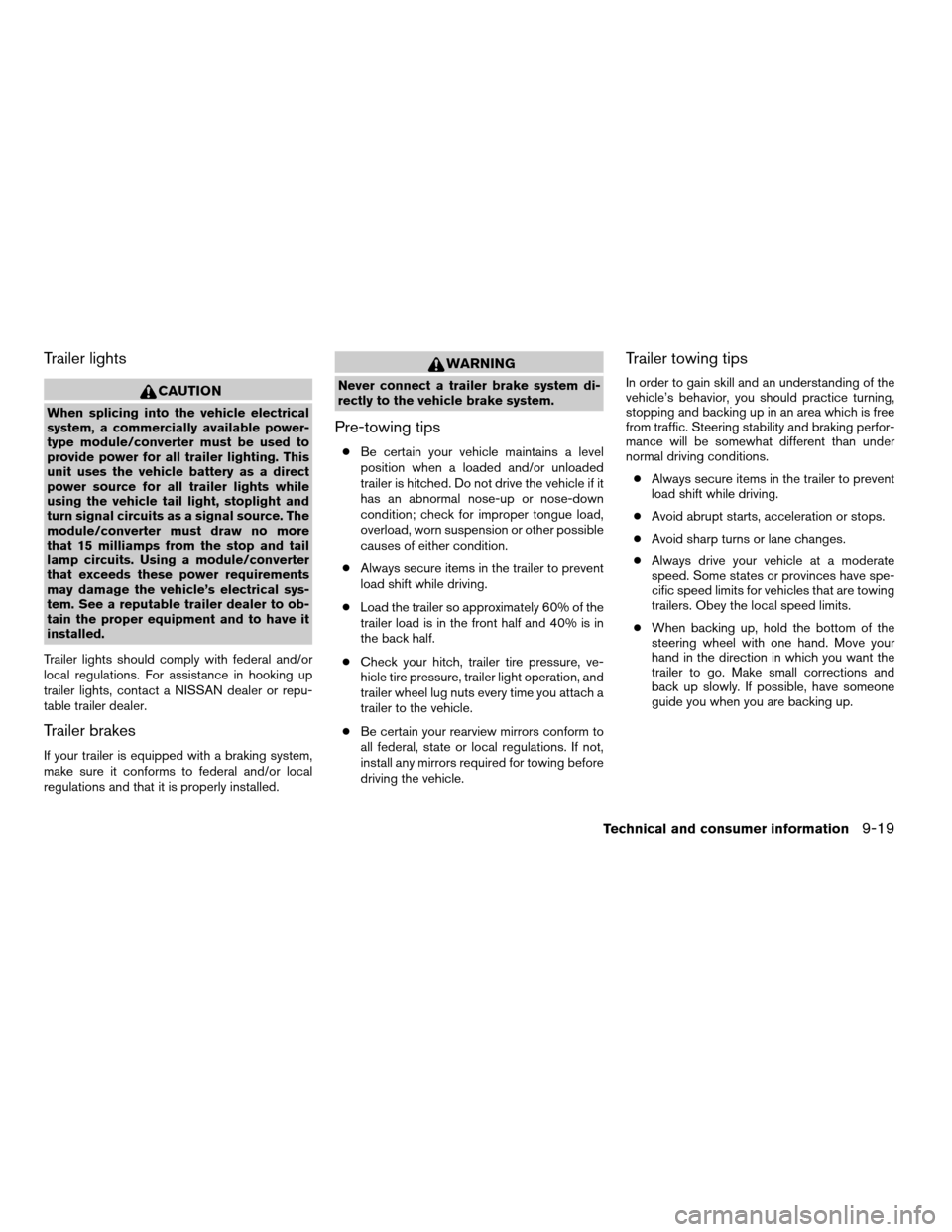
Trailer lights
CAUTION
When splicing into the vehicle electrical
system, a commercially available power-
type module/converter must be used to
provide power for all trailer lighting. This
unit uses the vehicle battery as a direct
power source for all trailer lights while
using the vehicle tail light, stoplight and
turn signal circuits as a signal source. The
module/converter must draw no more
that 15 milliamps from the stop and tail
lamp circuits. Using a module/converter
that exceeds these power requirements
may damage the vehicle’s electrical sys-
tem. See a reputable trailer dealer to ob-
tain the proper equipment and to have it
installed.
Trailer lights should comply with federal and/or
local regulations. For assistance in hooking up
trailer lights, contact a NISSAN dealer or repu-
table trailer dealer.
Trailer brakes
If your trailer is equipped with a braking system,
make sure it conforms to federal and/or local
regulations and that it is properly installed.
WARNING
Never connect a trailer brake system di-
rectly to the vehicle brake system.
Pre-towing tips
cBe certain your vehicle maintains a level
position when a loaded and/or unloaded
trailer is hitched. Do not drive the vehicle if it
has an abnormal nose-up or nose-down
condition; check for improper tongue load,
overload, worn suspension or other possible
causes of either condition.
cAlways secure items in the trailer to prevent
load shift while driving.
cLoad the trailer so approximately 60% of the
trailer load is in the front half and 40% is in
the back half.
cCheck your hitch, trailer tire pressure, ve-
hicle tire pressure, trailer light operation, and
trailer wheel lug nuts every time you attach a
trailer to the vehicle.
cBe certain your rearview mirrors conform to
all federal, state or local regulations. If not,
install any mirrors required for towing before
driving the vehicle.
Trailer towing tips
In order to gain skill and an understanding of the
vehicle’s behavior, you should practice turning,
stopping and backing up in an area which is free
from traffic. Steering stability and braking perfor-
mance will be somewhat different than under
normal driving conditions.
cAlways secure items in the trailer to prevent
load shift while driving.
cAvoid abrupt starts, acceleration or stops.
cAvoid sharp turns or lane changes.
cAlways drive your vehicle at a moderate
speed. Some states or provinces have spe-
cific speed limits for vehicles that are towing
trailers. Obey the local speed limits.
cWhen backing up, hold the bottom of the
steering wheel with one hand. Move your
hand in the direction in which you want the
trailer to go. Make small corrections and
back up slowly. If possible, have someone
guide you when you are backing up.
Technical and consumer information9-19
ZREVIEW COPYÐ2006 Altima(l30)
Owners ManualÐUSA_English(nna)
09/08/05Ðdebbie
X
Page 288 of 304

cAlways block the wheels on both vehicle and
trailer when parking. Parking on a slope is
not recommended; however, if you must do
so, and if your vehicle is equipped with an
automatic transmission, first block the
wheels and apply the parking brake, and
then move the transmission shift selector
lever into the P (Park) position. If you move
the shift selector lever to the P (Park) posi-
tion before blocking the wheels and applying
the parking brake, transmission damage
could occur.
cWhen going down a hill, shift into a lower
gear and use the engine braking effect.
When going up a long grade, downshift the
transmission to a lower gear and reduce
speed to reduce chances of engine over-
loading and/or overheating.
cIf the engine coolant rises to an extremely
high temperature when the air conditioner
system is on, turn off the air conditioner.
Coolant heat can be additionally vented by
opening the windows, switching the fan
control to high and setting the temperature
control to the HOT position.
cTrailer towing requires more fuel than normal
circumstances.
cAvoid towing a trailer for your vehicle’s first
500 miles (805 km) .cFor the first 500 miles that you do tow, do
not drive over 50 MPH (80 km/h) .
cHave your vehicle serviced more often than
at intervals specified in the recommended
Maintenance Schedule in the “NISSAN Ser-
vice and Maintenance Guide”.
cWhen making a turn, your trailer wheels will
be closer to the inside of the turn than your
vehicle wheels. To compensate for this,
make a larger than normal turning radius
during the turn.
cCrosswinds and rough roads will adversely
affect vehicle/trailer handling, possibly caus-
ing vehicle sway. When being passed by
larger vehicles, be prepared for possible
changes in crosswinds that could affect ve-
hicle handling. If swaying does occur, firmly
grip the steering wheel, steer straight ahead,
and immediately (but gradually) reduce ve-
hicle speed. This combination will help sta-
bilize the vehicle. Never increase speed.
cBe careful when passing other vehicles.
Passing while towing a trailer requires con-
siderably more distance than normal pass-
ing. Remember, the length of the trailer must
also pass the other vehicle before you can
safely change lanes.cTo maintain engine braking efficiency and
electrical charging performance, do not use
5th gear (manual transmission) or overdrive
(automatic transmission) .
cAvoid holding the brake pedal down too long
or too frequently. This could cause the
brakes to overheat, resulting in reduced
braking efficiency.
cIncrease your following distance to allow for
greater stopping distances while towing a
trailer. Anticipate stops and brake gradually.
cDo not use cruise control while towing a
trailer.
cCheck your hitch, trailer wiring harness con-
nections, and trailer wheel lug nuts after 50
miles (80 km) of travel and at every break.
cWhen stopped in traffic for long periods of
time in hot weather, put the vehicle in the P
(Park) position.
When towing a trailer, transmission
oil/fluid should be changed more fre-
quently. For additional information, see the
“Maintenance and do-it-yourself” section
earlier in this manual.
9-20Technical and consumer information
ZREVIEW COPYÐ2006 Altima(l30)
Owners ManualÐUSA_English(nna)
09/08/05Ðdebbie
X
Page 296 of 304

Clutch
Clutch fluid.................8-16
C.M.V.S.S. certification label..........9-10
Cold weather driving..............5-21
Console box...................2-33
Control panel buttons..............4-2
Controls
Heater and air conditioner
controls................4-11, 4-20
Coolant
Capacities and recommended
fuel/lubricants.................9-2
Changing engine coolant..........8-9
Checking engine coolant level........8-8
Engine coolant temperature gauge.....2-8
Corrosion protection...............7-5
Cruise control..................5-14
Cup holders...................2-32
D
Daytime running light system
(Canada only)..................2-24
Defroster switch
Rear window and outside mirror defroster
switch....................2-20
Dimensions and weights.............9-8
Dimmer switch for instrument panel......2-24
Display controls (see control panel buttons) . .4-2
Door locks....................3-3
Door open warning light............2-12
Drive belts....................8-19
Driving
Cold weather driving............5-21
Driving with automatic transmission.....5-7Driving with manual transmission.....5-11
Precautions when starting and driving . . .5-2
E
Economy - fuel.................5-16
Emission control information label.......9-11
Emission control system warranty.......9-22
Engine
Before starting the engine..........5-6
Capacities and recommended
fuel/lubricants.................9-2
Changing engine coolant..........8-9
Changing engine oil............8-10
Changing engine oil filter..........8-12
Checking engine coolant level........8-8
Checking engine oil level..........8-9
Engine compartment check locations. . . .8-8
Engine coolant temperature gauge.....2-8
Engine cooling system............8-8
Engine oil...................8-9
Engine oil and oil filter recommendation . .9-5
Engine oil pressure warning light.....2-12
Engine oil viscosity..............9-5
Engine serial number............9-10
Engine specifications.............9-7
Starting the engine..............5-6
Engine oil pressure gauge............2-9
English/Metric button..............4-8
Control panel buttons............4-8
ENTER button..................4-2
Enter button
Control panel buttons............4-2
Event data recorders..............9-24
Exhaust gas (Carbon monoxide)........5-2Eyeglass case..................2-31
F
Flashers
(See hazard warning flasher switch)......2-26
Flat tire......................6-2
Floor mat positioning aid.............7-5
Fluid
Automatic transmission fluid (ATF). . . .8-13
Brake fluid..................8-15
Capacities and recommended
fuel/lubricants.................9-2
Clutch fluid.................8-16
Engine coolant................8-8
Engine oil...................8-9
Power steering fluid.............8-15
Window washer fluid............8-16
F.M.V.S.S. certification label..........9-10
Fog light switch.................2-25
Front air bag system
(See supplemental restraint system).....1-41
Front seats....................1-2
Fuel
Capacities and recommended
fuel/lubricants.................9-2
Fuel economy................5-16
Fuel gauge..................2-8
Fuel octane rating..............9-4
Fuel recommendation............9-3
Fuel-filler door and cap...........3-12
Fuel-filler door lock opener lever......3-12
Fuel consumption gauge............2-10
FUEL ECON button...............4-4
10-2
ZREVIEW COPYÐ2006 Altima(l30)
Owners ManualÐUSA_English(nna)
09/08/05Ðdebbie
X
Page 298 of 304

Lights
Map lights..................2-42
Lock
Child safety rear door lock..........3-5
Door locks..................3-3
Fuel-filler door lock opener lever......3-12
Glove box lock...............2-33
Power door locks...............3-4
Trunk lid lock opener lever.........3-10
Low fuel warning light.............2-13
Low washer fluid warning light.........2-13
Luggage (See vehicle loading information) . .9-12
M
Maint (maintenance) button
Control panel buttons............4-4
Maint (Maintenance) button, control panel
display.......................4-4
Maintenance
General maintenance............8-2
Inside the vehicle...............8-3
Maintenance precautions..........8-5
Outside the vehicle..............8-2
Seat belt maintenance...........1-16
Under the hood and vehicle.........8-4
Malfunction indicator light...........2-14
Manual front seat adjustment..........1-2
Map lights....................2-42
Map pocket...................2-30
Meters and gauges................2-3
Instrument brightness control.......2-24
Mirror
Inside mirror.................3-15
Outside mirrors...............3-15Vanity mirror.................3-14
Multi-remote control system
(See remote keyless entry system).......3-5
N
NISSAN vehicle immobilizer
system................2-17, 3-2, 5-5
O
Octane rating (See fuel octane rating).....9-4
Odometer.....................2-4
Oil
Capacities and recommended
fuel/lubricants.................9-2
Changing engine oil............8-10
Changing engine oil filter..........8-12
Checking engine oil level..........8-9
Engine oil...................8-9
Engine oil and oil filter recommendation . .9-5
Engine oil viscosity..............9-5
Outside mirrors.................3-15
Overheat
If your vehicle overheats...........6-8
Owner’s manual order form..........9-24
Owner’s manual/service manual order
information....................9-24
P
Parking
Parking brake check............8-25Parking brake operation..........5-14
Parking/parking on hills...........5-17
Power
Power door locks...............3-4
Power outlet.................2-28
Power rear windows............2-39
Power steering fluid.............8-15
Power steering system...........5-18
Power windows...............2-38
Rear power windows............2-39
Precautions
Maintenance precautions..........8-5
Precautions on child restraints . . .1-17, 1-29
Precautions on seat belt usage.......1-9
Precautions on supplemental restraint
system....................1-34
Precautions when starting and driving . . .5-2
PREV button...................4-3
Prev button
Control panel buttons............4-3
Programmable features...........4-3, 4-6
Push starting...................6-8
R
Radio
Car phone or CB radio...........4-41
Compact Disc (CD) changer.......4-38
FM-AM radio with compact disc (CD)
changer...................4-30
FM-AM radio with compact disc (CD)
player....................4-25
Readiness for inspection maintenance (I/M)
test........................9-23
Rear power windows..............2-39
10-4
ZREVIEW COPYÐ2006 Altima(l30)
Owners ManualÐUSA_English(nna)
09/08/05Ðdebbie
X
Page 299 of 304

Rear seat.....................1-6
Rear window and outside mirror defroster
switch......................2-20
Recorders
Event data..................9-24
Refrigerant recommendation..........9-6
Registering your vehicle in another country. . .9-9
Remote keyless entry system..........3-5
Reporting safety defects (US only)......9-23
S
Safety
Child safety rear door lock..........3-5
Child seat belts...........1-17, 1-29
Reporting safety defects (US only). . . .9-23
Seat adjustment
Front manual seat adjustment........1-2
Front power seat adjustment........1-4
Rear seat adjustment.............1-6
Seat belt
Child safety.................1-11
Infants and small children.........1-12
Injured Person................1-13
Larger children...............1-12
Precautions on seat belt usage.......1-9
Pregnant women..............1-13
Seat belt extenders.............1-16
Seat belt maintenance...........1-16
Seat belts...................1-9
Shoulder belt height adjustment......1-15
Three-point type with retractor.......1-13
Seat belt warning light.............2-13
Seatback pockets................2-31Seats
Adjustment..................1-2
Front seats..................1-2
Heated seats................2-27
Manual front seat adjustment........1-2
Rear seat...................1-6
Security system (NISSAN vehicle immobilizer
system) , engine start.........2-17, 3-2, 5-5
Self-adjusting brakes..............8-26
Service manual order form...........9-24
Servicing air conditioner............4-22
Setting button
SETTING button...............4-6
Shift lock release................5-10
Shifting
Automatic transmission...........5-8
Manual transmission............5-12
Shoulder belt height adjustment........1-15
Spark plug replacement............8-20
Speedometer...................2-4
Spotlights (See map light)...........2-42
SRS warning label...............1-48
Starting
Before starting the engine..........5-6
Jump starting.................6-6
Precautions when starting and driving . . .5-2
Push starting.................6-8
Starting the engine..............5-6
Startup Screen
Control panel buttons............4-3
Startup screen display..............4-3
Steering
Power steering fluid.............8-15
Power steering system...........5-18
Stop light....................8-32
Storage.....................2-30Storage tray...................2-35
Sunglasses case................2-31
Sunglasses holder...............2-31
Sunroof.....................2-40
Supplemental air bag warning light . . .1-49, 2-13
Supplemental front impact air bag system . .1-41
Supplemental restraint system
Information and warning labels.......1-48
Precautions on supplemental restraint
system....................1-34
Supplemental restraint system
(Supplemental air bag system).........1-34
Switch
Autolight switch...............2-22
Automatic power window switch.....2-39
Fog light switch...............2-25
Hazard warning flasher switch.......2-26
Headlight and turn signal switch......2-21
Headlight control switch..........2-21
Ignition switch................5-4
Power door lock switch...........3-4
Rear window and outside mirror defroster
switch....................2-20
Traction control system (TCS) off
switch....................2-28
Turn signal switch..............2-25
Windshield wiper and washer switch . . .2-19
T
Tachometer....................2-7
Temperature gauge
Engine coolant temperature gauge.....2-8
Theft (NISSAN vehicle immobilizer system) ,
engine start..............2-17, 3-2, 5-5
10-5
ZREVIEW COPYÐ2006 Altima(l30)
Owners ManualÐUSA_English(nna)
09/08/05Ðdebbie
X