2006 MINI Hardtop 2 Door belt
[x] Cancel search: beltPage 53 of 168
51
OVERVIEW REPAIRS OPERATIONCONTROLS DATA INDEX
TRANSPORTING CHILDREN SAFELY
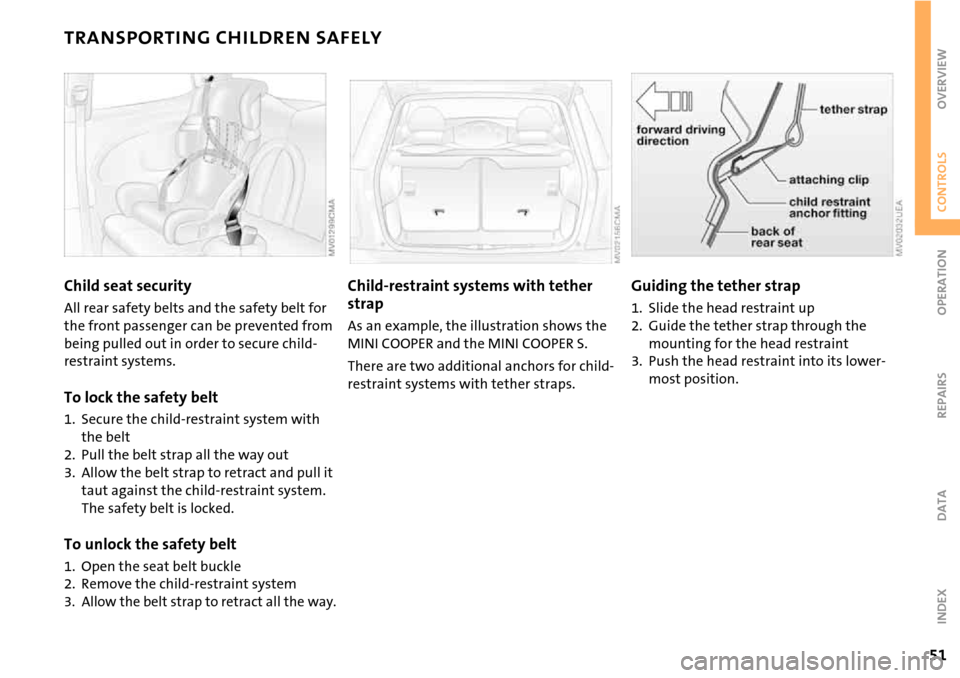
Child seat security
All rear safety belts and the safety belt for
the front passenger can be prevented from
being pulled out in order to secure child-
restraint systems.
To lock the safety belt
1. Secure the child-restraint system with
the belt
2. Pull the belt strap all the way out
3. Allow the belt strap to retract and pull it
taut against the child-restraint system.
The safety belt is locked.
To unlock the safety belt
1. Open the seat belt buckle
2. Remove the child-restraint system
3. Allow the belt strap to retract all the way.
Child-restraint systems with tether
strap
As an example, the illustration shows the
MINI COOPER and the MINI COOPER S.
There are two additional anchors for child-
restraint systems with tether straps.
Guiding the tether strap
1. Slide the head restraint up
2. Guide the tether strap through the
mounting for the head restraint
3. Push the head restraint into its lower-
most position.
Page 77 of 168

75
OVERVIEW REPAIRS OPERATIONCONTROLS DATA INDEX
AIRBAGS
The following airbags are located under the
marked covers:
MINI
1 Side airbags in the backrests
2 Head airbags
3 Front airbags
MINI Convertible
1 Side/head airbags in the backrests
3 Front airbags
Protective effect
Comply with the instructions on
page42, or the occupants' personal
safety will be diminished.<
The front airbags supplement the safety
belts by providing additional protection for
the driver and front passenger in the event
of a frontal collision in which the protec-
tion afforded by the belts alone may no
longer be sufficient. When needed, the
head and side airbags help to furnish pro-
tection in the event of side impact. Each of
the side airbags is designed to help support
the seat occupant's upper body. The corre-
sponding side/head airbag in the MINI Con-
vertible or the head airbag in the MINI sup-
ports the head.
The airbags are designed to not be trig-
gered in certain types of collisions, e.g. in
minor accidents or rear impacts.
For information on the ideal seating posi-
tion, refer to page42.
Do not apply adhesive materials to
the cover panels of the airbags, cover
them or modify them in any other way. Do
not fit covers, cushions or other items to
the front seats that have not been specially
approved for seats with integrated side air-
bags. Do not hang clothing, e. g. jackets,
over the backrests.
Do not attempt to remove the airbag
restraint system from the vehicle. Do not
touch the individual components directly after the system has been triggered; other-
wise there is a danger of burns. In the event
of malfunctions, deactivation or deploy-
ment of the airbag restraint system, have
the system checked, repaired or disassem-
bled only by a MINI Dealer or a workshop
with specially trained personnel working in
accordance with the specifications of the
MINI manufacturer and having the neces-
sary permits for handling explosive devices.
Unprofessional attempts to service the sys-
tem could lead to failure in an emergency
or undesired airbag activation, either of
which could result in personal injury.<
Warning notices and information regard-
ing airbags can also be found on the sun
visors.
Automatic deactivation of the front
passenger airbags
An analysis of the impression in the front
passenger seat cushion determines
whether and how the seat is occupied. The
system correspondingly activates or deacti-
vates the front and side airbags for the
front passenger.
The indicator lamp above the interior
rearview mirror shows the current
status of the front passenger airbags, deac-
Page 78 of 168

76
AIRBAGS
tivated or activated, refer to Functional sta-
tus of the front passenger airbags below. <
Before transporting a child on the
front passenger seat, read the safety
notes and instructions under Transporting
children safely, refer to page50.
Adolescents and adults sitting in certain
positions could also deactivate the front
and side airbags for the front passenger;
the indicator lamp for the front passenger
airbags comes on. In such cases, the occu-
pant should change his or her sitting posi-
tion so that the front passenger airbags are
activated and the indicator lamp goes out.
If the airbags are not activated although
the seat occupant has changed his or her
position, have the occupant sit on a rear
seat. Do not attach covers, cushions, ball
mats or other items to the front passenger
seat unless they are specifically recom-
mended by the manufacturer of your MINI.
Do not place any objects under the seat
which could press against the seat from
below. Otherwise, a correct analysis of the
seat cushion is not ensured.<
Functional status of the front
passenger airbags
As an example, the illustration shows the
indicator lamp for front passenger airbags
on the headliner of the MINI.
In accordance with whether and how the
front passenger seat is occupied, the indi-
cator lamp for the front passenger airbags
shows the functional status of the front
and side airbags for the front passenger.
The indicator lamp shows whether the
front passenger airbags are activated or
deactivated.
>The indicator lamp comes on as intended
when a child in a specially designated
child-restraint system is detected on the
front passenger's seat.
The front and side airbags for the front
passenger are not activated.
>The indicator lamp does not come on
when the system detects a person of suf-
ficient size sitting correctly on the seat,
for example. The front and side airbags
for the front passenger are activated.
>The indicator lamp does not come on
when the seat is empty. However, the
front and side airbags for the front pas-
senger are not activated.
Operational readiness of the airbag
system
Starting from ignition key
position 1, the warning lamp in the
display elements lights up briefly
for confirmation that the entire airbag sys-
tem and the seat belt tensioners are opera-
tional.
Airbag system malfunctioning
>The warning lamp does not come on
along with ignition key position 1
>The warning lamp stays lit continuously.
In the event of a malfunction, have
the airbag system checked immedi-
ately. Otherwise, there is a risk that the sys-
tem will not function as intended in an
accident of sufficient severity.<
Page 94 of 168

92
LOADING CARGO
Stowing cargo
>Place heavy cargo as far forward as possi-
ble, directly behind the backrests, and as
low as possible
>Cover sharp edges and corners
>Do not pile objects higher than the top
edges of the backrests.
For very heavy cargo when the rear seat is
unoccupied, fasten each safety belt in the
opposite buckle. This provides additional
stabilization for the backrests.Securing the load
As an example, the illustration shows the
luggage compartment of the MINI.
>Secure smaller and lighter items using
the luggage compartment net
* or elas-
tic straps
>Secure larger and heavier items with
load-securing devices
*. Lashing eyelets
are provided at the inner corners of the
luggage compartment for attaching
these load-securing devices.
Comply with the information enclosed
with the load-securing devices.
Page 107 of 168

105
OVERVIEW REPAIRSOPERATIONCONTROLS DATA INDEX
TIRE CODING
Knowing the tire code on the tire's sidewall
makes it easier for you to choose and iden-
tify the correct tires.
Tire size
e.g. 205/45 R 17 84 V
Nominal width in mm
Cross-sectional
ratio in %
Radial belt construction
Rim diameter in inches
Load index,
not on ZR tires
Speed code letter,
in front of the R on ZR tires
Speed code letters:
Q = up to 100 mph / 160 km/h
T = up to 118 mph / 190 km/h
H = up to 131 mph / 210 km/h
V = up to 150 mph / 240 km/h
W= up to 167 mph / 270 km/h
Tire Identification Number
Tires with DOT codes meet the guidelines
of the US Department of Transportation.DOT code:
e.g. DOT xxxx xxx 3505
Manufacturer's code
for tire make
Tire size and
tire version
Tire age
Tire age
The date on which the tire was manufac-
tured is indicated by the code on the side-
wall:
DOT...3505 indicates that the tire was man-
ufactured in Week 35 of the year 2005.
The manufacturer of your MINI recom-
mends replacing all tires after 6 years at
the latest, even if a tire service life of
10 years is possible.
Uniform Tire Quality Grading
Quality grades can be found where applica-
ble on the tire sidewall between tread
shoulder and maximum section width.
For example:
Treadwear 200 Traction AA
Temperature A
DOT quality grades
Tread wear
Traction AA A B C
Temperature A B C
All passenger car tires must conform
to Federal Safety Requirements in
addition to these grades.<
Tread wear
The tread wear grade is a comparative rat-
ing based on the wear rate of the tire when
tested under controlled conditions on a
specified government test course.
For example, a tire graded 150 would wear
one and one-half, 1γ, times as well on the
government course as a tire graded 100.
The relative performance of tires depends
upon the actual conditions of their use,
however, and may depart significantly
from the norm due to variations in driving
habits, service practices and differences in
road characteristics and climate.
Page 123 of 168

121
OVERVIEW REPAIRSOPERATIONCONTROLS DATA INDEX
CARING FOR YOUR VEHICLE
ner, heavy-duty grease remover, fuel or
similar
>Wood paneling
*:
Please clean wood paneling and other
wood parts only with a damp cloth. Dry
off with a soft cloth
>Safety belts:
Only clean using mild soap, leaving the
belts fitted.
Do not dry clean, as the fabric can be
destroyed.
Always roll up safety belts only when
dry.
Dirty safety belts prevent unrolling and
thus negatively affect safety
>Floor carpets and floor mats
*:
If heavily soiled, clean using interior
cleaner. Floor mats can be removed to
allow the interior to be cleaned
>Wiper blades:
Clean with soapy water. Replace wiper
blades twice a year, before and after the
cold season. This is particularly impor-
tant on vehicles fitted with a rain sensor.
Caring for leather* and imitation
leather
The leather and imitation leather used by
the manufacturer of your MINI are high
quality products processed using state-of-
the-art methods and will retain their qual-ity level for many years if cared for prop-
erly.
Regular cleaning and care are necessary, as
dust and road dirt scratch in pores and
creases and lead to heavy wear as well as
premature brittleness of the leather and
imitation leather surface.
This is why you should use a cloth or vac-
uum cleaner to remove dust on a regular
basis.
Since dirt and oil slowly destroy the protec-
tive layer of the leather and imitation
leather, a treatment with a leather care
product is necessary twice a year. This pre-
serves the quality of the leather and pre-
vents electrostatic charging.
Cleaning agents can contain hazard-
ous or health-damaging substances.
For this reason, always observe the warn-
ings on the package. For interior cleaning,
always open the doors or windows of the
vehicle.
Do not use any products that are not
intended for cleaning the vehicle.
vertible top largely depend on the proper
care and operation of the convertible top.
You should therefore observe the following
notes in particular:
>Whenever possible, park your vehicle in
the shade to protect it from intense sun-
light
>Do not fold the convertible top when it is
wet, dirty or frozen; otherwise water
marks, moisture stains and chafing could
result
>If the vehicle is parked in an enclosed
area for a longer period of time, make
sure that there is sufficient ventilation
>Remove bird droppings immediately
because they have corrosive properties.
Never use spot removers, paint thin-
ner, solvents, cleaning fuel or similar
since these products can destroy the rubber
seals and cause leaks.<
Page 156 of 168

EVERYTHING FROM A TO Z
154
A
ABS Antilock Brake System71
indicator lamp17,18
Accessories, refer to Your
individual vehicle6
Activated-charcoal filter83
Adjusting interior
temperature79,82
Air circulation, refer to
Recirculated air mode79,82
Air conditioning system78
Air distribution
air conditioning system79
automatic climate control82
Air outlets, refer to
Ventilation80,83
Air pressure, refer to Tire
inflation pressure101
Air volume
air conditioning system79
automatic climate control82
Airbags75
passenger airbag status
lamp76
safe seating position42
warning lamp18
AKI, refer to Fuel quality99
All Season traction Control
(ASC)71
indicator lamps17,18 All-season tires, refer to Winter
tires110
Antenna120
Antifreeze
coolant115
washer fluid63
Antilock Brake System (ABS)71
indicator lamp17,
18
Anti-theft system24
Approved axle load, refer to
Weights149,150
Approved engine oils115
Approved gross vehicle weight,
refer to Weights149,150
ASC All Season traction
Control71
indicator lamps17,18
Ashtray85
Assistant systems, refer to
All Season traction Control
(ASC)71
Dynamic Stability Control
(DSC)71
AUTO program, refer to
Automatic air distribution82
Automatic
air distribution82
air volume82
cruise control64
Automatic car washes119
Automatic climate control81 Automatic transmission with
Steptronic
ignition53
indicator lamp57
interlock53
selector lever lock56
shiftlock56
towing142
tow-starting143
Average consumption70
setting units70
Average speed70
setting units70
Axle loads, refer to
Weights149,150
B
Backrests, refer to
Adjusting seats44
Backup lamp
bulb replacement129
Bar, towing142
Base plate for telephone or
mobile phone84
Battery138
charging138
disposal138
indicator lamp16
jump-starting140
power failure138
Battery care68,118 Belts, refer to Safety belts46
Beverage holders85
Black ice, refer to Temperature
warning69
Blower
air conditioning system79
automatic climate control82
Blower, refer to Air volume79
Blowers, refer to Draft-free
ventilation80,83
Bonnet111
indicator lamp17
Bottle holders, refer to
Beverage holders85
Brake discs
brake system97
break-in procedures96
Brake fluid117
level117
warning lamp16
Brake lamps, bulb
replacement129
Brake pads117
break-in procedures96
warning lamp18
Brake system117
brake fluid117
brake pads117
break-in procedures96
disc brakes97
warning lamp17
Page 159 of 168

EVERYTHING FROM A TO Z
157
OVERVIEW REPAIRS OPERATION CONTROLS DATA INDEX
DSC Dynamic Stability
Control71
indicator lamp17
Dynamic Stability Control
(DSC)71
indicator lamp17
E
Easy entry to the rear45
EBD Electronic Brake Force
Distribution71
Electric glass sunroof33
Electric power windows31
initializing32
Electrical malfunction
automatic transmission with
Steptronic58
convertible top38
door lock27
driver's door27
fuel filler door100
glass sunroof, electric34
tailgate30
Electronic Brake Force
Distribution (EBD)71
Electronic Stability Program
(ESP), refer to
Dynamic Stability Control
(DSC)71 Emergency operation, refer to
Manual operation
convertible top38
driver's door27
fuel filler door100
glass sunroof, electric34
tailgate30
transmission lock, automatic
transmission with
Steptronic56
Engine
break-in procedures96
data146
electronics18
indicator lamp18
speed68
starting53
switching off54
Engine compartment
MINI COOPER and MINI
COOPER Convertible112
MINI COOPER S and MINI
COOPER S Convertible113
Engine coolant115
Engine data146
Engine oil114
capacity151
indicator/warning lamp16
recommended oils115
specified oil grades115 Engine oil level114
indicator/warning lamp16
Engine oil level, checking114
Engine oil pressure, indicator/
warning lamp16
Engine output, refer to Engine
data146
Entry to the rear45
ESP Electronic Stability
Program, refer to Dynamic
Stability Control (DSC)71
Exhaust system, refer to
Hot exhaust system98
Exterior mirrors48
folding in and out48
Eyelet, for towing and tow-
starting141
F
Failure of an electrical
consumer138
Fastening safety belts, refer to
Safety belts46
Filling canister, refer to MINI
Mobility System136
Filling hose, refer to MINI
Mobility System136
Filter, refer to
Microfilter80
Microfilter/Activated-
charcoal filter83 Flat
Run Flat tires
74
Flat tire
Flat Tire Monitor73,74
MINI Mobility System135
space-saver spare tire131
Flat Tire Monitor73
indicator lamp17
Flat tire, refer to Changing
tires133
Flat tire, refer to Tire
condition106
Floor mats121
Fog lamps61
indicator lamp61
Foldable rear backrest88,89
Folding roof, refer to
Convertible top with
integrated sliding sunroof35
Foot braking, refer to General
driving notes97
Front airbags75
Front turn signal indicators,
bulb replacement128
Fuel99
average consumption70
gauge66,67
quality99
tank capacity151