Page 71 of 480
70 Safety and SecurityOccupant safetyFront airbags
Driver and passenger airbags are de-
ployed:�
in the event of certain frontal impacts
�
if impact exceeds a preset deployment
threshold
�
independently of the head-thorax air-
bags
The airbags will not deploy in impacts
which do not exceed the system’s deploy-
ment thresholds. You will then be protect-
ed by the fastened seat belts.
The passenger airbag will only be deployed
if:
�
the passenger seat is occupied
�
the 7 indicator lamp on the glove
box is not lit (
�page 78)
�
the impact exceeds a preset deploy-
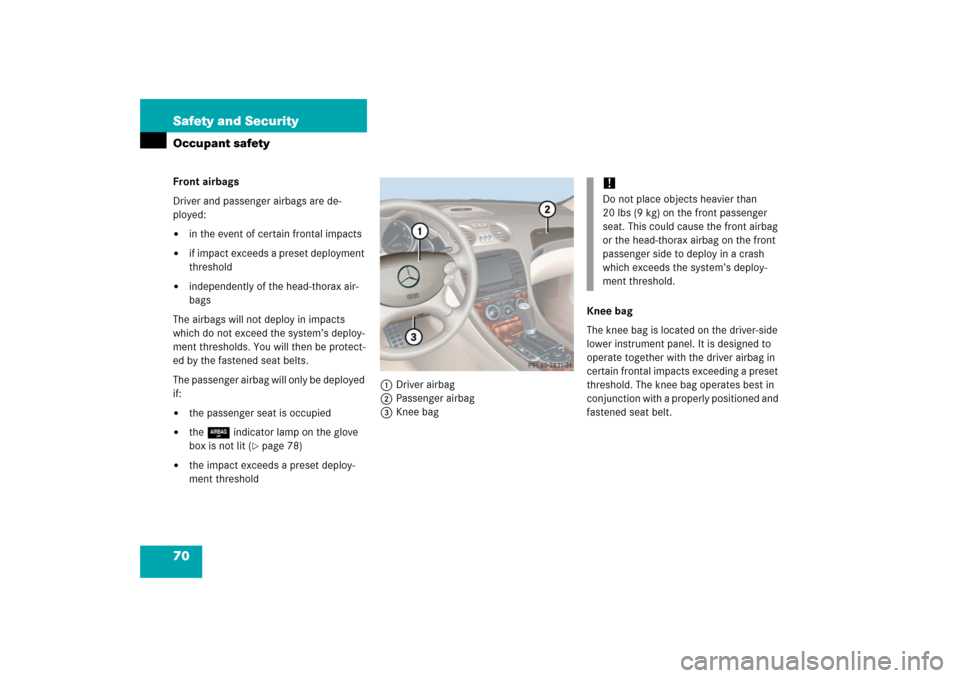
ment threshold1Driver airbag
2Passenger airbag
3Knee bagKnee bag
The knee bag is located on the driver-side
lower instrument panel. It is designed to
operate together with the driver airbag in
certain frontal impacts exceeding a preset
threshold. The knee bag operates best in
conjunction with a properly positioned and
fastened seat belt.
!Do not place objects heavier than
20 lbs (9 kg) on the front passenger
seat. This could cause the front airbag
or the head-thorax airbag on the front
passenger side to deploy in a crash
which exceeds the system’s deploy-
ment threshold.
Page 75 of 480

74 Safety and SecurityOccupant safety
Emergency tensioning device (ETD),
seat belt force limiter
The seat belts are equipped with emergen-
cy tensioning devices, belt force limiters,
and automatic comfort-fit.The ETD is designed to activate in the fol-
lowing cases:
�
in frontal or rear-end impacts exceed-
ing a preset severity level
�
if the restraint systems are operational
and functioning correctly, see 1 in-
dicator lamp (
�page 64).
In an impact, emergency tensioning devic-
es remove slack from the belts in such a
way that the seat belts fit more snugly
against the body. Belt force limiters reduce
the force exerted by the seat belts on oc-
cupants during a crash.
�
Never wear the shoulder belt under your
arm, against your neck or off your shoul-
der. In a crash, your body would move
too far forward. That would increase the
chance of head and neck injuries. The
belt would also apply too much force to
the ribs or abdomen, which could se-
verely injure internal organs such as
your liver or spleen.
�
Never wear belts over rigid or breakable
objects in or on your clothing, such as
eyeglasses, pens, keys, etc., as these
might cause injuries.
�
Position the lap belt as low as possible
on your hips and not across the abdo-
men. If the belt is positioned across your
abdomen, it could cause serious injuries
in a crash.
�
Never use a seat belt for more than one
person at a time. Do not fasten a seat
belt around a person and another per-
son or other objects.
�
Belts should not be worn twisted. In a
crash, you would not have the full width
of the belt to manage impact forces. The
twisted belt against your body could
cause injuries.
�
Pregnant women should also use a
lap-shoulder belt. The lap belt portion
should be positioned as low as possible
on the hips to avoid any possible pres-
sure on the abdomen.
�
Never place your feet on the instrument
panel, dashboard or on the seat. Always
keep both feet on the floor in front of the
seat.
iThe ETDs will only activate if the re-
spective seat belt is fastened (latch
plate properly inserted into buckle).
��
Page 84 of 480

83 Safety and Security
Driving safety systems
ABS
The Antilock Brake System (ABS) regulates
the brake pressure so that the wheels do
not lock during braking. This allows you to
maintain the ability to steer your vehicle.
The ABS is functional above a speed of
approximately 5 mph (8 km/h) indepen-
dent of road surface conditions.
On slippery road surfaces, the ABS will re-
spond even to light brake pressure. The - indicator lamp in the instrument
cluster comes on when you switch on the
ignition. It goes out when the engine is run-
ning.
Braking
If the ABS activates during braking, the
ABS/ESP
® warning lamp v in the in-
strument cluster dial flashes. Because of
the electro-hydraulic brake system, you
will not feel any pulsation in the brake ped-
al.
�
Keep firm and steady pressure on the
brake pedal.
Continuous, steady brake pedal pressure
yields the advantages provided by the ABS,
namely braking power and the ability to
steer the vehicle.The ABS/ESP
® warning lamp v flashes
whenever the ABS is activated which can
be an indication of hazardous road condi-
tions and functions as a reminder to take
extra care while driving.
Emergency brake maneuver
�
Keep continuous, full pressure on the
brake pedal.
Warning!
G
Do not pump the brake pedal. Use firm,
steady brake pedal pressure instead. Pump-
ing the brake pedal defeats the purpose of
the ABS and significantly reduces braking
effectiveness.
Warning!
G
When the ABS is malfunctioning, the BAS
and the ESP
® are also switched off.
When the ABS is malfunctioning, the wheels
may lock during hard braking, reducing
steering capability and extending the brak-
ing distance.
Page 86 of 480

85 Safety and Security
Driving safety systems
ESP
®
The Electronic Stability Program (ESP
®) is
operational as soon as the engine is run-
ning and monitors the vehicle's traction
(force of adhesive friction between the
tires and the road surface) and handling.
The ESP
® recognizes when a wheel is spin-
ning or if the vehicle starts to skid. By ap-
plying brakes to the appropriate wheel and
by limiting engine output, the ESP
® works
to stabilize the vehicle. The ESP
® is espe-
cially useful while driving off and on wet or
slippery road surfaces. The ESP® also sta-
bilizes the vehicle during braking maneu-
vers.
The ABS/ESP
® warning lamp v in the
instrument cluster (
�page 25) flashes
when the ESP
® is engaged.
The ABS/ESP® warning lamp v in the
instrument cluster comes on when you
switch on the ignition. It goes out when the
engine is running.
Warning!
G
Never switch off the ESP
® when you see the
ABS/ESP
® warning lamp v flashing in
the instrument cluster. In this case proceed
as follows:
�
While driving off, apply as little throttle
as possible.
�
While driving, ease up on the accelera-
tor.
�
Adapt your speed and driving style to
the prevailing road conditions.
Failure to observe these guidelines could
cause the vehicle to skid.
The ESP
® cannot prevent accidents result-
ing from excessive speed.
Warning!
G
The ESP
® cannot prevent the natural laws of
physics from acting on the vehicle, nor can
it increase the traction afforded. The ESP
®
cannot prevent accidents, including those
resulting from excessive speed in turns, or
hydroplaning. Only a safe, attentive, and
skillful driver can prevent accidents. The ca-
pabilities of an ESP
® equipped vehicle must
never be exploited in a reckless or danger-
ous manner which could jeopardize the us-
er’s safety or the safety of others.
iThe ESP
® will only function properly if
you use wheels of the recommended
tire size (�page 434).
Page 88 of 480
87 Safety and Security
Driving safety systems
The switch is located in the lower part of
the center console.
1ESP
® switch
�
Press ESP
® switch1 until the
ABS/ESP® warning lamp v in the
instrument cluster comes on.
ESP
® is deactivated.Switching on the ESP
®
�
Press ESP
® switch1.
The ABS/ESP® warning lamp v in
the instrument cluster goes out.
You are now again in normal driving
mode with the ESP
® switched on.
Warning!
G
When the ABS/ESP
® warning lampv is
illuminated continuously, the ESP
® is
switched off.
Adapt your speed and driving to the prevail-
ing road conditions and to the non-operating
status of the ESP
®.
!Avoid spinning of a drive wheel for an
extended period with the ESP
®
switched off. This may cause serious
damage to the drivetrain which is not
covered by the Mercedes-Benz Limited
Warranty.
Page 89 of 480

88 Safety and SecurityDriving safety systemsElectro-hydraulic brake system
The electro-hydraulic brake system com-
bines a hydraulic brake circuit with elec-
tronically controlled brake servo
assistance. You have increased braking
safety and improved braking comfort.Warning!
G
Never ignore a brake malfunction indicated
in the speedometer display, for example by
the;(USA only) or3(Canada only)
indicator lamp. Refer to the “Practical hints”
section (
�page 334). Also read and ob-
serve the messages in the instrument clus-
ter multifunction display (
�page 361).
Warning!
G
The electro-hydraulic brake system requires
electrical power to operate.
A malfunction in the vehicle’s power supply
or electrical system may impair brake sys-
tem operation and switch it into its emer-
gency operation mode. In such a case, the
red brake warning lamp (
�page 334)
comes on and warning messages
(
�page 361) appear in the multifunction
display while driving. To brake, the driver
must then apply significantly greater brake
pedal pressure and depress the pedal much
further to obtain the expected braking ef-
fect. If necessary, apply full pressure to the
brake pedal. Brakes are only applied to the
front wheels. Stopping distance is in-
creased!
If there is a malfunction in the
electro-hydraulic brake system, we recom-
mend that the vehicle be transported with
all wheels off the ground using flatbed or ap-
propriate wheel lift/dolly equipment.
A tow bar must be used if circumstances do
not permit the use of the recommended
towing methods and the vehicle requires
towing with all four wheels on the ground.
Towing the vehicle with all four wheels on
the ground is only permissible for distances
up to 30 miles (50 km) and at a speed not to
exceed 30 mph (50 km/h). For more infor-
mation, see “Towing the vehicle”
(�page 421).
Page 96 of 480
95 Controls in detail
Locking and unlocking
Seats
Memory function
Lighting
Instrument cluster
Control system
Automatic transmission
Good visibility
Automatic climate control
Power windows
Retractable hardtop
Driving systems
Useful features
Page 124 of 480

123 Controls in detail
Lighting
� Lighting
For information on how to switch on the
headlamps and use the turn signals, see
“Switching on headlamps” (
�page 53)
and “Turn signals” (
�page 53).
Exterior lamp switch
The exterior lamp switch is located on the
dashboard to the left of the steering wheel.
MOff
Daytime running lamp mode
(
�page 125)
UAutomatic headlamp mode
Daytime running lamp mode
(�page 125)CParking lamps (also tail lamps, li-
cense plate lamps, side marker
lamps, instrument panel lamps)
Canada only: When the engine is
running, the low beam headlamps
are also switched on.
BLow beam headlamps (or high
beam headlamps when the combi-
nation switch is pushed forward)
and parking lamps
ˆStanding lamps, right (turn left one
stop)
‚Standing lamps, left (turn left two
stops)
CIndicator lamp for parking lamps
‡Indicator lamp for front fog lamps
†Indicator lamp for rear fog lamp
iIf you drive in countries where vehicles
drive on the other side of the road than
the country in which the vehicle is reg-
istered, you must have the headlamps
modified for symmetrical low beams.
Relevant information can be obtained
at any authorized Mercedes-Benz
Center.

