Page 325 of 539
324 OperationAt the gas station�
Replace the fuel cap by turning it
clockwise until it audibly engages.
�
Close the fuel filler flap.
Check regularly and before a long trip�
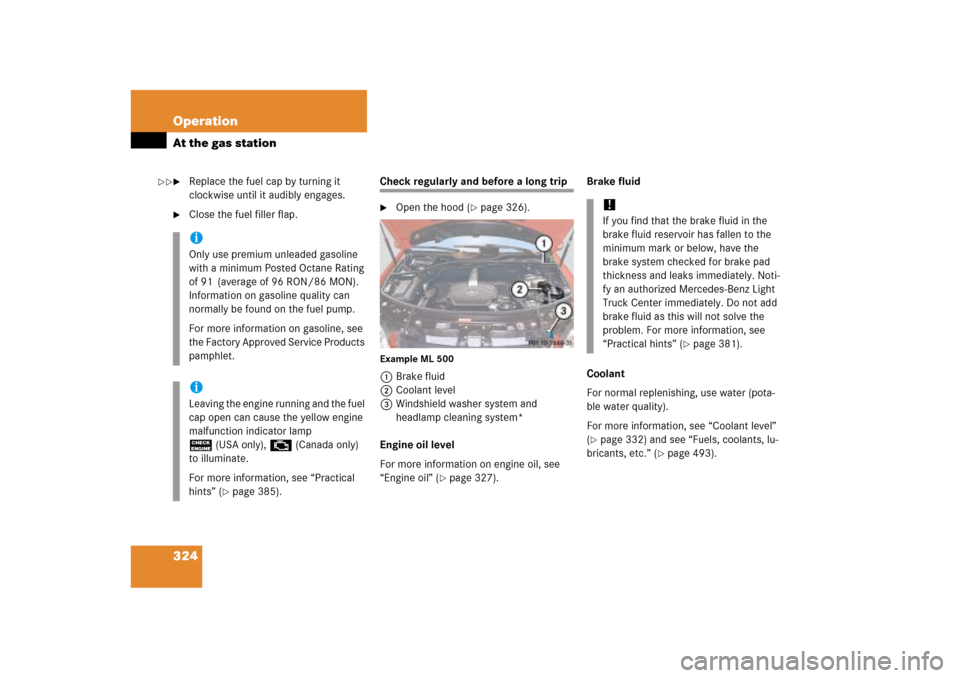
Open the hood (
�page 326).
Example ML 5001Brake fluid
2Coolant level
3Windshield washer system and
headlamp cleaning system*
Engine oil level
For more information on engine oil, see
“Engine oil” (
�page 327).Brake fluid
Coolant
For normal replenishing, use water (pota-
ble water quality).
For more information, see “Coolant level”
(
�page 332) and see “Fuels, coolants, lu-
bricants, etc.” (
�page 493).
iOnly use premium unleaded gasoline
with a minimum Posted Octane Rating
of 91 (average of 96 RON/86 MON).
Information on gasoline quality can
normally be found on the fuel pump.
For more information on gasoline, see
the Factory Approved Service Products
pamphlet.iLeaving the engine running and the fuel
cap open can cause the yellow engine
malfunction indicator lamp
?(USA only), ±(Canada only)
to illuminate.
For more information, see “Practical
hints” (
�page 385).
!If you find that the brake fluid in the
brake fluid reservoir has fallen to the
minimum mark or below, have the
brake system checked for brake pad
thickness and leaks immediately. Noti-
fy an authorized Mercedes-Benz Light
Truck Center immediately. Do not add
brake fluid as this will not solve the
problem. For more information, see
“Practical hints” (
�page 381).
��
Page 333 of 539
332 OperationEngine compartment�
Unscrew filler cap1 from filler neck.
�
Add engine oil as required. Be careful
not to overfill with oil.
Be careful not to spill any oil when adding.
Avoid environmental damage caused by oil
entering the ground or water.
�
Screw filler cap1 back on filler neck.
For more information on engine oil, see
“Technical data” (
�page 481).
Transmission fluid level
The transmission fluid level does not need
to be checked. If you notice transmission
fluid loss or gear shifting malfunctions,
have an authorized Mercedes-Benz Light
Truck Center check the automatic trans-
mission.Coolant level
The engine coolant is a mixture of water
and anticorrosion/antifreeze. To check
the coolant level, the vehicle must be
parked on level ground and the engine
must be cool.
!Excess oil must be siphoned or drained
off. It could cause damage to the
engine and catalytic converter not
covered by the Mercedes-Benz Limited
Warranty.
Warning!
G
In order to avoid any possibly serious burns:�
Use extreme caution when opening the
hood if there are any signs of steam or
coolant leaking from the cooling system,
or if the coolant temperature gauge indi-
cates that the coolant is overheated.
�
Do not remove pressure cap on coolant
reservoir if coolant temperature is
above 158°F (70°C). Allow engine to
cool down before removing cap. The
coolant reservoir contains hot fluid and
is under pressure.
�
Using a rag, slowly open the cap approx-
imately
1/2 turn to relieve excess pres-
sure. If opened immediately, scalding
hot fluid and steam will be blown out un-
der pressure.
�
Do not spill antifreeze on hot engine
parts. Antifreeze contains ethylene gly-
col which may burn if it comes into con-
tact with hot engine parts.
Page 334 of 539
333 Operation
Engine compartment
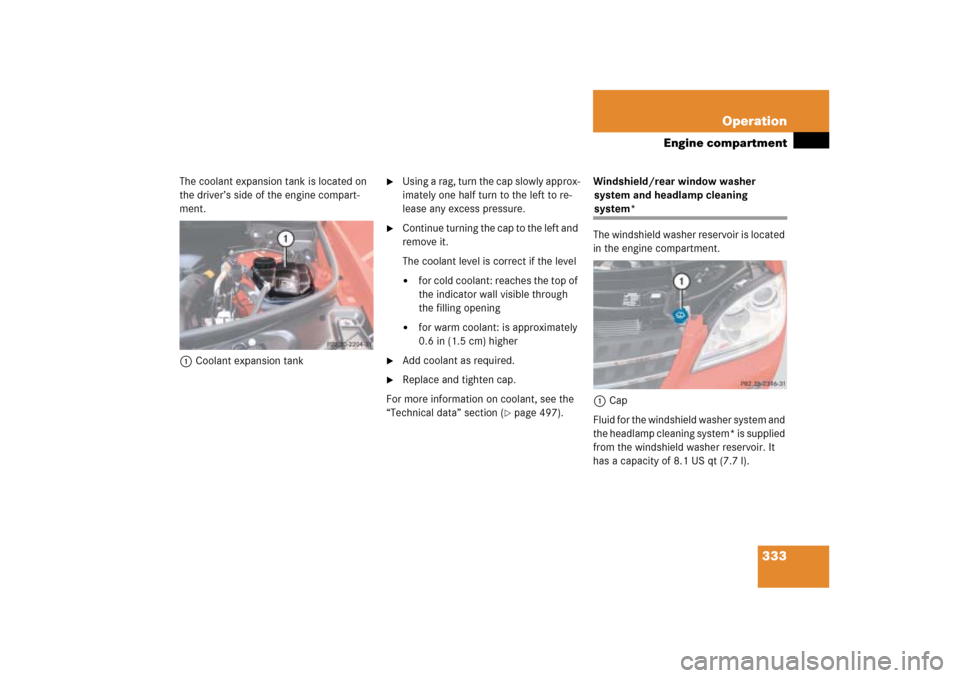
The coolant expansion tank is located on
the driver’s side of the engine compart-
ment.
1Coolant expansion tank
�
Using a rag, turn the cap slowly approx-
imately one half turn to the left to re-
lease any excess pressure.
�
Continue turning the cap to the left and
remove it.
The coolant level is correct if the level�
for cold coolant: reaches the top of
the indicator wall visible through
the filling opening
�
for warm coolant: is approximately
0.6 in (1.5 cm) higher
�
Add coolant as required.
�
Replace and tighten cap.
For more information on coolant, see the
“Technical data” section (
�page 497).Windshield/rear window washer
system and headlamp cleaning
system*
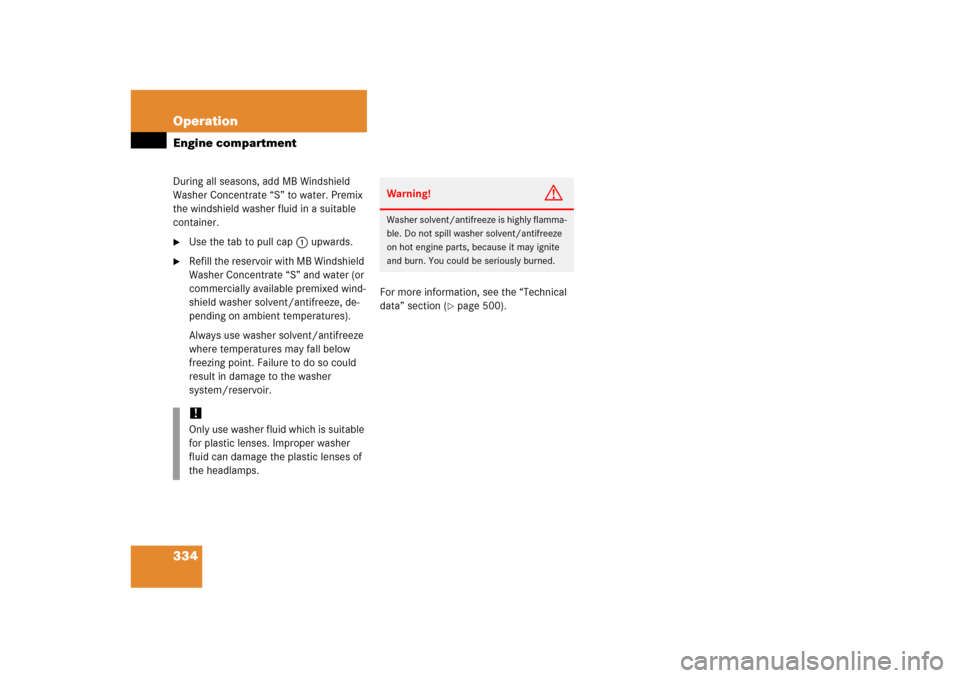
The windshield washer reservoir is located
in the engine compartment.
1Cap
Fluid for the windshield washer system and
the headlamp cleaning system* is supplied
from the windshield washer reservoir. It
has a capacity of 8.1 US qt (7.7 l).
Page 335 of 539
334 OperationEngine compartmentDuring all seasons, add MB Windshield
Washer Concentrate “S” to water. Premix
the windshield washer fluid in a suitable
container.�
Use the tab to pull cap1 upwards.
�
Refill the reservoir with MB Windshield
Washer Concentrate “S” and water (or
commercially available premixed wind-
shield washer solvent/antifreeze, de-
pending on ambient temperatures).
Always use washer solvent/antifreeze
where temperatures may fall below
freezing point. Failure to do so could
result in damage to the washer
system/reservoir.For more information, see the “Technical
data” section (
�page 500).
!Only use washer fluid which is suitable
for plastic lenses. Improper washer
fluid can damage the plastic lenses of
the headlamps.
Warning!
G
Washer solvent/antifreeze is highly flamma-
ble. Do not spill washer solvent/antifreeze
on hot engine parts, because it may ignite
and burn. You could be seriously burned.
Page 375 of 539
374 OperationVehicle careCleaning and care of the vehicle
While in operation, even while parked, your
vehicle is subjected to varying external in-
fluences which, if gone unchecked, can at-
tack the paintwork as well as the
underbody and cause lasting damage.Such damage is caused not only by ex-
treme and varying climatic conditions, but
also by:
�
Air pollution
�
Road salt
�
Tar
�
Gravel and stone chipping
To avoid paint damage, you should imme-
diately remove:
�
Grease and oil
�
Fuel
�
Coolant
�
Brake fluid
�
Bird droppings
�
Insects
�
Tree resins, etc.
Frequent washing reduces and/or elimi-
nates the aggressiveness and potency of
the above adverse influences.More frequent washings are necessary to
deal with unfavorable conditions:
�
near the ocean
�
in industrial areas (smoke, exhaust
emissions)
�
during winter operation
You should check your vehicle from time to
time for stone chipping or other damage.
Any damage should be repaired as soon as
possible to prevent corrosion.
In doing so, do not neglect the underbody
of the vehicle. A prerequisite for a thor-
ough check is a washing of the underbody
followed by a thorough inspection. Dam-
aged areas need to be re-undercoated.
Your vehicle has been treated at the facto-
ry with a wax-base rustproofing in the body
cavities which will last for the lifetime of
the vehicle. Post-production treatment is
neither necessary nor recommended by
Mercedes-Benz because of the possibility
of incompatibility between materials used
in the production process and others ap-
plied later.
Warning!
G
Many cleaning products can be hazardous.
Some are poisonous, others are flammable.
Always follow the instructions on the partic-
ular container. Always open your vehicle’s
doors or windows when cleaning the inside.
Never use fluids or solvents that are not de-
signed for cleaning your vehicle.
Page 384 of 539
383 Practical hints
What to do if …
Problem
Possible cause
Suggested solution
;
(USA only)
3
(Canada only)
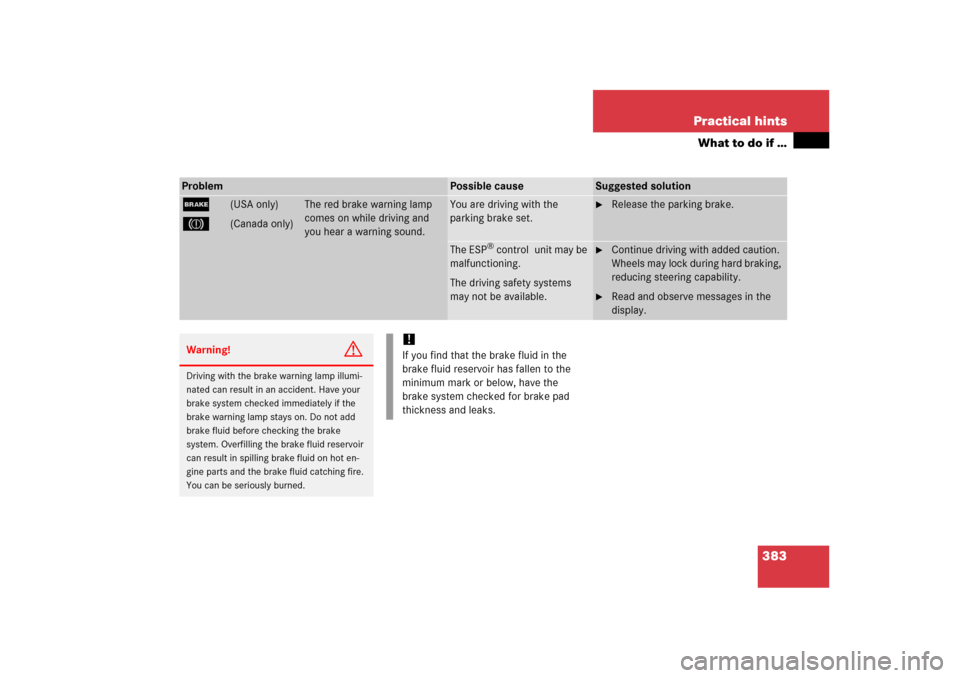
The red brake warning lamp
comes on while driving and
you hear a warning sound.
You are driving with the
parking brake set.
�
Release the parking brake.
The ESP
® control unit may be
malfunctioning.
The driving safety systems
may not be available.
�
Continue driving with added caution.
Whe el s m a y loc k du ring har d br ak ing,
reducing steering capability.
�
Read and observe messages in the
display.
Warning!
G
Driving with the brake warning lamp illumi-
nated can result in an accident. Have your
brake system checked immediately if the
brake warning lamp stays on. Do not add
brake fluid before checking the brake
system. Overfilling the brake fluid reservoir
can result in spilling brake fluid on hot en-
gine parts and the brake fluid catching fire.
You can be seriously burned.
!If you find that the brake fluid in the
brake fluid reservoir has fallen to the
minimum mark or below, have the
brake system checked for brake pad
thickness and leaks.
Page 385 of 539
384 Practical hintsWhat to do if …Problem
Possible cause
Suggested solution
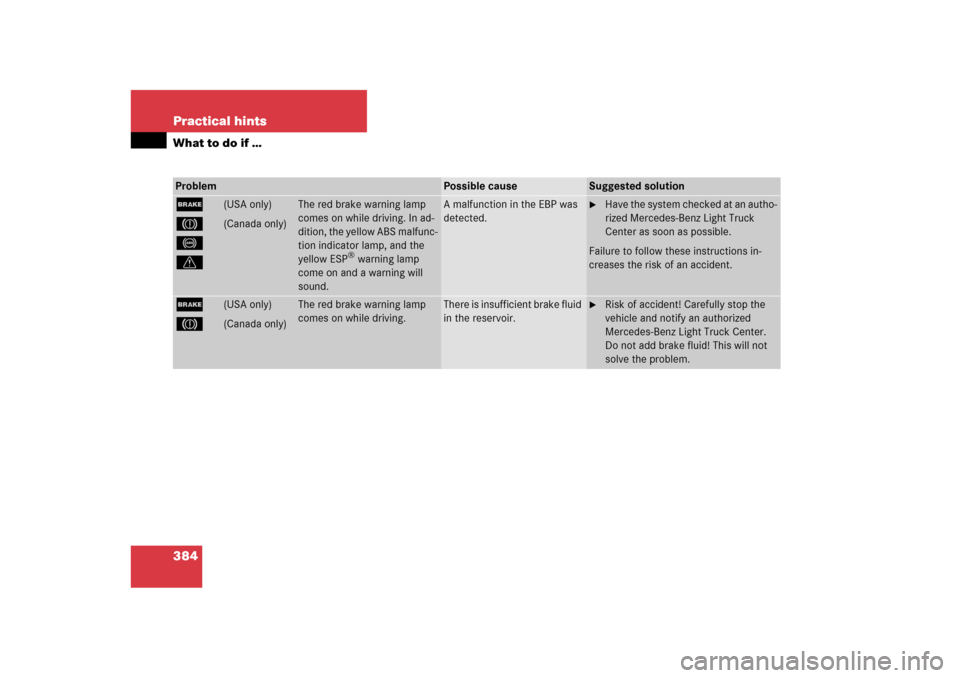
;
(USA only)
3
(Canada only)
-
v
The red brake warning lamp
comes on while driving. In ad-
dition, the yellow ABS malfunc-
tion indicator lamp, and the
yellow ESP
® warning lamp
come on and a warning will
sound.
A malfunction in the EBP was
detected.
�
Have the system checked at an autho-
rized Mercedes-Benz Light Truck
Center as soon as possible.
Failure to follow these instructions in-
creases the risk of an accident.
;
(USA only)
3
(Canada only)
The red brake warning lamp
comes on while driving.
There is insufficient brake fluid
in the reservoir.
�
Risk of accident! Carefully stop the
vehicle and notify an authorized
Mercedes-Benz Light Truck Center.
Do not add brake fluid! This will not
solve the problem.
Page 410 of 539
409 Practical hints
What to do if …
Display symbol
Display message
Possible cause
Possible solution
;
(USA only)
!
(Canada only)
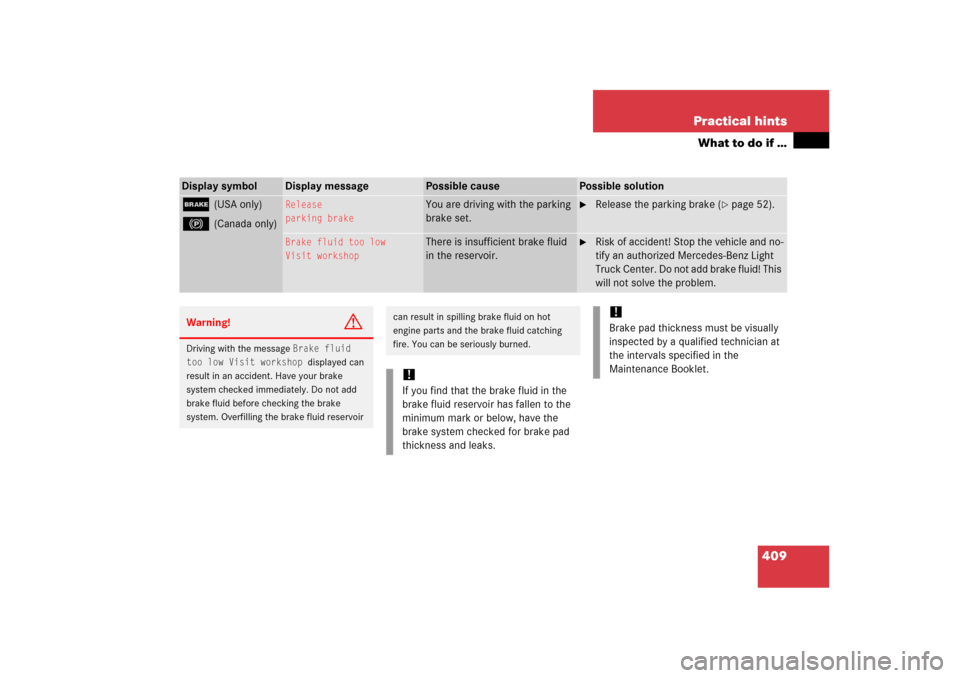
Release
parking brake
You are driving with the parking
brake set.
�
Release the parking brake (
�page 52).
Brake fluid too low
Visit workshop
There is insufficient brake fluid
in the reservoir.
�
Risk of accident! Stop the vehicle and no-
tify an authorized Mercedes-Benz Light
Truck Center. Do not add brake fluid! This
will not solve the problem.
Warning!
G
Driving with the message
Brake fluid
too low Visit workshop
displayed can
result in an accident. Have your brake
system checked immediately. Do not add
brake fluid before checking the brake
system. Overfilling the brake fluid reservoir
can result in spilling brake fluid on hot
engine parts and the brake fluid catching
fire. You can be seriously burned.!If you find that the brake fluid in the
brake fluid reservoir has fallen to the
minimum mark or below, have the
brake system checked for brake pad
thickness and leaks.
!Brake pad thickness must be visually
inspected by a qualified technician at
the intervals specified in the
Maintenance Booklet.