Page 297 of 417
296 Practical hints
What to do if …
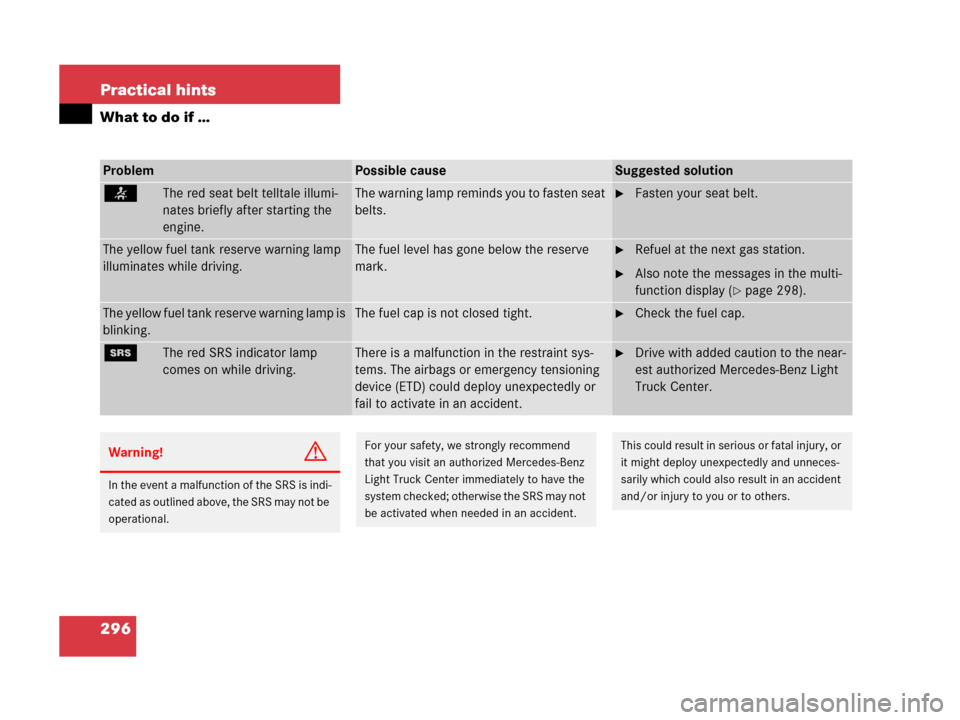
ProblemPossible causeSuggested solution
nates briefly after starting the
engine.The warning lamp reminds you to fasten seat
belts.�Fasten your seat belt.
The yellow fuel tank reserve warning lamp
illuminates while driving.The fuel level has gone below the reserve
mark.�Refuel at the next gas station.
�Also note the messages in the multi-
function display (
�page 298).
The yellow fuel tank reserve warning lamp is
blinking.The fuel cap is not closed tight.�Check the fuel cap.
1The red SRS indicator lamp
comes on while driving.There is a malfunction in the restraint sys-
tems. The airbags or emergency tensioning
device (ETD) could deploy unexpectedly or
fail to activate in an accident.�Drive with added caution to the near-
est authorized Mercedes-Benz Light
Truck Center.
Warning!G
In the event a malfunction of the SRS is indi-
cated as outlined above, the SRS may not be
operational.
For your safety, we strongly recommend
that you visit an authorized Mercedes-Benz
Light Truck Center immediately to have the
system checked; otherwise the SRS may not
be activated when needed in an accident.This could result in serious or fatal injury, or
it might deploy unexpectedly and unneces-
sarily which could also result in an accident
and/or injury to you or to others.
Page 305 of 417
304 Practical hints
What to do if …
Symbol messages
Display symbolDisplay messagePossible causePossible solution
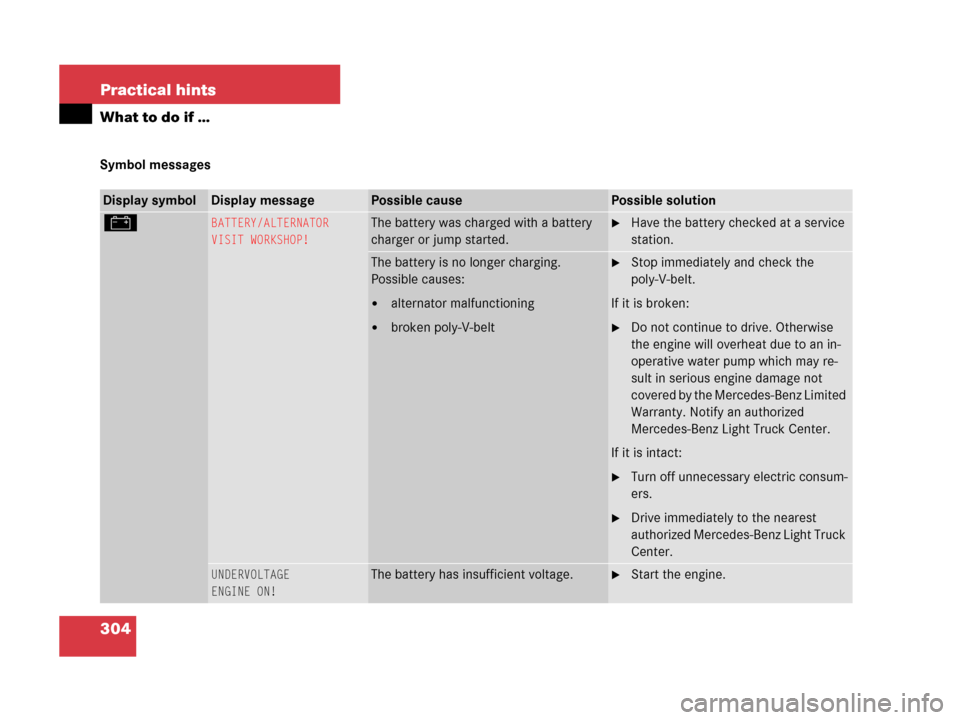
#BATTERY/ALTERNATOR
VISIT WORKSHOP!The battery was charged with a battery
charger or jump started.�Have the battery checked at a service
station.
The battery is no longer charging.
Possible causes:
�alternator malfunctioning
�broken poly-V-belt
�Stop immediately and check the
poly-V-belt.
If it is broken:
�Do not continue to drive. Otherwise
the engine will overheat due to an in-
operative water pump which may re-
sult in serious engine damage not
covered by the Mercedes-Benz Limited
Warranty. Notify an authorized
Mercedes-Benz Light Truck Center.
If it is intact:
�Turn off unnecessary electric consum-
ers.
�Drive immediately to the nearest
authorized Mercedes-Benz Light Truck
Center.
UNDERVOLTAGE
ENGINE ON!The battery has insufficient voltage.�Start the engine.
Page 310 of 417
309 Practical hints
What to do if …
Display symbolDisplay messagePossible causePossible solution
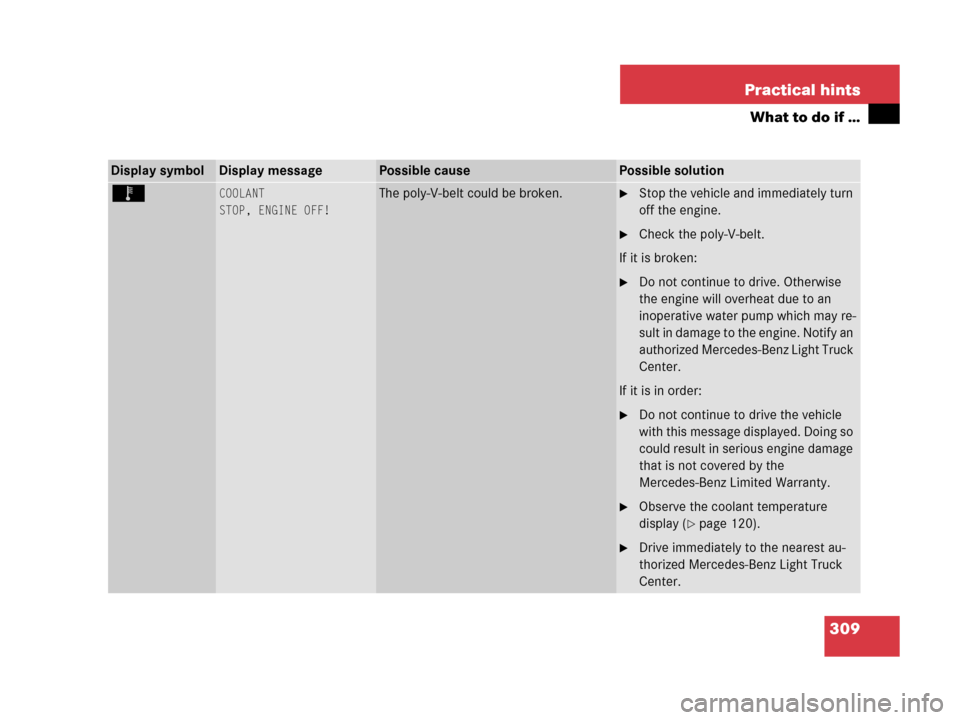
ÏCOOLANT
STOP, ENGINE OFF!The poly-V-belt could be broken. �Stop the vehicle and immediately turn
off the engine.
�Check the poly-V-belt.
If it is broken:
�Do not continue to drive. Otherwise
the engine will overheat due to an
inoperative water pump which may re-
sult in damage to the engine. Notify an
authorized Mercedes-Benz Light Truck
Center.
If it is in order:
�Do not continue to drive the vehicle
with this message displayed. Doing so
could result in serious engine damage
that is not covered by the
Mercedes-Benz Limited Warranty.
�Observe the coolant temperature
display (
�page 120).
�Drive immediately to the nearest au-
thorized Mercedes-Benz Light Truck
Center.
Page 321 of 417
320 Practical hints
What to do if …
Display symbolDisplay messagePossible causePossible solution
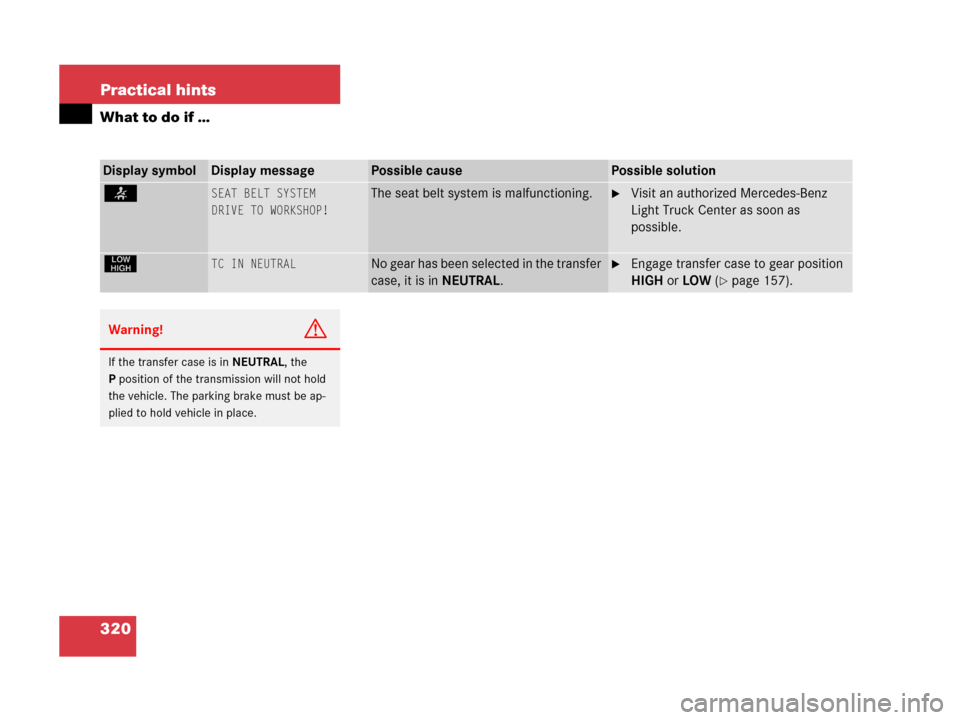
DRIVE TO WORKSHOP!The seat belt system is malfunctioning.�Visit an authorized Mercedes-Benz
Light Truck Center as soon as
possible.
§TC IN NEUTRALNo gear has been selected in the transfer
case, it is in NEUTRAL.�Engage transfer case to gear position
HIGH or LOW (
�page 157).
Warning!G
If the transfer case is in NEUTRAL, the
Pposition of the transmission will not hold
the vehicle. The parking brake must be ap-
plied to hold vehicle in place.
Page 366 of 417
365 Technical data
Parts service
Warranty coverage
Identification labels
Layout of poly-V-belt drive
Engine
Rims and tires
Electrical system
Main dimensions, vehicle weights and ratings
Fuels, coolants, lubricants, etc.
Page 370 of 417
369 Technical data
Layout of poly-V-belt drive
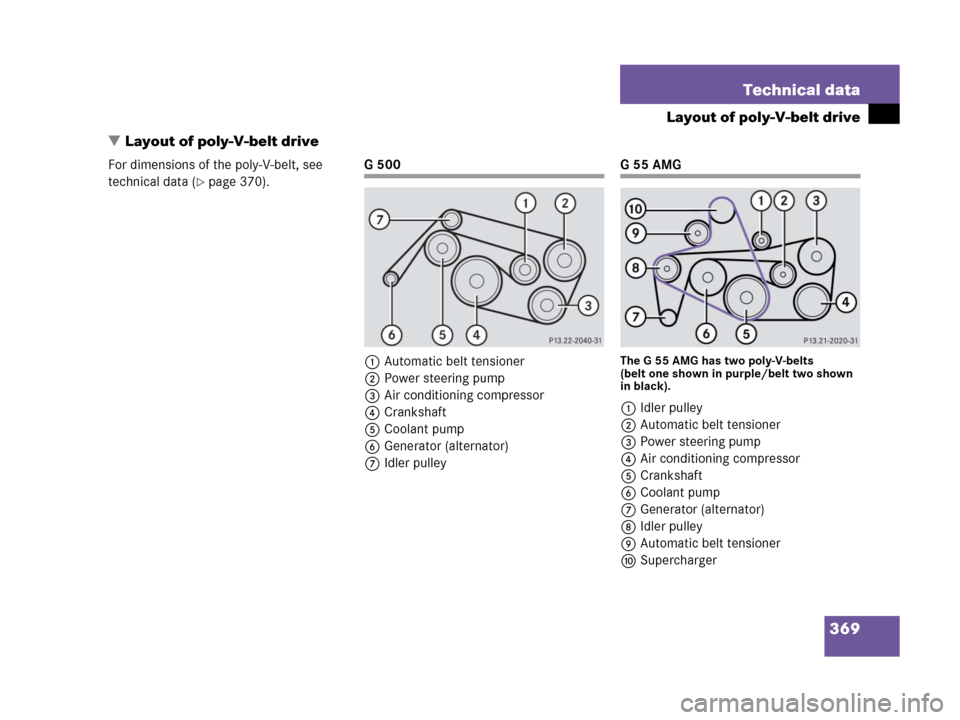
�Layout of poly-V-belt drive
For dimensions of the poly-V-belt, see
technical data (
�page 370).
G500
1Automatic belt tensioner
2Power steering pump
3Air conditioning compressor
4Crankshaft
5Coolant pump
6Generator (alternator)
7Idler pulleyG55AMG
The G 55 AMG has two poly-V-belts
(belt one shown in purple/belt two shown
in black).
1Idler pulley
2Automatic belt tensioner
3Power steering pump
4Air conditioning compressor
5Crankshaft
6Coolant pump
7Generator (alternator)
8Idler pulley
9Automatic belt tensioner
aSupercharger
Page 371 of 417
370 Technical data
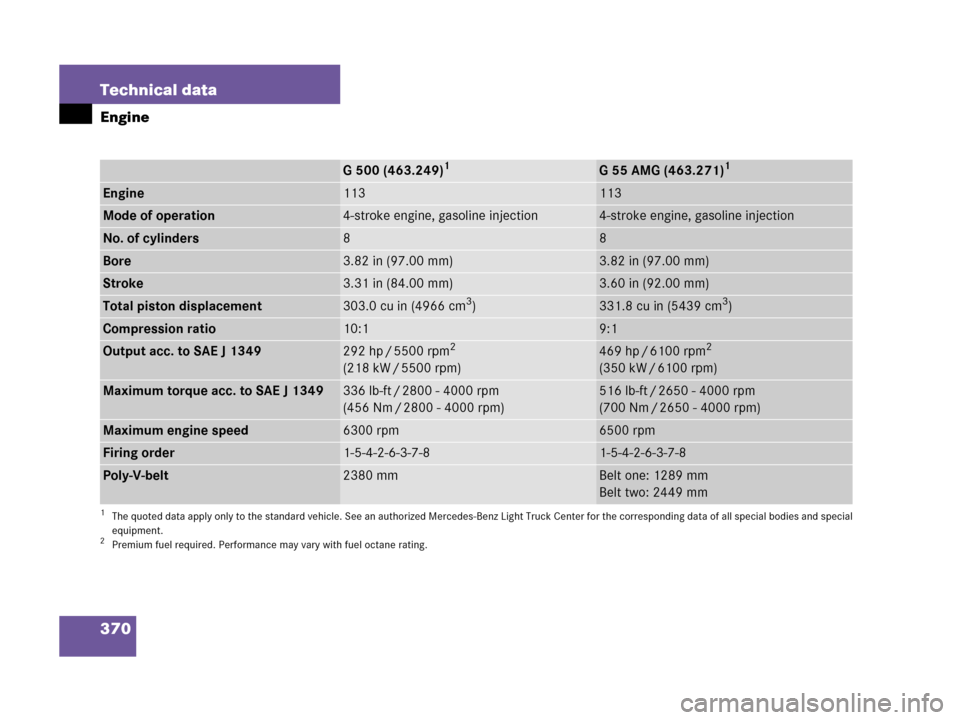
Engine
G 500 (463.249)1
1The quoted data apply only to the standard vehicle. See an authorized Mercedes-Benz Light Truck Center for the corresponding data of all special bodies and special
equipment.
G55AMG (463.271)1
Engine113113
Mode of operation4-stroke engine, gasoline injection4-stroke engine, gasoline injection
No. of cylinders88
Bore3.82 in (97.00 mm)3.82 in (97.00 mm)
Stroke3.31 in (84.00 mm)3.60 in (92.00 mm)
Total piston displacement303.0 cu in (4966 cm3)331.8 cu in (5439 cm3)
Compression ratio10:19:1
Output acc. to SAE J 1349292 hp / 5500 rpm2
(218 kW / 5500 rpm)
2Premium fuel required. Performance may vary with fuel octane rating.
469 hp / 6100 rpm2
(350 kW / 6100 rpm)
Maximum torque acc. to SAE J 1349336 lb-ft / 2800 - 4000 rpm
(456 Nm / 2800 - 4000 rpm)516 lb-ft / 2650 - 4000 rpm
(700 Nm / 2650 - 4000 rpm)
Maximum engine speed6300 rpm6500 rpm
Firing order1-5-4-2-6-3-7-81-5-4-2-6-3-7-8
Poly-V-belt2380 mmBelt one: 1289 mm
Belt two: 2449 mm
Page 385 of 417

384 Technical terms
COMAND
(C
ockpit Management and Data
System)
Information and operating center for
vehicle sound and communications
systems, including the radio and the
navigation system, as well as other op-
tional equipment (CD changer, tele-
phone, etc.).
Control system
The control system is used to call up
vehicle information and to change
component settings. Information and
messages appear in the multifunction
display. The driver uses the buttons on
the multifunction steering wheel to
navigate through the system and to ad-
just settings.
Differential locks
On slippery surfaces, differential locks
prevent one wheel of an axle from spin-
ning while the other wheel stands still,
resulting in driving force no longer be-
ing transferred.Cruise control
Driving convenience system that auto-
matically maintains the vehicle speed
set by the driver.
Curb weight
(
�page 273)
DOT
(D
epartment of Transportation)
(
�page 274)
Engine number
The number set by the manufacturer
and placed on the cylinder block to
uniquely identify each engine pro-
duced.
Engine oil viscosity
Measurement for the inner friction (vis-
cosity) of the oil at different tempera-
tures. The higher the temperature an
oil can tolerate without becoming thin,
or the lower the temperature it can tol-
erate without becoming viscous, the
better the viscosity.ESP
(E
lectronic Stability Program)
Improves vehicle handling and direc-
tional stability.
ETD
(E
mergency Tensioning Device)
Device which deploys in certain frontal
and rear collisions exceeding the sys-
tem’s threshold to tighten the seat
belts.
->SRS
FSS (Canada vehicles)
(F
lexible Service System)
Maintenance service indicator in the
speedometer display that informs the
driver when the next vehicle mainte-
nance service is due. FSS evaluates en-
gine temperature, oil level, vehicle
speed, engine speed, distance driven
and the time elapsed since your last
service, and calls for the next mainte-
nance service accordingly.