Page 220 of 417
219 Operation
The first 1000 miles (1500 km)
All of the above instructions, as may apply
to your vehicle type, also apply when driv-
ing the first 1000 miles (1500 km) after the
engine, the transfer case, the front differ-
ential or the rear differential has been re-
placed.i
G55AMG:
For better protection of the front and
rear differential, the oil must be
changed after a break-in period of
1900 miles (3000 km).
Changing oil in the front and rear
differential increases the service life
and helps reduce noise from the
differential locks.
See Maintenance Booklet for additional
information and Factory Approved
Service Products pamphlet for informa-
tion on the approved service product
required to perform the front and rear
axle oil change.
i
Always obey applicable speed limits.
Page 221 of 417
220 Operation
Driving instructions
Drive sensibly – save fuel
Fuel consumption, to a great extent, de-
pends on driving habits and operating
conditions.
To save fuel you should:
�Keep tires at the recommended infla-
tion pressures.
�Remove unnecessary loads.
�Allow engine to warm up under low
load use.
�Avoid frequent acceleration and decel-
eration.
�Have all maintenance work performed
at the intervals specified in the
Maintenance Booklet and as required
by the maintenance service display.
Contact an authorized Mercedes-Benz
Light Truck Center.
Fuel consumption is also increased by driv-
ing in cold weather, in stop-and-go traffic,
on short trips and in hilly area.
Drinking and drivingPedals
Warning!G
Drinking and driving and/or taking drugs
and driving are very dangerous combina-
tions. Even a small amount of alcohol or
drugs can affect your reflexes, perceptions
and judgment.
The possibility of a serious or even fatal ac-
cident are greatly increased when you drink
or take drugs and drive.
Do not drink or take drugs and drive or allow
anyone to drive who has been drinking or
taking drugs.
Warning!G
Keep driver’s foot area clear at all times. Ob-
jects stored in this area may impair pedal
movement.
Page 222 of 417

221 Operation
Driving instructions
Power assistance
BrakesTo help prevent brake disk corrosion after
driving on wet road surfaces (particularly
salted roads), it is advisable to brake the
vehicle with considerable force prior to
parking. The heat generated serves to dry
the brakes.
If your brake system is normally only sub-
jected to moderate loads, you should occa-
sionally test the effectiveness of the
brakes by applying above-normal braking
pressure at higher speeds. This will also
enhance the grip of the brake pads.If the parking brake is released and the
brake warning lamp in the instrument clus-
ter stays on and there is no audible warn-
ing (EBB), the brake fluid level in the
reservoir is too low.
Brake pad wear or a leak in the system may
be the reason for low brake fluid in the res-
ervoir.
Have the brake system inspected
immediately. Contact an authorized
Mercedes-Benz Light Truck Center.
All checks and service work on the brake
system should be carried out by qualified
technicians only. Contact an authorized
Mercedes-Benz Light Truck Center.
Install only brake pads and brake fluid
recommended by Mercedes-Benz.
Warning!G
With the engine not running, there is no
power assistance for the brake and steering
systems. In this case, it is important to keep
in mind that a considerably higher degree of
effort is necessary to brake and steer the ve-
hicle.
Warning!G
After driving in heavy rain for some time
without applying the brakes or through wa-
ter deep enough to wet brake components
or salty road conditions, the first braking ac-
tion may be somewhat reduced and in-
creased pedal pressure may be necessary to
obtain expected braking effect. Maintain a
safe distance from vehicles in front.
Resting your foot on the brake pedal will
cause excessive and premature wear of the
brake pads.
It can also result in the brakes overheating,
thereby significantly reducing their effec-
tiveness. It may not be possible to stop the
vehicle in sufficient time to avoid an acci-
dent.!
Be very careful not to endanger other
road users when you apply the brakes.
Refer to the description of the Brake
Assist System (BAS) (
�page 82).
Page 232 of 417
231 Operation
Driving instructions
Driving across a hilltop
Decelerate just ahead of a hilltop (do not
select gear rangeN), to prevent the vehi-
cle from speeding up too much after climb-
ing a hill.
Use the momentum of the vehicle to drive
across the hilltop.
After climbing a hill, driving in this manner
prevents the vehicle from:
�loosing ground contact when cresting
hills
�loosing its forward momentum
�speeding up too much after climbing
the hillDriving downhill
�Select gear range1 on the automatic
transmission (
�page 154).
�Drive downhill observing the same
rules as driving uphill (
�page 230).Driving through water
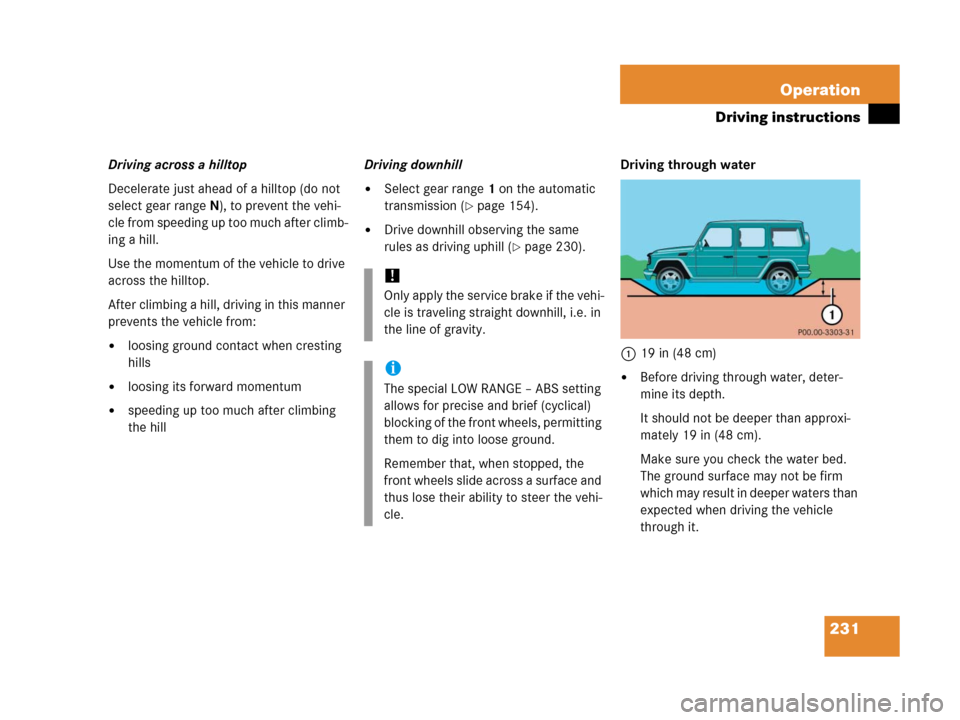
119 in (48 cm)
�Before driving through water, deter-
mine its depth.
It should not be deeper than approxi-
mately 19 in (48 cm).
Make sure you check the water bed.
The ground surface may not be firm
which may result in deeper waters than
expected when driving the vehicle
through it.
!
Only apply the service brake if the vehi-
cle is traveling straight downhill, i.e. in
the line of gravity.
i
The special LOW RANGE – ABS setting
allows for precise and brief (cyclical)
blocking of the front wheels, permitting
them to dig into loose ground.
Remember that, when stopped, the
front wheels slide across a surface and
thus lose their ability to steer the vehi-
cle.
Page 237 of 417

236 Operation
Driving instructions
Driving abroad
Abroad, there is an extensive
Mercedes-Benz service network at your
disposal. If you plan to drive into areas
which are not listed in the index of a
Mercedes-Benz Light Truck Center directo-
ry, you should request pertinent informa-
tion from an authorized Mercedes-Benz
Light Truck Center.Catalytic converter
Your Mercedes-Benz is equipped with
monolithic-type catalytic converters, an
important element in conjunction with the
oxygen sensors to achieve substantial con-
trol of the pollutants in the exhaust emis-
sions. Keep your vehicle in proper
operating condition by following our rec-
ommended maintenance instructions as
outlined in your Maintenance Booklet.!
To prevent damage to the catalytic con-
verters, use only premium unleaded
gasoline in this vehicle.
Any noticeable irregularities in engine
operation should be repaired promptly.
Otherwise, excessive unburned fuel
may reach the catalytic converter,
causing it to overheat and potentially
start a fire.
Page 238 of 417
237 Operation
Driving instructions
Emission control
Certain engine systems serve to keep the
toxic components of the exhaust gases
within permissible legal limits.
These systems, of course, will function
properly only when maintained strictly ac-
cording to factory specifications. Any ad-
justments on the engine should, therefore,
be carried out only by qualified
Mercedes-Benz Light Truck Center autho-
rized technicians. Engine adjustments
should not be altered in any way. More-
over, the specified service jobs must be
carried out regularly according to
Mercedes-Benz servicing requirements.
For details refer to the Maintenance
Booklet.
Warning!G
As with any vehicle, do not idle, park or op-
erate this vehicle in areas where combusti-
ble materials such as grass, hay or leaves
can come into contact with the hot exhaust
system, as these materials could be ignited
and cause a vehicle fire.
Warning!G
Inhalation of exhaust gas is hazardous to
your health. All exhaust gas contains carbon
monoxide, and inhaling it can cause uncon-
sciousness and lead to death.
Do not run the engine in confined areas
(such as a garage) which are not properly
ventilated. If you think that exhaust gas
fumes are entering the vehicle while driving,
have the cause determined and corrected
immediately. If you must drive under these
conditions, drive only with at least one win-
dow fully open at all times.
Page 241 of 417
240 Operation
At the gas station
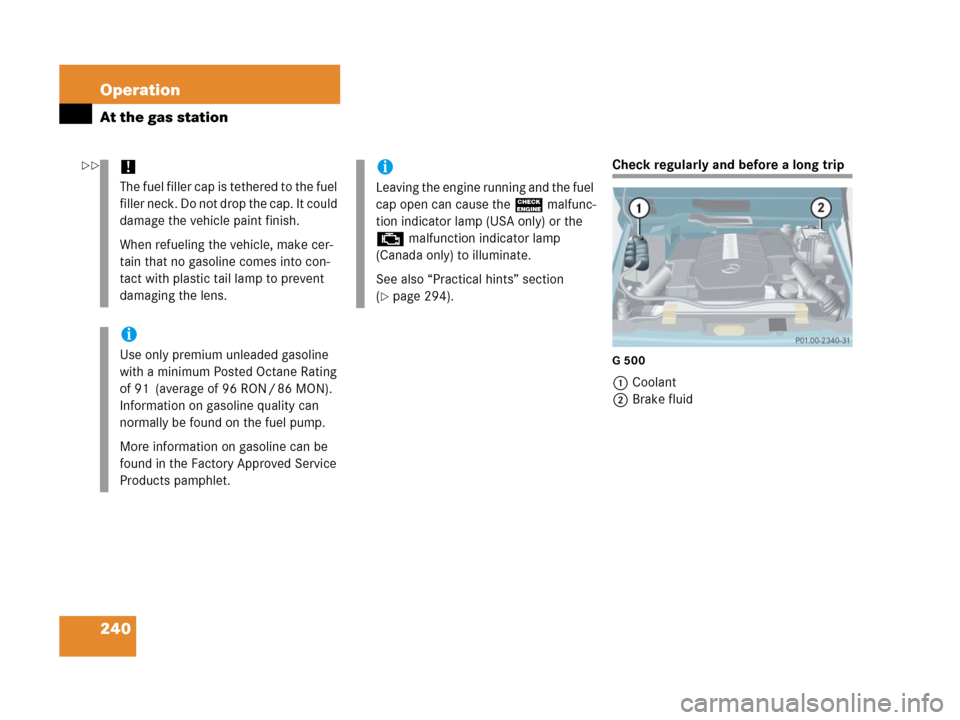
Check regularly and before a long trip
G 500
1Coolant
2Brake fluid
!
The fuel filler cap is tethered to the fuel
filler neck. Do not drop the cap. It could
damage the vehicle paint finish.
When refueling the vehicle, make cer-
tain that no gasoline comes into con-
tact with plastic tail lamp to prevent
damaging the lens.
i
Use only premium unleaded gasoline
with a minimum Posted Octane Rating
of 91 (average of 96 RON / 86 MON).
Information on gasoline quality can
normally be found on the fuel pump.
More information on gasoline can be
found in the Factory Approved Service
Products pamphlet.
i
Leaving the engine running and the fuel
cap open can cause the ? malfunc-
tion indicator lamp (USA only) or the
± malfunction indicator lamp
(Canada only) to illuminate.
See also “Practical hints” section
(
�page 294).
��
Page 248 of 417
247 Operation
Engine compartment
Adding engine oil
Only use approved engine oils and oil fil-
ters required for vehicles with
Maintenance System (U.S. vehicles) or
FSS (Canada vehicles). For a listing of ap-
proved engine oils and oil filters, refer to
the Factory Approved Service Products
pamphlet in your vehicle literature portfo-
lio, or contact an authorized
Mercedes-Benz Light Truck Center.
Using engine oils and oil filters of specifica-
tion other than those expressly required
for the Maintenance System (U.S. vehi-
cles) or FSS (Canada vehicles), or changing
of oil and oil filter at change intervals long-
er than those called for by the
Maintenance System (U.S. vehicles) or
FSS (Canada vehicles) will result in engine
damage not covered by the
Mercedes-Benz Limited Warranty.
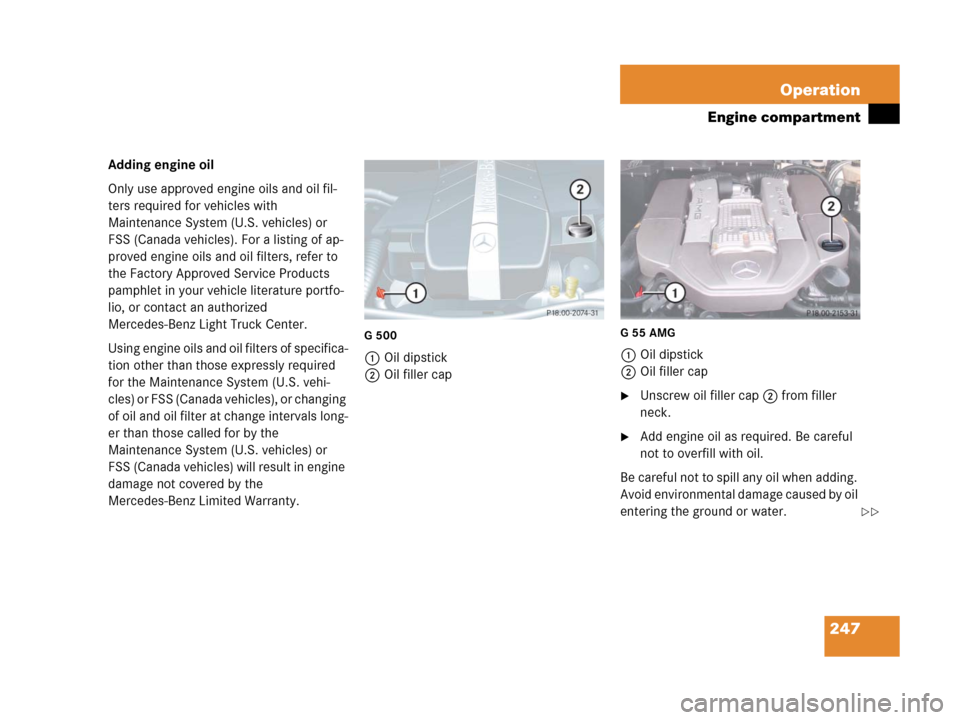
G500
1Oil dipstick
2Oil filler cap
G55AMG
1Oil dipstick
2Oil filler cap
�Unscrew oil filler cap2 from filler
neck.
�Add engine oil as required. Be careful
not to overfill with oil.
Be careful not to spill any oil when adding.
Avoid environmental damage caused by oil
entering the ground or water.
��