Page 367 of 521

366 OperationVehicle care�
Use the appropriate MB-Touch-Up
Stick for quick and provisional repairs
of minor paint damage (i.e. chips from
stones, vehicle doors, etc.).
Engine cleaning
Prior to cleaning the engine compartment,
make sure to protect electrical compo-
nents and connectors from contact with
water and cleaning agents.
Corrosion protection, such as MB Anticor-
rosion Wax should be applied to the engine
compartment after every engine cleaning.
Before applying, all control linkage bush-
ings and joints should be lubricated. The
poly-V-belt and all pulleys should be pro-
tected from any wax.
Vehicle washing
In the winter, thoroughly remove all traces
of road salt as soon as possible.
When washing the vehicle underbody, do
not forget to clean the inner sides of the
wheels.Hand-wash
Do not use hot water or wash your vehicle
in direct sunlight.
�
Only use a mild car wash detergent,
such as Mercedes-Benz approved Car
Shampoo.
�
Thoroughly spray the vehicle with a dif-
fused jet of water.
Direct only a very weak spray towards
the ventilation intake.
�
Use plenty of water and rinse the
sponge and chamois frequently.
�
Rinse with clean water and thoroughly
dry with a chamois.
Do not allow cleaning agents to dry on
the finish.
Automatic car wash
You can have your car washed in an auto-
matic car wash from the start. Automatic
car washes without brushes are prefera-
ble.
If the vehicle is very dirty, prewash it be-
fore running it through the automatic car
wash.
iVehicles with KEYLESS-GO*:
If a door handle is hit by a strong jet of
water, and a SmartKey with
KEYLESS-GO* is in close proximity, i.e.
within approximately 3 ft (approxi-
mately 1 m), the vehicle could be inad-
vertently locked or unlocked.
Page 399 of 521

398 Practical hintsWhat to do if …Symbol messagesDisplay symbol
Display messages
Possible cause/consequence
Possible solution
#
Low voltage
Switch off
consumers
The battery has insufficient voltage.
�
Turn off unnecessary electrical con-
sumers.
Visit workshop
The battery was charged with a battery
charger or jump started.
�
Have the battery checked at a service
station.
The battery is no longer charging.
Possible causes:�
alternator malfunctioning
�
broken poly-V-belt
Do not forget that the brake system re-
quires electrical energy and may be oper-
ating with restricted capability.
Considerably greater brake pedal force is
required and the stopping distance is in-
creased.
�
Stop immediately in a safe location or
as soon as it is safe to do so and
check the poly-V-belt.
If it is broken:
�
Do not continue to drive. Otherwise
the engine will overheat due to an in-
operative water pump which may re-
sult in damage to the engine. Notify
an authorized Mercedes-Benz Center.
If it is intact:
�
Drive immediately to the nearest au-
thorized Mercedes-Benz Center. Ad-
just driving to be consistent with
reduced braking responsiveness.
Page 400 of 521
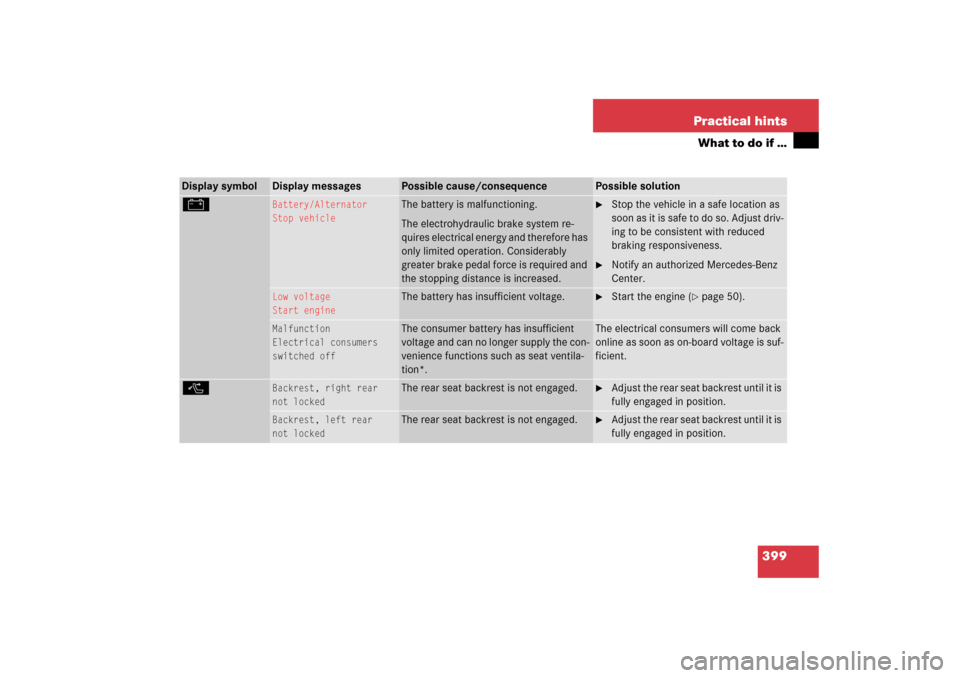
399 Practical hints
What to do if …
Display symbol
Display messages
Possible cause/consequence
Possible solution
#
Battery/Alternator
Stop vehicle
The battery is malfunctioning.
The electrohydraulic brake system re-
quires electrical energy and therefore has
only limited operation. Considerably
greater brake pedal force is required and
the stopping distance is increased.
�
Stop the vehicle in a safe location as
soon as it is safe to do so. Adjust driv-
ing to be consistent with reduced
braking responsiveness.
�
Notify an authorized Mercedes-Benz
Center.
Low voltage
Start engine
The battery has insufficient voltage.
�
Start the engine (
�page 50).
Malfunction
Electrical consumers
switched off
The consumer battery has insufficient
voltage and can no longer supply the con-
venience functions such as seat ventila-
tion*.
The electrical consumers will come back
online as soon as on-board voltage is suf-
ficient.
(
Backrest, right rear
not locked
The rear seat backrest is not engaged.
�
Adjust the rear seat backrest until it is
fully engaged in position.
Backrest, left rear
not locked
The rear seat backrest is not engaged.
�
Adjust the rear seat backrest until it is
fully engaged in position.
Page 452 of 521

451 Practical hints
Batteries
Disconnecting the battery�
Depress parking brake firmly or move
gear selector lever to positionP.
�
Turn off all electrical consumers.
�
Remove SmartKey from starter switch.
Vehicles with KEYLESS-GO*:�
Press the start/stop button until
the engine shuts off.
�
Open the driver’s door.
�
Open the trunk.
!Never loosen or detach battery termi-
nal clamps while the engine is running
or the SmartKey is in the starter switch.
Otherwise the alternator and other
electronic components could be se-
verely damaged.
Have the battery checked regularly by
an authorized Mercedes-Benz Center.
Refer to Maintenance Booklet for main-
tenance intervals or contact an autho-
rized Mercedes-Benz Center for further
information.Warning!
G
Do not place metal objects on the battery as
this could result in a short circuit.
Use leak-proof battery only to avoid the risk
of acid burns in the event of an accident.
Warning!
G
The electrohydraulic brake system requires
electrical power to operate.
A malfunction in the vehicle’s power supply
or electrical system may impair brake sys-
tem operation and switch it into its emer-
gency operation mode. The same applies if
battery is disconnected. To brake, the driver
must then apply significantly greater brake
pedal pressure and depress the pedal much
further to obtain the expected braking ef-
fect. If necessary, apply full pressure to the
brake pedal. Brakes may only be applied to
the front wheels. Stopping distance is in-
creased! Adjust your driving style according-
ly. For more information, refer to
“Electrohydraulic brake system”
(�page 97).
Warning!
G
With a disconnected battery�
you will no longer be able to turn the
SmartKey in the starter switch and
pressing the KEYLESS-GO* start/stop
button on the gear selector lever will
have no effect
�
the gear selector lever will remain
locked in positionP
��
Page 455 of 521

454 Practical hintsJump starting
If the battery is discharged, the engine can
be started with jumper cables and the bat-
tery of another vehicle. Observe the follow-
ing:�
Jump starting should only be performed
when the engine and catalytic
converter
1 are cold.
�
Do not start the engine if the battery is
frozen. Let the battery thaw out first.
�
Only jump start from batteries with the
same voltage rating (12-V). Jump start-
ing with a more powerful battery could
damage the vehicle’s electrical system,
which will not be covered by the
Mercedes-Benz Limited Warranty.
�
Use only jumper cables with sufficient
cross-section and insulated terminal
clamps.
�
Always make sure the jumper cables
are not on or near pulleys, fans or other
parts that move when the engine is
started or running.
Warning!
G
Failure to follow these directions will cause
damage to the electronic components, and
can lead to a battery explosion and severe
injury or death.
Never lean over batteries while connecting
or jump starting, you might get injured.
Battery fluid contains sulfuric acid. Do not
allow this fluid to come in contact with eyes,
skin or clothing. In case it does, immediately
flush affected area with water, and seek
medical help if necessary.
A battery will also produce hydrogen gas,
which is flammable and very explosive. Keep
flames or sparks away from battery, avoid
improper connection of jumper cables,
smoking, etc.
Attempting to jump start a frozen battery
can result in it exploding, causing personal
injury.
Read all instructions before proceeding.
1Vehicles with gasoline engine only.
!Jump starting may only be performed
on the main battery installed in the
trunk.
Avoid repeated and lengthy starting at-
tempts.
Do not attempt to start the engine us-
ing a battery quick charge unit.
If the engine does not run after several
unsuccessful starting attempts, have it
checked at the nearest authorized
Mercedes-Benz Center.
Excessive unburned fuel generated by
repeated failed starting attempts may
damage the catalytic converter
1.
Make sure the jumper cables do not
have loose or missing insulation.
Make sure the cable clamps do not
touch any other metal part while the
other end is still attached to a battery.
Page 457 of 521
456 Practical hintsJump starting�
Start engine of the vehicle with the
charged battery and run at idle speed.
�
Connect negative terminals4 and2
of the batteries with the jumper cable.
Clamp cable to charged battery4
first.
�
Start the engine of the disabled vehi-
cle.Now you can again turn on the electrical
consumers. Do not turn on the lights under
any circumstances.
�
Remove the jumper cables first from
negative terminals2 and4 and then
from positive terminals1 and3.
Now you can turn on the lights.
�
Have the battery checked at the near-
est authorized Mercedes-Benz Center.
iThe message
Malfunction - electric
consumers switched off
may appear
in the instrument cluster. It will disap-
pear as soon as the battery is suffi-
ciently charged.
!Do not tow-start the vehicle.
��
Page 459 of 521

458 Practical hintsTowing the vehicle
!
To be certain to avoid a possibility of
damage to the drivetrain, however, we
recommend the drive shaft be discon-
nected at the rear axle drive flange (ve-
hicles with 4MATIC: disconnected at
the front and rear axle drive flanges) for
any towing beyond a short tow to a
nearby garage.
Warning!
G
If circumstances require towing the vehicle
with all wheels on the ground, always tow
with a tow bar if:�
the engine will not run
�
there is a malfunction in the electrohy-
draulic brake system
�
there is a malfunction in the power sup-
ply or in the vehicle’s electrical system
as that will be necessary to adequately con-
trol the towed vehicle.
Prior to towing the vehicle with all wheels on
the ground, make certain the SmartKey is in
starter switch position2.
If the SmartKey is left in the starter switch
position0 for an extended period of time, it
can no longer be turned in the switch. In this
case, the steering is locked. To unlock, re-
move SmartKey from starter switch and re-
insert.
Warning!
G
The brake system requires electrical power
to operate.
A malfunction in the vehicle’s power supply
or electrical system may impair brake sys-
tem operation and switch it into its emer-
gency operation mode. To brake, the driver
must then apply significantly greater brake
pedal pressure and depress the pedal much
further to obtain the expected braking ef-
fect. If necessary, apply full pressure to the
brake pedal. Brakes may only be applied to
the front wheels. Stopping distance is in-
creased! Adapt your driving style according-
ly. For more information, refer to
“Electrohydraulic brake system”
(�page 97).
With the engine not running, there is no
power assistance for the steering system. In
this case, it is important to keep in mind that
a considerably higher degree of effort is nec-
essary to steer the vehicle. Adapt your driv-
ing accordingly.
Page 466 of 521
465 Technical data
Parts service
Warranty coverage
Identification labels
Layout of poly-V-belt drive
Engine
Rims and tires
Electrical system
Main dimensions and weights
Fuels, coolants, lubricants etc.

