Page 95 of 262

WARNING: Airbags can kill or injure a child in a child seat.
Never place a rear facing child seat in the right front seat
unless the airbag on/off switch is turned OFF. If you place a
forward-facing child seat in the right front seat, turn the airbag
on/off switch to OFF. SeePassenger airbag on/off switchin
this chapter.
WARNING: Rear facing child seats should NEVER be placed in
the front seats unless the passenger airbag switch is turned off.
Also, slide the front seat forward until the rear facing child seat
contacts the dash board for maximum support. (All other
children and forward facing child seats and booster seats should
be on front seats that are slid back as far away as possible from
the dashboard.)
2. Pull down on the shoulder belt
and then grasp the shoulder
belt and lap belt together.
3. While holding the shoulder and
lap belt portions together, route
the tongue through the child
seat according to the child seat
manufacturer’s instructions. Be
sure the belt webbing is not
twisted.
2006 B-Series(mbs)
Owners Guide (post-2002-fmt)
Canadian_French(fr_can)
Seating and Safety Restraints
95
Page 96 of 262
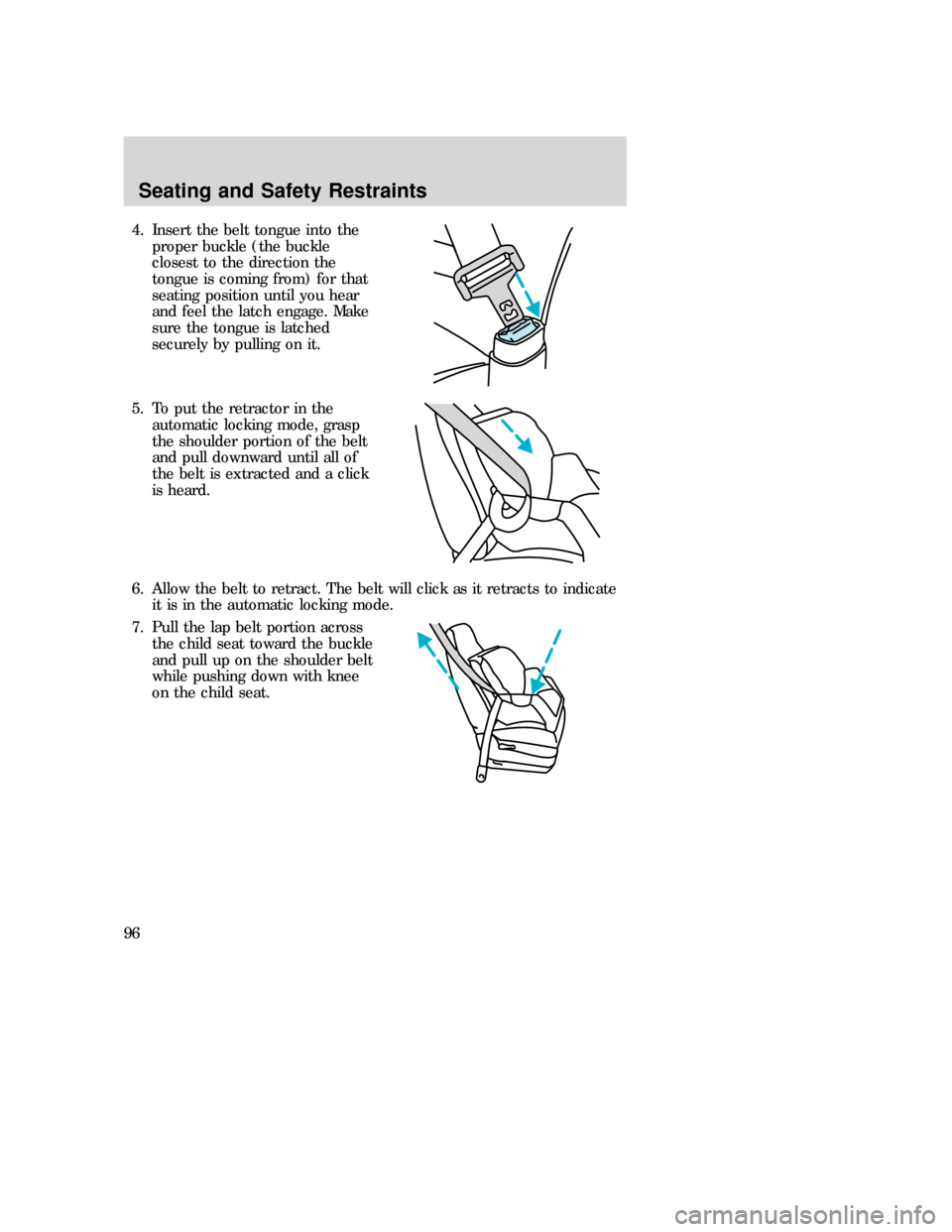
4. Insert the belt tongue into the
proper buckle (the buckle
closest to the direction the
tongue is coming from) for that
seating position until you hear
and feel the latch engage. Make
sure the tongue is latched
securely by pulling on it.
5. To put the retractor in the
automatic locking mode, grasp
the shoulder portion of the belt
and pull downward until all of
the belt is extracted and a click
is heard.
6. Allow the belt to retract. The belt will click as it retracts to indicate
it is in the automatic locking mode.
7. Pull the lap belt portion across
the child seat toward the buckle
and pull up on the shoulder belt
while pushing down with knee
on the child seat.
2006 B-Series(mbs)
Owners Guide (post-2002-fmt)
Canadian_French(fr_can)
Seating and Safety Restraints
96
Page 97 of 262

8. Allow the safety belt to retract
to remove any slack in the belt.
9. Before placing the child in the
seat, forcibly tilt the seat
forward and back to make sure
the seat is securely held in
place. To check this, grab the
seat at the belt path and
attempt to move it side to side
and forward. There should be
no more than one inch of
movement for proper installation.
10. Try to pull the belt out of the retractor to make sure the retractor is
in the automatic locking mode (you should not be able to pull more
belt out). If the retractor is not locked, unbuckle the belt and repeat
Steps two through nine.
11. SeeAttaching child safety seats with tether strapsin this chapter.
Check to make sure the child seat is properly secured before each use.
Attaching child safety seats with tether straps
Most new forward-facing child safety seats include a tether strap which
goes over the back of the seat and hooks to an anchoring point. Tether
straps are available as an accessory for many older safety seats. Contact
the manufacturer of your child seat for information about ordering a
tether strap.
The tether anchors in your vehicle are located on the back of the front
seat cushion.
The tether strap anchors in your vehicle are in the following positions
(shown from top view):
•Bucket seats
2006 B-Series(mbs)
Owners Guide (post-2002-fmt)
Canadian_French(fr_can)
Seating and Safety Restraints
97
Page 100 of 262
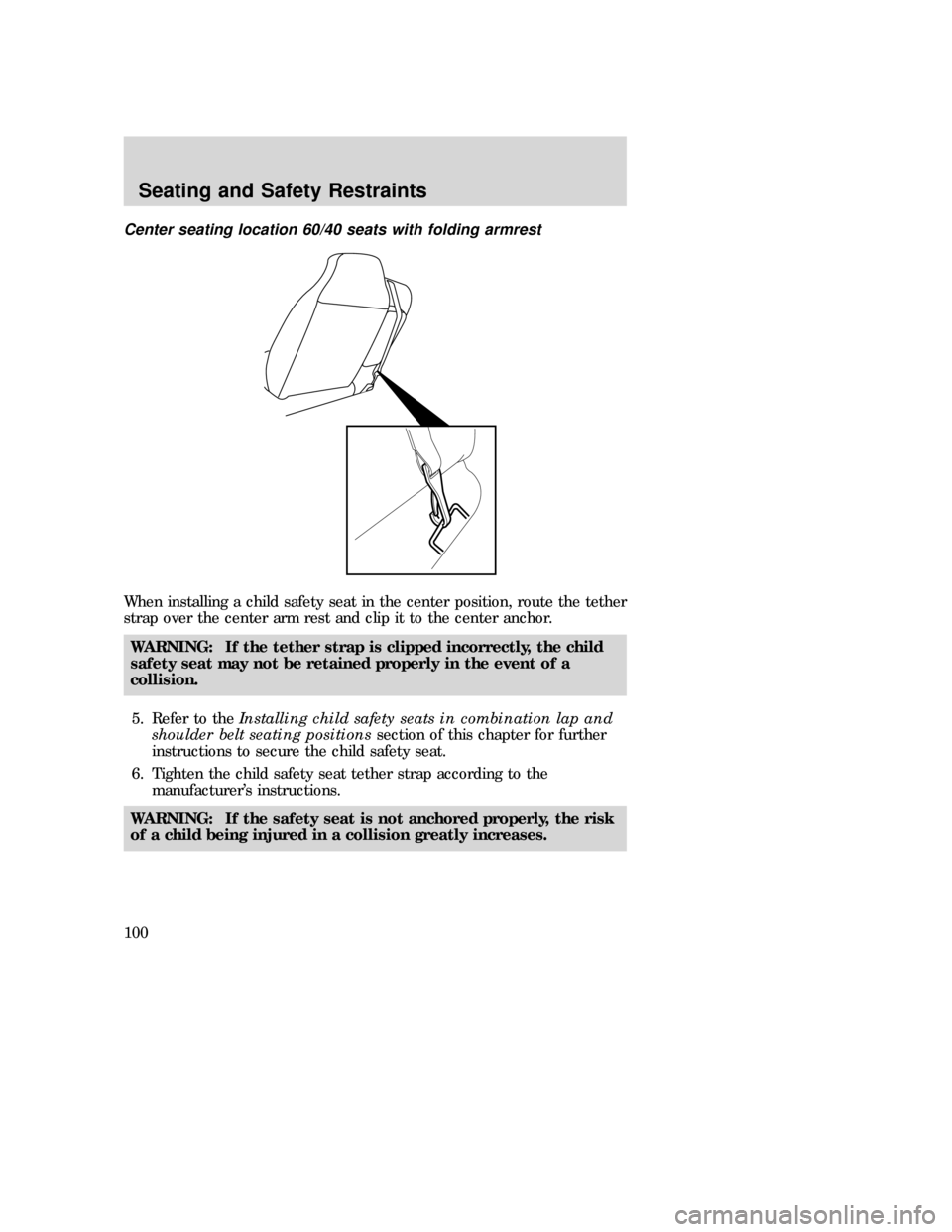
Center seating location 60/40 seats with folding armrest
When installing a child safety seat in the center position, route the tether
strap over the center arm rest and clip it to the center anchor.
WARNING: If the tether strap is clipped incorrectly, the child
safety seat may not be retained properly in the event of a
collision.
5. Refer to theInstalling child safety seats in combination lap and
shoulder belt seating positionssection of this chapter for further
instructions to secure the child safety seat.
6. Tighten the child safety seat tether strap according to the
manufacturer’s instructions.
WARNING: If the safety seat is not anchored properly, the risk
of a child being injured in a collision greatly increases.
2006 B-Series(mbs)
Owners Guide (post-2002-fmt)
Canadian_French(fr_can)
Seating and Safety Restraints
100
Page 101 of 262

Attaching safety seats with LATCH (Lower Anchors and Tethers for
Children) attachments for child seat anchors
Some child safety seats have two rigid or webbing mounted attachments
that connect to two anchors at certain seating positions in your vehicle.
This type of child seat eliminates the need to use seat belts to attach the
child seat. For forward-facing child seats, the tether strap must also be
attached to the proper tether anchor. SeeAttaching safety seats with
tether strapsin this chapter.
Your vehicle may be equipped with LATCH anchors for child seat
installation at the following seating positions:
•Bucket seats
•60/40 seats
represents LATCH anchors.
represents tether strap anchors.
To improve child seat protection, use the tether anchor when using the
LATCH to install a child safety seat. SeeAttaching child safety seats
with tether straps in this section.
WARNING: Never attach two LATCH child safety seats to the
same anchor. In a crash, one anchor may not be strong enough
to hold two child safety seat attachments and may break,
causing serious injury or death.
2006 B-Series(mbs)
Owners Guide (post-2002-fmt)
Canadian_French(fr_can)
Seating and Safety Restraints
101
Page 102 of 262

WARNING: Do not put the LATCH type seat in the center seat
position — it only has one possible anchor point and the seat
will not be properly attached.
WARNING: If there are two LATCH seats to install — you can
only mount one LATCH seat in this vehicle with the LATCH
anchor bars. You need to mount the second seat with the center
seat belt using the lap belt method and the child safety seat
tether (if equipped).
WARNING: Do not attach two seats to one LATCH anchor bar.
The lower anchors for child seat
installation are located at the rear
section of the front passenger seat
between the cushion and seat back.
The LATCH anchors are below
locator symbols on the seat back.
Two plastic LATCH guides may be
purchased from your local Mazda
dealer (part number 1F60–57–751).
They snap onto the latch lower
anchor in the vehicle to help attach
a child seat with rigid latch
attachments. It will hold the seat
foam away and expose the anchor
making attachment of the child seat
easier.
Make sure you attach the proper
child safety seat tether after
securing the LATCH.
WARNING: If the tether strap
is clipped incorrectly, the child
safety seat may not be
retained properly in the event
of a collision.
2006 B-Series(mbs)
Owners Guide (post-2002-fmt)
Canadian_French(fr_can)
Seating and Safety Restraints
102
Page 104 of 262

NOTICE TO UTILITY VEHICLE AND TRUCK OWNERS
Utility vehicles and trucks handle
differently than passenger cars in
the various driving conditions that
are encountered on streets,
highways and off-road. Utility
vehicles and trucks are not designed
for cornering at speeds as high as
passenger cars any more than
low-slung sports cars are designed
to perform satisfactorily under
off-road conditions.
WARNING: Utility vehicles have a significantly higher rollover
rate than other types of vehicles. To reduce the risk of serious
injury or death from a rollover or other crash you must:
•Avoid sharp turns and abrupt maneuvers;
•Drive at safe speeds for the conditions;
•Keep tires properly inflated;
•Never overload or improperly load your vehicle; and
•Make sure every passenger is properly restrained.
WARNING: In a rollover crash, an unbelted person is
significantly more likely to die than a person wearing a seat
belt. All occupants must wear safety belts and children/infants
must use appropriate restraints to minimize the risk of injury
or ejection.
Study yourOwner’s Guideand any supplements for specific information
about equipment features, instructions for safe driving and additional
precautions to reduce the risk of an accident or serious injury.
VEHICLE CHARACTERISTICS
4WD and AWD Systems (if equipped)
A vehicle equipped with AWD or 4WD (when selected) has the ability to
use all four wheels to power itself. This increases traction which may
enable you to safely drive over terrain and road conditions that a
conventional two-wheel drive vehicle cannot.
2006 B-Series(mbs)
Owners Guide (post-2002-fmt)
Canadian_French(fr_can)
Tires, Wheels and Loading
104
Page 141 of 262

WARNING: Do not park, idle, or drive your vehicle in dry grass
or other dry ground cover. The emission system heats up the
engine compartment and exhaust system, which can start a fire.
WARNING: Do not start your vehicle in a closed garage or in
other enclosed areas. Exhaust fumes can be toxic. Always open
the garage door before you start the engine. SeeGuarding
against exhaust fumesin this chapter for more instructions.
WARNING: If you smell exhaust fumes inside your vehicle,
have your dealer inspect your vehicle immediately. Do not drive
if you smell exhaust fumes.
Important safety precautions
When the engine starts, the idle RPM runs faster to warm the engine. If
the engine idle speed does not slow down automatically, have the vehicle
checked.
Before starting the vehicle:
1. Make sure all occupants buckle their safety belts. For more
information on safety belts and their proper usage, refer to the
Seating and Safety Restraintschapter.
2. Make sure the headlamps and electrical accessories are off.
If starting a vehicle with an automatic transmission:
•Make sure the parking brake is
set.
•Make sure the gearshift is in P
(Park).
2006 B-Series(mbs)
Owners Guide (post-2002-fmt)
Canadian_French(fr_can)
Driving
141