Page 224 of 320

The BRAKE warning lamp will
illuminate and will remain
illuminated until the parking brake
is released.
The parking brake will automatically disengage when the gearshift lever
is moved from P (Park) with the ignition in the ON position or if the
engine is running. The parking brake will also disengage if a gear is
selected and the accelerator pedal is depressed.
If the battery is disconnected (or removed), it will be necessary to reset
the parking brake; the message center will display APPLY PARK BRAKE
followed by FOOT ON BRAKE or APPLY ((P)) followed by FOOT BRK.
With the ignition on and the engine not running, depress the brake pedal
and apply the parking brake. The brake lamp will illuminate; this is
normal and the parking brake is now reset. To release the parking brake,
push the lever down with your foot on the brake pedal.
If there is a failure in the parking brake system, the amber warning light
on the parking brake control will illuminate. See your authorized dealer
for service on the parking brake system.
TRACTION CONTROL�
The Traction Control�system helps you maintain the stability and
steerability of your vehicle, especially on slippery road surfaces such as
snow- or ice-covered roads and gravel roads. The system will allow your
vehicle to make better use of available traction in these conditions.
During Traction Control�operation, the traction control active light will
illuminate, you may hear an electric motor type of sound coming from
the engine compartment and the engine will not “rev-up” when you push
further on the accelerator. This is normal system behavior and should be
no reason for concern.
The Traction Control�switch,
located on the center console by the
gearshift lever, has an indicator light
that illuminates when the system is
off. The Traction Control�system
will automatically turn on every time
the ignition is turned off and on.
P!
BRAKE
2006 Lincoln LS(dew)
Owners Guide (post-2002-fmt)
USA(fus)
Driving
224
Page 228 of 320

STEERING
To prevent damage to the power steering system:
•Never hold the steering wheel at its furthest turning points (until it
stops) for more than a few seconds when the engine is running.
•Do not operate the vehicle with a low power steering pump reservoir
fluid level (below the MIN mark on the reservoir).
If the power steering system breaks down (or if the engine is turned
off), you can steer the vehicle manually, but it takes more effort.
If the steering wanders or pulls, check for:
•an improperly inflated tire
•uneven tire wear
•loose or worn suspension components
•loose or worn steering components
•improper steering alignment
A high crown in the road or high crosswinds may also make the steering
seem to wander/pull.
Speed sensitive steering
The steering in your vehicle is speed sensitive. At high speeds, steering
assist will decrease to improve steering feel. At lower speeds,
maneuverability will be increased.
If the amount of effort required to steer your vehicle changes while
driving at a constant vehicle speed, have the power steering system
checked by your authorized dealer.
AUTOMATIC TRANSMISSION OPERATION
Brake-shift interlock
This vehicle is equipped with a brake-shift interlock feature that prevents
the gearshift lever from being moved from P (Park) when the ignition is
in the RUN position unless brake pedal is depressed.
If you cannot move the gearshift lever out of P (Park) with ignition in
the RUN position and the brake pedal depressed:
1. Apply the parking brake, turn ignition key to LOCK, then remove the
key.
2. Insert the key and turn it to OFF.Apply the brake pedal and shift
to N (Neutral).
2006 Lincoln LS(dew)
Owners Guide (post-2002-fmt)
USA(fus)
Driving
228
Page 229 of 320

When the key is in the ignition and in the OFF position, the
automatic transmission shift lever can be moved from the P
(Park) position without the brake pedal depressed. To avoid unwanted
vehicle movement, always set the parking brake.
3. Start the vehicle.
If it is necessary to use the above procedure to move the gearshift lever,
it is possible that a fuse has blown or the vehicle’s brakelamps are not
operating properly. Refer toFuses and relaysin theRoadside
Emergencieschapter.
Do not drive your vehicle until you verify that the brakelamps
are working.
Always set the parking brake fully and make sure the gearshift is
latched in P (Park). Turn the ignition to the LOCK position and
remove the key whenever you leave your vehicle.
If the parking brake is fully released, but the brake warning lamp
remains illuminated, the brakes may not be working properly.
See your authorized dealer as soon as possible.
2006 Lincoln LS(dew)
Owners Guide (post-2002-fmt)
USA(fus)
Driving
229
Page 230 of 320
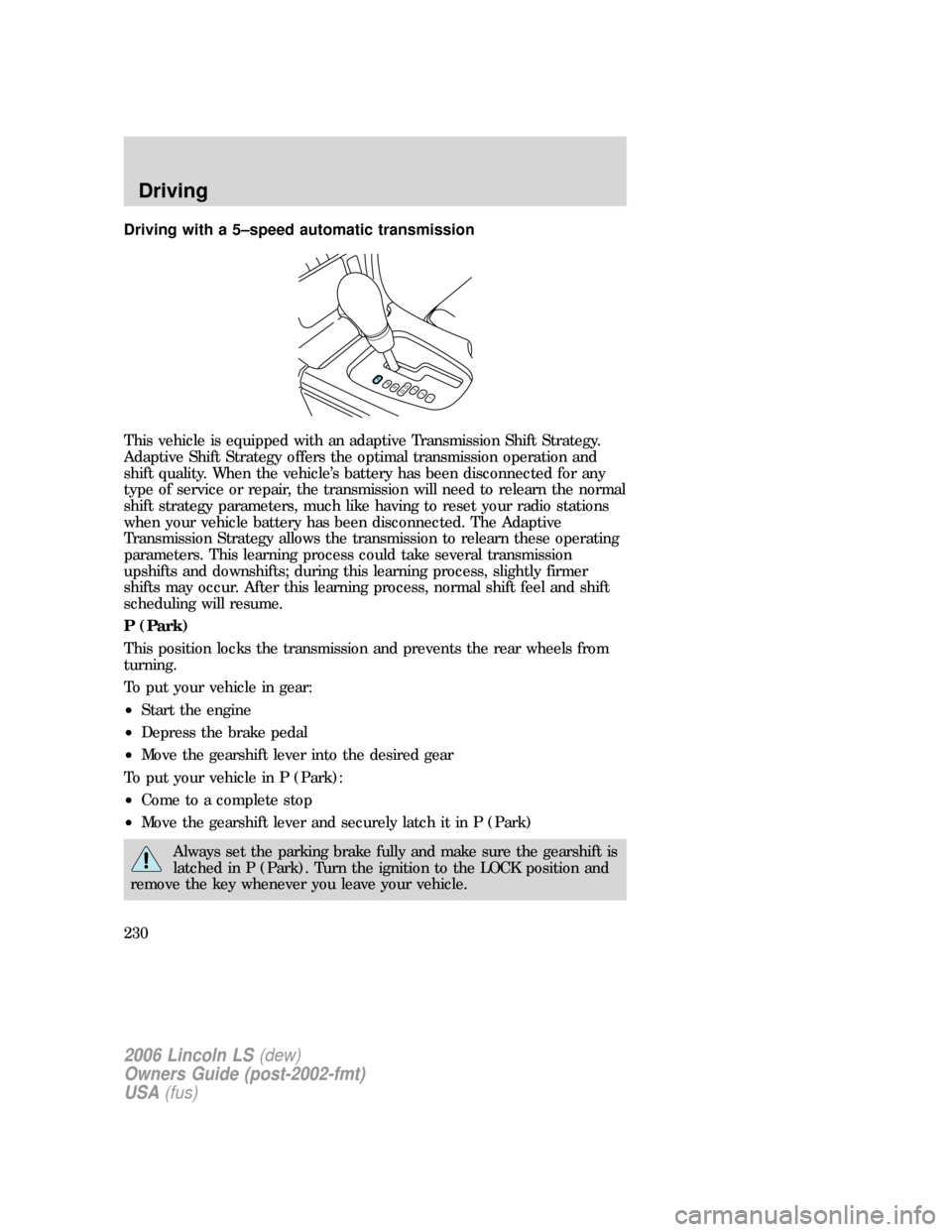
Driving with a 5–speed automatic transmission
This vehicle is equipped with an adaptive Transmission Shift Strategy.
Adaptive Shift Strategy offers the optimal transmission operation and
shift quality. When the vehicle’s battery has been disconnected for any
type of service or repair, the transmission will need to relearn the normal
shift strategy parameters, much like having to reset your radio stations
when your vehicle battery has been disconnected. The Adaptive
Transmission Strategy allows the transmission to relearn these operating
parameters. This learning process could take several transmission
upshifts and downshifts; during this learning process, slightly firmer
shifts may occur. After this learning process, normal shift feel and shift
scheduling will resume.
P (Park)
This position locks the transmission and prevents the rear wheels from
turning.
To put your vehicle in gear:
•Start the engine
•Depress the brake pedal
•Move the gearshift lever into the desired gear
To put your vehicle in P (Park):
•Come to a complete stop
•Move the gearshift lever and securely latch it in P (Park)
Always set the parking brake fully and make sure the gearshift is
latched in P (Park). Turn the ignition to the LOCK position and
remove the key whenever you leave your vehicle.
PRND5D4321
2006 Lincoln LS(dew)
Owners Guide (post-2002-fmt)
USA(fus)
Driving
230
Page 236 of 320

The rear park assist is automatically
enabled when the gear selector is
placed in R (Reverse) and the
ignition is ON. A park assist control
allows the driver to disable the
system only when the ignition is
ON, and the gear selector is in R
(Reverse).
The OFF indicator remains
illuminated when the system is
disabled. Press the control to
disable or enable the system. Once disabled, the system will remain
disabled until the control is pressed or until the next ignition cycle.
The indicator will remain illuminated to indicate a failure of the rear park
assist.
Always keep the sensors (located on the rear bumper/fascia) free
from snow, ice and large accumulations of dirt (do not clean the
sensors with sharp objects). These elements may cause the
system to operate inaccurately.
If the vehicle sustains damage to the rear bumper/fascia, leaving
it misaligned or bent, the sensing zone may be altered causing
inaccurate measurement of obstacles or false alarms.
DRIVING THROUGH WATER
If driving through deep or standing
water is unavoidable, proceed very
slowly especially when the depth is
not known. Never drive through
water that is higher than the bottom
of the wheel rims (for cars) or the
bottom of the hubs (for trucks).
When driving through water, traction or brake capability may be limited.
Also, water may enter your engine’s air intake and severely damage your
engine or your vehicle may stall.Driving through deep water where
the transmission vent tube is submerged may allow water into the
transmission and cause internal transmission damage.
Once through the water, always dry the brakes by moving your
vehicle slowly while applying light pressure on the brake pedal.
Wet brakes do not stop the vehicle as quickly as dry brakes.
2006 Lincoln LS(dew)
Owners Guide (post-2002-fmt)
USA(fus)
Driving
236
Page 239 of 320
HAZARD FLASHER
The hazard flasher is located on the
steering column, just behind the
steering wheel. The hazard flashers
will operate when the ignition is in
any position or if the key is not in
the ignition.
Push in the flasher control and all
front and rear direction signals will
flash. Press the flasher control again
to turn them off. Use it when your
vehicle is disabled and is creating a
safety hazard for other motorists.
Note:With extended use, the flasher may run down your battery.
FUEL PUMP SHUT-OFF SWITCH
FUEL
RESET
This device stops the electric fuel pump from sending fuel to the engine
when your vehicle has had a substantial jolt.
After an accident, if the engine cranks but does not start, this switch
may have been activated.
2006 Lincoln LS(dew)
Owners Guide (post-2002-fmt)
USA(fus)
Roadside Emergencies
239
Page 240 of 320
This switch is located in the driver’s
footwell, behind the kick panel.
To reset the switch:
1. Turn the ignition OFF.
2. Check the fuel system for leaks.
3. If no leaks are apparent, reset the
switch by pushing in on the reset
button.
4. Turn the ignition ON.
5. Wait a few seconds and return
the key to OFF.
6. Make another check for leaks.
FUSES AND RELAYS
Fuses
If electrical components in the
vehicle are not working, a fuse may
have blown. Blown fuses are
identified by a broken wire within
the fuse. Check the appropriate
fuses before replacing any electrical
components.
Note:Always replace a fuse with one that has the specified amperage
rating. Using a fuse with a higher amperage rating can cause severe wire
damage and could start a fire.
15
2006 Lincoln LS(dew)
Owners Guide (post-2002-fmt)
USA(fus)
Roadside Emergencies
240
Page 249 of 320
Fuse/Relay
LocationFuse Amp
RatingPower Distribution Box Description
18 20A* Subwoofer amp
30A* THX amp, Subwoofer amp
19 20A** REM - Left rear window
20 30A** Front window motors
21 20A** Driver lumbar, Power seats
22 20A** Ignition switch
23 30A** SSP4
24 30A** SSP3
25 40A** P-J/B
26 30A** Climate control seat module
27 30A** SSP1
28 20A** Passenger lumbar, Power seats
29 40A** Rear defroster
30 20A** REM - Right rear window
31 30A** Powertrain main power
32 30A** SSP2
Relay 001 — SSP1
Relay 002 — SSP4
Relay 003 — Rear defroster
Relay 004 — SSP3
Relay 005 — SSP2
Relay 006 — Not used
Relay 007 — Fuel pump motor
Diode 01 — Not used
Diode 02 — Fuel pump motor
*Mini fuses **Maxi fuses
CHANGING THE TIRES
If you get a flat tire while driving:
•do not brake heavily.
•gradually decrease the vehicle’s speed.
•hold the steering wheel firmly.
2006 Lincoln LS(dew)
Owners Guide (post-2002-fmt)
USA(fus)
Roadside Emergencies
249


