Page 607 of 651

CHASSIS
586
This applies also to the spare tire and tires stored
for future use.
Tire selection
When replacing a tire, use a tire of the same size
and construction, and the same or greater
maximum load as the originally installed tires.
Also, on fourwheel drive models, all the tires
must be the same brand and have the same tread
patterns.
Using any other size or type of tire may seriously
affect handling, ride, speedometer/odometer
calibration, ground clearance, and clearance between
the body and tires or snow chains.
Check that the maximum load of the replaced tire is
greater than 1/2 of the Gross Axle Weight Ratings
(GAWR) of either the front axle or the rear axle,
whichever is greater. As for the maximum load of
the tire, see the load limit at maximum cold tire
inflation pressure mentioned on the sidewall of the tire,
and as for the Gross Axle Weight Ratings (GAWR),
see the Certification Label. For details about
Certification Label and sidewall of the tire, see pages
536 and 573.
CAUTION
Observe the following instructions. Otherwise,
an accident may occur resulting in death or
serious injuries.
�Do not mix radial, bias belted, or biasply tires
on your vehicle, as this may cause dangerous
handling characteristics resulting in loss of
control.
� Do not use tires other than the manufacturer’s
recommended size, as this may cause
dangerous handling characteristics resulting
in loss of control.
� Fourwheel drive models:
Do not use tires of different brands, sizes,
construction or tread patterns, as this may
cause dangerous handling characteristics
resulting in loss of control.
Page 612 of 651
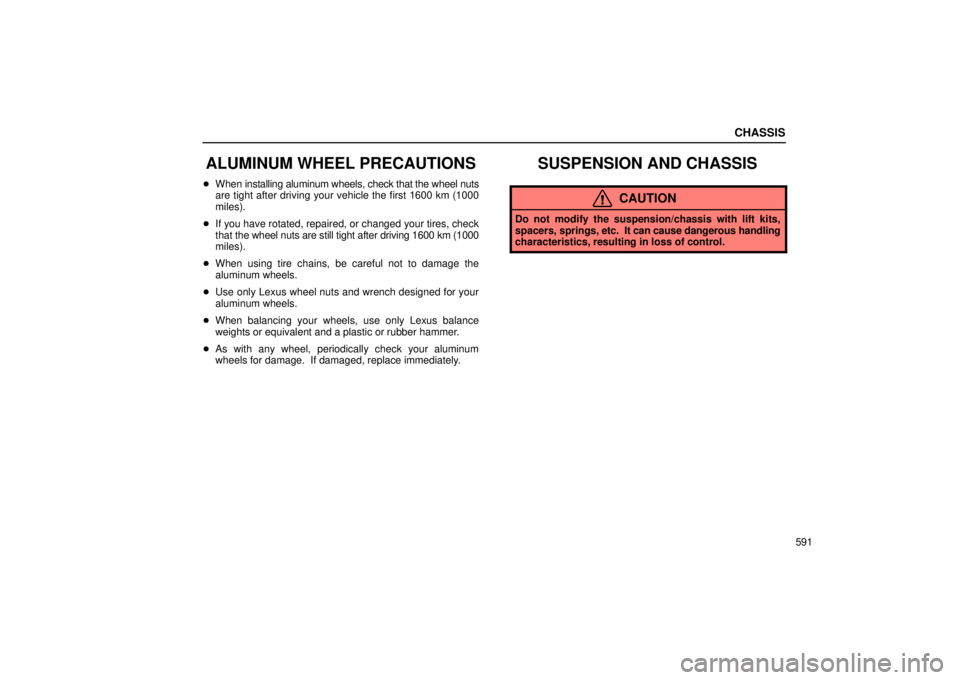
CHASSIS
591
ALUMINUM WHEEL PRECAUTIONS
�When installing aluminum wheels, check that the wheel nuts
are tight after driving your vehicle the first 1600 km (1000
miles).
� If you have rotated, repaired, or changed your tires, check
that the wheel nuts are still tight after driving 1600 km (1000
miles).
� When using tire chains, be careful not to damage the
aluminum wheels.
� Use only Lexus wheel nuts and wrench designed for your
aluminum wheels.
� When balancing your wheels, use only Lexus balance
weights or equivalent and a plastic or rubber hammer.
� As with any wheel, periodically check your aluminum
wheels for damage. If damaged, replace immediately.
SUSPENSION AND CHASSIS
CAUTION
Do not modify the suspension/chassis with lift kits,
spacers, springs, etc. It can cause dangerous handling
characteristics, resulting in loss of control.
Page 637 of 651
BODY
616
SPECIFICATIONS
— DIMENSIONS AND WEIGHTSOverall length
4730 mm (186.2 in.)
Overall width1845 mm (72.6 in.)
Overall height*1
Tw o −wheel drive models
Four−wheel drive models — With electronically modulated air suspension
— Without electronically modulated air suspension1670 mm (65.7 in.)*2
1710 mm (67.3 in.)*3
1725 mm (67.9 in.)*4
1670 mm (65.7 in.)*2
1710 mm (67.3 in.)*3
1725 mm (67.9 in.)*4
1680 mm (66.1 in.)*2
1720 mm (67.7 in.)*3
1735 mm (68.3 in.)*4
*1: Unladen vehicle
*2: Without roof rails
*3: With roof rails
*4: With roof rails and cross rails
Page 638 of 651
BODY
617
— DIMENSIONS AND WEIGHTSWheelbase
2715 mm (107 in.)
Tread Tw o −wheel drive models
— Front
— Rear
Four−wheel drive models — Front
— Rear (with electronically
modulated air suspension)
— Rear (without electronically
modulated air suspension)
1580 mm (62.2 in.)
1565 mm (61.6 in.)
1575 mm (62.0 in.)
1560 mm (61.4 in.)
1555 mm (61.2 in.)
Vehicle capacity weight
(occupants + cargo)420 kg (925 lb.)
Towing capacity
(trailer weight + cargo weight)— Without towing package
— With towing package
907 kg (2000 lb.)
1588 kg (3500 lb.)
— FUEL TANK
Capacity
72.5 L (19.2 gal., 15.9 Imp. gal.)