Page 231 of 651
OCCUPANT RESTRAINT SYSTEMS
210
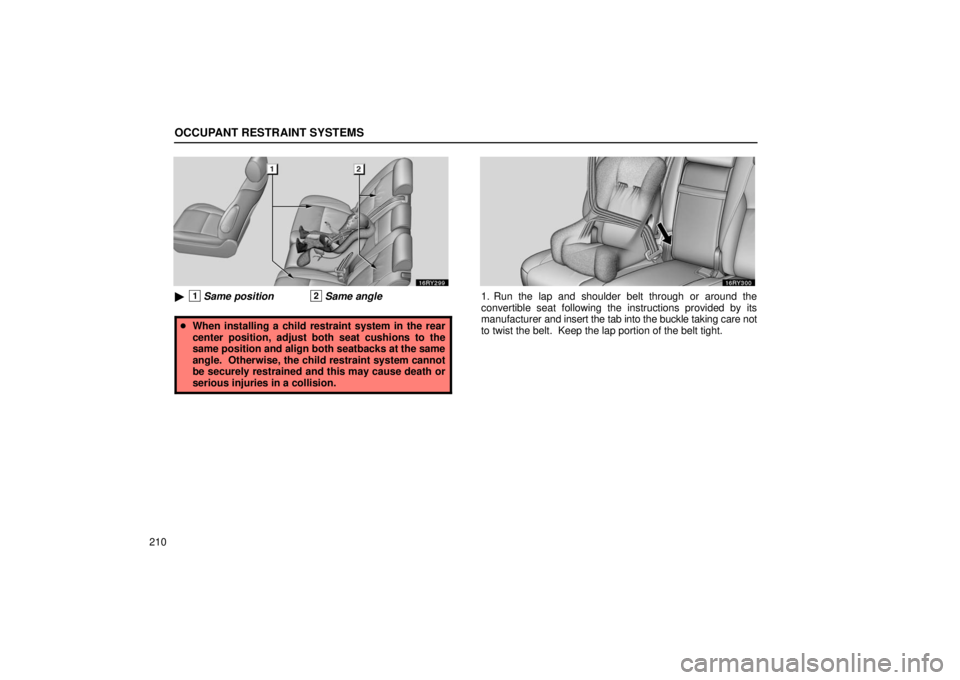
�1Same position2Same angle
�When installing a child restraint system in the rear
center position, adjust both seat cushions to the
same position and align both seatbacks at the same
angle. Otherwise, the child restraint system cannot
be securely restrained and this may cause death or
serious injuries in a collision.
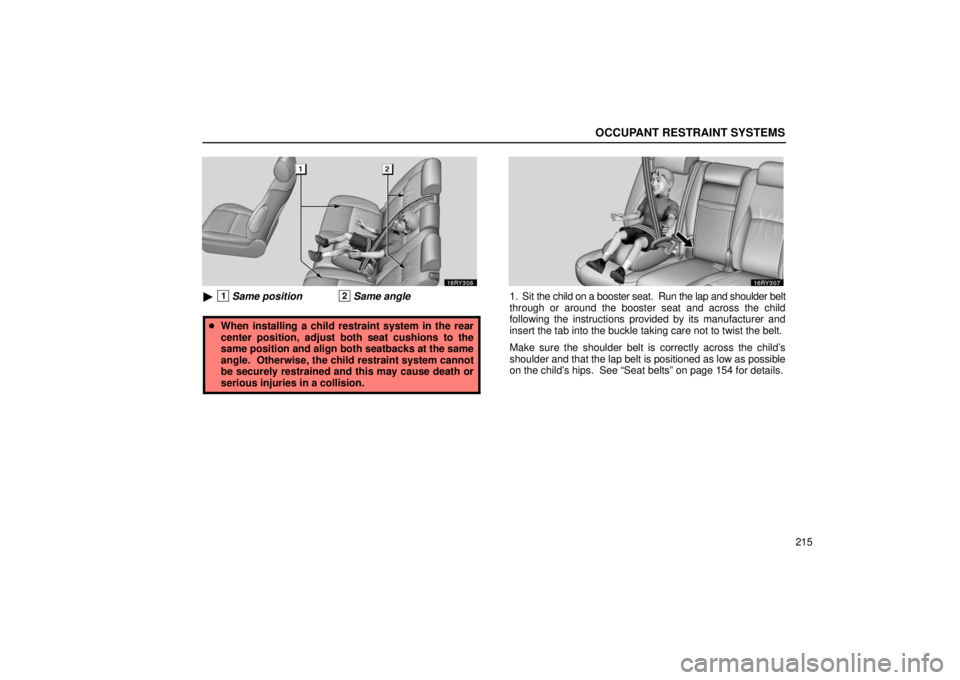
1. Run the lap and shoulder belt through or around the
convertible seat following the instructions provided by its
manufacturer and insert the tab into the buckle taking care not
to twist the belt. Keep the lap portion of the belt tight.
Page 236 of 651
OCCUPANT RESTRAINT SYSTEMS
215
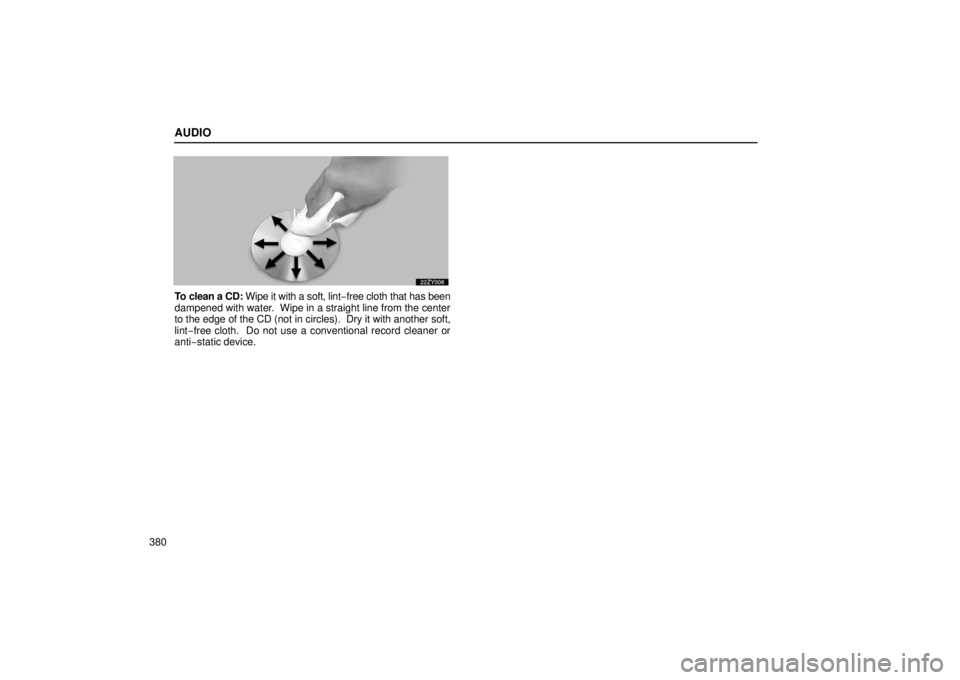
�1Same position2Same angle
�When installing a child restraint system in the rear
center position, adjust both seat cushions to the
same position and align both seatbacks at the same
angle. Otherwise, the child restraint system cannot
be securely restrained and this may cause death or
serious injuries in a collision.
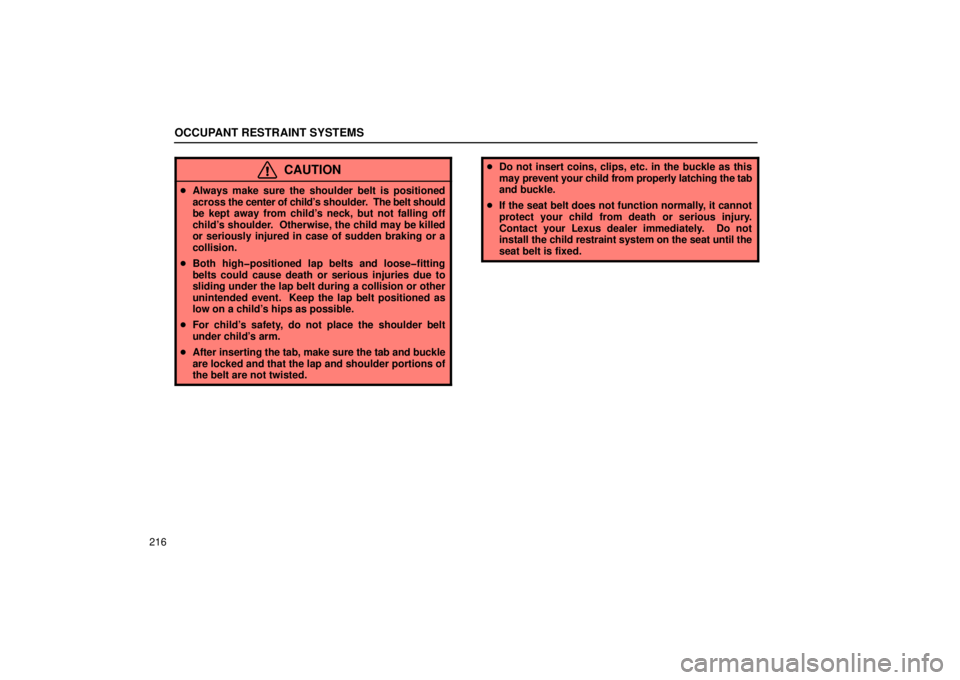
1. Sit the child on a booster seat. Run the lap and shoulder belt
through or around the booster seat and across the child
following the instructions provided by its manufacturer and
insert the tab into the buckle taking care not to twist the belt.
Make sure the shoulder belt is correctly across the child’s
shoulder and that the lap belt is positioned as low as possible
on the child’s hips. See “Seat belts” on page 154 for details.
Page 237 of 651
OCCUPANT RESTRAINT SYSTEMS
216
CAUTION
�Always make sure the shoulder belt is positioned
across the center of child’ s shoulder. The belt should
be kept away from child’s neck, but not falling off
child’s shoulder. Otherwise, the child may be killed
or seriously injured in case of sudden braking or a
collision.
� Both highpositioned lap belts and loosefitting
belts could cause death or serious injuries due to
sliding under the lap belt during a collision or other
unintended event. Keep the lap belt positioned as
low on a child’s hips as possible.
� For child’s safety, do not place the shoulder belt
under child’s arm.
� After inserting the tab, make sure the tab and buckle
are locked and that the lap and shoulder portions of
the belt are not twisted.
� Do not insert coins, clips, etc. in the buckle as this
may prevent your child from properly latching the tab
and buckle.
� If the seat belt does not function normally, it cannot
protect your child from death or serious injury.
Contact your Lexus dealer immediately. Do not
install the child restraint system on the seat until the
seat belt is fixed.
Page 241 of 651
OCCUPANT RESTRAINT SYSTEMS
220
5. Replace the head restraint and lift it up to the
uppermost lock position.
Be sure to close the cover when the anchor bracket is not in
use.
Installation with child restraint lower
anchorages
Lower anchorages for the child restraint systems
complying with the FMVSS225 or CMVSS210.2
specifications are installed in the rear seat.
The anchorages are installed in the seat cushion of the right
side seating position and between the center and left side
seating position.
Page 401 of 651
AUDIO
380
To clean a CD: Wipe it with a soft, lint−free cloth that has been
dampened with water. Wipe in a straight line from the center
to the edge of the CD (not in circles). Dry it with another soft,
lint−free cloth. Do not use a conventional record cleaner or
anti−static device.
Page 460 of 651
STARTING AND DRIVING
439
Vehicle’s height mm (in.)Vehicle speedkm/h (mph)
80
(50) 100
(62)
“HI”
+30 (1.2)
30 (19) — 50 (31)
“N”
− 7.0 (0.3)
� “HI” (high) mode
“HI” (high) mode: The vehicle’s height is about 30 mm (1.2
in.) higher than the normal height.
This mode is suitable for driving on bumpy roads.
When the vehicle speed exceeds approximately 50 km/h (31
mph) or driving at the speeds of 30 km/h (19 mph) or over for
ten seconds total in “HI” mode, “N” mode is automatically
selected. Even if the vehicle speed then reduces to under 50
km/h (31 mph), the vehicle’s height will not return to “HI” mode.
CAUTION
The “HI” mode should be used for severe offroad
driving conditions only. As the vehicle’s center of
gravity is higher in this setting, the vehicle may become
unstable when turning abruptly, resulting in an
unexpected accident.
Page 489 of 651
DRIVING TIPS
468
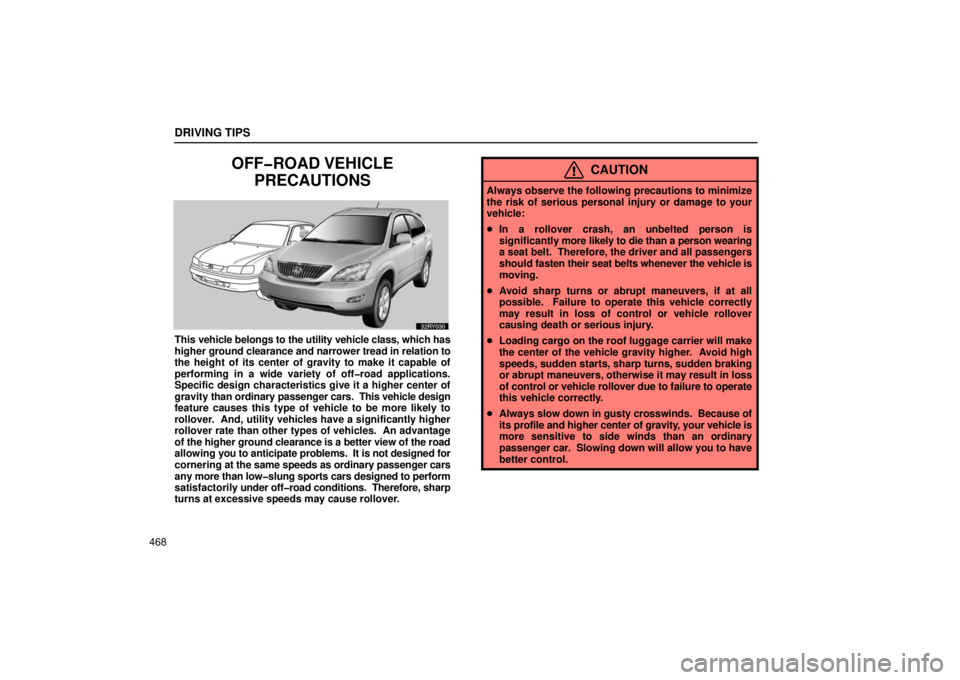
OFFROAD VEHICLEPRECAUTIONS
This vehicle belongs to the utility vehicle class, which has
higher ground clearance and narrower tread in relation to
the height of its center of gravity to make it capable of
performing in a wide variety of offroad applications.
Specific design characteristics give it a higher center of
gravity than ordinary passenger cars. This vehicle design
feature causes this type of vehicle to be more likely to
rollover. And, utility vehicles have a significantly higher
rollover rate than other types of vehicles. An advantage
of the higher ground clearance is a better view of the road
allowing you to anticipate problems. It is not designed for
cornering at the same speeds as ordinary passenger cars
any more than lowslung sports cars designed to perform
satisfactorily under offroad conditions. Therefore, sharp
turns at excessive speeds may cause rollover.
CAUTION
Always observe the following precautions to minimize
the risk of serious personal injury or damage to your
vehicle:
� In a rollover crash, an unbelted person is
significantly more likely to die than a person wearing
a seat belt. Therefore, the driver and all passengers
should fasten their seat belts whenever the vehicle is
moving.
� Avoid sharp turns or abrupt maneuvers, if at all
possible. Failure to operate this vehicle correctly
may result in loss of control or vehicle rollover
causing death or serious injury.
� Loading cargo on the roof luggage carrier will make
the center of the vehicle gravity higher. Avoid high
speeds, sudden starts, sharp turns, sudden braking
or abrupt maneuvers, otherwise it may result in loss
of control or vehicle rollover due to failure to operate
this vehicle correctly.
� Always slow down in gusty crosswinds. Because of
its profile and higher center of gravity, your vehicle is
more sensitive to side winds than an ordinary
passenger car . Slowing down will allow you to have
better control.
Page 521 of 651

IN CASE OF AN EMERGENCY
500B: If no steam is coming from your engine:
Leave the engine running and turn off the air conditioning.
Check the following.
�
Is the cooling fan operating?
� Is the coolant in the acceptable range?
� Is the engine drive belt O.K.?
CAUTION
�When the engine is running, keep hands and clothing
away from the moving fan and engine drive belt.
� Do not attempt to remove the radiator cap when the
engine and radiator are hot. Serious injury could
result from scalding hot fluid and steam blown out
under pressure.
If the cooling fan is not operating or the coolant is not in the
acceptable range, turn off the engine and call your Lexus
dealer.
If both conditions are O.K., after the engine coolant
temperature has cooled to normal, continue driving your
vehicle.
If the engine coolant temperature does not cool down, or your
vehicle overheats again, have it checked as soon as possible
by your Lexus dealer.
IF YOU HAVE A FLAT TIRE
1. Reduce your speed gradually, keeping a straight
line. Move cautiously off the road to a safe place
— well away from the traffic. Avoid stopping on the
center divider of a highway. Park on a level spot with
firm ground.
2. Stop the engine and turn on your emergency
flashers.
3. F i r m l y s e t t h e p a r k i n g b r a k e a n d p u t t h e
transmission in “P”.
4. Have everyone get out of the vehicle on the side
away from traffic.
5. Read the following instructions thoroughly.