Page 161 of 419
145
2
When driving
2-5. Driving information
Cargo & luggage
Capacity and distribution
Cargo capacity depends on the total weight of the occupants.
(Cargo capacity) = (Total load capacity) - (T
otal weight of occupants)
■ Steps for determining corr
ect load limit
Locate the statement “The combin ed w
eight of occupants and
cargo should never exceed xxx pounds” on your vehicle’s plac -
ard.
Determine the combined weight of the driv
er and passengers
that will be riding in your vehicle.
Subtract the combined weight of the driver and passengers from
xxx pounds or xxx kilograms
The resulting figure equals the available amount of car
go and lug-
gage load capacity.
For example, if the “xxx” amount equa ls 1400 lbs. and there will be five
150 lb. passengers in your vehicle, the amount of available cargo and
luggage load capacity is 650 lbs. 1400 - 750 (5 150) = 650 lbs.
Take notice of the following information about stowage precautions, cargo
capacity and load.
When stowing cargo and luggage in the vehicle, observe the following precau-
tions:
• Put cargo and luggage in the trunk wh en at all possible. Be sure all
items are secured in place.
• Be careful to keep the vehicle level. Placing the w
eight as far forward
as possible helps maintain vehicle balance.
• For better fuel economy, do not carry unnecessary weight.
Page 168 of 419
152
2-5. Driving information
Trailer Towing
Your vehicle is designed primarily as a passenger-carrying vehicle, thus tow-
ing a trailer will have an adverse effec t on
handling, performance, braking,
durability, and fuel consumption. For yo ur safety and the safety of others, do
not overload the vehicle or trailer.
Lexus warranties do not apply to damage or malfunction caused b
y towing a
trailer for commercial purposes
■ Weight limits
Confirm the total trailer weight, gross v
ehicle weight, gross axle weight
and trailer tongue load are all within the limits.
■ Gr
oss vehicle weight
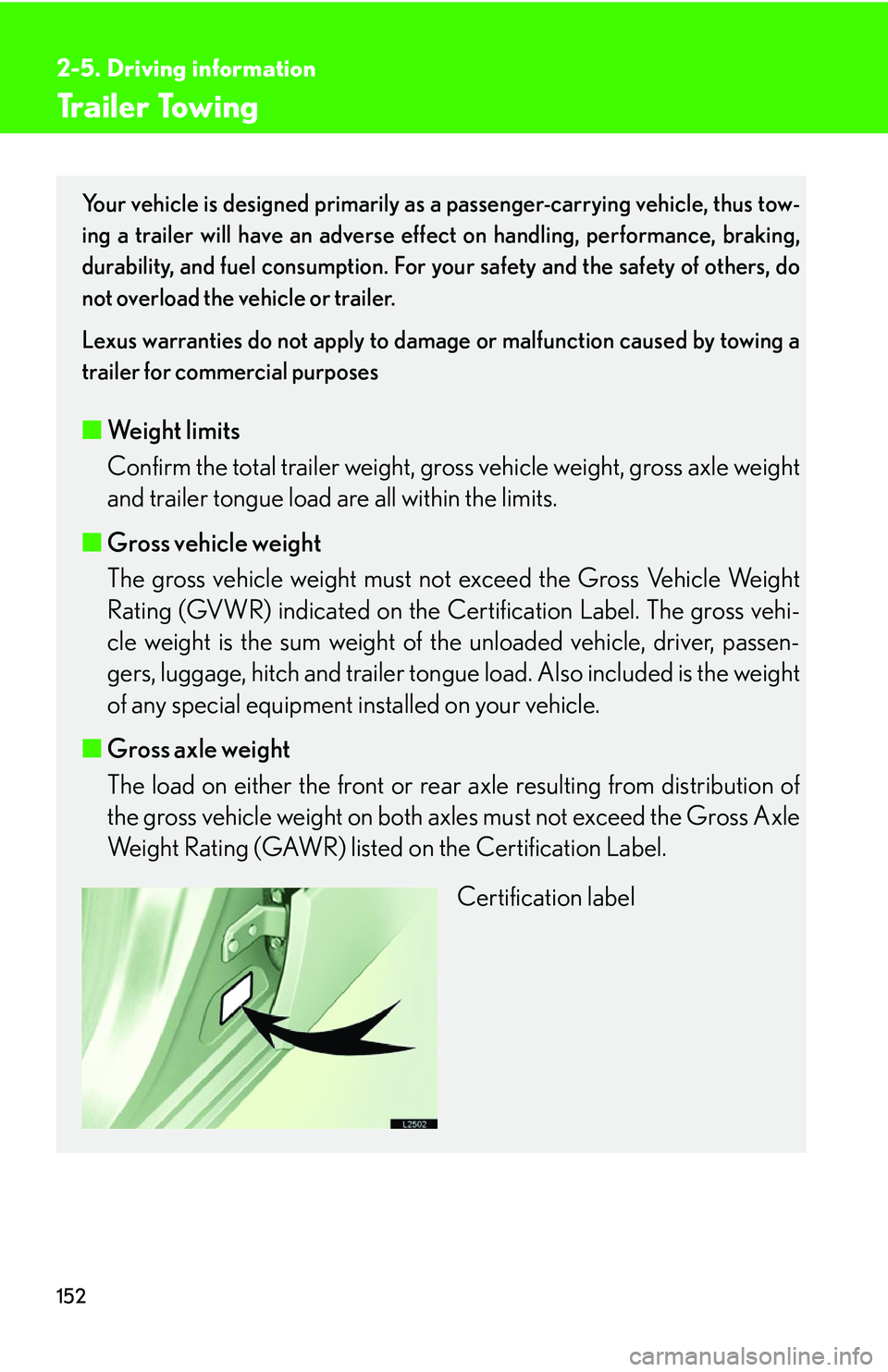
The gross vehicle weight must not exceed the Gross Vehicle Weight
R
ating (GVWR) indicated on the Certification Label. The gross vehi -
cle weight is the sum weight of th e unloaded v
ehicle, driver, passen-
gers, luggage, hitch and trailer tongue load. Also included is the w
eight
of any special equipment installed on your vehicle.
■ Gr
oss axle weight
The load on either the front or rear axle r
esulting from distribution of
the gross vehicle weight on both ax les must not exceed the Gross Axle
Weight Rating (GAWR) listed on the Certification Label.
Certification label
Page 260 of 419
244
4-1. Maintenance and care
Cleaning and protecting the vehicle exterior
■Automatic car washes
●Fold the mirrors back before washing the vehicle.
●Brushes used in automatic car washes may scratch the vehicle surface, which
can harm your vehicle’s paint.
■High pressure automatic car washes
Do not allow the nozzles of the car wash to come within close proximity of the win-
dows or door weather seals of your vehicle.
Before entering the automatic car wash, check that the fuel filler door on your vehi -
cle is closed properly.
Follow these guidelines when washing and waxing your Lexus:
●Working from top to bottom, libera lly apply water to the vehicle body,
wheel wells and underside of the vehi cle to remove any built up dirt
and dust.
Wash the vehicle body using a sponge or sof
t cloth, such as a chamois.
●For hard-to-remove dirts, use car wash soap and rinse thoroughly with
water.
●Thoroughly dry your vehicle.
●Apply polish or wax only when the vehicle body is cool.
Wax or polish your vehicle when the e
xisting coating of wax or polish
begin to deteriorate. A good way to determine this, is by checking to
see if water beads on the painted surfac e of your vehicle. If it does not
bead, that means the wax or polish is no longer protecting the finish,
and therefore should be reapplied.
Page 267 of 419
251
4-2. Maintenance
4
Maintenance and care
■Repair and replacement
It is recommended that genuine Lexus parts be used for repairs to ensure optimum
pe
rformance. If non-Lexus replacement parts are used or if a repair shop other
than a Lexus dealer performs repairs, confirm the warranty coverage.
■Have inspections and repairs performe d by a Lexus dealer whenever possible
●Lexus technicians are well-trained specialists and are kept up to date with the
latest service information. They specialize in the operation of all systems on your
Lexus.
●Keep a copy of the repair order. It proves that the maintenance that has been
performed is under warranty coverage. If any problem should arise while your
vehicle is under warranty, your Lexus de aler will promptly take care of it.
CAUTION
■Hazardous materials
●Engine exhaust, some of its constituents, and a wide variety of automobile com -
ponents contain or emit chemicals known to the State of California to cause can -
cer and birth defects and other reproductive harm. Work in a well ventilated area.
●Oils, fuels and fluids contained in vehicles as well as waste produced by compo -
nent wear contain or emit chemicals known to the State of California to cause
cance
r and birth defects or other reproductive harm. Avoid exposure and wash
any affected area immediately.
●Battery posts, terminals and related accessories contain lead and lead com -
pounds which are known to cause brain damage. Wash your hands after han -
dling. ( P.273 )
●Used engine oil contains chemicals that have caused cancer in laboratory ani -
mals. Avoid prolonged and repeated contact. Always protect your skin by wash -
ing thoroughly with soap and water.
Page 271 of 419

255
4-2. Maintenance
4
Maintenance and care
Emission inspection and maintenance (I/M) programs
Some states have vehicle emission in spection programs which include OBD
(On-Board Diagnostics) checks.
The OBD system monitors the operation of the emission control system.
■ If the malfunction indicator lamp comes on
The OBD system determines that a pr
oblem exists somewhere in the
emission control system. Your vehicle may not pass the I/M test and
may need to be repaired. Contact your Lexus dealer to service the
vehicle.
■ Y
our vehicle may not pass the I/M test:
●When the battery is disconnected or discharged
Readiness codes that are set during or
dinary driving are erased.
Also, depending on your driving habits, the readiness codes may not
be completely set.
●When the fuel tank cap is loose
The malfunction indicator lamp co mes on as tempor
ary malfunction
and your vehicle may not pass the I/M test.
■ When the malfunction indicator lamp goes off after se
veral driving
trips
The error code in the OBD system wi ll not be clear
ed unless the vehi-
cle is driven 40 or more times.
■ If y
our vehicle does not pass the I/M test
Contact your Lexus dealer to prep ar
e the vehicle for re-testing.
Page 274 of 419

258
4-3. Do-it-yourself maintenance
CAUTION
The engine compartment contains many mechanisms and fluids that many move
suddenly, become hot, or become electrically energized. To avoid death or serious
injury:
■When working in the engine compartment:
●Keep hands, clothing, and tools away from the moving fan and engine drive belt.
●Be careful not to touch the engine, radiator, exhaust manifold and power steering
fluid reservoir, etc. right after driving as they may be hot. Oil and other fluids may
also be hot.
●Do not leave anything that may burn easily , such as paper or rags, in the engine
compartment.
●Do not smoke, cause sparks or expose an open flame to fuel or the battery.
Fuel and battery fumes are flammable.
●Be extremely cautious when working on the battery.
It contains poisonous and corrosive sulfuric acid.
■When the engine is running
Perform maintenance checks with adequate ventilation
■When working near the electric cooling fan or radiator grill:
Be sure the ignition is off. With the igni tion on, th
e electric cooling fan may automat-
ically start to run if the air conditioning is on and/
or if the coolant temperature is
high. ( P.262 )
■When working on or under the vehicle:
●Do not get under the vehicle with just the jack supporting it.
Always use automotive jack stands or other solid supports.
●Use eye protection to prevent flying or falling material, fluid spray, etc. from get -
ting in your eyes.
Page 280 of 419
264
4-3. Do-it-yourself maintenance
■Adding the engine oil
If the oil level is below or near the low
level mark, add engine oil of the same
type as already in the engine.
Make sure to check the oil type and prepare the items needed before adding.
Remove the oil filler cap.
Add engine oil slowly, checking the dipstick.
Return the filler cap and turn the ca
p clockwise until you hear a
click.
It takes about 1.6 qt. (1.5 L, 1.3 lmp.qt.) to raise the oil level from low to full on the
dipstick.
■ Recommended viscosity
Temperature range anticipated before next oil change.
SAE 5W-30 is the best choice for
goo
d fuel economy, and good starting
in cold weather.
If SAE 5W-30 is not available, SAE
1
0W-30 may be used. However, it
should be replaced with 5W-30 at
the next oil change.
Dummy
Oil gradeILSAC multigrade engine oil.
ItemsClean funnel (only for adding oil)
Page 301 of 419
285
4-3. Do-it-yourself maintenance
4
Maintenance and care
■Tire inflation pressure check interval
You should check the tire inflation pressur
e every two weeks, or at least once a
month.
Do not forget the spare. The inflation pressure for the spare tire should be the same
as
that for the standard tire. ( P.364 )
■Effects of incorrect tire inflation pressure
Driving with incorrect tire inflation pressure may result in the following:
•Wasting fuel
• Reducing driving comfort and tire life
• Making your vehicle less safe to drive
If a tire needs frequent refilling, have it checked by your Lexus dealer.
■Instructions for checking tire inflation pressure
When checking tire inflation pressure, observing the following;
• Check only when the tires are cold.
If your vehicle has been parked for at least 3 hours and has not been driven for
mor
e than 1 mile or 1.5 km since, you will get an accurate cold tire inflation pres -
sure reading.
• Always use a tire pressure gauge.
The appearance of the tire can be misleadi n
g. In addition, tire inflation pressures
that are even just a few pounds off can degrade ride and handling.
• Do not bleed or reduce tire inflation pressure after driving.
It is normal for the tire inflation pressure to be higher after driving.
• Never exceed the vehicle weight capacity.
Passengers and luggage weight should be pla
ced so that the vehicle is bal-
anced.
