Page 114 of 419
98
2-1. Driving procedures
Automatic transmission
Select a gear position appropriate for the driving conditions.
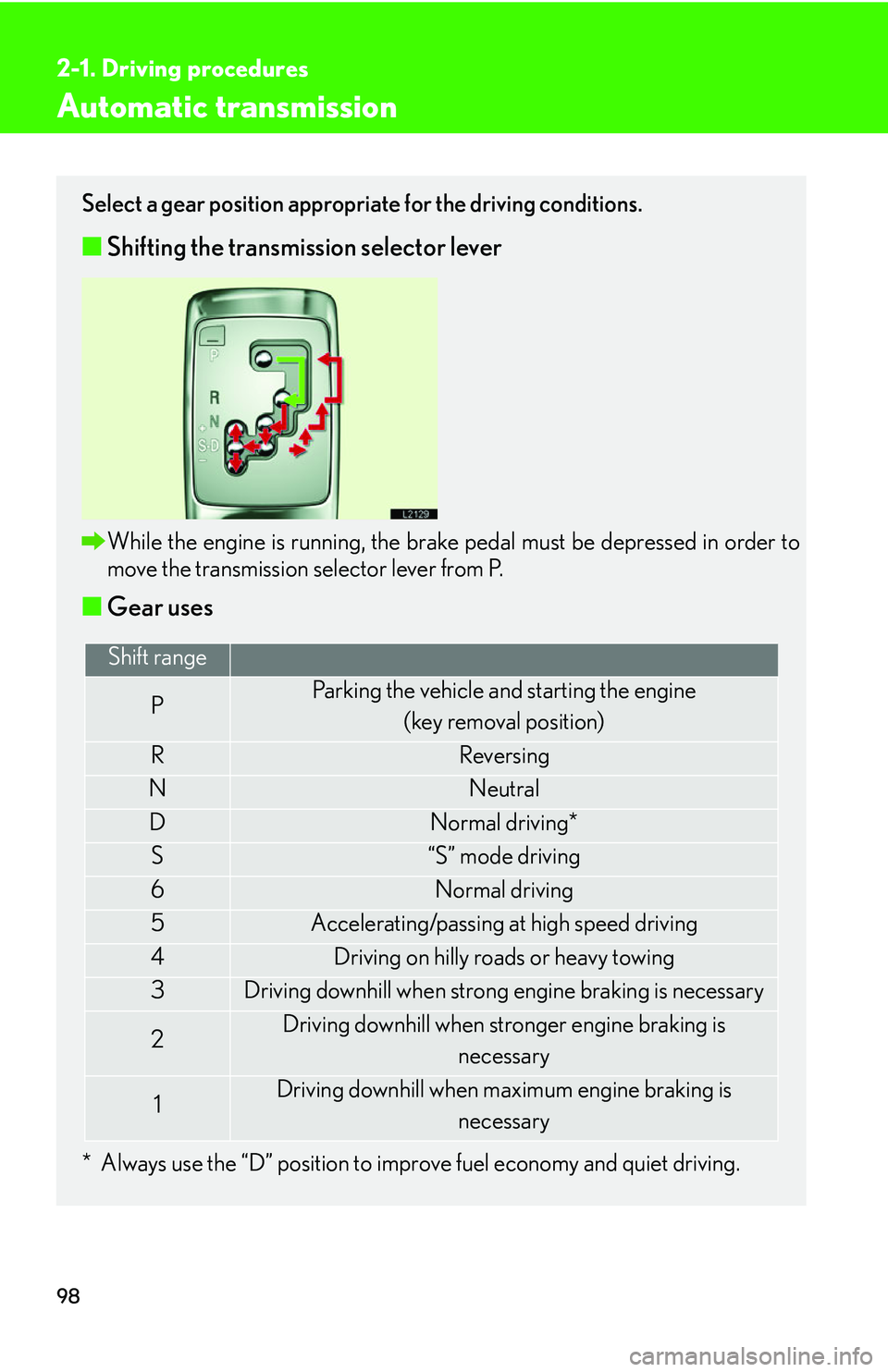
■Shifting the transmission selector lever
While the engine is running, the brake pedal must be depressed in order to
move the transmission selector lever from P.
■Gear uses
* Always use the “D” position to improve fuel economy and quiet driving.
Shift range
PParking the vehicle and starting the engine
(key removal position)
RReversing
NNeutral
DNormal driving*
S“S” mode driving
6Normal driving
5Accelerating/passing at high speed driving
4Driving on hilly roads or heavy towing
3Driving downhill when strong engine braking is necessary
2Driving downhill when stronger engine braking is necessary
1Driving downhill when maximum engine braking is
necessary
Page 116 of 419
100
2-1. Driving procedures
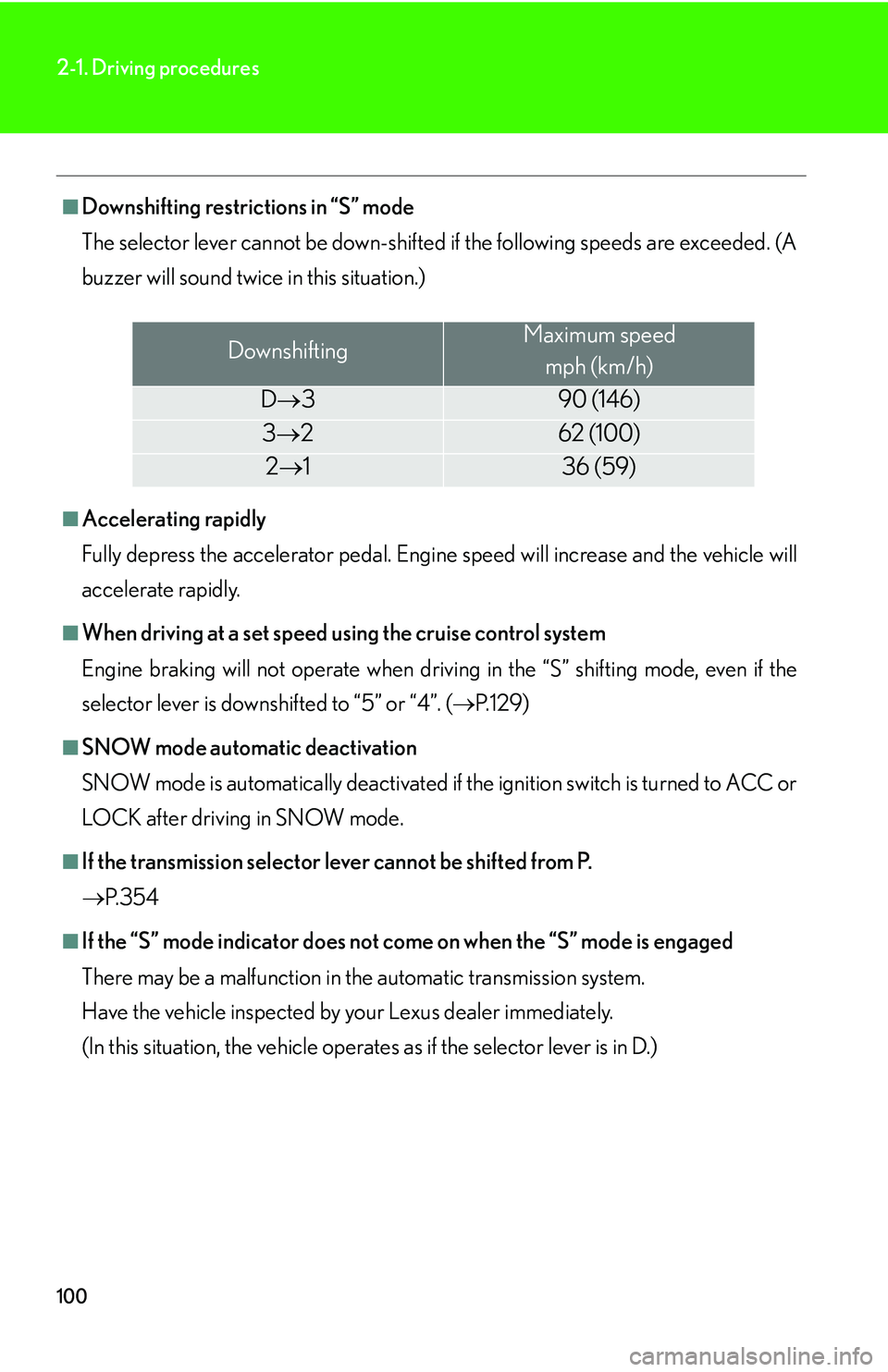
■Downshifting restrictions in “S” mode
The selector lever cannot be down-shifted if the following speeds are exceeded. (A
buzz
er will sound twice in this situation.)
■Accelerating rapidly
Fully depress the accelerator pedal. Engine sp
eed will increase and the vehicle will
accelerate rapidly.
■When driving at a set speed using the cruise control system
Engine braking will not operate when driving in the “S” shifting mode, even if the
select
or lever is downshifted to “5” or “4”. ( P.129 )
■SNOW mode automatic deactivation
SNOW mode is automatically deactivated if the ignition switch is turned to ACC or
L
OCK after driving in SNOW mode.
■If the transmission selector le ver cannot be shifted from P.
P.
3 5 4
■If the “S” mode indicator does not come on when the “S” mode is engaged
There may be a malfunction in the automatic transmission system.
Have the vehicle inspected by your Lexus dealer immediately.
(In this situation, the vehicle operates as if
the selector lever is in D.)
DownshiftingMaximum speed
mph (km/h)
D 390 (146)
3 262 (100)
2 136 (59)
Page 173 of 419

157
2-5. Driving information
2
When driving
• As stopping distance is increased when towing a trailer, vehicle-to-
vehicle distance should be increas ed. For each 10 mph (16 km/h) of
speed, allow at least one vehicle and trailer length.
• Avoid sudden braking as you may sk id, r
esulting in jackknifing and loss
of control. This is especially true on wet or slippery surfaces.
• Avoid jerky starts or sudden acceleration.
• Avoid jerky steering and sharp turn s, and slo
w down before making a
turn.
• Note that when making a turn, the tr ailer wheels will be closer than the
v
ehicle wheels to the inside of th e turn. Compensate by making a
larger than normal turning radius.
• Crosswinds and rough roads will ad v
ersely affect handling of your
vehicle and trailer, causing sway. Peri odically check the rear to prepare
for being passed by large trucks or buses, which may cause your vehi-
cle and trailer to sway. If s
waying occurs, firmly grip the steering wheel,
reduce speed immediately but gradually, and steer straight ahead.
Never increase speed. If you make no extreme correction with the
steering or brakes, your vehi cle and trailer will stabilize.
• Take care when passing other vehicl es. P
assing requires considerable
distance. After passing a vehicle, do not forget the length of your
trailer, and be sure you have plenty of room before changing lanes.
• In order to maintain efficient engine br
aking and electrical charging
performance, do not use overdrive. Transmission shift range position
must be in “4”, in the “S” mode.
• Due to the added load of the traile r
, your vehicle’s engine may overheat
on hot days (at temperatures over 85°F [30°C]) when driving up a
long or steep grade. If the engine coolant temperature gauge indicates
overheating, immediately turn off the air conditioning (if in use), pull
your vehicle off the road and stop in a safe spot. See “If your vehicle
overheats” ( P.359 ).
Page 174 of 419
158
2-5. Driving information
• Always place wheel blocks under both the vehicle and the trailer
wheels when parking. Apply the pa rking brake firmly, and put the
transmission in “P”. Avoi d parking on a slope, but if unavoidable, do so
only after performing the following:
Apply the brakes and keep them applied.
Have someone place wheel blocks under both the v
ehicle and
trailer wheels.
When the wheel blocks are in pl ace, r
elease the brakes slowly
until the blocks absorb the load.
Apply the parking brake firmly.
Shift into “P” and turn off the engine.
• When restarting after parking on a slope:
With the transmission in the “P” position, star
t the engine. Be sure
to keep the brake pedal pressed.
Shift into “3”, “2”, “1”, or the “R” position (if r
eversing).
Release the parking brake and br ak
e pedal, and slowly pull or
back away from the wheel blocks.
Stop and apply the brakes.
Have someone retrieve the blocks.
Page 241 of 419
225
3-5. Other interior features
3
Interior features
Sunshades
■Rear power sunshade operating conditions
The ignition switch must be in the ON position
■Automatic operation
●When the transmission selector lever is shifted into the “R” position while the
sunshade is up, the sunshade will be automatically lowered.
●To raise the sunshade again, perform any of the following operations:
• Shift the transmission selector lever in “P” position
• Push the switch again
• Move the transmission selector lever out of
“R” position and drive your vehi-
cle over 9 mph (15 km/h)
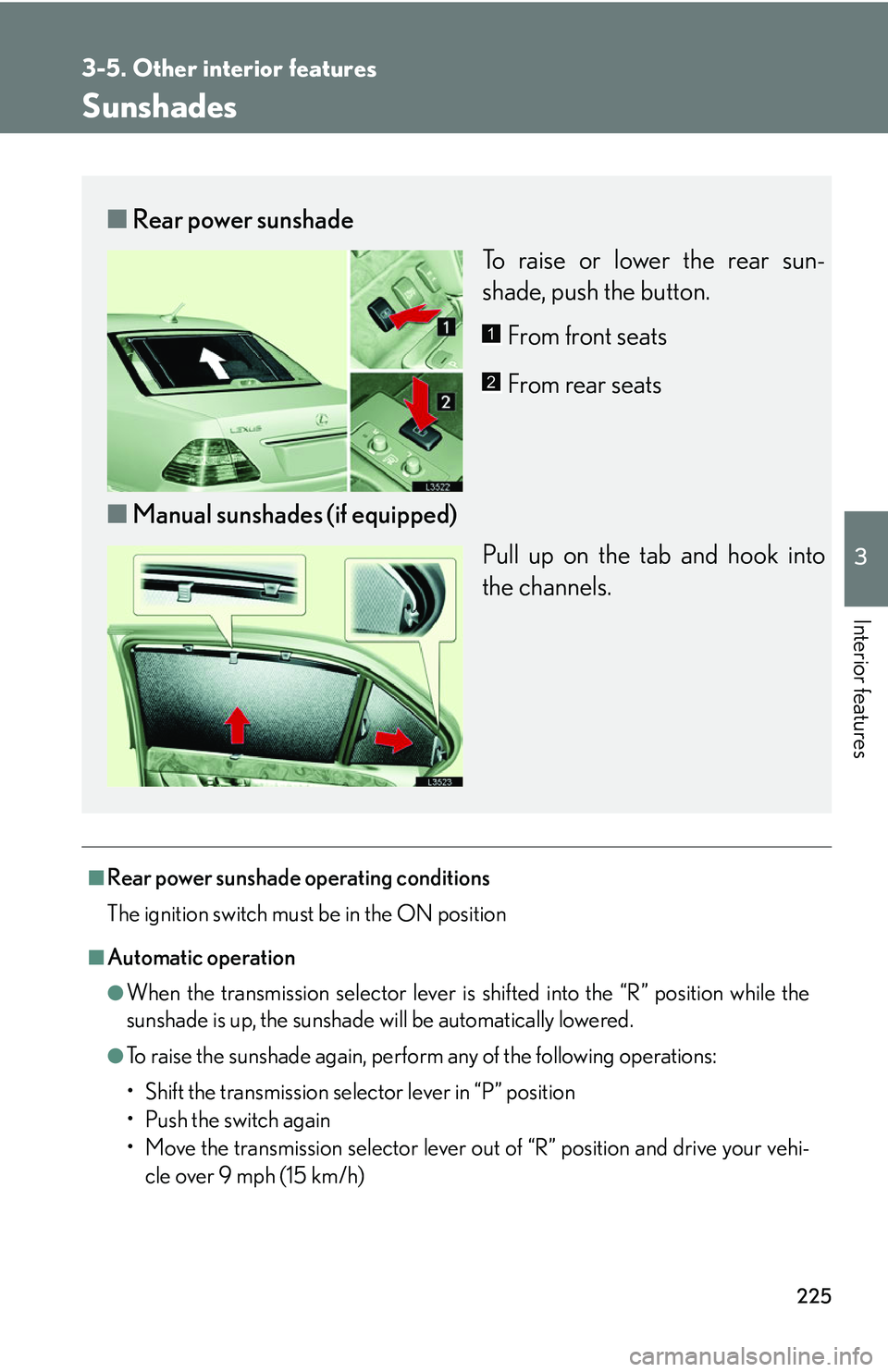
■ Rear power sunshade
To raise or lower the rear sun-
shade, push the button.
From front seats
From rear seats
■ Manual sunshades (if equipped)
Pull up on the tab and hook into
the channels.
1
2
Page 269 of 419
253
4-2. Maintenance
4
Maintenance and care
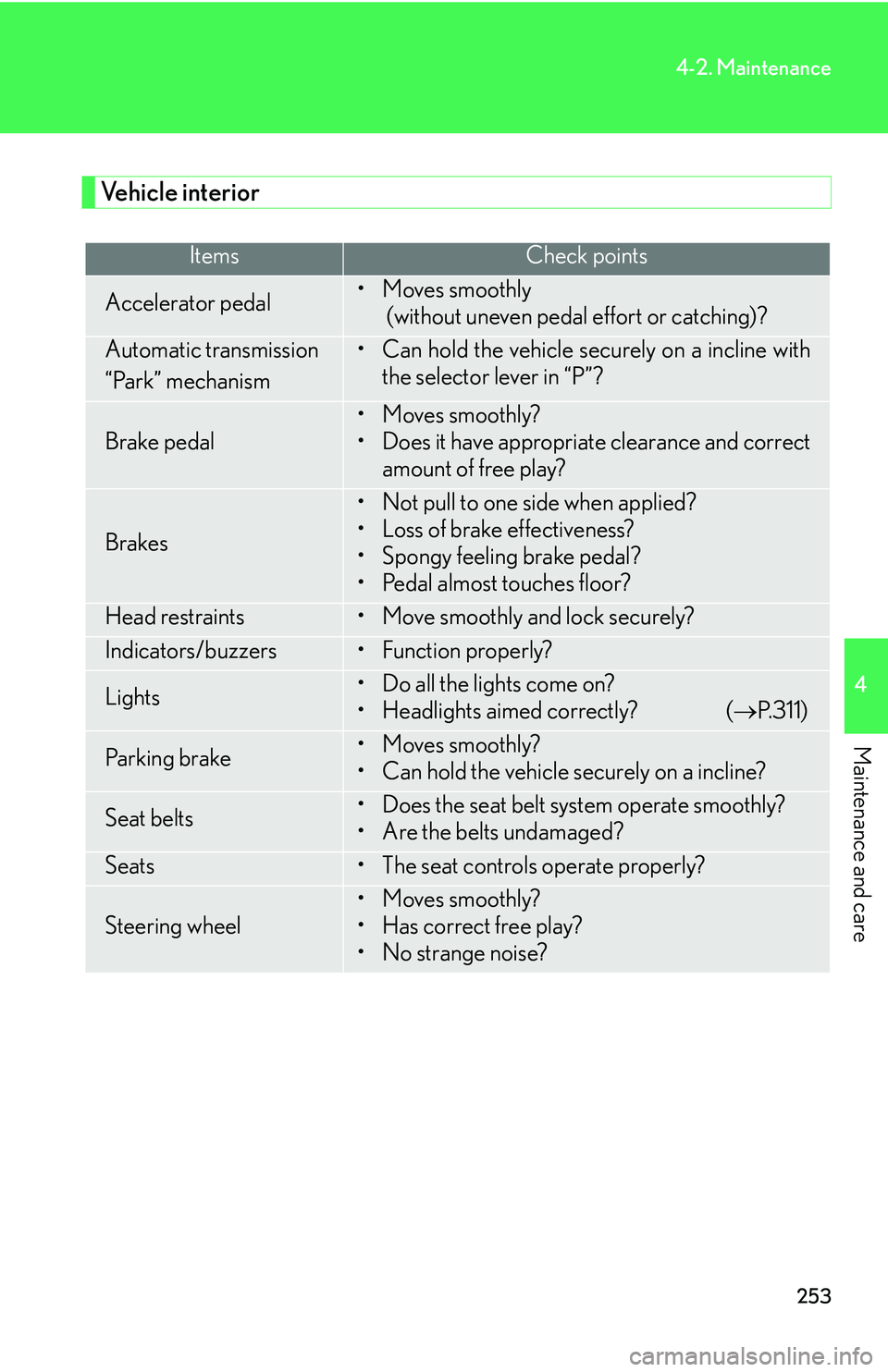
Vehicle interior
ItemsCheck points
Accelerator pedal• Moves smoothly
(without uneven pedal effort or catching)?
Automatic transmission
“Park” mechanism• Can hold the vehicle securely on a incline with the selector lever in “P”?
Brake pedal
• Moves smoothly?
• Does it have appropriate clearance and correct amount of free play?
Brakes
• Not pull to one side when applied?
• Loss of brake effectiveness?
• Spongy feeling brake pedal?
• Pedal almost touches floor?
Head restraints• Move smoothly and lock securely?
Indicators/buzzers• Function properly?
Lights• Do all the lights come on?
• Headlights aimed correctly? ( P.311)
Pa r k i n g b r a ke• Moves smoothly?
• Can hold the vehicle securely on a incline?
Seat belts• Does the seat belt system operate smoothly?
• Are the belts undamaged?
Seats• The seat controls operate properly?
Steering wheel
• Moves smoothly?
• Has correct free play?
•No strange noise?
Page 273 of 419
257
4-3. Do-it-yourself maintenance
4
Maintenance and care
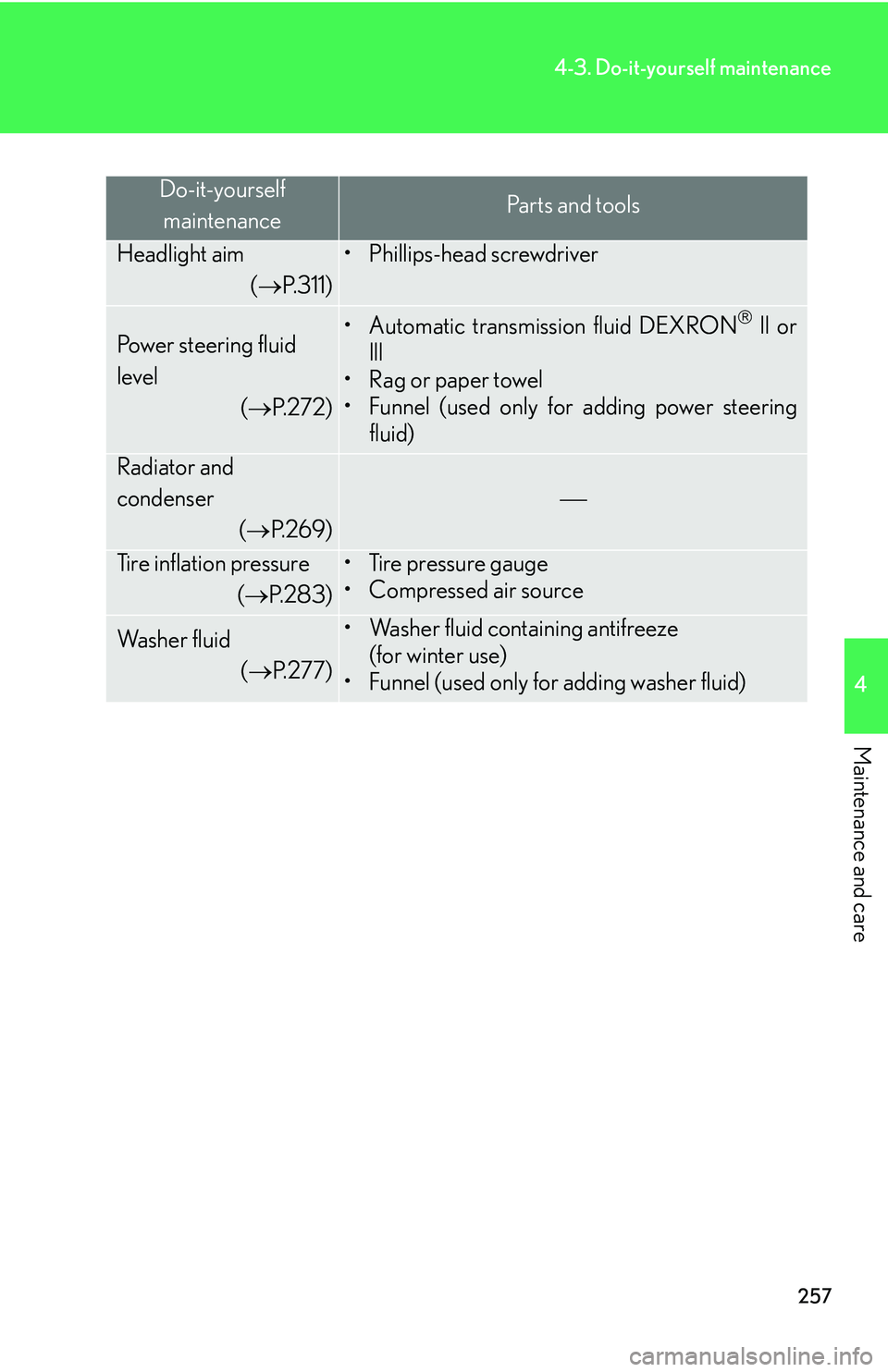
Do-it-yourself maintenancePa r t s a n d t o o l s
Headlight aim
( P.311)
• Phillips-head screwdriver
Power steering fluid
level
(P. 2 7 2 )
• Automatic transmission fluid DEXRON ll or
lll
• Rag or paper towel
• Funnel (used only for adding power steering fluid)
Radiator and
condenser
(P. 2 6 9 )
Tire inflation pressure
(P. 2 8 3 )
• Tire pressure gauge
• Compressed air source
Wa s h e r f l u i d
(P. 2 7 7 )
• Washer fluid containing antifreeze
(for winter use)
• Funnel (used only for adding washer fluid)
Page 288 of 419

272
4-3. Do-it-yourself maintenance
Power steering fluid
■Fluid level
The fluid level should be within the
appropriate range.
Full line when cold
Add fluid if at or below line
when cold.
Full line when hot
Add fluid if at or below line
when hot.
Hot : If the vehicle has been driven around 50 mph (80 km/h) for 20 min -
utes (slightly longer in frigid te mper
atures), the fluid is hot (140F -
175
F or 60C - 80C).
Cold : If the engine has not been run for about
five hours, the fluid is cold.
(about room temperature, 50
F - 85F or 10C - 30C).
■ Checking the fluid level
Make sure to check the fluid type and prepare the necessary items before
checking.
Clean all dirt off the reservoir.
Remove the reservoir cap by tu rning it counter
clockwise and
wipe the dipstick clean.
Reinstall the reservoir cap.
Remove the reservoir cap again and look at the fluid le
vel.
1
2
3
4
Fluid typeAutomatic transmission fluid DEXRON II or III
ItemsRag or paper towel and funnel (only for adding fluid)