Page 300 of 419
284
4-3. Do-it-yourself maintenance
For sustained high speeds above 100 mph (160 km/h), in countries where such
speeds are permitted by law, add the below pressure to the front tires and rear
tires, but never exceed the maximum cold tire inflation pressure molded on the
tire sidewall.
• P225/55R17 95H: 3 psi (20 kPa, 0.2 kgf/cm2 or bar)
• 245/45R18 96W: 6 psi (40 kPa, 0.4 kgf/cm2 or bar)
• P245/45R18 96V: 6 psi (40 kPa, 0.4 kgf/cm2 or bar)
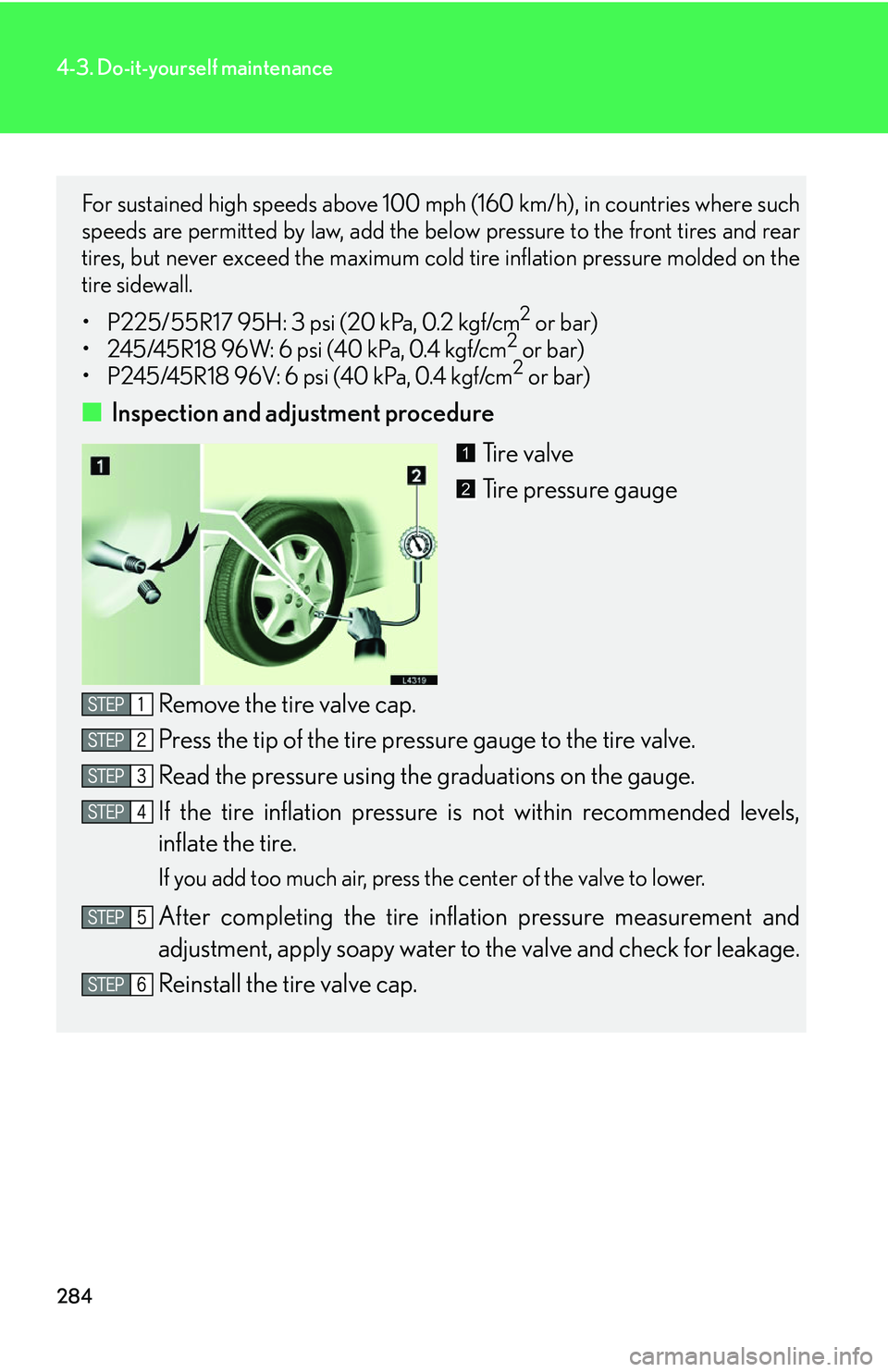
■ Inspection and adjustment procedure
Ti r e v a l v e
Tire pressure gauge
Remove the tire valve cap.
Press the tip of the tire pressure gauge to the tire valve.
Read the pressure using the graduations on the gauge.
If the tire inflation pressure is not within r
ecommended levels,
inflate the tire.
If you add too much air, press the center of the valve to lower.
After completing the tire inflation pressure measurement and
adjustment, apply soapy water to the v
alve and check for leakage.
Reinstall the tire valve cap.
1
2
Page 301 of 419
285
4-3. Do-it-yourself maintenance
4
Maintenance and care
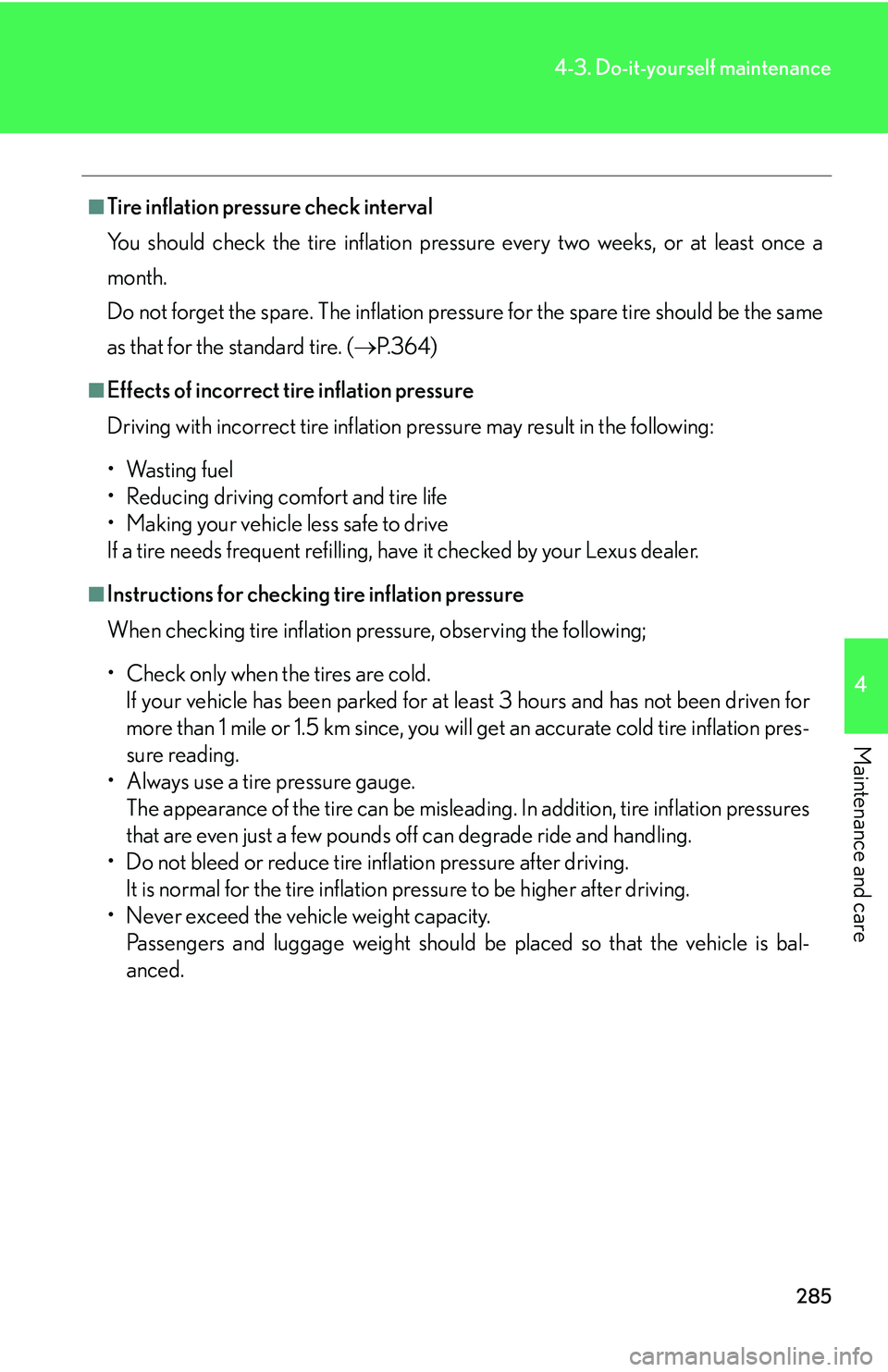
■Tire inflation pressure check interval
You should check the tire inflation pressur
e every two weeks, or at least once a
month.
Do not forget the spare. The inflation pressure for the spare tire should be the same
as
that for the standard tire. ( P.364 )
■Effects of incorrect tire inflation pressure
Driving with incorrect tire inflation pressure may result in the following:
•Wasting fuel
• Reducing driving comfort and tire life
• Making your vehicle less safe to drive
If a tire needs frequent refilling, have it checked by your Lexus dealer.
■Instructions for checking tire inflation pressure
When checking tire inflation pressure, observing the following;
• Check only when the tires are cold.
If your vehicle has been parked for at least 3 hours and has not been driven for
mor
e than 1 mile or 1.5 km since, you will get an accurate cold tire inflation pres -
sure reading.
• Always use a tire pressure gauge.
The appearance of the tire can be misleadi n
g. In addition, tire inflation pressures
that are even just a few pounds off can degrade ride and handling.
• Do not bleed or reduce tire inflation pressure after driving.
It is normal for the tire inflation pressure to be higher after driving.
• Never exceed the vehicle weight capacity.
Passengers and luggage weight should be pla
ced so that the vehicle is bal-
anced.
Page 302 of 419
286
4-3. Do-it-yourself maintenance
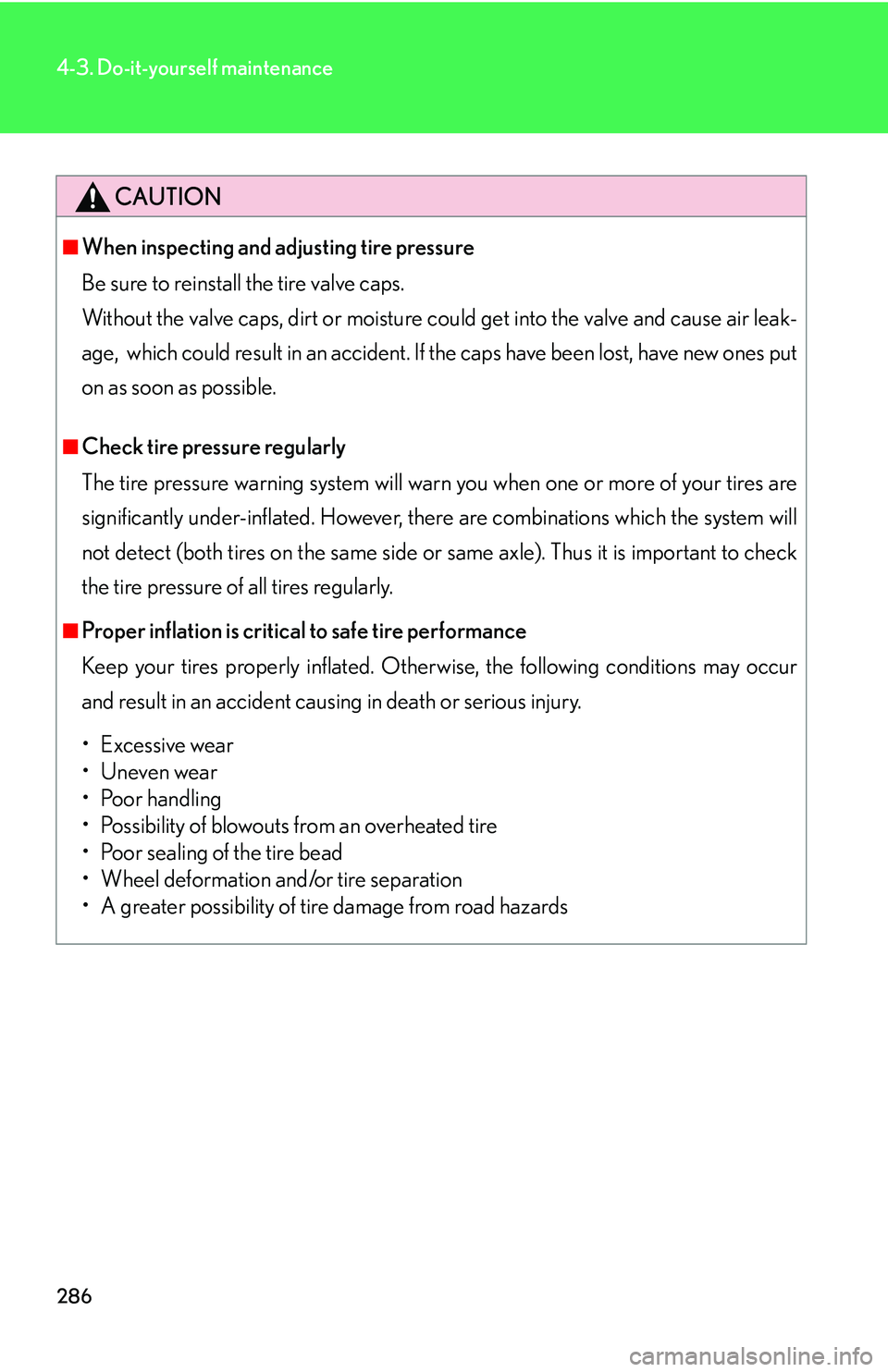
CAUTION
■When inspecting and adjusting tire pressure
Be sure to reinstall the tire valve caps.
Without the valve caps, dirt or moisture c
ould get into the valve and cause air leak-
age, which could result in an accident. If the caps ha
ve been lost, have new ones put
on as soon as possible.
■Check tire pressure regularly
The tire pressure warning system will warn you when one or more of your tires are
si
gnificantly under-inflated. However, ther e are combinations which the system will
not detect (both tires on the same side or same axle). Thus it is important to check
the tire pressure of all tires regularly.
■Proper inflation is critical to safe tire performance
Keep your tires properly inflated. Otherwise, the following conditions may occur
and r
esult in an accident causi ng in death or serious injury.
•Excessive wear
• Uneven wear
• Poor handling
• Possibility of blowouts from an overheated tire
• Poor sealing of the tire bead
• Wheel deformation and/or tire separation
• A greater possibility of tire damage from road hazards
Page 354 of 419
338
5-2. Steps to take in an emergency
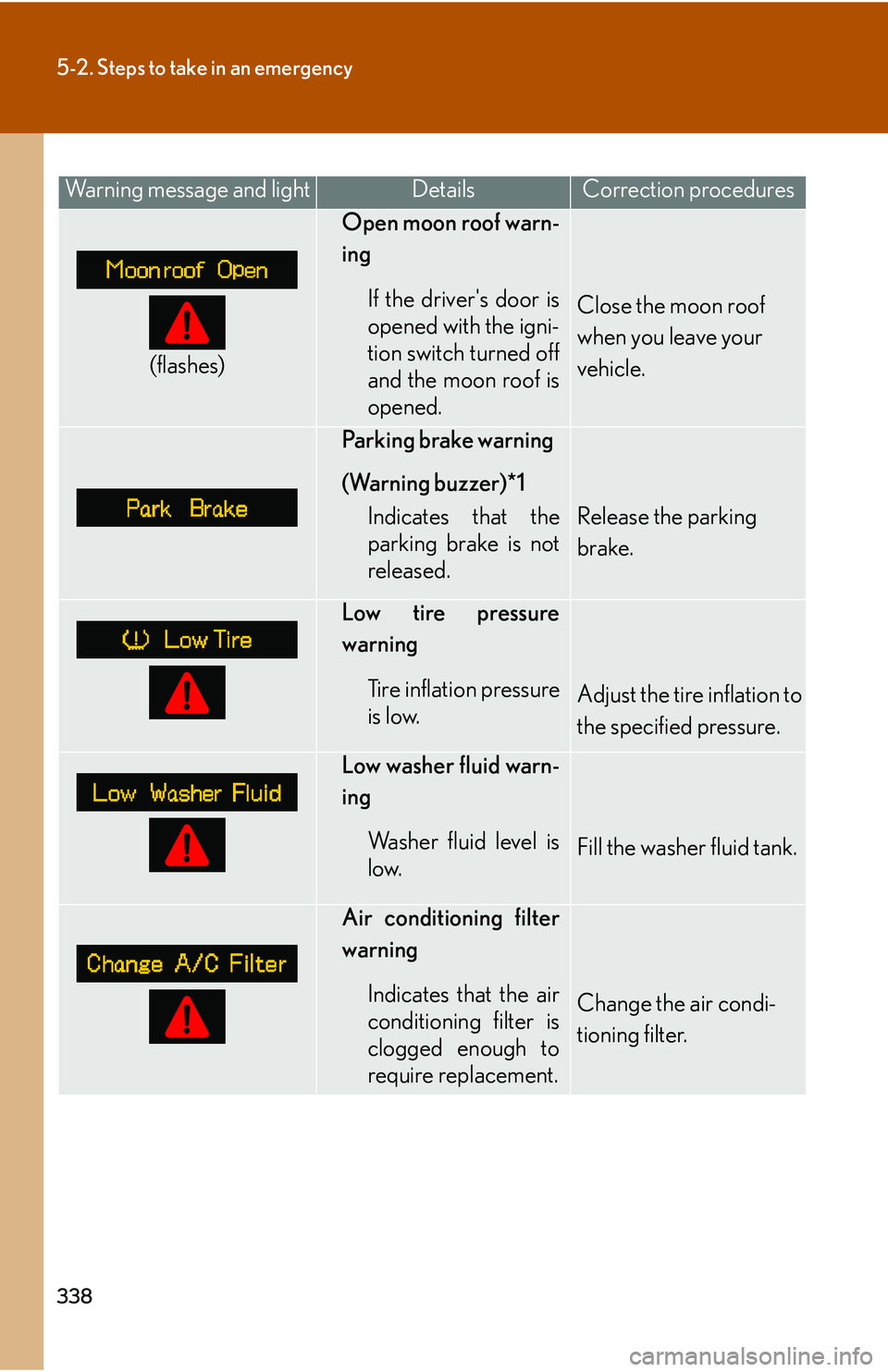
Warning message and lightDetailsCorrection procedures
(flashes)
Open moon roof warn-
ing
If the driver's door is
opened with the igni-
tion switch turned off
and the moon roof is
opened.
Close the moon roof
when you leave your
vehicle.
Parking brake warning
(Warning buzzer)*1
Indicates that the
parking brake is not
released.Release the parking
brake.
Low tire pressure
warning
Tire inflation pressure
is low.Adjust the tire inflation to
the specified pressure.
Low washer fluid warn -
ing
Washer fluid level is
low.Fill the washer fluid tank.
Air conditioning filter
warning
Indicates that the air
conditioning filter is
clogged enough to
require replacement.Change the air condi-
tioning filter.
Page 358 of 419
342
5-2. Steps to take in an emergency
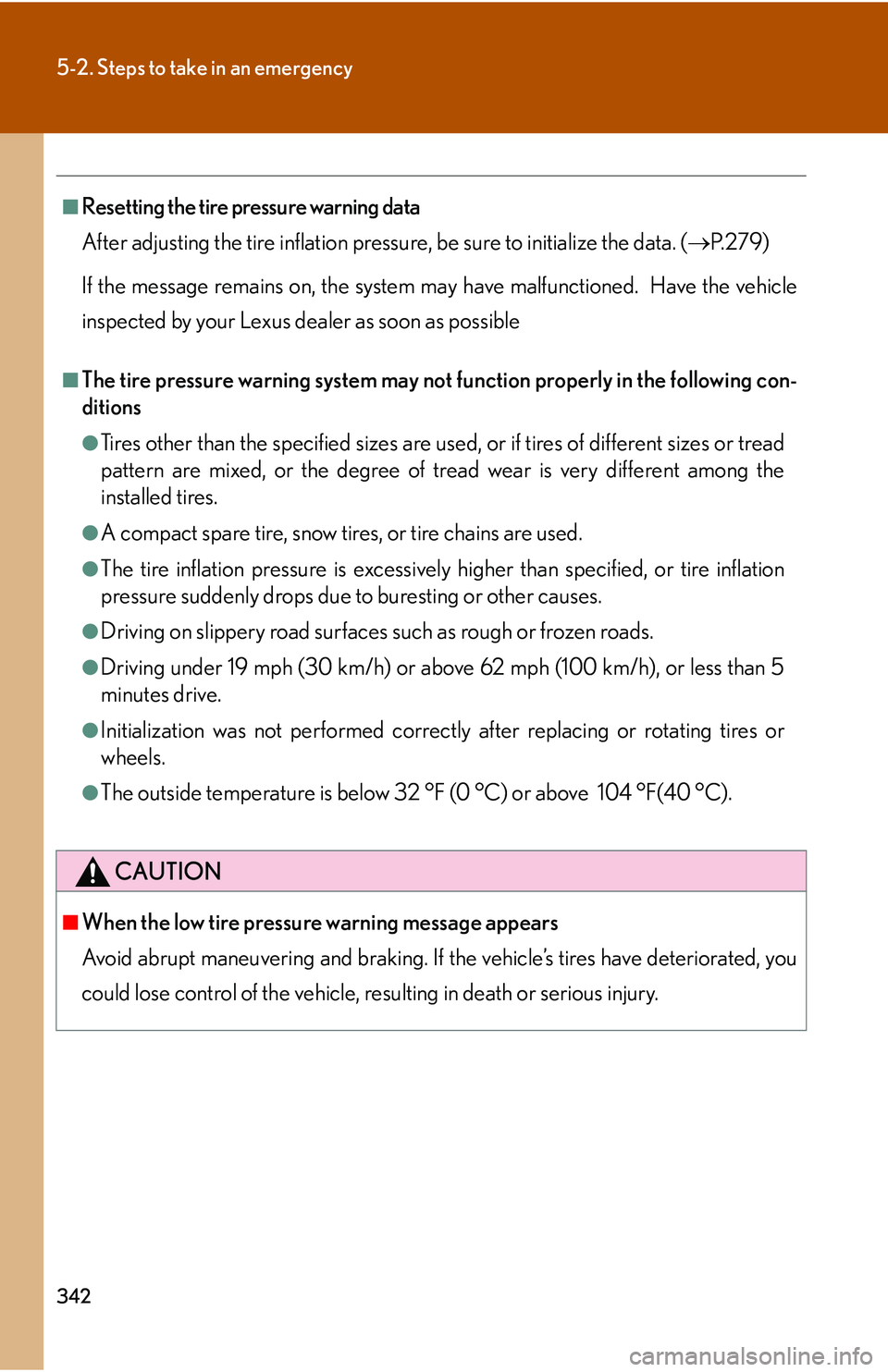
■Resetting the tire pressure warning data
After adjusting the tire inflation pressur
e, be sure to initialize the data. (P. 2 7 9 )
If the message remains on, the system may have malfunctioned. Have the vehicle
inspected b
y your Lexus dealer as soon as possible
■The tire pressure warning system may not function properly in the following con -
ditions
●Tires other than the sp ecified sizes are used, or if tires of different sizes or tread
pattern are mixed, or the degree of tread wear is very different among the
installed tires.
●A compact spare tire, snow tires, or tire chains are used.
●The tire inflation pressure is excessively higher than specified, or tire inflation
pressure suddenly drops due to buresting or other causes.
●Driving on slippery road surfaces such as rough or frozen roads.
●Driving under 19 mph (30 km/h) or above 62 mph (100 km/h), or less than 5
minutes drive.
●Initialization was not performed correctly after replacing or rotating tires or
wheels.
●The outside temperature is below 32 °F (0 °C) or above 104 °F(40 °C).
CAUTION
■When the low tire pressure warning message appears
Avoid abrupt maneuvering and braking. If th
e vehicle’s tires have deteriorated, you
could lose control of the vehicle, resulting in death or serious injury.
Page 386 of 419
370
6-1. Specifications
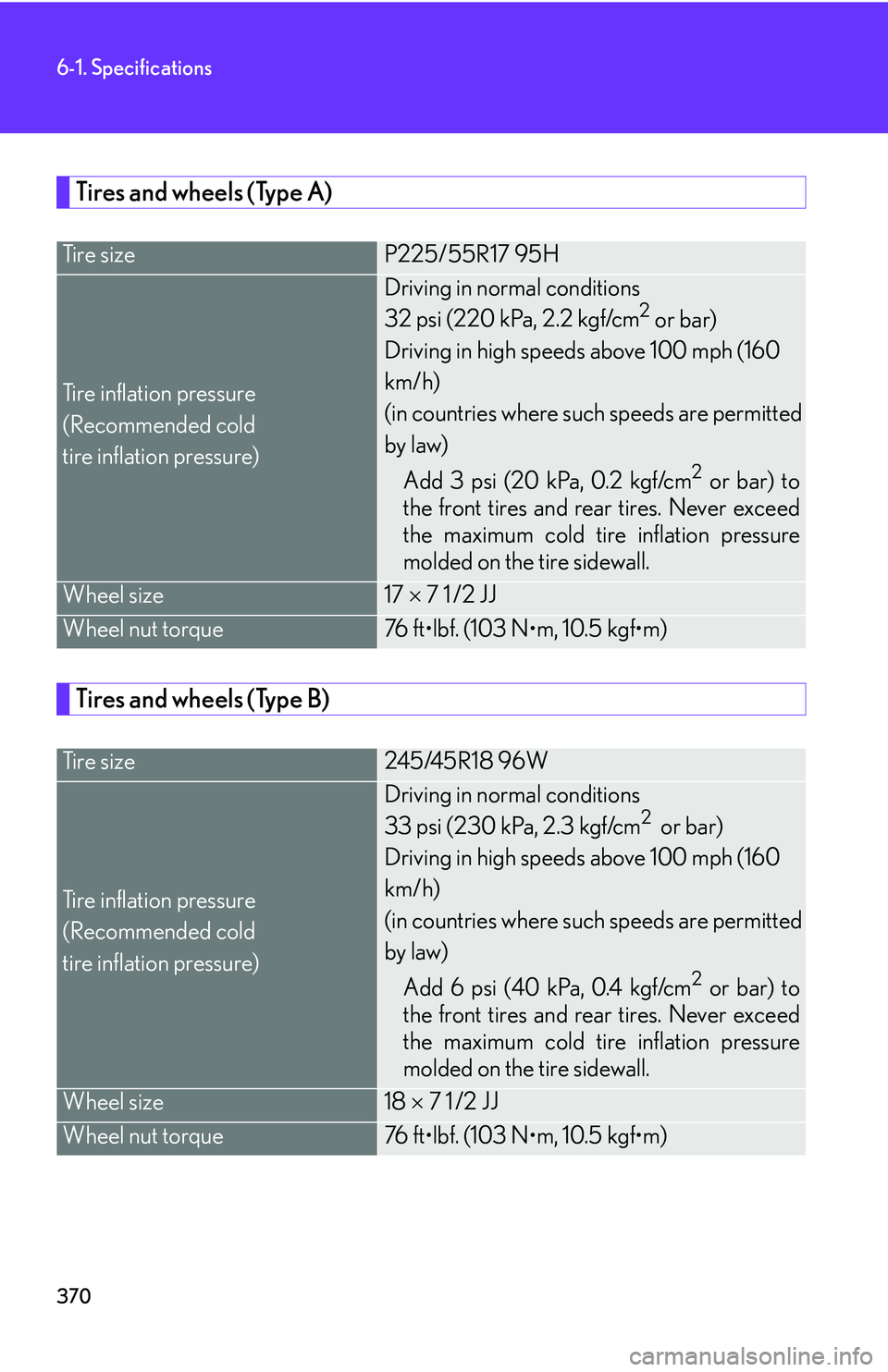
Tires and wheels (Type A)
Tires and wheels (Type B)
Ti r e s i z eP225/55R17 95H
Tire inflation pressure
(Recommended cold
tire inflation pressure)
Driving in normal conditions
32 psi (220 kPa, 2.2 kgf/cm2 or bar)
Driving in high speeds above 100 mph (160
km/
h)
(in countries where such speeds are permitted
b
y law)
Add 3 psi (20 kPa, 0.2 kgf/cm
2 or bar) to
the front tires and rear tires. Never exceed
the maximum cold tire inflation pressure
molded on the tire sidewall.
Wheel size17 7 1 /2 JJ
Wheel nut torque76 f t•lbf. (103 N•m, 10.5 kgf•m)
Ti r e s i z e245/45R18 96W
Tire inflation pressure
(Recommended cold
tire inflation pressure)
Driving in normal conditions
33 psi (230 kPa, 2.3 kgf/cm2 or bar)
Driving in high speeds above 100 mph (160
km/
h)
(in countries where such speeds are permitted
b
y law)
Add 6 psi (40 kPa, 0.4 kgf/cm
2 or bar) to
the front tires and rear tires. Never exceed
the maximum cold tire inflation pressure
molded on the tire sidewall.
Wheel size18 7 1 /2 JJ
Wheel nut torque76 f t•lbf. (103 N•m, 10.5 kgf•m)
Page 387 of 419
371
6-1. Specifications
6
Vehicle specifications
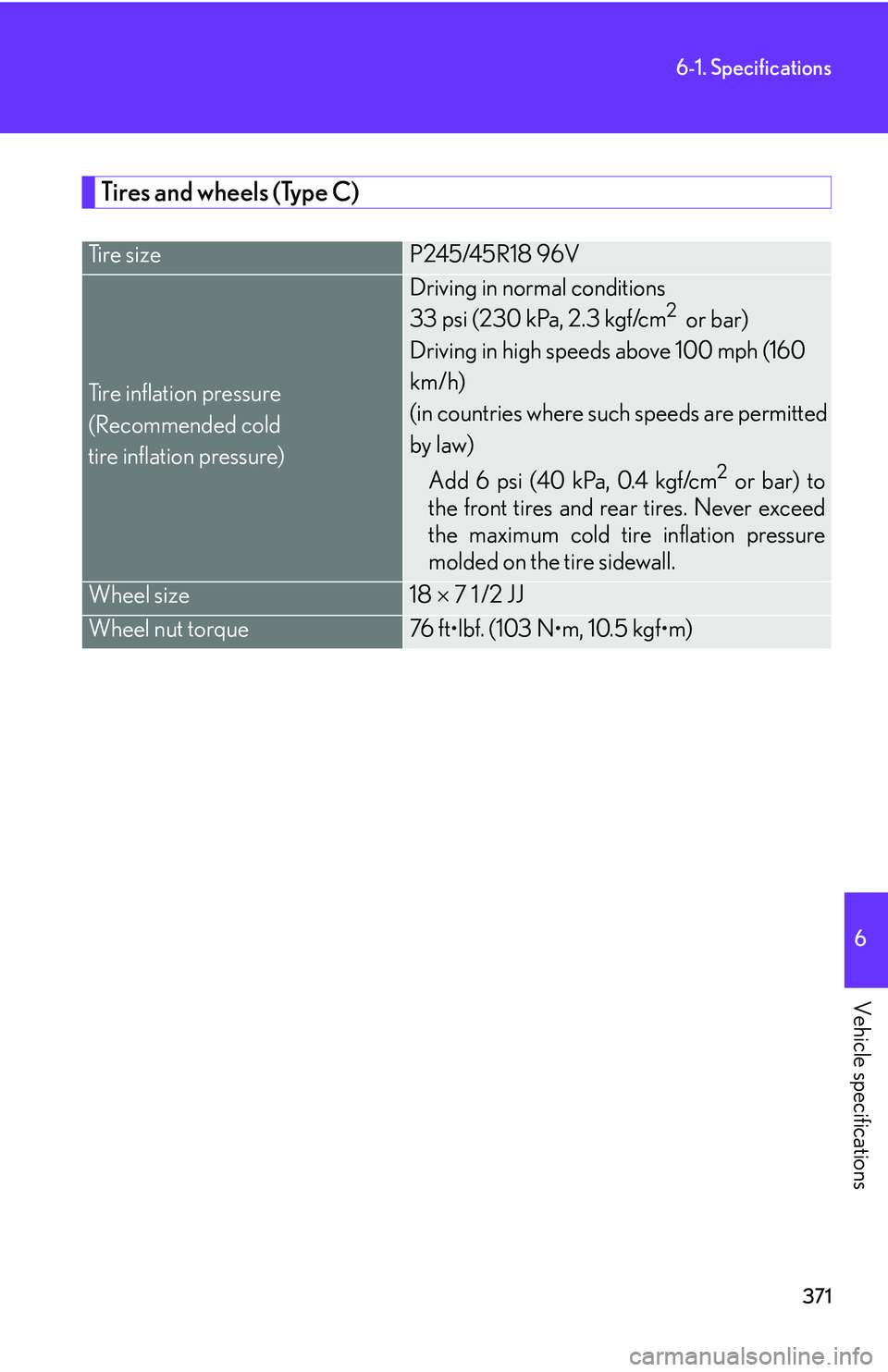
Tires and wheels (Type C)
Ti r e s i z eP245/45R18 96V
Tire inflation pressure
(Recommended cold
tire inflation pressure)
Driving in normal conditions
33 psi (230 kPa, 2.3 kgf/cm2 or bar)
Driving in high speeds above 100 mph (160
km/
h)
(in countries where such speeds are permitted
b
y law)
Add 6 psi (40 kPa, 0.4 kgf/cm
2 or bar) to
the front tires and rear tires. Never exceed
the maximum cold tire inflation pressure
molded on the tire sidewall.
Wheel size18 7 1 /2 JJ
Wheel nut torque76 f t•lbf. (103 N•m, 10.5 kgf•m)
Page 392 of 419
376
6-1. Specifications
Tire information
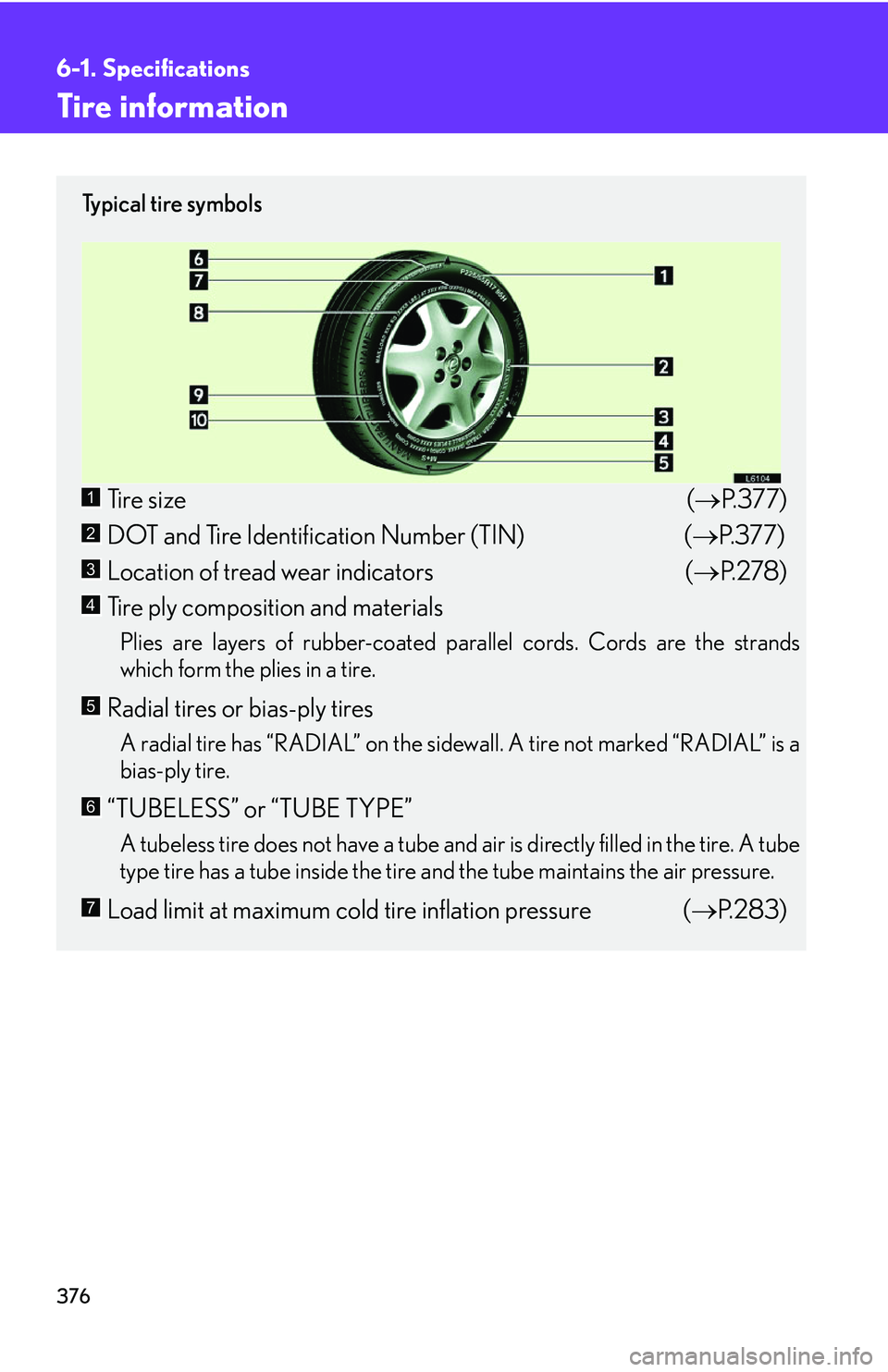
Ty p i c a l t i r e s y m b o l s
Tire size(P.377 )
DOT and Tire Identification Number (TIN) ( P.377 )
Location of tread wear indicators ( P.278 )
Tire ply composition and materials
Plies are layers of rubber-coated parallel cords. Cords are the strands
which form the plies in a tire.
Radial tires or bias-ply tires
A radial tire has “RADIAL” on the sidewall. A tire not marked “RADIAL” is a
bias-ply tire.
“TUBELESS” or “TUBE TYPE”
A tubeless tire does not have a tube and air is directly filled in the tire. A tube
type tire has a tube inside the tire and the tube maintains the air pressure.
Load limit at maximum cold tire inflation pressure ( P.283 )
1
2
3
4
5
6
7