Page 172 of 419

156
2-5. Driving information
Trailer towing tips
Your vehicle will handle differently when towing a trailer. The three main
causes of vehicle-trailer accidents are driver error, excessive speed and
improper trailer loading. Keep these in mind when towing.
• Before starting out, check the tra iler
’s lights and the vehicle-trailer
connections. Recheck after driving a short distance.
• Practice turning, stopping and reversi ng with the tr
ailer attached in an
area away from traffic until you be come accustomed to the feel of the
vehicle.
• Reversing with a trailer attached is dif
ficult and requires practice. Grip
the bottom of the steering wheel and move your hand to the left to
move the trailer to the left. Move yo ur hand to the right to move the
trailer to the right. (This is gene rally opposite to reversing without a
trailer attached.) Avoid sharp or prolonged turning. Have someone
guide you when reversing to redu ce the risk of an accident.
NOTICE
■When installing a trailer hitch
●Use only the position recommended by your Lexus dealer. Do not install the
trailer hitch on the bumper; this may cause body damage.
●Do not use axle-mounted hitches as they can cause damage to the axle housing,
wheel bearings, wheels or tires.
■Brakes
Lexus recommends trailers with brakes that conform to any applicable federal and
sta
te/provincial requlations.
■Do not directly splice trailer lights
Direct splicing may damage your vehicle’s electrical system and cause a malfunc -
tion.
Page 173 of 419

157
2-5. Driving information
2
When driving
• As stopping distance is increased when towing a trailer, vehicle-to-
vehicle distance should be increas ed. For each 10 mph (16 km/h) of
speed, allow at least one vehicle and trailer length.
• Avoid sudden braking as you may sk id, r
esulting in jackknifing and loss
of control. This is especially true on wet or slippery surfaces.
• Avoid jerky starts or sudden acceleration.
• Avoid jerky steering and sharp turn s, and slo
w down before making a
turn.
• Note that when making a turn, the tr ailer wheels will be closer than the
v
ehicle wheels to the inside of th e turn. Compensate by making a
larger than normal turning radius.
• Crosswinds and rough roads will ad v
ersely affect handling of your
vehicle and trailer, causing sway. Peri odically check the rear to prepare
for being passed by large trucks or buses, which may cause your vehi-
cle and trailer to sway. If s
waying occurs, firmly grip the steering wheel,
reduce speed immediately but gradually, and steer straight ahead.
Never increase speed. If you make no extreme correction with the
steering or brakes, your vehi cle and trailer will stabilize.
• Take care when passing other vehicl es. P
assing requires considerable
distance. After passing a vehicle, do not forget the length of your
trailer, and be sure you have plenty of room before changing lanes.
• In order to maintain efficient engine br
aking and electrical charging
performance, do not use overdrive. Transmission shift range position
must be in “4”, in the “S” mode.
• Due to the added load of the traile r
, your vehicle’s engine may overheat
on hot days (at temperatures over 85°F [30°C]) when driving up a
long or steep grade. If the engine coolant temperature gauge indicates
overheating, immediately turn off the air conditioning (if in use), pull
your vehicle off the road and stop in a safe spot. See “If your vehicle
overheats” ( P.359 ).
Page 174 of 419
158
2-5. Driving information
• Always place wheel blocks under both the vehicle and the trailer
wheels when parking. Apply the pa rking brake firmly, and put the
transmission in “P”. Avoi d parking on a slope, but if unavoidable, do so
only after performing the following:
Apply the brakes and keep them applied.
Have someone place wheel blocks under both the v
ehicle and
trailer wheels.
When the wheel blocks are in pl ace, r
elease the brakes slowly
until the blocks absorb the load.
Apply the parking brake firmly.
Shift into “P” and turn off the engine.
• When restarting after parking on a slope:
With the transmission in the “P” position, star
t the engine. Be sure
to keep the brake pedal pressed.
Shift into “3”, “2”, “1”, or the “R” position (if r
eversing).
Release the parking brake and br ak
e pedal, and slowly pull or
back away from the wheel blocks.
Stop and apply the brakes.
Have someone retrieve the blocks.
Page 175 of 419
159
2-5. Driving information
2
When driving
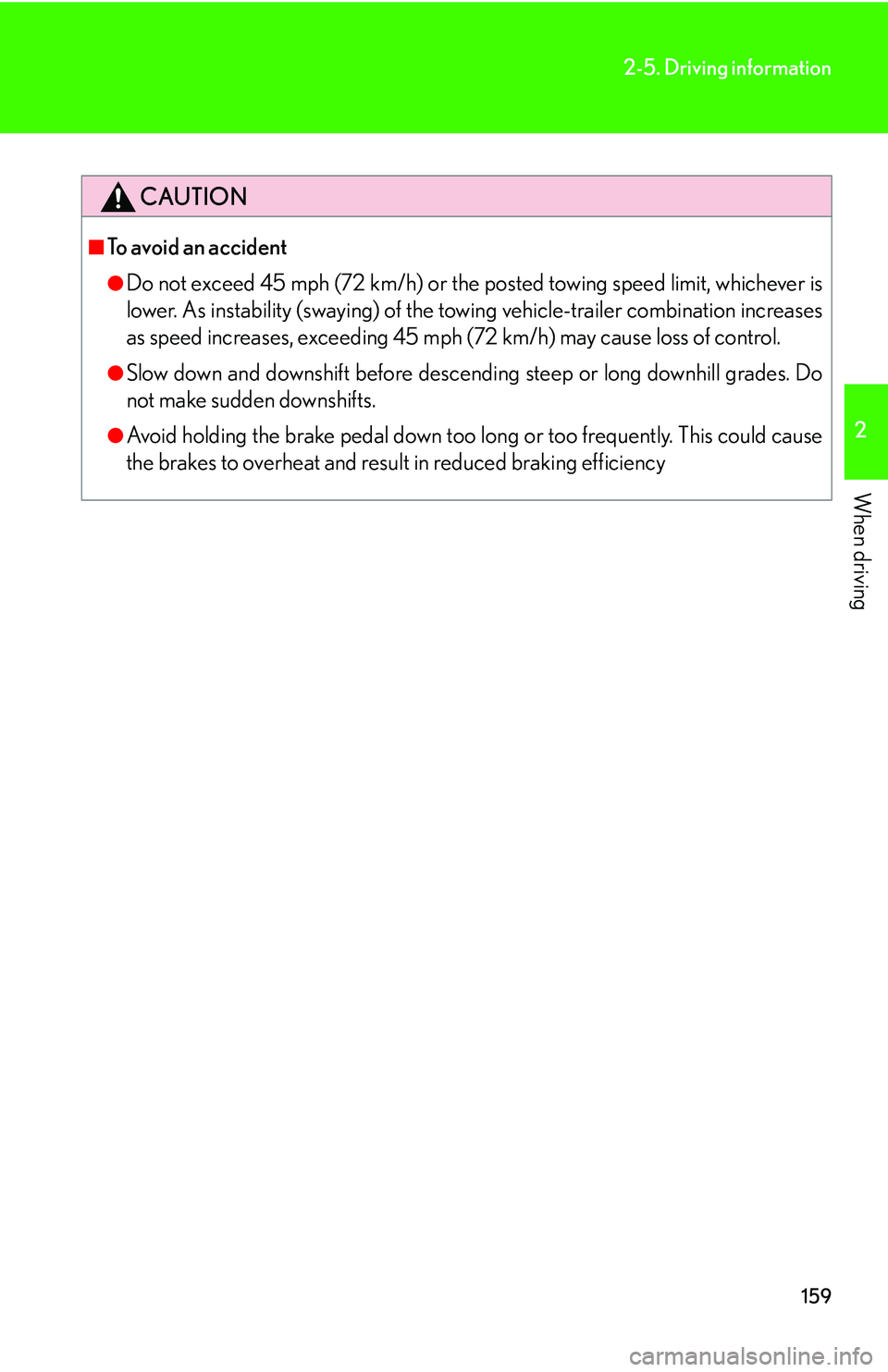
CAUTION
■To avoid an accident
●Do not exceed 45 mph (72 km/h) or the posted towing speed limit, whichever is
lower. As instability (swaying) of the towing vehicle-trailer combination increases
as speed increases, exceeding 45 mph (72 km/h) may cause loss of control.
●Slow down and downshift before descending steep or long downhill grades. Do
not make sudden downshifts.
●Avoid holding the brake pedal down too long or too frequently. This could cause
the brakes to overheat and result in reduced braking efficiency
Page 269 of 419
253
4-2. Maintenance
4
Maintenance and care
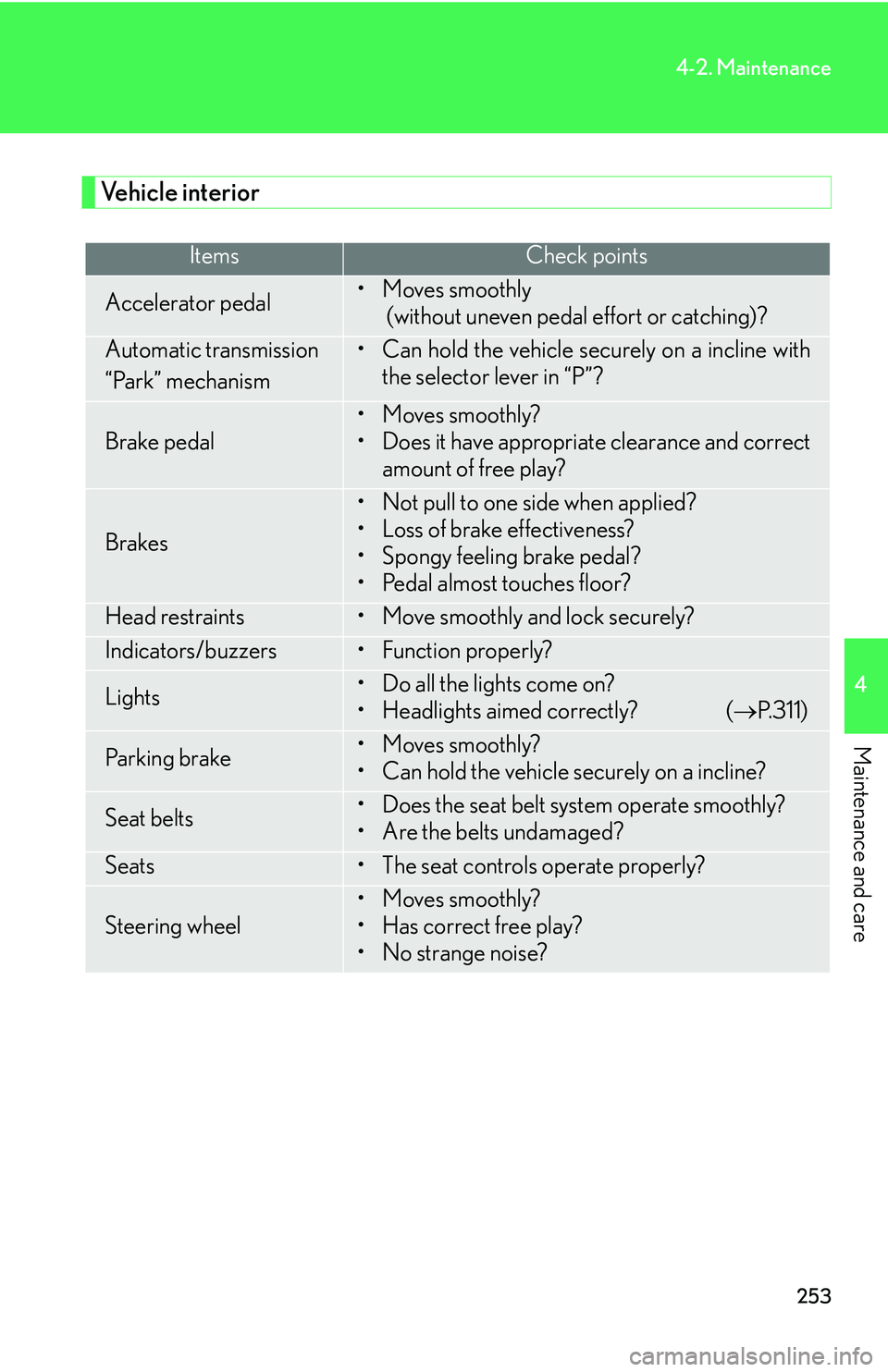
Vehicle interior
ItemsCheck points
Accelerator pedal• Moves smoothly
(without uneven pedal effort or catching)?
Automatic transmission
“Park” mechanism• Can hold the vehicle securely on a incline with the selector lever in “P”?
Brake pedal
• Moves smoothly?
• Does it have appropriate clearance and correct amount of free play?
Brakes
• Not pull to one side when applied?
• Loss of brake effectiveness?
• Spongy feeling brake pedal?
• Pedal almost touches floor?
Head restraints• Move smoothly and lock securely?
Indicators/buzzers• Function properly?
Lights• Do all the lights come on?
• Headlights aimed correctly? ( P.311)
Pa r k i n g b r a ke• Moves smoothly?
• Can hold the vehicle securely on a incline?
Seat belts• Does the seat belt system operate smoothly?
• Are the belts undamaged?
Seats• The seat controls operate properly?
Steering wheel
• Moves smoothly?
• Has correct free play?
•No strange noise?
Page 337 of 419

5
When trouble arises
321
5-1. Essential information
Emergency towing
If a tow truck is not available in an emergency, your vehicle may be tem-
porarily towed by a cable or chain secur
ed to the emergency towing eye-
let(s). This should only attempted on har
d, surfaced roads for short
distance at low speeds.
A driver must be in the vehicle to steer and oper
ate the brakes. The vehi-
cle's wheels, drive train, axles, steer ing and br
akes must be in good con-
dition.
Towing eyelet
1
■Emergency towing proceduresRelease the parking brake.
Put the transmission in “N”.
The ignition switch must be in ACC (eng
ine off) or ON (engine running).
CAUTION
■Caution while towing
●Use extreme caution when towing the vehi cle. Avoid sudden starts or erratic
driving maneuvers which place excessive stress on the emergency towing eyelets
and the cable or chain.
●If the engine is not running, the power assi st for the brakes and steering will not
function, making steering and braking more difficult.
STEP1
STEP2
STEP3
Page 385 of 419
369
6-1. Specifications
6
Vehicle specifications
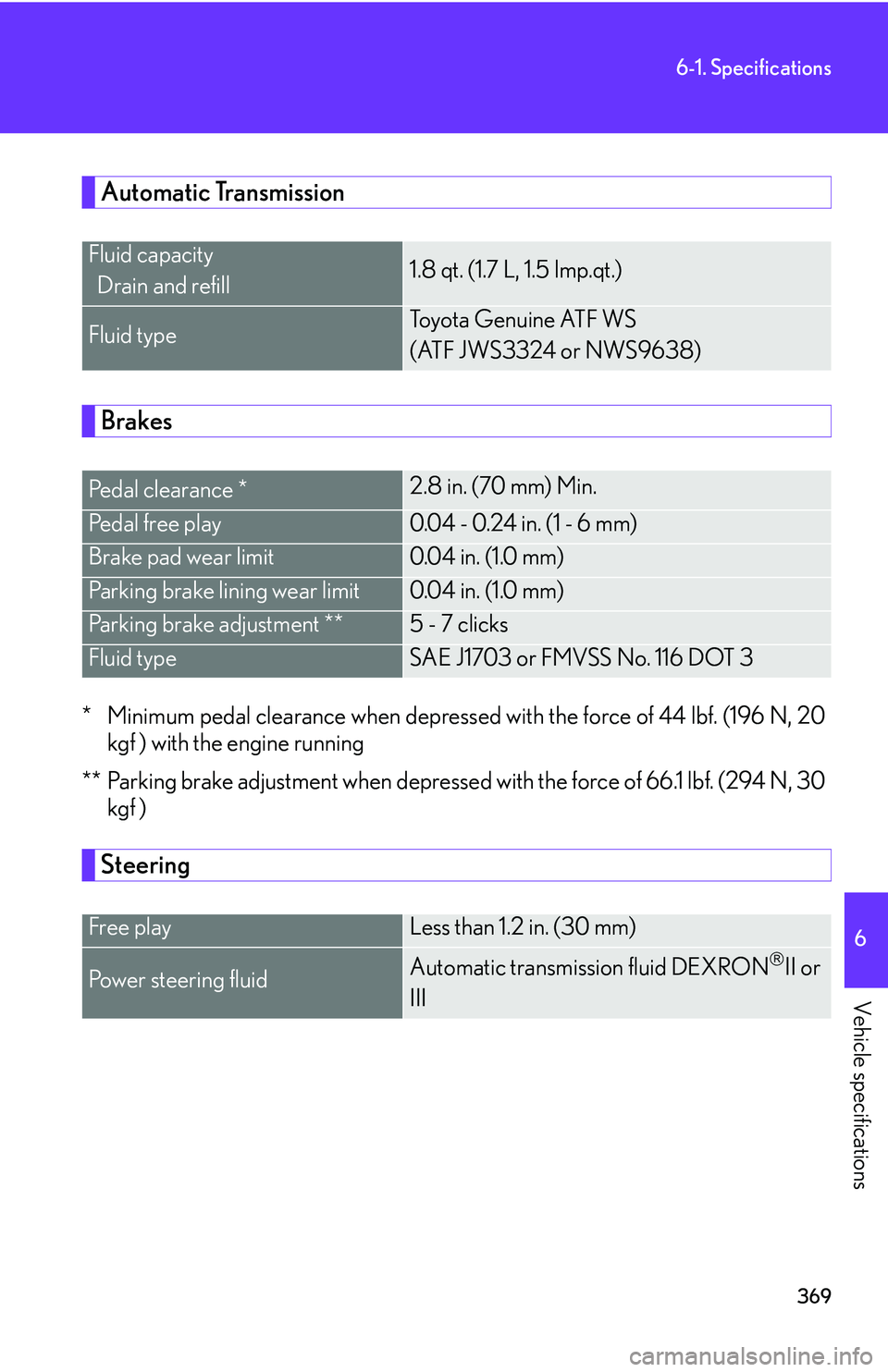
Automatic Transmission
Brakes
* Minimum pedal clearance when depressed with the force of 44 lbf. (196 N, 20 kgf ) with the engine running
** Parking brake adjustment when depressed with the for
ce of 66.1 lbf. (294 N, 30
kgf )
Steering
Fluid capacity
Drain and refill1.8 qt. (1.7 L, 1.5 lmp.qt.)
Fluid typeToyota Genuine ATF WS
(ATF JWS3324 or NWS9638)
Pedal clearance *2.8 in. (70 mm) Min.
Pedal free play0.04 - 0.24 in. (1 - 6 mm)
Brake pad wear limit0.04 in. (1.0 mm)
Parking brake lining wear limit0.04 in. (1.0 mm)
Parking brake adjustment **5 - 7 clicks
Fluid typeSAE J1703 or FMVSS No. 116 DOT 3
Free playLess than 1.2 in. (30 mm)
Power steering fluidAutomatic transmission fluid DEXRONII or
III
Page 398 of 419
382
6-1. Specifications
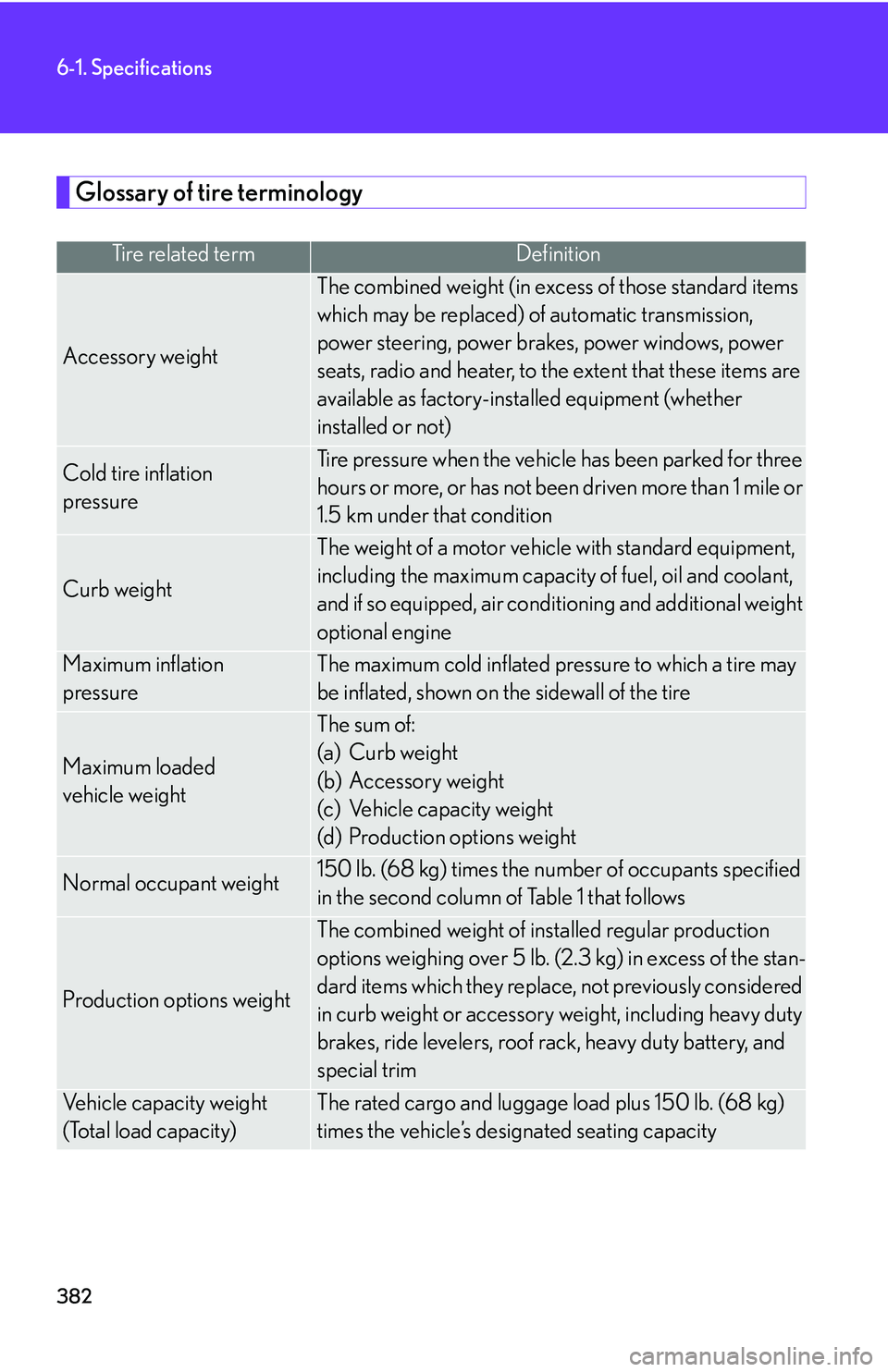
Glossary of tire terminology
Tire related termDefinition
Accessory weight
The combined weight (in excess of those standard items
which may be replaced) of automatic transmission,
power steering, power brakes, power windows, power
seats, radio and heater, to the extent that these items are
available as factory-installed equipment (whether
installed or not)
Cold tire inflation
pressure
Tire pressure when the vehicle has been parked for three
hours or more, or has not been driven more than 1 mile or
1.5 km under that condition
Curb weight
The weight of a motor vehicl e with standard equipment,
including the maximum capacity of fuel, oil and coolant,
and if so equipped, air conditioning and additional weight
optional engine
Maximum inflation
pressure
The maximum cold inflated pressure to which a tire may
be inflated, shown on the sidewall of the tire
Maximum loaded
vehicle weight
The sum of:
(a) Curb weight
(b) Accessory weight
(c) Vehicle capacity weight
(d) Production options weight
Normal occupant weight150 lb. (68 kg) times the numb er of occupants specified
in the second column of Table 1 that follows
Production options weight
The combined weight of installed regular production
options weighing over 5 lb. (2.3 kg) in excess of the stan -
dard items which they replace, not previously considered
in curb weight or accessory weight, including heavy duty
brakes, ride levelers, roof rack, heavy duty battery, and
special trim
Vehicle capacity weight
(Total load capacity)The rated cargo and luggage load plus 150 lb. (68 kg)
times the vehicle’s designated seating capacity