Page 165 of 419

149
2-5. Driving information
2
When driving
Winter driving tips
Carry out the necessary preparations and inspections before driving the
vehicle in winter. Always drive the vehicle in a manner appropriate for the
prevailing weather and roadway conditions.
■ Pre-winter preparations
●Use fluids appropriate to the p revailing outside temperatures.
• Engine oil
• Engine coolant
• Washer fluid
●Inspect the level and specific gravity of battery electrolyte.
●Have the vehicle fitted with four sno w tires or purchase a set of tire
chains for the rear tires.
Ensure that all tires are the same si
ze and brand, and that chains
match the size of the tires.
■ Befor
e driving the vehicle
Perform the following steps acco r
ding to the driving conditions.
●Do not forcibly try to open a window or move a wiper that has fro-
zen. Pour some warm water over the frozen area to melt the ice.
Wipe away the water immediately to pr
event it from freezing.
●To ensure proper operation of the climate control system fan,
remove any snow that has accumulated on the air inlet vents in front
of the windshield.
●Remove any ice that has accumulated on the vehicle chassis.
●Periodically check for and remove any excess ice or snow that may
accumulate in the wheel well or brakes.
Page 173 of 419

157
2-5. Driving information
2
When driving
• As stopping distance is increased when towing a trailer, vehicle-to-
vehicle distance should be increas ed. For each 10 mph (16 km/h) of
speed, allow at least one vehicle and trailer length.
• Avoid sudden braking as you may sk id, r
esulting in jackknifing and loss
of control. This is especially true on wet or slippery surfaces.
• Avoid jerky starts or sudden acceleration.
• Avoid jerky steering and sharp turn s, and slo
w down before making a
turn.
• Note that when making a turn, the tr ailer wheels will be closer than the
v
ehicle wheels to the inside of th e turn. Compensate by making a
larger than normal turning radius.
• Crosswinds and rough roads will ad v
ersely affect handling of your
vehicle and trailer, causing sway. Peri odically check the rear to prepare
for being passed by large trucks or buses, which may cause your vehi-
cle and trailer to sway. If s
waying occurs, firmly grip the steering wheel,
reduce speed immediately but gradually, and steer straight ahead.
Never increase speed. If you make no extreme correction with the
steering or brakes, your vehi cle and trailer will stabilize.
• Take care when passing other vehicl es. P
assing requires considerable
distance. After passing a vehicle, do not forget the length of your
trailer, and be sure you have plenty of room before changing lanes.
• In order to maintain efficient engine br
aking and electrical charging
performance, do not use overdrive. Transmission shift range position
must be in “4”, in the “S” mode.
• Due to the added load of the traile r
, your vehicle’s engine may overheat
on hot days (at temperatures over 85°F [30°C]) when driving up a
long or steep grade. If the engine coolant temperature gauge indicates
overheating, immediately turn off the air conditioning (if in use), pull
your vehicle off the road and stop in a safe spot. See “If your vehicle
overheats” ( P.359 ).
Page 177 of 419

3Interior features
161
3-1. Using the air conditioning
system and defogger ........... 162
Automatic air conditioning
control .......................................... 162
Rear window defogger............. 170
Rear air conditioning
controls ........................................ 172
3-2. Using the audio system .......... 174 Audio system ................................. 174
Operating the radio................... 176
Operating the cassette
player ............................................ 182
Using the CD changer ............ 185
Optimal use of the audio
system ............................................ 191
Using the rear controller ......... 193
Using the steering switches.... 195
3-3. Turning on interior lights ...... 198 Interior lights list ......................... 198
3-4. Storage ...................................... 201 Storage features......................... 201 3-5. Other interior features ....... 208
Sun visors ..................................... 208
Vanity mirror and light ............ 209
Clock ............................................... 210
Ashtray............................................. 211
Cigarette lighter ......................... 213
Power outlets................................ 214
Outside temperature display .......................................... 216
Seat heaters .................................. 218
Climate control seat
switches ..................................... 220
Refreshing rear seat
switches ...................................... 222
Coat hooks................................... 223
Floor mats ..................................... 224
Sunshades ................................... 225
Trunk features.............................. 227
Garage door opener ............... 232
Compass (vehicles without
navigation system) ................ 238
Page 178 of 419
162
3-1. Using the air conditioning system and defogger
Automatic air conditioning control
Airflow and outlets automatically adjust according to the temperature set-
ting.
For vehicles equipped with navigation sy
stem, refer to the separate Naviga-
tion System Owner’s manual for further details.
Vehicles equipped with rear air conditioning
Driver's side
temperature
control
Simultaneous
or individual
mode Winds hield
defogger
Automatic
mode
Driver's side
temperature display Off
Fan speed Changes the air
outlets used Passenger’s side
temperature display Swing
center
vent
Po w e r
Passenger’s side
temperature
control
Rear air conditioning
control switches
( P. 1 7 2 )
Outside air or
recirculate
mode
Page 179 of 419
163
3-1. Using the air conditioning system and defogger
3
Interior features
Using the automatic mode
Push .
The air conditioning system will begin to oper
ate. Air intake
and fan speed are automatically adjusted accor
ding to the
temperature setting.
Adjust the temperature setting using or .
The temperature for the driver and passenger seats can be set sepa -
rately. ( P.164
)
Vehicles without rear air conditioning
Driver’s side
temperature
control
Simultaneous
or individual
mode Windshield
defogger Outside air or
recirculate mode
Automatic
mode
Driver’s side
temperature display Off
Fan speed Changes the air
outlets used Passenger’s side
temperature display Po w e r
Passenger’s side
temperature
control
Swing
center
vent
Page 180 of 419
164
3-1. Using the air conditioning system and defogger
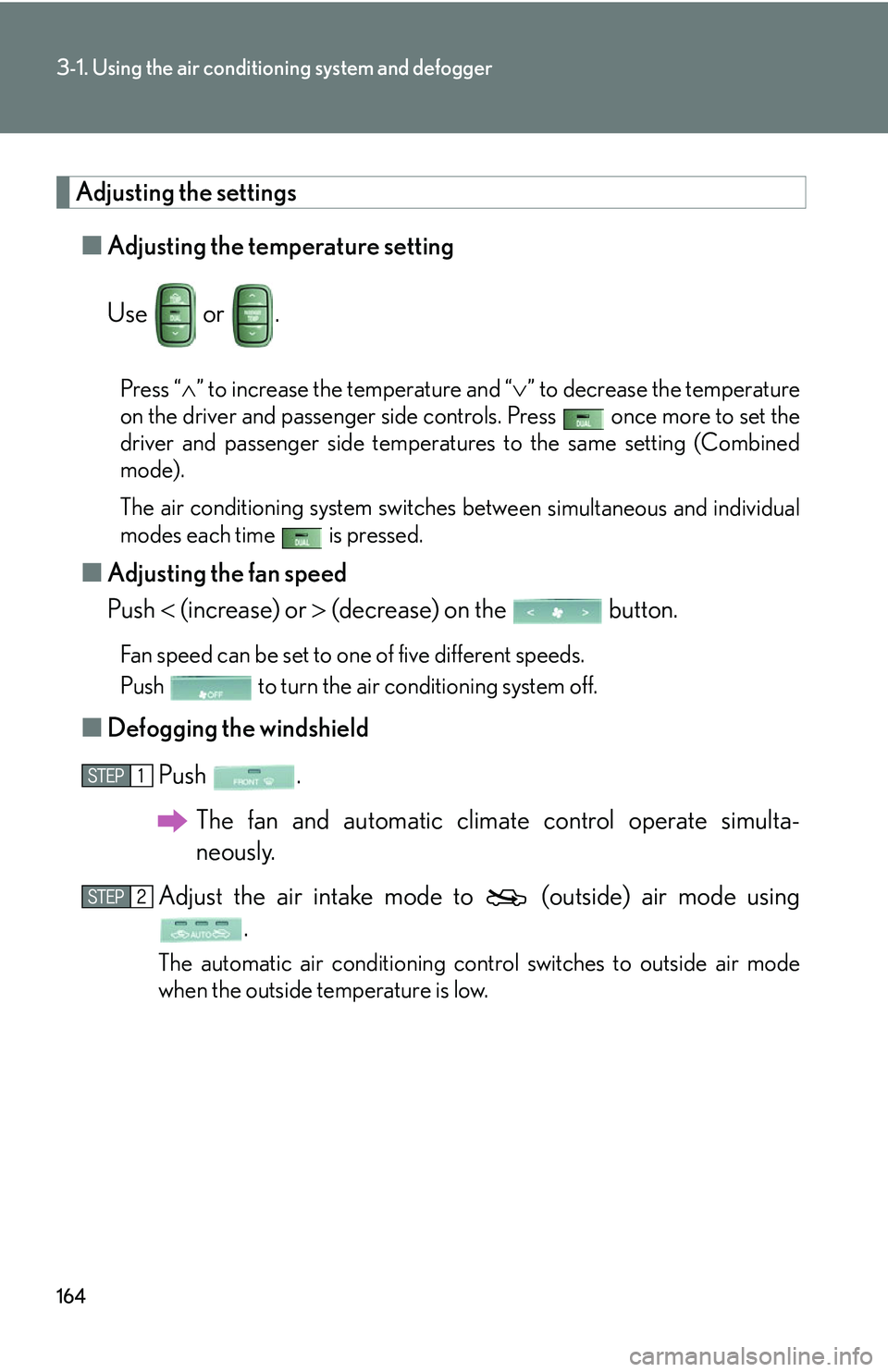
Adjusting the settings
■Adjusting the temperature setting
Use or .
Press “ ” to increase the temperature and “ ” to decrease the temperature
on the driver and passenger side controls. Press once more to set the
driver and passenger side temperatures to the same setting (Combined
mode).
The air conditioning system switches betw
een simultaneous and individual
modes each time is pressed.
■Adjusting the fan speed
Push (incr
ease) or (decrease) on the button.
Fan speed can be set to one of five different speeds.
Push to turn the air conditioning system off.
■Defogging the windshield
Push .
The fan and automatic clima te contr
ol operate simulta-
neously.
Adjust the air intake mode to (outside) air mode using
.
The automatic air conditioning cont rol switches to outside air mode
when the outside temperature is low.
Page 181 of 419
165
3-1. Using the air conditioning system and defogger
3
Interior features
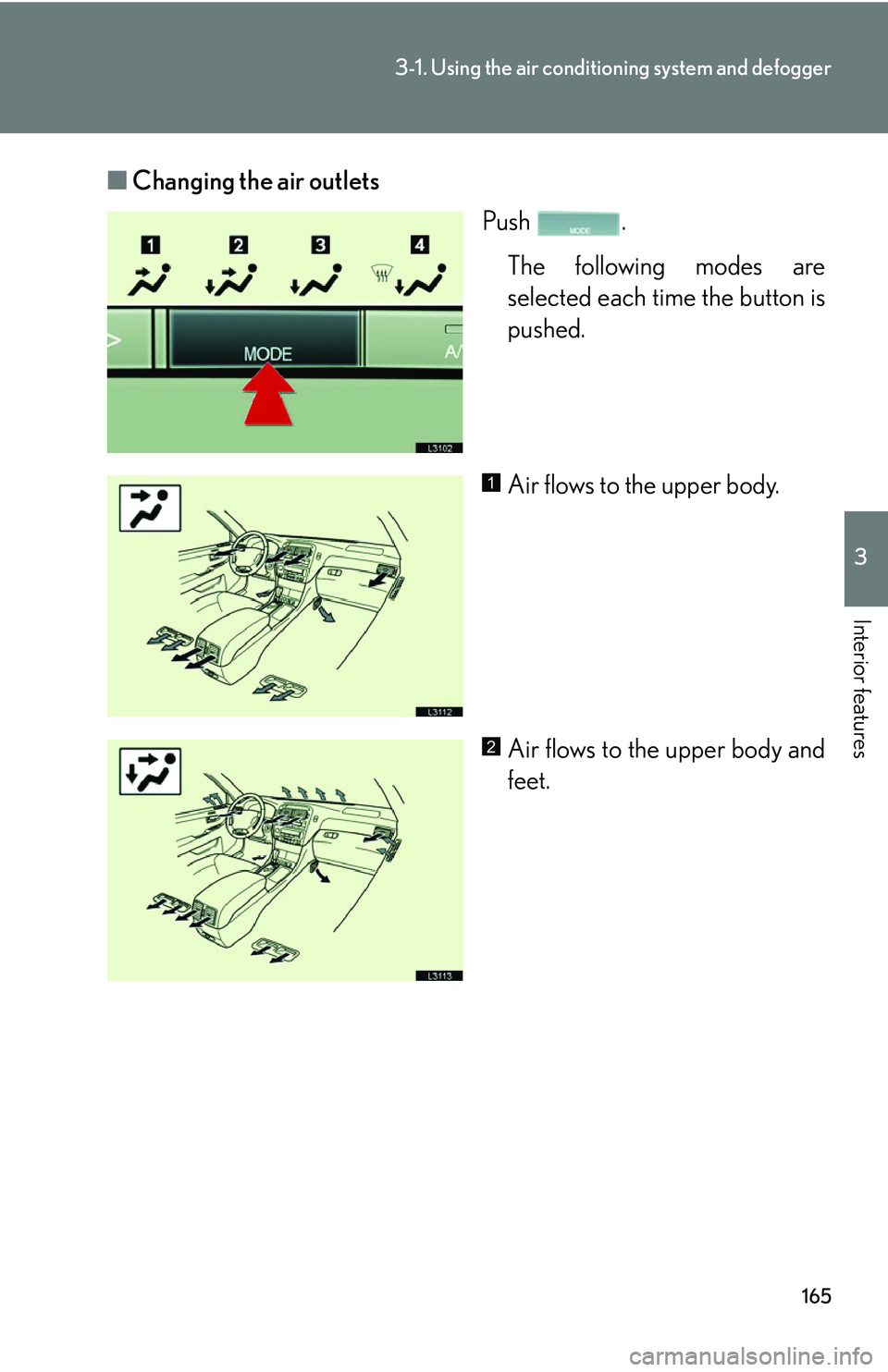
■Changing the air outlets
Push .
The following modes are
selected each ti me the bu
tton is
pushed.
Air flows to the upper body.
Air flows to the upper body and
feet.
1
2
Page 182 of 419
166
3-1. Using the air conditioning system and defogger
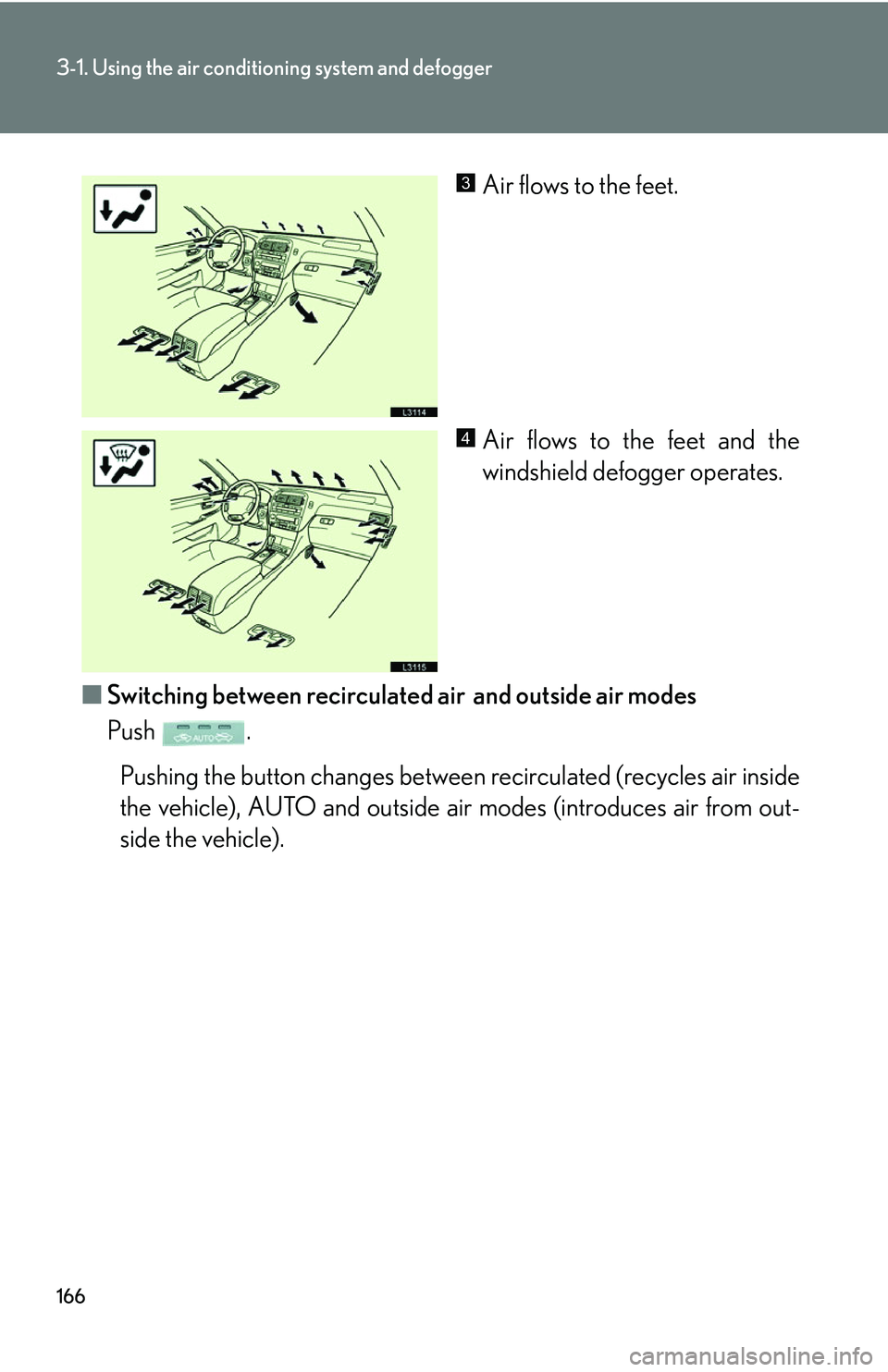
Air flows to the feet.
Air flows to the feet and the
windshield defogger operates.
■ S
witching between recirculated air and outside air modes
Push .
Pushing the button change s betw
een recirculated (recycles air inside
the vehicle), AUTO and outside air modes (introduces air from out-
side the vehicle).
3
4