Page 564 of 622

CHASSIS
543
1 Tire size: For details, see “Tire size” on page
546.
2 DOT and Tire Identification Number (TIN): For
details, see “DOT and Tire Identification Number
(TIN)” on page 546.
3 Tire ply composition and materials : Plies
mean a layer of rubber −coated parallel cords.
Cords mean the strands forming the plies in the
tire.
4 Load limit at maximum cold tire inflation
pressure: For details, see “Checking and
replacing tires” on page 554.
5 Uniform tire quality grading For details, see
“Uniform tire quality grading” on page 548.
6 Maximum cold tire inflation pressure: This
means the pressure to which a tire may be
inflated. For recommended cold tire inflation
pressure, see “Specifications” on page 537.
7 “TUBELESS” or “TUBE TYPE”: A tubeless tire
does not have a tube inside the tire and air is
directly filled in the tire. A tube type tire has a
tube inside the tire and the tube maintains the air
pressure.
8 Radial tires or biasply tires : A radial tire has
“RADIAL” on the sidewall. A tire not marked with
“RADIAL” is a bias −ply tire.
9 Runflat tire (RFT) or standard tire: This
vehicle can be equipped with either run −flat tires
(RFT) or standard tires. A “RFT” or “DSST” mark
is molded on the sidewall of the run −flat tire. For
details, see “Run −flat tires” on page 552.
10 Location of tread wear indicators: For details,
see “Checking and replacing tires” on page 554.
11 Summer tire or all season tire: An all season
tire has “M+S” on the sidewall. The tire not
marked with “M+S” is a summer tire. For details,
see “Types of tires” on page 553.
Page 566 of 622

CHASSIS
545
1 “TEMPORARY USE ONLY”: A compact spare
tire is identified by the phrase “TEMPOTRARY
USE ONLY” molded into its sidewall. This tire is
designed for temporary emergency use only. For
details, see “Compact spare tire” on page 471.
2 Tire size: For details, see “Tire size” on page
546.
3 DOT and Tire Identification Number (TIN): For
details, see “DOT and Tire Identification Number
(TIN)” on page 546.
4 Load limit at maximum cold tire inflation
pressure: For details, see “Checking and
replacing tires” on page 554.
5 Maximum cold tire inflation pressure: This
means the pressure to which a tire may be
inflated. For recommended cold tire inflation
pressure, see “Specifications” on page 532.
6 Tire ply composition and materials : Plies
mean a layer of rubber −coated parallel cords.
Cords mean the strands forming the plies in the
tire.
7 Location of tread wear indicators: For details,
see “Checking and replacing tires” on page 554.
8 “TUBELESS” or “TUBE TYPE”: A tubeless tire
does not have a tube inside the tire and air is
directly filled in the tire. A tube type tire has a
tube inside the tire and the tube maintains the air
pressure.
9 Radial tires or biasply tires : A radial tire has
“RADIAL” on the sidewall. A tire not marked with
“RADIAL” is a bias −ply tire.
Page 567 of 622
CHASSIS
546
DOT and Tire Identification Number (TIN)
63SA11a
�The illustration indicates typical DOT and Tire
Identification Number (TIN)
1“DOT” symbol
2Tire Identification Number (TIN)
3Tire manufacturer’s identification mark
4Tire size code
5Manufacturer’s optional tire type code
(3 or 4 letters)
6Manufacturing week
7Manufacturing year
The “DOT” symbol certifies that the tire conforms to
applicable Federal Motor Vehicle Safety Standards.
Tire size
63ca01
The illustrations indicate typical tire sizes.
1Tire use (P=Passenger car, T=Temporary use)
2Section width (in millimeters)
3Aspect ratio (tire height to section width)
4Speed category (alphabet with one letter)
5Tire construction code
(R=Radial, D=Diagonal)
6Wheel diameter (in inches)
7Load index (2 digits or 3 digits)
8Speed symbol (alphabet with one letter)
Page 572 of 622

CHASSIS
551
Tire related termMeaning
Rim size designationrim diameter and width
Rim type designationthe industry of manufacturer’s designation for a rim by style or code
Rim widthnominal distance between rim flanges
Vehicle maximum load on
the tirethe load on an individual tire that is determined by distributing to eac\
h axle its
share of the maximum loaded vehicle weight and dividing by two
Vehicle normal load on
the tirethe load on an individual tire that is determined by distributing to eac\
h axle its
share of the curb weight, accessory weight, and normal occupant weight
(distributed in accordance with Table 1 that follows) and dividing by two
Weather sidethe surface area of the rim not covered by the inflated tire
Table 1 – Occupant loading and distribution for vehicle normal load for various designated seating capacities
Designated seating capacity, Number of occupants
Vehicle normal load,
Number of occupantsOccupant distribution in a normally loaded vehicle
2 through 422 in front
5 through 1032 in front, 1 in second seat
Page 574 of 622

CHASSIS
553
TYPES OF TIRES
Determine what kind of tires your vehicle is originally
equipped with.
1. Summer tires
Summer tires are high −speed capability tires best suited
to highway driving under dry conditions.
Since summer tires do not have the same traction
performance as snow tires, summer tires are
inadequate for driving on snow −covered or icy roads.
For driving on snow− covered or icy roads, we
recommend using snow tires. If installing snow tires, be
sure to replace all four tires.
2. All season tires
All season tires are designed to provide better traction
in snow and to be adequate for driving in most winter
conditions, as well as for use all year round.
All season tires, however, do not have adequate traction
performance compared with snow tires in heavy or loose
snow. Also, all season tires fall short in acceleration and
handling performance compared with summer tires in
highway driving.
CAUTION
� Do not mix summer and all season tires on your
vehicle as this can cause dangerous handling
characteristics, resulting in loss of control.
� Do not use tires other than the manufacturer’s
designated tires, and never mix tires or wheels
of the sizes different from the originals as this
could result in loss of control and could cause
death or serious injury.
Page 577 of 622

CHASSIS
556
The effectiveness of snow tires is lost if the tread
wears down below 4 mm (0.16 in.).
If you have tire damage such as cuts, splits, cracks
deep enough to expose the fabric, or bulges
indicating internal damage, the tire should be
replaced.
If a tire often goes flat or cannot be properly repaired due
to the size or location of a cut or other damage, it should
be replaced. If you are not sure, consult with your Lexus
dealer.
If air loss occurs while driving, do not continue driving.
Driving even a short distance can damage a tire beyond
repair.
Any tires which are over 6 years old must be
checked by a qualified technician even if damage is
not obvious.
Tires deteriorate with age even if they have never or
seldom been used.
This applies also to the spare tire and tires stored for
future use.NOTICE
� When you purchase new tires, consult your
Lexus dealer. If you change from runflat tires
to standard tires, a spare tire should also be
equipped.
� When the tires must be repaired or replaced,
have them repaired or replaced by Lexus dealer
or authorized dealer. The tire pressure sensors
will be affected by the installation or removal of
tires.
� When the tires must be replaced, replace the
grommets for tire pressure sensors as well.
Page 578 of 622

CHASSIS
557
Tire selection
When replacing a tire, use a tire of the same size and
construction, and the same or greater maximum
load as the originally installed tires. Also, all the
tires must be the same brand and have the same
tread patterns.
Using any other size or type of tire may seriously affect
handling, ride, speedometer/odometer calibration,
ground clearance, and clearance between the body and
tires or snow chains.
Check that the maximum load of the replaced tire is
greater than 1/2 of the Gross Axle Weight Ratings
(GAWR) of either the front axle or the rear axle,
whichever is greater. As for the maximum load of the
tire, see the load limit at maximum cold tire inflation
pressure mentioned on the sidewall of the tire, and as for
the Gross Axle Weight Ratings (GAWR), see the
Certification Label. For details about the Certification
Label and sidewall of the tire, see pages 500 and 542.CAUTION
Observe the following instructions. Otherwise, an
accident may occur resulting in death or serious
injuries.
� Do not mix radial, bias belted, or biasply tires
on your vehicle, as this may cause dangerous
handling characteristics resulting in loss of
control.
� Do not use tires other than the manufacturer’s
recommended size, as this may cause
dangerous handling characteristics resulting in
loss of control.
Page 579 of 622
CHASSIS
558
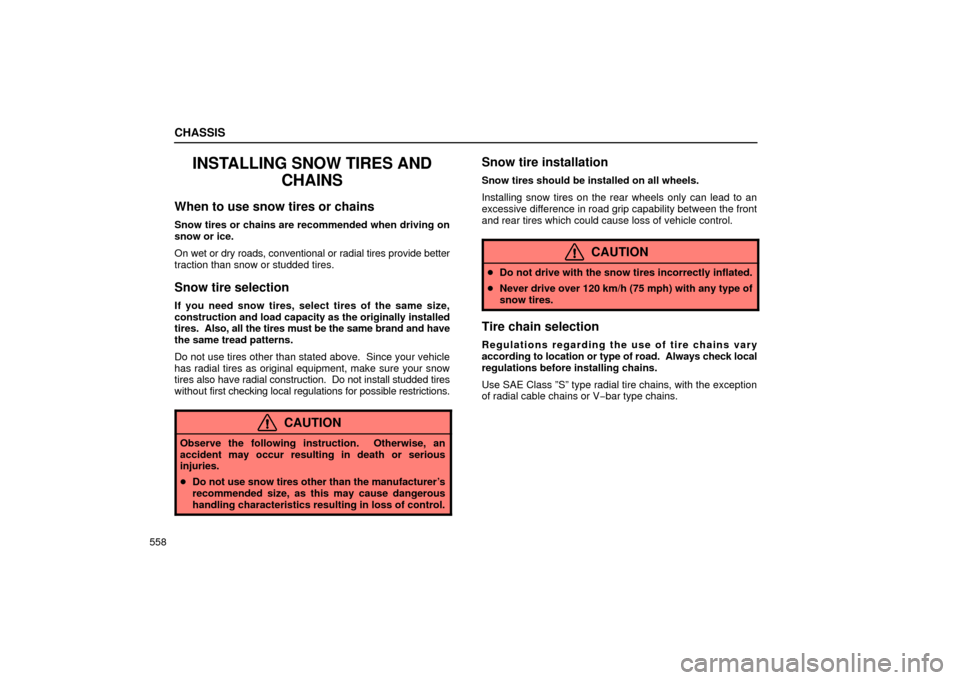
INSTALLING SNOW TIRES ANDCHAINS
When to use snow tires or chains
Snow tires or chains are recommended when driving on
snow or ice.
On wet or dry roads, conventional or radial tires provide better
traction than snow or studded tires.
Snow tire selection
If you need snow tires, select tires of the same size,
construction and load capacity as the originally installed
tires. Also, all the tires must be the same brand and have
the same tread patterns.
Do not use tires other than stated above. Since your vehicle
has radial tires as original equipment, make sure your snow
tires also have radial construction. Do not install studded tires
without first checking local regulations for possible restrictions.
CAUTION
Observe the following instruction. Otherwise, an
accident may occur resulting in death or serious
injuries.
�Do not use snow tires other than the manufacturer’s
recommended size, as this may cause dangerous
handling characteristics resulting in loss of control.
Snow tire installation
Snow tires should be installed on all wheels.
Installing snow tires on the rear wheels only can lead to an
excessive difference in road grip capability between the front
and rear tires which could cause loss of vehicle control.
CAUTION
�Do not drive with the snow tires incorrectly inflated.
� Never drive over 120 km/h (75 mph) with any type of
snow tires.
Tire chain selection
Regulations regarding the use of tire chains vary
according to location or type of road. Always check local
regulations before installing chains.
Use SAE Class ”S” type radial tire chains, with the exception
of radial cable chains or V− bar type chains.
