2006 KIA Sportage weight
[x] Cancel search: weightPage 63 of 354

Knowing your vehicle106
3
1
2
3
4
5
6
7
8
9
✽ ✽
NOTICESince the tonneau cover may be
damaged or malformed, do not put
the luggage on it when it is used.
CAUTION
Do not place objects on the
tonneau cover. Such objects
may be thrown about inside
the vehicle and possibly injure
vehicle occupants during an
accident or when braking.
Never allow anyone to ride in the luggage compartment. It is
designed for luggage only.
Maintain the balance of the vehicle and locate the weight
as far forward as possible.
KM CAN (ENG) 3 (55~)new.qxd 7/29/05 9:37 AM Page 106
Page 65 of 354
Knowing your vehicle108
3
1
2
3
4
5
6
7
8
9
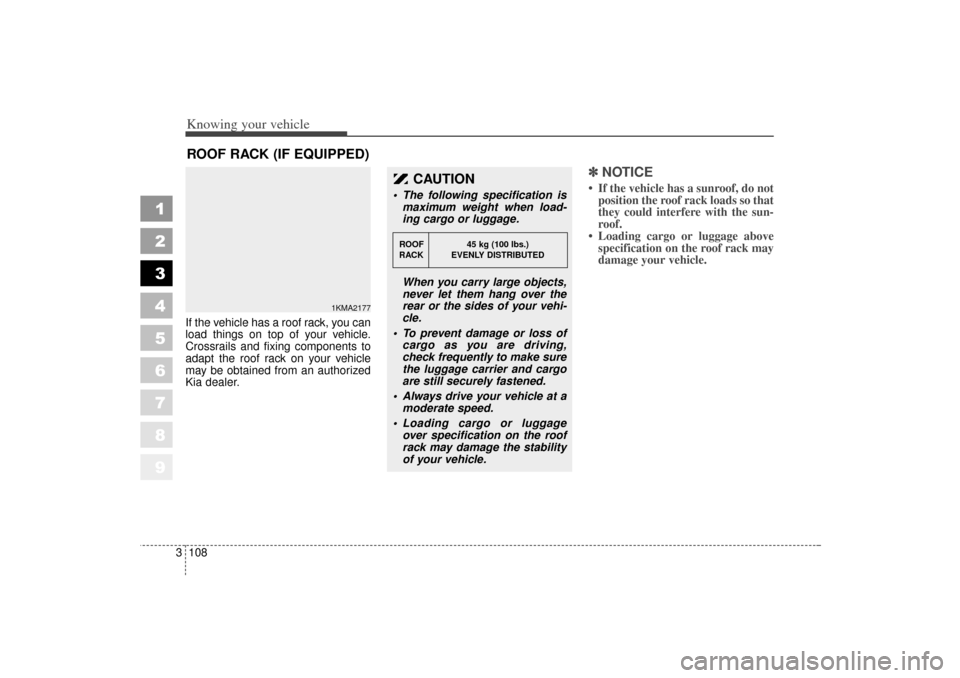
If the vehicle has a roof rack, you can
load things on top of your vehicle.
Crossrails and fixing components to
adapt the roof rack on your vehicle
may be obtained from an authorized
Kia dealer.
✽ ✽
NOTICE If the vehicle has a sunroof, do not
position the roof rack loads so that
they could interfere with the sun-
roof.
Loading cargo or luggage above specification on the roof rack may
damage your vehicle.
ROOF RACK (IF EQUIPPED)
1KMA2177
CAUTION
The following specification is
maximum weight when load-
ing cargo or luggage.
When you carry large objects,
never let them hang over the
rear or the sides of your vehi-
cle.
To prevent damage or loss of cargo as you are driving,
check frequently to make sure
the luggage carrier and cargo
are still securely fastened.
Always drive your vehicle at a moderate speed.
Loading cargo or luggage over specification on the roof
rack may damage the stability
of your vehicle.ROOF 45 kg (100 lbs.)
RACK EVENLY DISTRIBUTED
KM CAN (ENG) 3 (55~)new.qxd 7/29/05 9:37 AM Page 108
Page 131 of 354
411
Driving your vehicle
1
2
3
4
5
6
7
8
9
Moving up a steep grade from
a standing startTo move up a steep grade from a
standing start, depress the brake
pedal, shift the shift lever to D
(Drive). Select the appropriate gear
depending on load weight and steep-
ness of the grade, and release the
parking brake. Depress the accelera-
tor gradually while releasing the
service brakes.
When accelerating from a stop on
a steep hill, the vehicle may have a
tendency to roll backwards.
Shifting the shift lever into 2
(Second Gear) while in Sport
mode will help prevent the vehicle
from rolling backwards.
Shift lock systemFor your safety, the Automatic
Transaxle has a shift lock system
which prevents shifting the transaxle
out of P (Park) unless the brake
pedal is depressed.
To shift the transaxle out of P (Park):
1. Depress and hold the brake pedal.
2. Start the engine or turn the ignitionto the ON position.
3. Depress the lock release button and move the shift lever.
When the ignition switch is in the
ACC or LOCK position, the transaxle
cannot be shifted from P (Park).
If the brake pedal is repeatedly
depressed and released with the
shift lever in the P (Park) position, a
chattering noise near the shift lever
may be heard. This is a normal con-
dition.
Ignition key interlock systemThe ignition key cannot be removed
unless the shift lever is in the P
(Park) position. If the ignition switch
is in any other position, the key can-
not be removed.
KM CAN (ENG) 4 new.qxd 7/29/05 9:35 AM Page 11
Page 213 of 354
1
2
3
4
5
6
7
8
9
Fuel requirements / 5-2
Emission control system / 5-3
Before driving / 5-5
Suggestions for economical operation / 5-6
Special driving conditions / 5-8
Using four-wheel drive / 5-14
Weight of the vehicle / 5-32
Trailer towing / 5-33
Overloading / 5-40
Vehicle load limit / 5-41
Homelink® wireless control system / 5-45
Label information / 5-51
Driving tips
KM CAN (ENG) 5 new.qxd 7/29/05 9:38 AM Page 1
Page 218 of 354
Driving tips65SUGGESTIONS FOR ECONOMICAL OPERATIONYour vehicle's fuel economy depends
mainly on your style of driving, where
you drive and when you drive.
Each of these factors affects how
many kilometers (miles) you can get
from liter (a gallon) of fuel. To operate
your vehicle as economically as pos-
sible, use the following driving sug-
gestions to help save money in both
fuel and repairs: Avoid lengthy warm-up idling.
Once the engine is running
smoothly, begin driving.
Remember, engine warm-up may
take a little longer on cold days.
Save fuel by accelerating slowly after stopping.
Keep the engine in tune and follow the recommended periodic mainte-
nance schedule. This will increase
the life of all parts and lower your
operating costs.
Do not use the air conditioner unnecessarily.
Slow down when driving on rough roads.
For longer tire life and better fuel economy, always keep the tires
inflated to the recommended pres-
sures. Maintain a safe distance from other
vehicles to avoid sudden stops.
This will reduce wear on brake lin-
ings and pads. Driving in such a
way will also save fuel because
extra fuel is required to accelerate
back to driving speed.
Do not carry unnecessary weight in the vehicle.
Do not rest your foot on the brake pedal while driving. This can cause
needless wear, possible damage
to the brakes, and poor fuel econo-
my.
Improper wheel alignment results in faster tire wear and lower fuel
economy.
Open windows at high speeds can reduce fuel economy.
Fuel economy is less in crosswinds and headwinds. To help offset
some of this loss, slow down when
driving in these conditions.
1
2
3
4
5
6
7
8
9KM CAN (ENG) 5 new.qxd 7/29/05 9:38 AM Page 6
Page 239 of 354
527
Driving tips
1
2
3
4
5
6
7
8
9
Stalling downhill
Stalling is much more likely to hap-
pen going uphill. But if it happens
going downhill, here’s what to do.
Stop your vehicle by applying thebrakes. Then apply the parking
brake.
Move the shift lever to P (Park) in automatic transaxle or shift to N
(Neutral) in manual transaxle and,
while still braking, restart the
engine.
Shift back to a low gear, release the parking brake, and drive
straight down.
If the engine won’t start, get out and seek help. Exit on the uphill
side of the vehicle and stay clear of
the path the vehicle would take if it
rolled downhill. Driving across an incline
Sooner or later, an off-road trail will
probably go across the incline of a
hill. If this happens, you have to
decide whether or not to try to drive
across the incline. Here are some
things to consider:
A hill that can be driven straight up
or down may be too steep to drive
across. When you go straight up or
down a hill, the length of the wheel
base (the distance from the front
wheels to the rear wheels) reduces
the likelihood the vehicle will tum-
ble end over end. But when you
drive across an incline, the much
narrower track width (the distance
between the left and right wheels)
may not prevent the vehicle from
tilting and rolling over. Also, driving
across an incline puts more weight
on the downhill wheels. This could
cause a downhill slide or a rollover. Surface conditions can be a prob-
lem when you drive across a hill.
Loose gravel, muddy spots, or
even wet grass can cause your
tires to slip sideways. If the vehicle
slips sideways, it can hit something
that will tip it (a rock, a rut, etc.) and
cause it to roll over.
Hidden obstacles can make the steepness of the incline even
worse. If you drive across a rock
with the uphill wheels, or if the
downhill wheels drop into a rut or
depression, your vehicle can tilt
even more.
For reasons like these, you need to
decide carefully whether or not to try
to drive across an incline. Just
because the trail goes across the
incline doesn’t mean you have to
drive it.
KM CAN (ENG) 5 new.qxd 7/29/05 9:38 AM Page 27
Page 244 of 354

Driving tips32
5
1
2
3
4
5
6
7
8
9
WEIGHT OF THE VEHICLE This section will guide you in the
proper loading of your vehicle and/or
trailer, to keep your loaded vehicle
weight within its design rating capa-
bility, with or without a trailer.
Properly loading your vehicle will
provide maximum return of the vehi-
cle design performance. Before load-
ing your vehicle, familiarize yourself
with the following terms for determin-
ing your vehicle's weight ratings, with
or without a trailer, from the vehicle's
Specifications and the Vehicle
Certification Label:Base curb weight This is the weight of the vehicle
including a full tank of fuel and all
standard equipment. It does not
include passengers, cargo, or option-
al equipment.Vehicle curb weightThis is the weight of your new vehicle
when you picked it up from your deal-
er plus any aftermarket equipment.
Cargo weightThis figure includes all weight added
to the Base Curb Weight, including
cargo and optional equipment. When
towing, trailer tongue load or king pin
weight also is part of the Cargo
Weight.GAW (Gross axle weight)This is the total weight placed on
each axle (front and rear) - including
vehicle curb weight and all payload.GAWR (Gross axle weight rating)This is the maximum allowable
weight that can be carried by a single
axle (front or rear). These numbers
are shown on the Vehicle
Certification Label. The total load on
each axle must never exceed its
GAWR.
GVW (Gross vehicle weight)This is the Base Curb Weight plus
actual Cargo Weight plus passen-
gers.GVWR (Gross vehicle weight
rating)This is the maximum allowable weight
of the fully loaded vehicle (including
all options, equipment, passengers
and cargo). The GVWR is shown on
the Vehicle Certification Label located
on the driver's door pillar.
KM CAN (ENG) 5 new.qxd 7/29/05 9:38 AM Page 32
Page 245 of 354
533
Driving tips
1
2
3
4
5
6
7
8
9
TRAILER TOWING✽ ✽NOTICE
Pulling a trailer improperly can
damage your vehicle and result in
costly repairs not covered by your
warranty. To pull a trailer correctly,
follow the advice in this section. Your vehicle can tow a trailer. To
identify what the vehicle trailering
capacity is for your vehicle, you
should read the information in
“Weight of the Trailer” that appears
later in this section.
Remember that trailering is different
than just driving your vehicle by itself.
Trailering means changes in han-
dling, durability, and fuel economy.
Successful, safe trailering requires
correct equipment, and it has to be
used properly. This section contains many time-
tested, important trailering tips and
safety rules. Many of these are
important for your safety and that of
your passengers. Please read this
section carefully before you pull a
trailer.
Load-pulling components such as
the engine, transaxle, wheel assem-
blies, and tires are forced to work
harder against the load of the added
weight. The engine is required to
operate at relatively higher speeds
and under greater loads. This addi-
tional burden generates extra heat.
The trailer also adds considerably to
wind resistance, increasing the
pulling requirements.
WARNING
- Towing a
trailer
If you don't use the correct
equipment and drive properly,
you can lose control when you
pull a trailer. For example, if the
trailer is too heavy, the brakes
may not work well - or even at
all. You and your passengers
could be seriously or fatally
injured. Pull a trailer only if you
have followed all the steps in
this section.
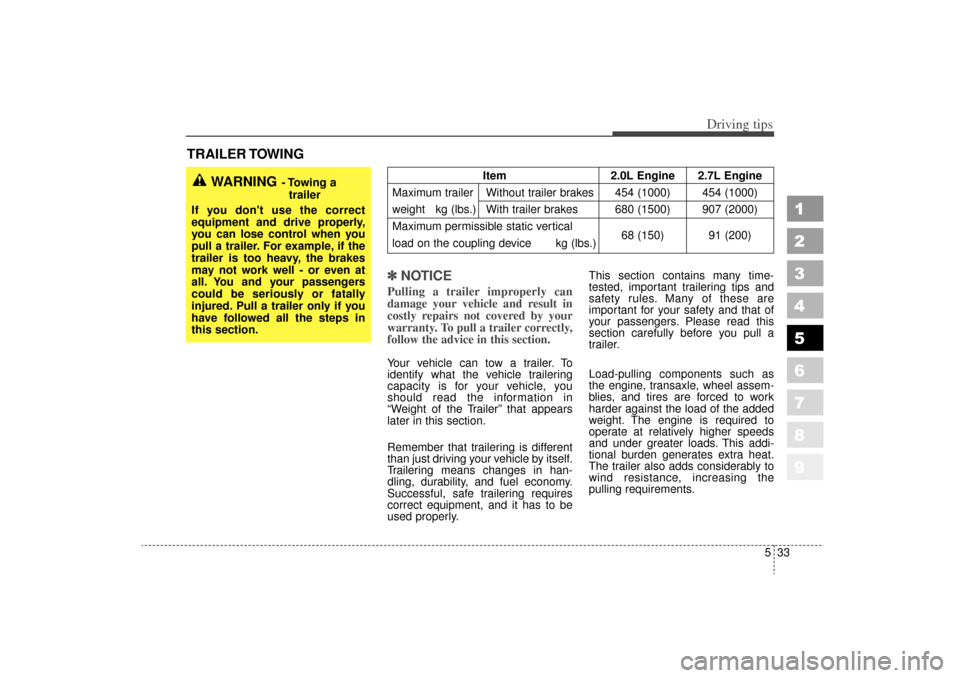
Item 2.0L Engine 2.7L Engine
Maximum trailer Without trailer brakes 454 (1000) 454 (1000)
weight kg (lbs.) With trailer brakes 680 (1500) 907 (2000)
Maximum permissible static vertical
load on the coupling device kg (lbs.) 68 (150) 91 (200)
KM CAN (ENG) 5 new.qxd 7/29/05 9:38 AM Page 33