2006 KIA Sportage sensor
[x] Cancel search: sensorPage 45 of 354
Knowing your vehicle88
3
1
2
3
4
5
6
7
8
9
Electric type (if equipped)
The electric day/night rearview mir-
ror automatically controls the glare
from the headlights of the car behind
you in nighttime or low light driving
conditions. The sensor mounted in
the mirror senses the light level
around the vehicle, and through a
chemical reaction, automatically
controls the headlight glare (10% to
70 %) from vehicles behind you.
When the engine is running, the
glare is automatically controlled by
the sensor mounted in the rearview
mirror.
Whenever the shift lever is shifted
into reverse (R), the mirror will auto-
matically go to the brightest setting in
order to improve the drivers view
behind the vehicle.✽ ✽
NOTICEWhen cleaning the mirror, use a
paper towel or similar material
dampened with glass cleaner. Do not
spray glass cleaner directly on the
mirror as that may cause the liquid
cleaner to enter the mirror housing.
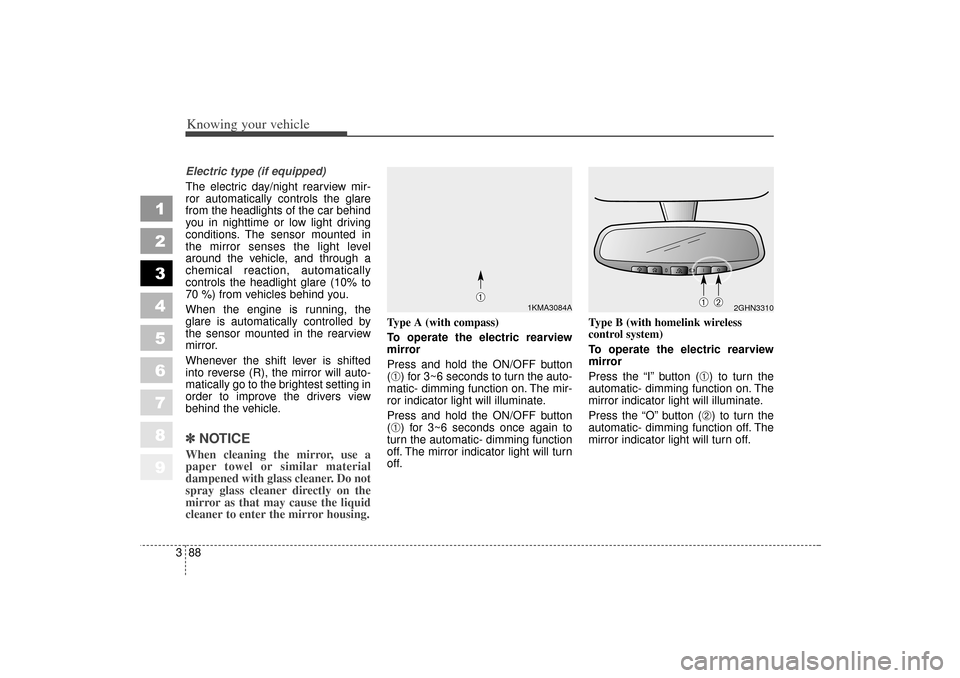
Type A (with compass)
To operate the electric rearview
mirror
Press and hold the ON/OFF button
(➀) for 3~6 seconds to turn the auto-
matic- dimming function on. The mir-
ror indicator light will illuminate.
Press and hold the ON/OFF button
(➀) for 3~6 seconds once again to
turn the automatic- dimming function
off. The mirror indicator light will turn
off. Type B (with homelink wireless
control system)
To operate the electric rearview
mirror
Press the “I” button (
➀) to turn the
automatic- dimming function on. The
mirror indicator light will illuminate.
Press the “O” button (➁) to turn the
automatic- dimming function off. The
mirror indicator light will turn off.
2GHN3310
➀
➁
1KMA3084A
➀
KM CAN (ENG) 3 (55~)new.qxd 7/29/05 9:37 AM Page 88
Page 96 of 354
Knowing your vehicle30
3
1
2
3
4
5
6
7
8
9
Pre-tensioner safety belt Your vehicle is equipped with driver's
and front passenger's pre-tensioner
safety belts. The purpose of the pre-
tensioner is to make sure that excess
slack is taken up in certain frontal
collisions. The pre-tensioners may
activate along with the front airbags
in frontal collisions based on angle of
impact, seat belt usage and impact
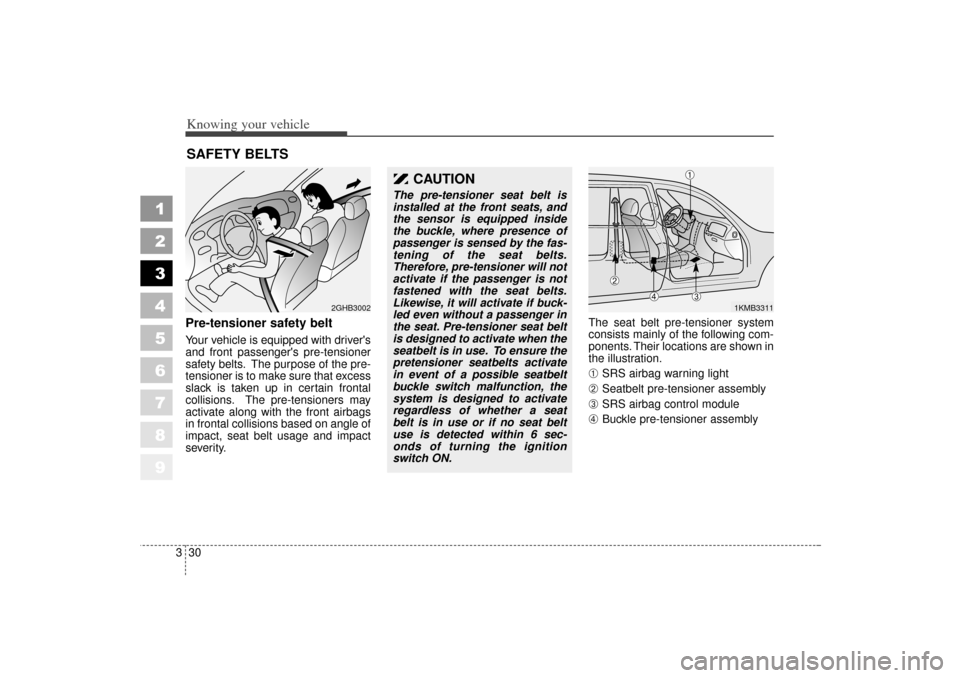
severity. The seat belt pre-tensioner system
consists mainly of the following com-
ponents. Their locations are shown in
the illustration.
➀
SRS airbag warning light
➁
Seatbelt pre-tensioner assembly
➂
SRS airbag control module
➃
Buckle pre-tensioner assembly
SAFETY BELTS
2GHB3002
1KMB3311
➀
➁
➂
➃
CAUTION
The pre-tensioner seat belt is
installed at the front seats, and
the sensor is equipped inside
the buckle, where presence of
passenger is sensed by the fas-
tening of the seat belts.
Therefore, pre-tensioner will not
activate if the passenger is not
fastened with the seat belts.
Likewise, it will activate if buck-
led even without a passenger in
the seat. Pre-tensioner seat belt
is designed to activate when the
seatbelt is in use. To ensure the
pretensioner seatbelts activate
in event of a possible seatbelt
buckle switch malfunction, the
system is designed to activate
regardless of whether a seat
belt is in use or if no seat belt
use is detected within 6 sec-
onds of turning the ignition
switch ON.
KM CAN (ENG) 3 (~54)new.qxd 7/29/05 9:33 AM Page 30
Page 120 of 354

Knowing your vehicle54
3
1
2
3
4
5
6
7
8
9
AIRBAG - ADVANCED SUPPLEMENTAL RESTRAINT SYSTEM
➀Driver’ s airbag
➁Front passenger’ s
airbag
➃Curtain Airbag
\bFront impact sensor➆SRS control module
1KMN2055/1KMA2056/1KMA2058/1KMA2057/1KMA2059/1KMA2060/1KMA2061/1KMB2062/\
1KMN3357/1KMN3358/1KMN3356
➂Side airbag
➄Side impact sensor
➈Occupant classi-
fication system
➇Front seat position
sensor
KM CAN (ENG) 3 (~54)new.qxd 7/29/05 9:33 AM Page 54
Page 156 of 354
Driving your vehicle36
4
1
2
3
4
5
6
7
8
9
The Electronic Stability Program
(ESP) monitors information from
various vehicle sensors and then
compares the driver's commands
with the actual behavior of the
vehicle. If an unstable condition
occurs - a sudden evasive movement
for example - ESP intervenes within
fractions of a second via the engine
computer and brake system and
attempts to stabilize the vehicle.
ESP operationESP ON condition
When the ignition is turnedON, ESP and ESP OFF
indicator lights illuminate
for approximately 3 sec-
onds, then ESP is turned
on.
Press the ESP OFF button for at least half a second
after turning the ignition
ON to turn ESP off. (ESP
OFF indicator will illumi-
nate). To turn the ESP on,
press the ESP OFF button
(ESP OFF indicator light
will go off).
When starting the engine, you may hear a slight tick-
ing sound. This is the ESP
performing an automatic
system self-check and
does not indicate a prob-
lem. When operating
When the ESP is in opera-
tion, ESP indicator light
blinks.
When the ElectronicStability Program is oper-
ating properly, you can feel
a slight pulsation in the
vehicle. This is only the
effect of brake control and
indicates nothing unusual.
When moving out of the mud or slippery road,
pressing the accelerator
pedal may not cause the
engine rpm (revolutions
per minute) to increase.
ELECTRONIC STABILITY PROGRAM (IF EQUIPPED)
-
ESP
1KMA2128
KM CAN (ENG) 4 new.qxd 7/29/05 9:35 AM Page 36
Page 214 of 354
Driving tips25FUEL REQUIREMENTSGasoline engine (unleaded)Your new Kia vehicle is designed to
use only unleaded fuel with a mini-
mum Octane Rating of 87 Anti-
Knock Index (AKI).✽ ✽NOTICENEVER USE LEADED FUEL. The
use of leaded fuel is detrimental to
the catalytic converter and will
damage the engine control system’s
oxygen sensor and affect emission
control.
Never add any fuel system cleaning
agents to the fuel tank other than
what Kia has specified. (Consult an
Authorized Kia Dealer for details.)
Gasoline containing alcohol
and methanolGasohol, a mixture of gasoline and
ethanol (also known as grain alco-
hol), and gasoline or gasohol con-
taining methanol (also known as
wood alcohol) are being marketed
along with or instead of leaded or
unleaded gasoline.
Do not use gasohol containing more
than 10% ethanol, and do not use
gasoline or gasohol containing any
methanol. Either of these fuels may
cause drivability problems and dam-
age to the fuel system.
Discontinue using gasohol of any
kind if drivability problems occur. Vehicle damage or driveability prob-
lems may not be covered by the
manufacturer’s warranty if they result
from the use of:
1. Gasohol containing more than
10% ethanol.
2. Gasoline or gasohol containing methanol.
3. Leaded fuel or leaded gasohol.
✽ ✽ NOTICENever use gasohol which contains
methanol. Discontinue use of any
gasohol product which impairs dri-
vability.
1
2
3
4
5
6
7
8
9KM CAN (ENG) 5 new.qxd 7/29/05 9:38 AM Page 2
Page 257 of 354
545
Driving tips
1
2
3
4
5
6
7
8
9
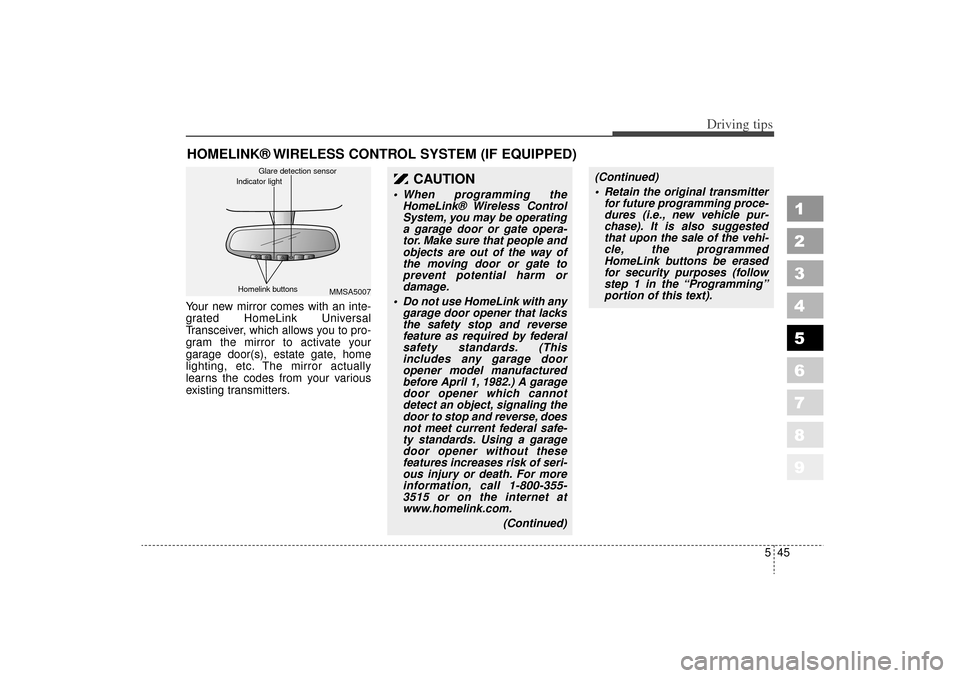
HOMELINK® WIRELESS CONTROL SYSTEM (IF EQUIPPED)Your new mirror comes with an inte-
grated HomeLink Universal
Transceiver, which allows you to pro-
gram the mirror to activate your
garage door(s), estate gate, home
lighting, etc. The mirror actually
learns the codes from your various
existing transmitters.
CAUTION
When programming theHomeLink® Wireless Control
System, you may be operating
a garage door or gate opera-
tor. Make sure that people and
objects are out of the way of
the moving door or gate to
prevent potential harm or
damage.
Do not use HomeLink with any garage door opener that lacks
the safety stop and reverse
feature as required by federal
safety standards. (This
includes any garage door
opener model manufactured
before April 1, 1982.) A garage
door opener which cannot
detect an object, signaling the
door to stop and reverse, does
not meet current federal safe-
ty standards. Using a garage
door opener without these
features increases risk of seri-
ous injury or death. For more
information, call 1-800-355-
3515 or on the internet at
www.homelink.com.
(Continued)
(Continued)
Retain the original transmitterfor future programming proce-
dures (i.e., new vehicle pur-
chase). It is also suggested
that upon the sale of the vehi-
cle, the programmed
HomeLink buttons be erased
for security purposes (follow
step 1 in the “Programming”
portion of this text).
MMSA5007
Homelink buttons Glare detection sensor
Indicator light
KM CAN (ENG) 5 new.qxd 7/29/05 9:39 AM Page 45
Page 276 of 354
In case of an emergency12
6
1
2
3
4
5
6
7
8
9
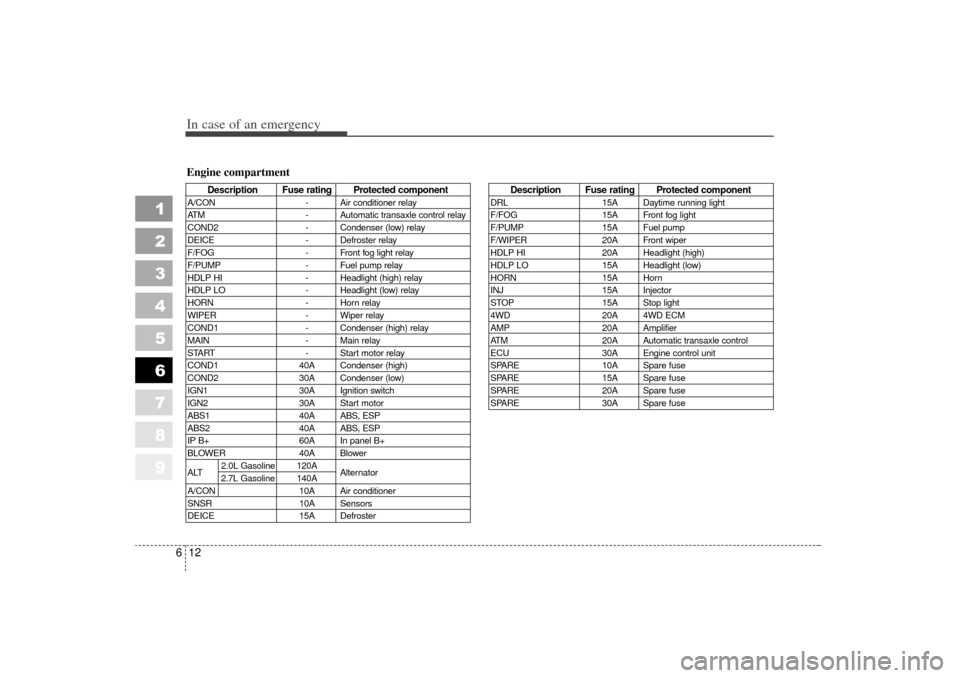
Engine compartment
Description Fuse rating Protected component
A/CON - Air conditioner relay
ATM - Automatic transaxle control relay
COND2 - Condenser (low) relay
DEICE - Defroster relay
F/FOG - Front fog light relay
F/PUMP - Fuel pump relay
HDLP HI - Headlight (high) relay
HDLP LO - Headlight (low) relay
HORN - Horn relay
WIPER - Wiper relay
COND1 - Condenser (high) relay
MAIN - Main relay
START - Start motor relay
COND1 40A Condenser (high)
COND2 30A Condenser (low)
IGN1 30A Ignition switch
IGN2 30A Start motor
ABS1 40A ABS, ESP
ABS2 40A ABS, ESP
IP B+ 60A In panel B+
BLOWER 40A Blower
ALT 2.0L Gasoline 120A
Alternator
2.7L Gasoline 140A
A/CON 10A Air conditioner
SNSR 10A Sensors
DEICE 15A Defroster
Description Fuse rating Protected component
DRL15A Daytime running light
F/FOG 15A Front fog light
F/PUMP 15A Fuel pump
F/WIPER 20A Front wiper
HDLP HI 20A Headlight (high)
HDLP LO 15A Headlight (low)
HORN 15A Horn
INJ 15A Injector
STOP 15A Stop light
4WD 20A 4WD ECM
AMP 20A Amplifier
ATM 20A Automatic transaxle control
ECU 30A Engine control unit
SPARE 10A Spare fuse
SPARE 15A Spare fuse
SPARE 20A Spare fuse
SPARE 30A Spare fuse
KM CAN (ENG) 6 new.qxd 7/29/05 9:40 AM Page 12