Page 312 of 354
723
Maintenance
1
2
3
4
5
6
7
8
9
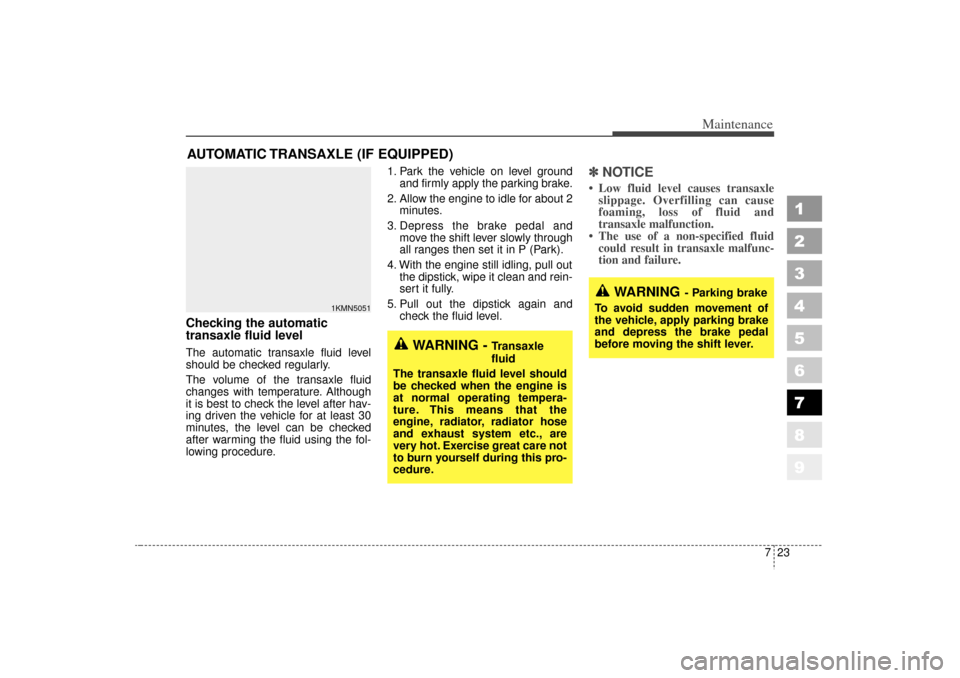
AUTOMATIC TRANSAXLE (IF EQUIPPED)Checking the automatic
transaxle fluid level The automatic transaxle fluid level
should be checked regularly.
The volume of the transaxle fluid
changes with temperature. Although
it is best to check the level after hav-
ing driven the vehicle for at least 30
minutes, the level can be checked
after warming the fluid using the fol-
lowing procedure.1. Park the vehicle on level ground
and firmly apply the parking brake.
2. Allow the engine to idle for about 2 minutes.
3. Depress the brake pedal and move the shift lever slowly through
all ranges then set it in P (Park).
4. With the engine still idling, pull out the dipstick, wipe it clean and rein-
sert it fully.
5. Pull out the dipstick again and check the fluid level.
✽ ✽NOTICE Low fluid level causes transaxle
slippage. Overfilling can cause
foaming, loss of fluid and
transaxle malfunction.
The use of a non-specified fluid could result in transaxle malfunc-
tion and failure.
1KMN5051
WARNING -
Transaxle
fluid
The transaxle fluid level should
be checked when the engine is
at normal operating tempera-
ture. This means that the
engine, radiator, radiator hose
and exhaust system etc., are
very hot. Exercise great care not
to burn yourself during this pro-
cedure.
WARNING
- Parking brake
To avoid sudden movement of
the vehicle, apply parking brake
and depress the brake pedal
before moving the shift lever.
KM CAN (ENG) 7.qxd 7/29/05 9:41 AM Page 23
Page 315 of 354
Maintenance26
7
1
2
3
4
5
6
7
8
9
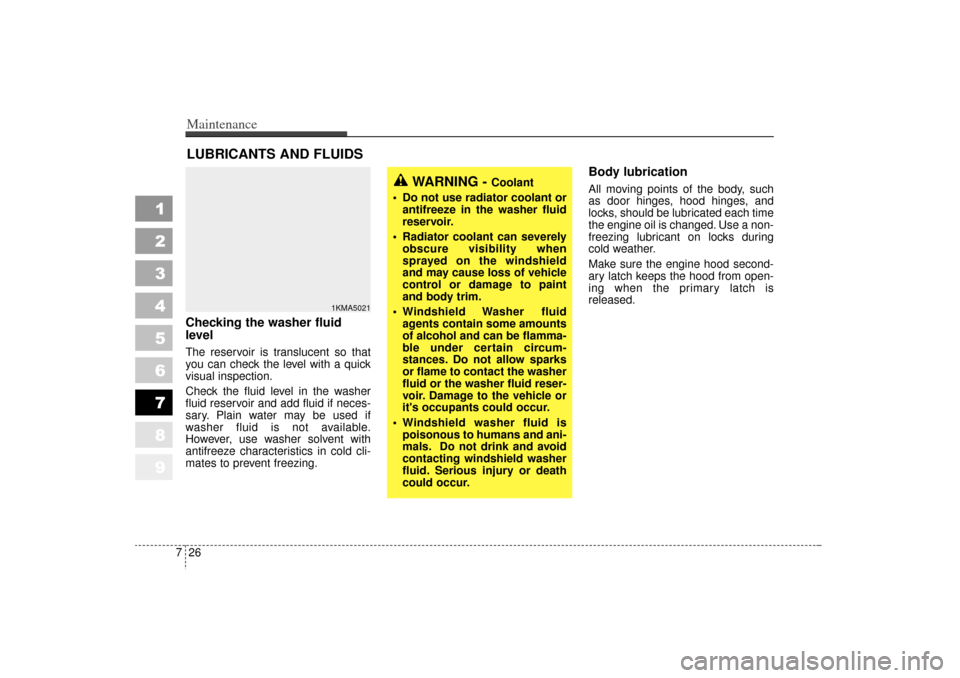
LUBRICANTS AND FLUIDS Checking the washer fluid
level The reservoir is translucent so that
you can check the level with a quick
visual inspection.
Check the fluid level in the washer
fluid reservoir and add fluid if neces-
sary. Plain water may be used if
washer fluid is not available.
However, use washer solvent with
antifreeze characteristics in cold cli-
mates to prevent freezing.
Body lubrication All moving points of the body, such
as door hinges, hood hinges, and
locks, should be lubricated each time
the engine oil is changed. Use a non-
freezing lubricant on locks during
cold weather.
Make sure the engine hood second-
ary latch keeps the hood from open-
ing when the primary latch is
released.
1KMA5021
WARNING -
Coolant
Do not use radiator coolant or antifreeze in the washer fluid
reservoir.
Radiator coolant can severely obscure visibility when
sprayed on the windshield
and may cause loss of vehicle
control or damage to paint
and body trim.
Windshield Washer fluid agents contain some amounts
of alcohol and can be flamma-
ble under certain circum-
stances. Do not allow sparks
or flame to contact the washer
fluid or the washer fluid reser-
voir. Damage to the vehicle or
it's occupants could occur.
Windshield washer fluid is poisonous to humans and ani-
mals. Do not drink and avoid
contacting windshield washer
fluid. Serious injury or death
could occur.
KM CAN (ENG) 7.qxd 7/29/05 9:41 AM Page 26
Page 349 of 354
85
1
2
3
4
5
6
7
8
9
Specifications
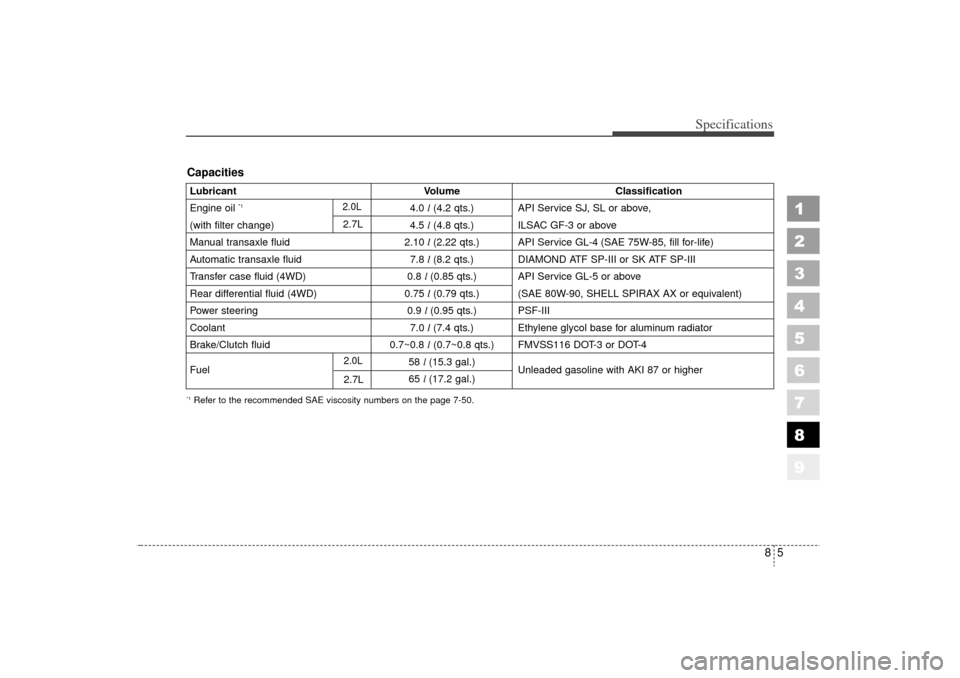
*1Refer to the recommended SAE viscosity numbers on the page 7-50.LubricantVolume Classification
Engine oil
*1
4.0 l(4.2 qts.) API Service SJ, SL or above,
(with filter change) 4.5 l(4.8 qts.) ILSAC GF-3 or above
Manual transaxle fluid 2.10 l (2.22 qts.) API Service GL-4 (SAE 75W-85, fill for-life)
Automatic transaxle fluid 7.8 l (8.2 qts.) DIAMOND ATF SP-III or SK ATF SP-III
Transfer case fluid (4WD) 0.8 l (0.85 qts.) API Service GL-5 or above
Rear differential fluid (4WD) 0.75 l (0.79 qts.) (SAE 80W-90, SHELL SPIRAX AX or equivalent)
Power steering 0.9 l (0.95 qts.) PSF-III
Coolant 7.0 l (7.4 qts.) Ethylene glycol base for aluminum radiator
Brake/Clutch fluid 0.7~0.8 l(0.7~0.8 qts.) FMVSS116 DOT-3 or DOT-4
Fuel 58
l (15.3 gal.)
Unleaded gasoline with AKI 87 or higher
65 l (17.2 gal.)
2.0L2.7L2.0L2.7L
Capacities
KM CAN (ENG) 8.qxd 7/29/05 9:43 AM Page 5