Page 65 of 312

If the curtain airbag deploys, it
remains inflated for approximately
3 seconds. The curtain airbag
deployment occurs only on the side
of the vehicle affected by the
impact.
The curtain airbags are not
designed to deploy during colli-
sions from the front or rear of the
vehicle or in most rollover situa-
tions.
The curtain airbags are designed to
deploy only during certain side-
impact collisions, depending on the
crash severity, angle, speed and
impact. The curtain airbags are not
designed to deploy in all side
impact situations.KNOWING YOUR VEHICLE3-56
WARNING
In order for the curtain airbags
to provide its best protection,
both front seat occupants and
both outboard rear occupants
should sit in an upright posi-
tion with the safety belts prop-
erly fastened. Especially, chil-
dren should sit in a proper
child restraint system.
When children are seated in
the rear outboard seats, they
must be seated in the proper
child restraint system. Make
sure to put the child restraint
system as far away from the
door side as possible, and
secure the child restraint sys-
tem to be locked in position.
(Continued)
(Continued)
Do not allow the passengers
to lean their heads or bodies
onto doors, put their arms on
the doors, stretch their arms
out of the window, or place
objects between the doors and
passengers when they are
seated on the seats where cur-
tain airbags are equipped.
Never try to open or repair any
components of the curtain
airbag system. This should be
done only by an authorized
Kia dealer.
Failure to follow the above men-
tioned instructions can result in
injury or death to the vehicle
occupants in an accident.
BL-ENG (CAN)-3.qxd 7/28/05 5:52 PM Page 56
Page 68 of 312
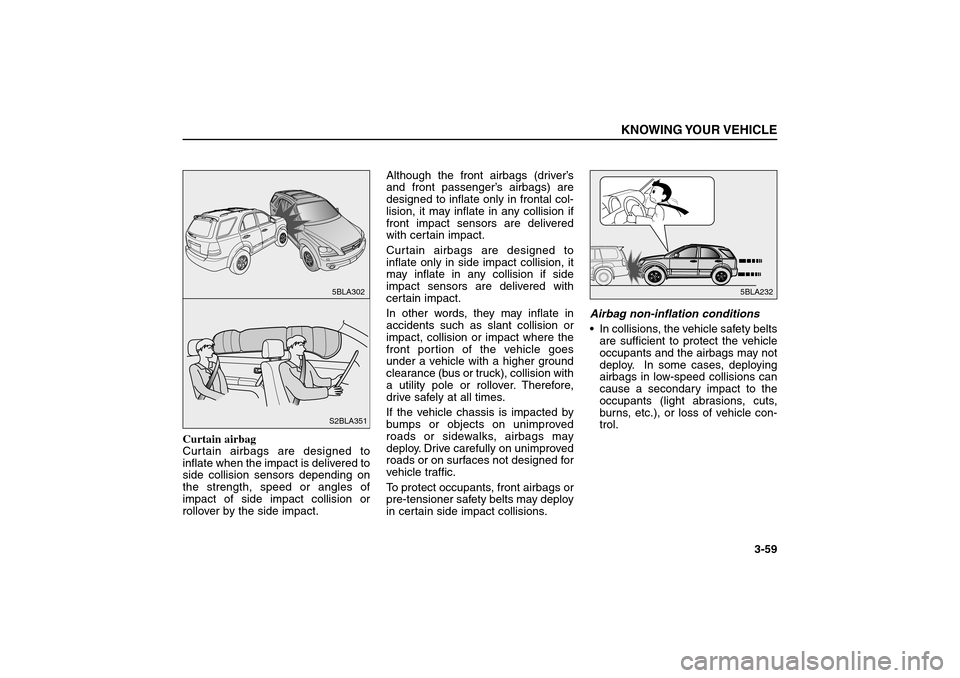
Curtain airbag
Curtain airbags are designed to
inflate when the impact is delivered to
side collision sensors depending on
the strength, speed or angles of
impact of side impact collision or
rollover by the side impact.Although the front airbags (driver’s
and front passenger’s airbags) are
designed to inflate only in frontal col-
lision, it may inflate in any collision if
front impact sensors are delivered
with certain impact.
Curtain airbags are designed to
inflate only in side impact collision, it
may inflate in any collision if side
impact sensors are delivered with
certain impact.
In other words, they may inflate in
accidents such as slant collision or
impact, collision or impact where the
front portion of the vehicle goes
under a vehicle with a higher ground
clearance (bus or truck), collision with
a utility pole or rollover. Therefore,
drive safely at all times.
If the vehicle chassis is impacted by
bumps or objects on unimproved
roads or sidewalks, airbags may
deploy. Drive carefully on unimproved
roads or on surfaces not designed for
vehicle traffic.
To protect occupants, front airbags or
pre-tensioner safety belts may deploy
in certain side impact collisions.Airbag non-inflation conditions
In collisions, the vehicle safety belts
are sufficient to protect the vehicle
occupants and the airbags may not
deploy. In some cases, deploying
airbags in low-speed collisions can
cause a secondary impact to the
occupants (light abrasions, cuts,
burns, etc.), or loss of vehicle con-
trol.
KNOWING YOUR VEHICLE
3-59
5BLA232
5BLA302S2BLA351
BL-ENG (CAN)-3.qxd 7/28/05 5:52 PM Page 59
Page 72 of 312

Noise and smoke
When the airbags inflate, they make
a loud noise and they leave smoke
and powder in the air inside of the
vehicle. This is normal and is a result
of the ignition of the airbag inflator.
After the airbag inflates, you may feel
substantial discomfort in breathing
due to the contact of your chest to
both the safety belt and the airbag, as
well as from breathing the smoke and
powder.We strongly urge you to
open your doors and/or windows
as soon as possible after impact in
order to reduce discomfort and
prevent prolonged exposure to the
smoke and powder.
Though smoke and powder are non-
toxic, it may cause irritation to the
skin (eyes, nose and throat etc). If
this is the case, wash and rinse with
the cold water immediately and con-
sult the doctor if the symptom per-
sists.Installing a child restraint on a
front passenger seat is forbidden.
Never place a rear-facing child
restraint in the front passenger seat.
If the airbag deploys, it would impact
the rear-facing child restraint, caus-
ing serious or fatal injury.
In addition, do not place front-facing
child restraint in the front passenger
seat either. If the front passenger
airbag inflates, it would cause serious
or fatal injuries to the improperly posi-
tioned or improperly restrained child.
KNOWING YOUR VEHICLE
3-63
WARNING
When the airbags deploy, the
airbag related parts in steering
wheel and/or instrument panel
and/or in both sides of the roof
rails above the front and rear
doors are very hot. To prevent
injury, do not touch the airbag
storage areas internal compo-
nents immediately after an
airbag has inflated.
ADAIRBAG
BL-ENG (CAN)-3.qxd 7/28/05 5:52 PM Page 63
Page 119 of 312

Always hold the steering wheel
firmly when you are driving off-
road.
Make sure all passengers are
wearing seat belts.
Do not drive in water if the level is
higher than the bottom of the vehi-
cle.
Check your brake condition once
you are out of mud or water. Press
the brake pedal several times as
you move slowly until you feel nor-
mal braking forces return.
Shorten your scheduled mainte-
nance interval if you drive in off-road
conditions such as sand, mud or
water (see “Scheduled Maintenance”
in the Index). Always wash you car
thoroughly.
DRIVING YOUR VEHICLE
4-21
WARNING
Reduce speed when you turn
corners. The center of gravity of
4WD vehicles is higher than
that of conventional 2WD vehi-
cles, making them more likely to
roll over when you turn corners
too fast.
CAUTION
If you are driving in heavy wind,
the vehicle's higher center of
gravity decreases your steering
control capacity and requires
you to drive more slowly.
WARNING
If you are driving too fast in
water, the water spray can get
into the engine compartment
and wet the ignition system,
causing your vehicle a sudden
stop. If this happens and your
vehicle is in a tilted position,
your vehicle may roll over.
BL-ENG (CAN)-4.qxd 7/28/05 5:55 PM Page 21
Page 125 of 312

You must learn how to corner in a
4WD vehicle as soon as possible.
Do not rely on your experience in
conventional 2WD vehicles in
choosing a safe cornering speed.
You must drive more slowly.
Drive off-road carefully because
your vehicle may be damaged by
rocks or roots of trees. Become
familiar with the off-road conditions
you are going to drive before you
start.
Always hold the steering wheel
firmly when you are driving off-
road.
Make sure all passengers are
wearing seat belts.If you need to drive in water, stop
your vehicle, set your transfer lever
to “4LO’’or “LOW”and drive at less
than 5 mph (8 km/h).
DRIVING YOUR VEHICLE
4-27
WARNING
- Turning
Corners
Reduce speed when you turn
corners. The center of gravity of
4WD vehicles is raised higher
than that of conventional 2WD
vehicles, making them more
likely to roll over when you turn
corners too fast.
WARNING
Do not grab inside of the steer-
ing wheel when you are driving
off-road. Your arm may be hurt
by a sudden steering maneuver
or from steering wheel rebound
due to impact with objects on
the ground. You could lose con-
trol of the steering wheel.
WARNING
If you are driving in heavy wind,
the vehicle’s higher center of
gravity decreases your steering
control. Drive more slowly than
you would in calm conditions.
SRSAIRBAG
R
E
S
A
C
C
E
LC
O
A
S
T
S
E
T
PWRSEEK
CANCEL
S2BLC499
BL-ENG (CAN)-4.qxd 7/28/05 5:55 PM Page 27
Page 127 of 312
DRIVING YOUR VEHICLE
4-29
WARNING
Avoid high cornering speed.
Do not make quick steering
wheel movements, such as
sharp lane changes or fast,
sharp turns.
The risk of rollover is greatly
increased if you lose control
of your vehicle at high
speeds.
In a collision crash, an unbelt-
ed person is significantly
more likely to die compared to
a person wearing a seat belt.
Loss of control often occurs if
two or more wheels drop off
the roadway and the driver
over steers to re-enter the
roadway.
In the event your vehicle
leaves the roadway, do not
steer sharply.
Instead, slow down before
pulling back into the travel
lanes.
BL-ENG (CAN)-4.qxd 7/28/05 5:55 PM Page 29
Page 135 of 312

POWER STEERINGPower steering uses energy from the
engine to assist you in steering the
vehicle. If the engine is off or if the
power steering system becomes
inoperative, the vehicle may still be
steered, but it will require increased
steering effort.
Should you notice any change in the
effort required to steer during normal
vehicle operation, have the power
steering system checked by an
authorized Kia dealer.
DRIVING YOUR VEHICLE
4-37
✽ ✽
NOTICEIf the vehicle is parked for extended
periods outside in cold weather
(below-10°C (14°F)), the power
steering may require increased
effort when the engine is first start-
ed. This is caused by increased fluid
viscosity due to the cold weather
and does not indicate a malfunc-
tion.
When this happens, increase the
engine RPM to 1500rpm then
release or let the engine idle for two
or three minutes to warm up the
fluid.
✽ ✽
NOTICE Never hold the steering wheel
against a stop (extreme right or
left turn) for more than five sec-
onds with the engine running.
Holding the steering wheel for
more than five seconds in either
position may cause damage to the
power steering pump.
If the power steering drive belt
breaks or if the power steering
pump malfunctions, the steering
effort will greatly increase.
BL-ENG (CAN)-4.qxd 7/28/05 5:55 PM Page 37
Page 144 of 312

Charging System Warning
This warning light indicates a mal-
function of either the generator or
electrical charging system.
If the warning light comes on while
the vehicle is in motion:
1. Drive to the nearest safe location.
2. With the engine off, check the gen-
erator drive belt for looseness or
breakage.
3. If the belt is adjusted properly, a
problem exists somewhere in the
electrical charging system. Have
an Authorized Kia Dealer correct
the problem as soon as possible.Safety Belt Warning
Type A
As a reminder to the driver and pas-
senger, safety belt warning light will
illuminate for approximately 6 sec-
onds each time you turn the ignition
switch ON regardless of belt fasten-
ing.
Type B
As a reminder to the driver and pas-
senger, safety belt warning light will
blink for approximately 6 seconds
each time you turn the ignition switch
ON regardless of belt fastening.
If the driver's safety belt is unfastened
after the ignition switch is ON, the
safety belt warning light will blink for
approximately 6 seconds.Shift Pattern
Indicators
(A/T: 30-40LEi)
The individual indicators illuminate to
show the shift lever selection.
Shift Pattern
Indicators
(A/T: A5SR1)
The individual indicators illuminate to
show the shift lever selection.DRIVING YOUR VEHICLE4-46
P
R
N
D2
L
P
R
N
D
BL-ENG (CAN)-4.qxd 7/28/05 5:55 PM Page 46