Page 228 of 312

Parking on hills
Generally, you should not park your
vehicle, with a trailer attached, on a
hill. People can be seriously or fatally
injured, and both your vehicle and the
trailer can be damaged if they begin a
downhill trajectory.However, if you ever have to park
your trailer on a hill, here’s how to do
it:
1. Apply your brakes, but don’t shift
into gear.
2. Have someone place chocks
under the trailer wheels.
3. When the wheel chocks are in
place, release the brakes until the
chocks absorb the load.
4. Reapply the brakes. Apply your
parking brake, and then shift to R
(Reverse) for a manual transmis-
sion or P (Park) for an automatic
transmission.
5. Be sure the transfer case (if
equipped) is fully engaged in a
drive gear – not in N (Neutral).
6. Release the brakes.
DRIVING TIPS
5-41
WARNING- Parking on a Hill
Parking your vehicle on a hill
with an attached trailer could
cause serious injury or fatal
injury. If the brakes fail, the
vehicle and trailer could roll
down hill and strike people or
property.
WARNING- Parking Brake
Not setting the parking brake
when leaving the vehicle could
lead to a serious accident.
If you have left the engine run-
ning, the vehicle can move sud-
denly. Always set the parking
brake and take the key with you
to be sure your vehicle is
securely parked.
BL-ENG (CAN)-5.qxd 7/28/05 5:56 PM Page 41
Page 241 of 312
If the 120A “MAIN”fuse is blown, it
must be removed as follows:
1. Disconnect the negative battery
cable.
2. Remove the bolts in the photo
above.
3. Replace the fuse with a new one of
the same 120A rating.
4. Reinstall in the reverse order of
removal.
IN CASE OF AN EMERGENCY
6-9
3500DOHC24V
S2BLC701Fuse Box
S2BLA606A
✽ ✽
NOTICEAfter checking the fuse box in the
engine compartment, securely
install the fuse box cover. If not,
electrical failures may occur from
water leaking in.
BL-ENG (CAN)-6.qxd 7/28/05 5:57 PM Page 9
Page 243 of 312

Engine compartment
IN CASE OF AN EMERGENCY
6-11
( )MAIN 120A
HORN20A15A 15A 25A
15A10A 15A 10A 10A 25A 25A
15A 15A 15A 15A 10A
AUDIO
HEAD(HI)
HEAD(LO)
INJECTOR
DEF25A 20A 15A 10ASPARE
SPARE
SPARE
SPARE
MEMORY15A(F/FOG)
ILLUMIP/TRN
P/W(LH)O
2(DN)
O2(UP)
P/W(RH) ECU (EXT)
FUEL
FUSE
PULLER
START
RELAY
MAIN
RELAY
F/BLW
RELAY
P/WIN
RELAY
C/FAN (L)
RELAY A/CON
RELAY
USE THE DESIGNATED FUSES ONLY.
*( ) FOR OPTION.
K52Y
C/F (H)
RELAYC/FAN (2)
RELAY
FUEL
RELAYHORN
RELAY HEAD(LO)
RELAY HEAD(HI)
RELAYTNS
RELAYDEF
RELAY
F/FOG
RELAY
IGN 2
30ABTN 3
40A
ABS
40A
C /FAN (1)
40AF/BLW
30A
C/FAN (2)
30ABTN 1
40A
IGN 1
40ABTN 2
30A( )
( )
HORN 15 A Horm
P/TRN 10 A PCM, Main relay
INJECTOR 15 A PCM
AUDIO 20 A Audio
HEAD (HI) 15 A Head Light
ILLUMI 10 A Key hole illumination
O2(DN) 15 A PCM
HEAD (LO) 15 A Head light
EXT 15 A
DRL, License lamp, Tail lamp, Position lamp, Turn lamp
P/W (LH) 25 A Power window
O2(UP) 15 A PCM
DEF 25 A Defroster
FUEL 15 A Fuel pump relay
P/W (RH) 25 A Power window
ECU 10 A PCM, Cooling
MEMORY 10 A Front heater & aircon, Etwis, Keyless entry system
F/FOG 15 A Front fog lamp
IGN 2 30 A Ignition switch
BTN 3 40 A Turn & Hazard flasher unit, Power door lock
ABS 1 40 A ABS
C/FAN (1) 40 A Cooling system
F/BLW 30 A Front heater & Aircon
C/FAN (2) 30 A Cooling system
BTN 1 40 A Cigar lighter, Power socket
IGN 1 40 A Ignition switch
BTN 2 30 A Power seat, PCM
BL-ENG (CAN)-6.qxd 7/28/05 5:57 PM Page 11
Page 247 of 312
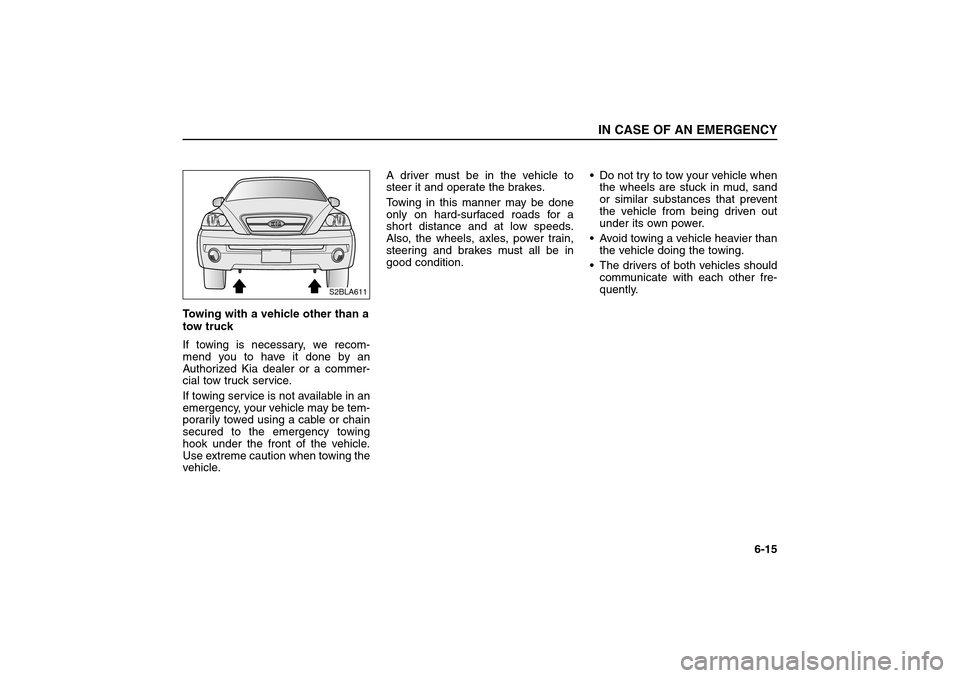
Towing with a vehicle other than a
tow truck
If towing is necessary, we recom-
mend you to have it done by an
Authorized Kia dealer or a commer-
cial tow truck service.
If towing service is not available in an
emergency, your vehicle may be tem-
porarily towed using a cable or chain
secured to the emergency towing
hook under the front of the vehicle.
Use extreme caution when towing the
vehicle.A driver must be in the vehicle to
steer it and operate the brakes.
Towing in this manner may be done
only on hard-surfaced roads for a
short distance and at low speeds.
Also, the wheels, axles, power train,
steering and brakes must all be in
good condition.Do not try to tow your vehicle when
the wheels are stuck in mud, sand
or similar substances that prevent
the vehicle from being driven out
under its own power.
Avoid towing a vehicle heavier than
the vehicle doing the towing.
The drivers of both vehicles should
communicate with each other fre-
quently.
IN CASE OF AN EMERGENCY
6-15
S2BLA611
BL-ENG (CAN)-6.qxd 7/28/05 5:57 PM Page 15
Page 248 of 312
Before emergency towing, check
that the hook is not broken or dam-
aged.
Fasten the towing cable or chain
securely to the hook.
Do not jerk the hook. Apply steady
and even force.
To avoid damaging the hook, do not
pull from the side or at a vertical
angle. Always pull straight ahead.
IN CASE OF AN EMERGENCY6-16
✽ ✽
NOTICE Attach a towing strap to the tow
hook.
Using a portion of the vehicle
other than the tow hooks for tow-
ing may damage the body of your
vehicle.
Use only a cable or chain specifi-
cally intended for use in towing
vehicles. Securely fasten the cable
or chain to the towing hook pro-
vided.
CAUTION
Use extreme caution when tow-
ing the vehicle.
Avoid sudden starts or erratic
driving maneuvers which
would place excessive stress
on the emergency towing
hook and towing cable or
chain. The hook and towing
cable or chain may break and
cause serious injury or dam-
age.
If the towing vehicle can hard-
ly move, do not forcibly con-
tinue the towing. Contact an
Authorized Kia dealer or a
commercial tow truck service
for assistance.
Tow the vehicle as straight
ahead as possible.
Keep away from the vehicle
during towing.
BL-ENG (CAN)-6.qxd 7/28/05 5:57 PM Page 16
Page 253 of 312

Tire replacement
1. Park on a level surface and apply
the parking brake firmly.
2. Shift into R (Reverse) with manual
transmission or P (Park) with auto-
matic transmission.
3. Activate the hazard warning flash-
er.IN CASE OF AN EMERGENCY
6-21
S2BLA618
WARNING- Changing Tires
Never attempt vehicle repairs
in the traffic lanes of a public
road or highway.
Always move the vehicle com-
pletely off the road and onto
the shoulder before trying to
change a tire. If you cannot
find a firm, level place off the
road, call a towing service
company for assistance.
Be sure to use the correct
front and rear jacking posi-
tions on the vehicle; never
use the bumpers or any other
part of the vehicle for jack
support.
(Continued)
(Continued)
The vehicle can easily roll off
the jack causing serious
injury or death. Never allow
any portion of your body to
get beneath the vehicle while
using the jack.
Do not start or run the engine
while the vehicle is on the
jack.
Do not allow anyone to remain
in the vehicle while it is on the
jack.
Make sure any children pres-
ent are in a secure place away
from the road and from the
vehicle to be raised with the
jack.
BL-ENG (CAN)-6.qxd 7/28/05 5:57 PM Page 21
Page 255 of 312
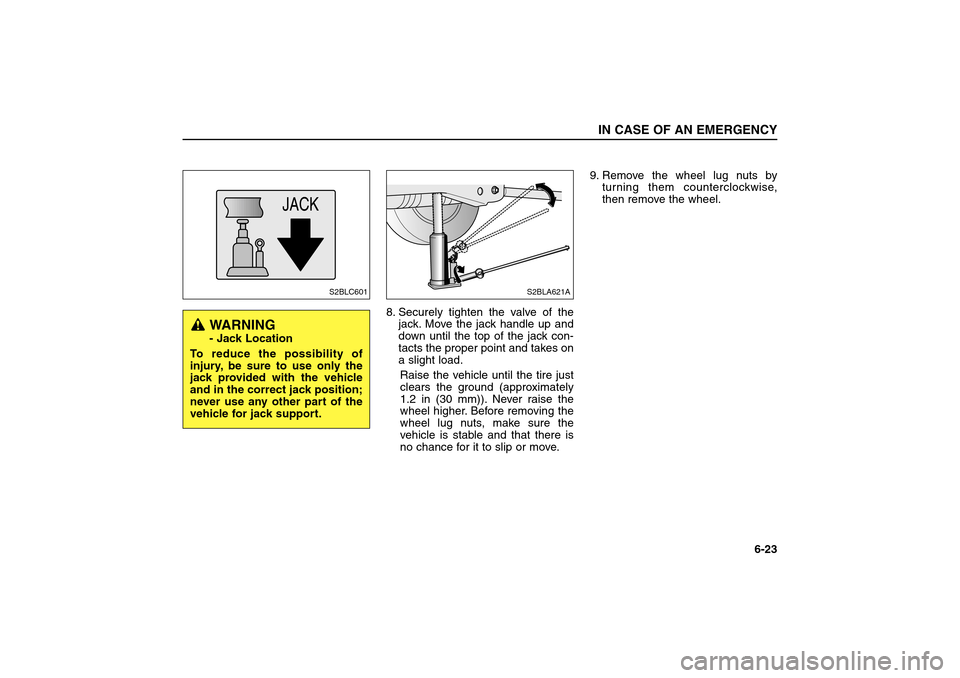
8. Securely tighten the valve of the
jack. Move the jack handle up and
down until the top of the jack con-
tacts the proper point and takes on
a slight load.
Raise the vehicle until the tire just
clears the ground (approximately
1.2 in (30 mm)). Never raise the
wheel higher. Before removing the
wheel lug nuts, make sure the
vehicle is stable and that there is
no chance for it to slip or move.9. Remove the wheel lug nuts by
turning them counterclockwise,
then remove the wheel.
IN CASE OF AN EMERGENCY
6-23
JACK
S2BLC601
S2BLA621A
WARNING - Jack Location
To reduce the possibility of
injury, be sure to use only the
jack provided with the vehicle
and in the correct jack position;
never use any other part of the
vehicle for jack support.
BL-ENG (CAN)-6.qxd 7/28/05 5:57 PM Page 23
Page 256 of 312
10. Mount the spare tire into position
and install the wheel lug nuts with
the beveled edge inward.11. Gradually loosen the valve of the
jack with the groove on the jack
handle to lower the vehicle.12. Once the wheel lug nuts have
been tightened, lower the vehicle
fully to the ground and continue to
tighten the lug nuts until they are
fully secured. Tighten the wheel
lug nuts firmly in a “star”pattern.
If you are unsure of the tightness
of the wheel lug nuts, have them
checked at the nearest service
station. The specified tightening
torque is 65-87 ftIb (9~12 kgm,
88-118 Nm).IN CASE OF AN EMERGENCY6-24
S2BLA622
S2BLA621B
1
34
25
S2BLA623
BL-ENG (CAN)-6.qxd 7/28/05 5:57 PM Page 24