Page 62 of 347
353
Features of your vehicle
Stowing the rear seat (3rd row)The rear seat can be folded and stowed
in the luggage compartment to provide
additional cargo space.
To stow the rear seat:
1. Lower the headrest to the lowest posi-tion. 2. Fold the seatback by pulling out the
folding strap. 3. Stow the seat by pulling out the stow-
ing strap and pushing down firmly.
WARNING
Make sure there is no body orobject around the seat and be
careful not to injure your hands or
body under the seat or in the mov-
ing parts when stowing or rein-
stalling the seat.
Do not sit on the seat stowed with the seatback upright in the lug-
gage compartment. Sitting on the
unstable and unlocked seat could
cause serious injuries in an acci-
dent.
OVQ036218N
OVQ036219N
OVQ036220N
Page 63 of 347
Features of your vehicle54
3To use the rear seat:
1. Lift the seat by pulling out the stowing
strap and release the strap. 2. Push the seat forward firmly until it
clicks into place to insert the catches
into the anchors. 3. Make sure the catches are locked in
position by moving the seat forward
and backward or lifting the front por-
tion of the seat. If the seat moves, it is
not locked properly.
4. Push the seatbacks to an upright and locked position.
OVQ036221N
OVQ036222N
OVQ036223N
Page 66 of 347
357
Features of your vehicle
Storing and recalling with trans-
mitterStoring with the transmitterRemove the key from the ignition switch
and lock all the doors using the transmit-
ter. The driver seat, outside rearview mir-
ror and adjustable pedal positions will be
stored in the system memory.Driver’s position recalling with trans-mitterUnlock the door with the transmitter,
positions stored in the system memory
will be recalled automatically.
Easy access functionWhen the AUTO button is ON (the indi-
cator light illuminates) with the shift lever
in P position, the system will move the
driver’s seat forward or rearward auto-
matically so you can comfortably enter
and exit the vehicle.
It will move driver’s seat rearward when the ignition key is removed.
It will move driver’s seat forward when the ignition key is inserted. To adjust the position of the accelerator
and brake pedals, push the switch with
the shift lever in the P position.
If you push the �
portion of the switch,
the pedals move toward the driver.
If you push the � portion of the switch,
the pedals move away from the driver.
POWER ADJUSTABLE
PEDALS (IF EQUIPPED)
1VQA2066
1VQH2065N
Page 67 of 347
Features of your vehicle58
3Setting the adjustable pedal posi-
tion1. Be sure the parking brake is engaged.
2. Move the accelerator and brake ped-
als to the front most position by push-
ing the � portion of the switch.
3. Adjust the seat position and the steer- ing wheel angle properly.
4. Move the pedals toward you until you can fully depress the brake pedal by
pushing the � portion of the switch.
5. Depress the pedals a few times to get used to the feel after adjusting.
Safety belt restraint system We strongly recommend that the driver
and all passengers be properly
restrained at all times by using the safety
belts provided with the vehicle. Proper
use of the safety belts decreases the risk
of severe injury or death in accidents or
sudden stops. In most states, and in
Canada, the law requires their use. All seats have lap/shoulder belts. Inertial
locks in the safety belt retractors allow all
of the lap/shoulder safety belts to remain
unlocked during normal vehicle opera-
tion. This allows the occupants some
freedom of movement and increased
comfort while using the safety belts. If a
force is applied to the vehicle, such as a
strong stop, a sharp turn, or a collision,
the safety belt retractors will automatical-
ly lock the safety belts.
Since the inertial locks do not require a
collision in order to lock up, you may
become aware of the safety belts locking
while braking or going around sharp cor-
ners.
Always use the rear seat position(s) to
install your child restraint(s).
WARNING
- Safety belts
To minimize the risk of serious or
fatal injury in an accident, the driver
and all passengers should use the
appropriate safety restraints for
their age and size. The presence of
air bags does not change the need
to be properly restrained by a safe-
ty belt or size-appropriate child
restraint. In fact, air bags are
designed to work the best when
passengers are correctly restrained
in the vehicle.
Be sure you are familiar with the
information in this section,
including the information on
infant and child restraints.
Read the safety warnings on the sun visors of your vehicle also.
WARNING
- Child restraint
in front seat
Never install a child restraint sys-
tem in the front passenger position,
as an inflating air bag could cause
serious or fatal injury to a child in
that position.
WARNING
Adjust the pedals after parking
the vehicle on level ground. Never
attempt to adjust the pedals while
the vehicle is moving.
Never adjust the pedals with your foot on the accelerator pedal as
this may result in increasing the
engine speed and acceleration.
Make sure that you can fully depress the brake pedal before
driving. Otherwise, you may not
be able to hold down the brake
pedal firmly in an emergency
stop.
SAFETY BELTS
Page 68 of 347
359
Features of your vehicle
WARNING
- Belt use
Safety belts must be used correctly
to work properly in an accident.
Each seating position in your vehi-
cle has a specific safety belt assem-
bly that includes a buckle and
tongue designed to be used togeth-
er.
Failure to heed these warnings and
follow these instructions will
increase the risk and severity of
injuries and the likelihood of death
in an accident.(Continued)
WARNING
- Twisted belts
A twisted or jammed safety belt
cannot restrain you properly. If you
cannot untwist or unjam the safety
belt, have an authorized Kia dealer
service it immediately. Never drive
or ride with a twisted or jammed
safety belt.
The rear (or front passenger) safety belts
use a special auto-lock feature designed
to allow a child restraint to be used in
these positions without an added locking
clip. They normally lock only under
extreme or emergency conditions (emer-
gency lock mode). However they can be
adjusted so that they remain fixed and
locked when a child restraint system is
placed in these positions. (Use this auto-
lock mode only to secure a child
restraint, never for passengers restrained
by the safety belts.)
The drivers safety belt can only operate
in the emergency lock mode.
Safety belts provide the best restraint
when:
The seatback is upright.
The occupant is sitting upright (notslouched).
The lap belt is snug across the hips.
The shoulder belt is snug across the chest.
The knees are straight forward.
WARNING
- After a colli- sion
Lap/shoulder belt assemblies
may be stretched or damaged
when subjected to the stress and
forces of a collision.
The entire restraint system should be inspected following
any collision. All belts, retractors,
anchors and hardware damaged
by a collision should be replaced
before the vehicle is operated
again.
WARNING -
Cargo area
Passengers should never be
allowed to ride in the cargo area of
a vehicle. No safety belts are pro-
vided for the cargo area. Persons
riding in the vehicle without a fas-
tened safety belt are much more
likely to suffer serious bodily injury
or death during an accident.
Page 70 of 347
361
Features of your vehicle
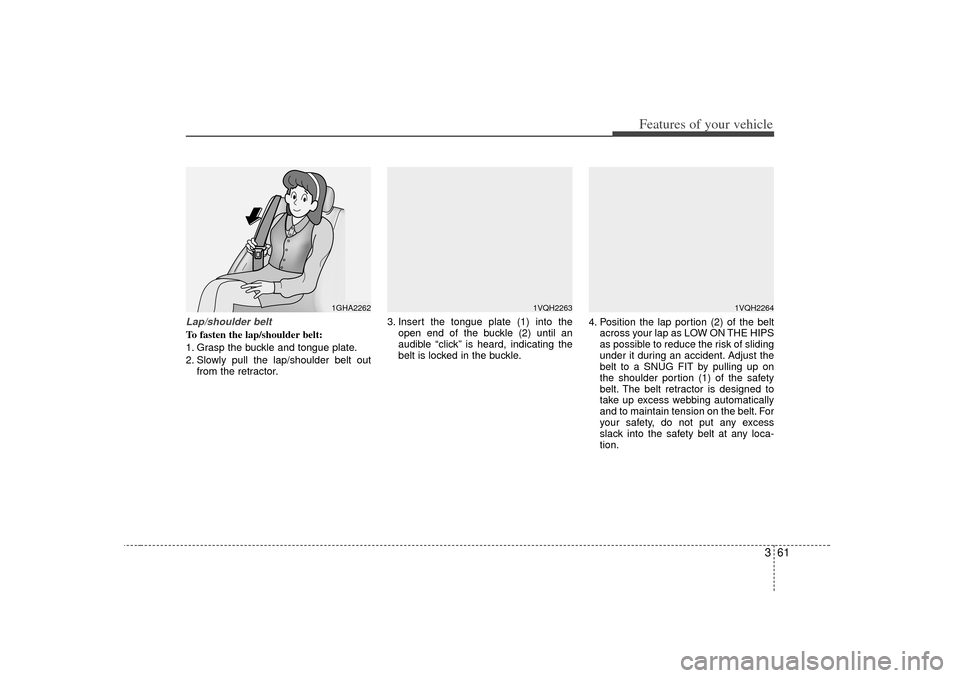
Lap/shoulder beltTo fasten the lap/shoulder belt:
1. Grasp the buckle and tongue plate.
2. Slowly pull the lap/shoulder belt outfrom the retractor. 3. Insert the tongue plate (1) into the
open end of the buckle (2) until an
audible “click” is heard, indicating the
belt is locked in the buckle. 4. Position the lap portion (2) of the belt
across your lap as LOW ON THE HIPS
as possible to reduce the risk of sliding
under it during an accident. Adjust the
belt to a SNUG FIT by pulling up on
the shoulder portion (1) of the safety
belt. The belt retractor is designed to
take up excess webbing automatically
and to maintain tension on the belt. For
your safety, do not put any excess
slack into the safety belt at any loca-
tion.
1GHA2262
1VQH2263
1VQH2264
Page 71 of 347
Features of your vehicle62
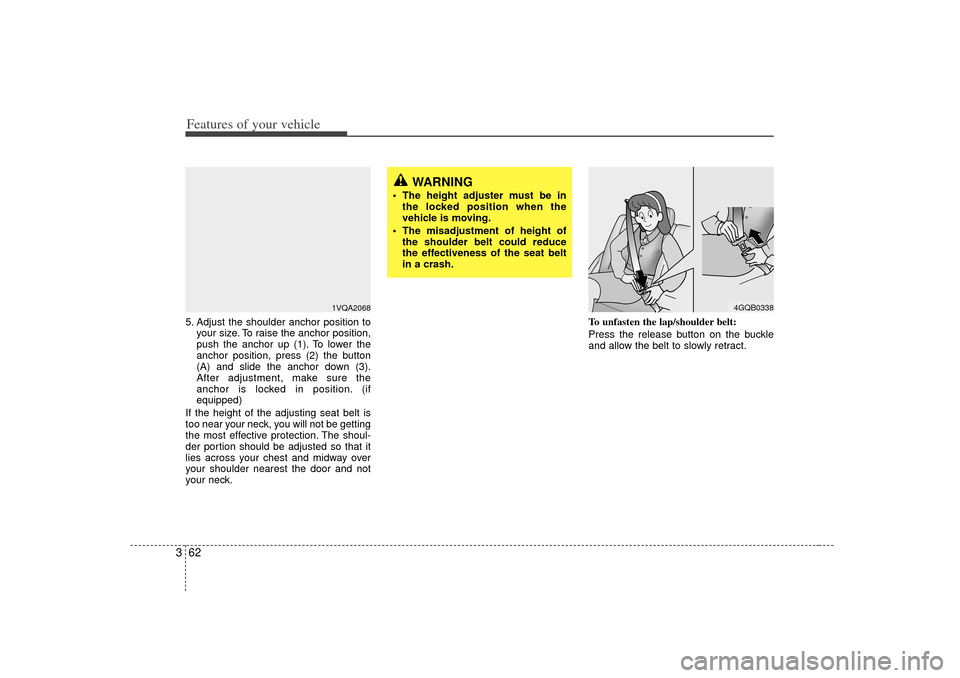
35. Adjust the shoulder anchor position to
your size. To raise the anchor position,
push the anchor up (1). To lower the
anchor position, press (2) the button
(A) and slide the anchor down (3).
After adjustment, make sure the
anchor is locked in position. (if
equipped)
If the height of the adjusting seat belt is
too near your neck, you will not be getting
the most effective protection. The shoul-
der portion should be adjusted so that it
lies across your chest and midway over
your shoulder nearest the door and not
your neck. To unfasten the lap/shoulder belt:
Press the release button on the buckle
and allow the belt to slowly retract.
4GQB0338
1VQA2068
WARNING
The height adjuster must be in
the locked position when the
vehicle is moving.
The misadjustment of height of the shoulder belt could reduce
the effectiveness of the seat belt
in a crash.
Page 72 of 347
363
Features of your vehicle
3 Point rear center belt To fasten the rear center belt
1. Extract the tongue plate from the holeon the belt assembly cover and slowly
pull the tongue plates out from the
retractor. 2. Insert the tongue plate (A) into the
open end of the buckle (C) until an
audible “click" is heard, indicating the
latch is locked. Make sure the belt is
not twisted. 3. Pull the tongue plate (B) and insert the
tongue plate (B) into the open end of
the buckle (D) until an audible “click” is
heard, indicating the latch is locked.
Make sure the belt is not twisted.
1VQH3903
CAUTION
- Cargo
Be sure that the cargo is securelyloaded in the rear cargo area.Failing to do so may damage therear center safety belt in sudden stop or certain collisions.
OVQ036225N
OVQ036097N