Page 61 of 281
351
1 23456789
Knowing your vehicle
3. Route the lap/shoulder beltthrough the restraint according to
the seat manufacturer’s instruc-
tions. 4. Buckle the seat belt and allow the
seat belt to take up any slack. After
installation of the child restraint
system, try to move it in all direc-
tions to be sure the child restraintsystem is securely installed.
If you need to tighten the belt, pull
more webbing toward the retractor.
When you unbuckle the seat belt and
allow it to retract, the retractor will
automatically revert back to its nor-mal seated passenger emergency
locking usage condition. Installing a child restraint system by
lap belt (on the center rear seat) (if
equipped) - Except Europe
To install a child restraint system on
the center rear seats, do the follow-ing:
1. Place the child restraint system on
the center rear seat.
2. Extend the latch plate tongue of the lap belt.
MMSA3030E2BLD310E2BLD347
Page 86 of 281

Knowing your vehicle
76
3
1 23456789
CAUTION
To avoid injury from sharp
objects, it is recommended thatprotective gloves be worn whenopening the fuel filler door man- ually.
Closing the hood
1. Before closing the hood, check the following:
All filler caps in engine compart- ment must be correctly installed.
Gloves, rags or any other com- bustible material must be
removed from the engine com-
partment.
2. Secure the support rod in its clip.
3. Lower the hood to about 30 cm (12 inches) height and then let it
drop to properly lock in place.
Make sure the hood is properly
locked before driving. 1. Stop the engine.
2. To open the fuel filler lid, pull the
release lever. 3. Pull the fuel filler lid out to open.
4. To remove the cap, turn the fuel
tank cap counter-clockwise.
5. Refuel as needed.
6. To install the cap, turn it clockwise until it “clicks”. This indicates that the cap is securely tightened.
7. Close the fuel filler lid and push it lightly and make sure that it issecurely closed.
CAUTION
Before closing the hood, make
sure that all engine parts andtools have been removed fromthe engine area and that noone’s hands are near the hoodopening.
Do not leave gloves, rags or any other combustible materi-al in the engine compartment.Doing so may cause a heat- induced fire.
FUEL FILLER LID
1SAA20181SAA2019
Page 99 of 281
389
1 23456789
Knowing your vehicle
Digital clock (if equipped)
Whenever the battery terminals, A/V
CLOCK fuse, or Power Connect are
disconnected, you must reset the
time.
When the ignition switch is in the
ACC or ON position, the clock but-
tons operate as follows:
HOUR:
Turn the knob to the left (H), will
advance the time displayed by one
hour.
MINUTE: Turn the knob to the right (M), will
advance the time displayed by one
minute.
1SAA2150
Page 103 of 281

Driving your vehicle
2
4
1 23456789
Ignition switch and anti-theft
steering column lock
Ignition switch position
LOCK
The steering wheel locks to protect
against theft. The ignition key can be
removed only in the LOCK position.
When turning the ignition switch to
the LOCK position, push the key
inward at the ACC position and turn
the key toward the LOCK position. ACC (Accessory)
The steering wheel is unlocked and
electrical accessories are operative. ON
The warning lights can be checked
before the engine is started. This is
the normal running position after the
engine is started.
Do not leave the ignition switch ON if
the engine is not running to preventbattery discharge.
START
Turn the ignition key to the START
position to start the engine. The
engine will crank until you release
the key; then it returns to the ON
position. The brake warning lamp
can be checked in this position.
If difficulty is experienced in turning the ignition key to the START posi-tion, turn the steering wheel rightand left to release the tension and then turn the key.
IGNITION SWITCH
1XTA3017
Page 104 of 281

43
1 23456789
Driving your vehicle
(Continued)
• Never reach for the ignitionswitch, or any other controls
through the steering wheel
while the vehicle is in motion.
The presence of your hand orarm in this area could cause a
loss of vehicle control, an
accident and serious bodily
injury or death.
Do not place any movable objects around the driver’s
seat as they may move while
driving, interfere with the driv-er and lead to an accident.WARNING - Ignition key
Never turn the ignition switch to LOCK or ACC while the
vehicle is moving. This wouldresult in loss of directional
control and braking function,
which could cause an immedi-ate accident.
The anti-theft steering column lock is not a substitute for the
parking brake. Before leaving
the driver’s seat, always make
sure the shift lever is engagedin 1 st
gear for manual transaxle
or P (Park) for automatic
transaxle, set the parking
brake fully and shut the
engine off. Unexpected and
sudden vehicle movement
may occur if these precau-tions are not taken.
(Continued)
Page 106 of 281

45
1 23456789
Driving your vehicle
4. If the glow indicator light goes out,turn the ignition switch to START and hold it there until the engine
starts (a maximum of 10 sec-onds), then release the key.
✽✽
NOTICE
If the engine were not started within
2 seconds after the preheating iscompleted, turn the ignition key
once more to the LOCK positionduring 10 seconds, and then to the
ON position, in order to preheatagain.
Starting and stopping the
engine for turbo charger
intercooler (if equipped)
1. Do not race or accelerate the engine immediately after starting.
If the engine is cold, allow the
engine to idle for several seconds
before it is driven to ensure suffi-
cient lubrication of the turbocharger unit.
2. After high speed or extended driv- ing, requiring a heavy engine load,
the engine should be allowed to
idle, as shown in the chart below,
before turning it off.
This idle time will allow the turbocharger to cool prior to shutting
the engine off.
WARNING
Do not turn the engine off imme-
diately after it has been subject-
ed to a heavy load. Doing so
may cause severe damage to
the engine or turbo charger unit.
Driving Condition Required Idle Time
Normal driving Not necessary
High speed Up to 80 km/h About 20 seconds
driving Up to 100 km/h About 1 minuteSteep mountain slopes or
continued driving in excess About 2 minutesof 100 km/h
W-60
Glow indicator light
Page 108 of 281
47
1 23456789
Driving your vehicle
Downshifting
When you must slow down in heavy
traffic or while driving up steep hills,
downshift before the engine starts to“labor ’’. Downshifting reduces the
chance of stalling and gives better
acceleration when you again need to
increase your speed. When the vehi-
cle is traveling down steep hills,
downshifting helps maintain safe
speed and prolongs brake life.
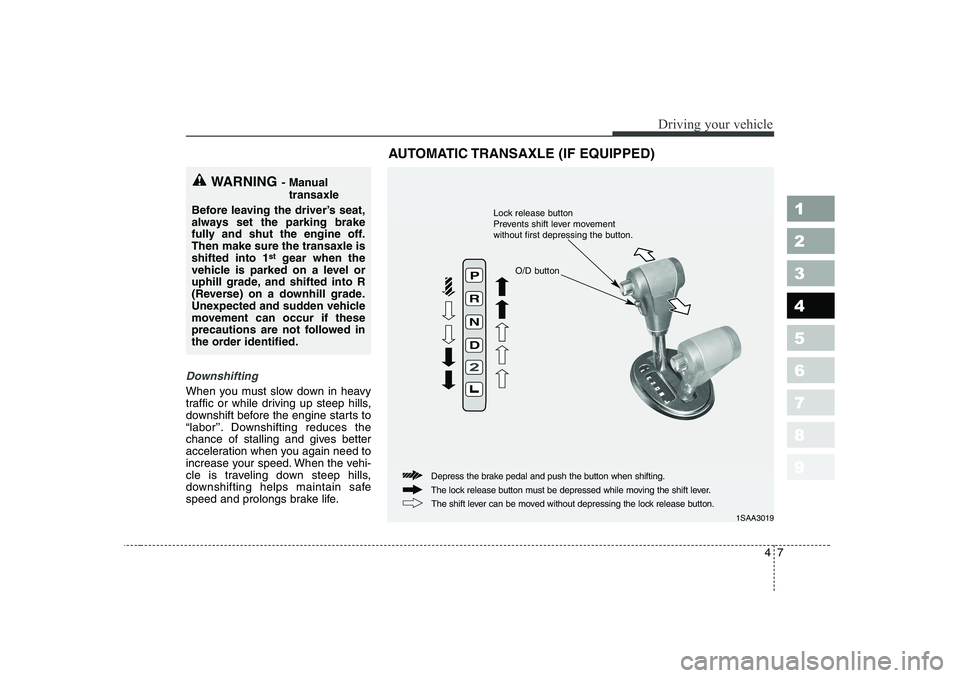
1SAA3019
The lock release button must be depressed while moving the shift lever.
The shift lever can be moved without depressing the lock release button.
Depress the brake pedal and push the button when shifting. Lock release button
Prevents shift lever movement
without first depressing the button.
O/D button
WARNING - Manual
transaxle
Before leaving the driver ’s seat,
always set the parking brake
fully and shut the engine off.Then make sure the transaxle isshifted into 1 st
gear when the
vehicle is parked on a level or
uphill grade, and shifted into R
(Reverse) on a downhill grade.
Unexpected and sudden vehicle
movement can occur if these
precautions are not followed in
the order identified.
AUTOMATIC TRANSAXLE (IF EQUIPPED)
Page 109 of 281
Driving your vehicle
8
4
1 23456789
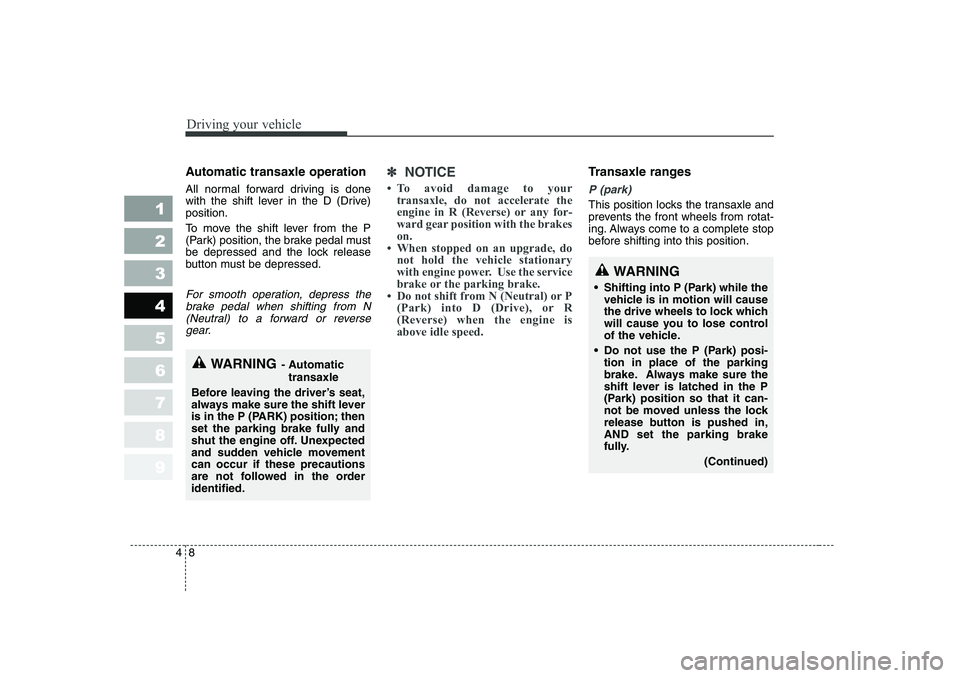
Automatic transaxle operation
All normal forward driving is done
with the shift lever in the D (Drive)position.
To move the shift lever from the P
(Park) position, the brake pedal must
be depressed and the lock release
button must be depressed.
For smooth operation, depress the
brake pedal when shifting from N(Neutral) to a forward or reverse gear.
✽✽
NOTICE