2006 KIA Optima cooling
[x] Cancel search: coolingPage 153 of 225

ROAD WARNINGHAZARD WARNING FLASHERThe hazard warning flasher serves as a
warning to other drivers to exercise
extreme caution when approaching,
overtaking, or passing your vehicle. It
should be used whenever emergency
repairs are being made or when the vehicle
is stopped near the edge of a roadway.Depress the flasher switch with the
ignition switch in any position.
All turn signal lights will flash
simultaneously.
• The hazard warning flasher will
operate whether your vehicle is
running or not.
The turn signals do not operate when
the hazard flasher is on.
Care must be taken when using the
hazard warning flasher while the
vehicle is being towed. Local
regulations may prohibit using it in
this manner.
OVERHEATINGIf your temperature gauge indicates
overheating, if you experience a loss of
power, or if you hear a loud knocking or
pinging noise, the engine has probably
overheated. You should follow these
procedures if you experience any of
these symptoms.
1. Turn the hazard warning flasher on,
then drive to the nearest safe location
and stop your vehicle; set the
automatic transaxle in P (Park), or
shift the manual transaxle to neutral
and apply the parking brake.
2. Make sure the air conditioner is off.
3. If coolant or steam is boiling out of
the radiator, stop the engine, then
turn the ignition switch to the ON
position. Do not restart the engine.
The radiator cooling fan will
automatically operate with the
ignition switch in the ON position. If
the cooling fan does not operate, call
an Authorized Kia Dealer for
IN CASE OF EMERGENCY
6-2
MMSA6001
MS-CNA-Eng 6.QXD 7/25/2005 5:13 PM Page 2
Page 154 of 225

assistance. If coolant is not boiling
out, allow the engine to idle and open
the hood to permit the engine to cool
gradually. If the temperature does not
go down with the engine idling, stop
the engine and allow sufficient time
for it to cool.
4. The coolant level should then be
checked. If the level in the reservoir
is low, look for leaks at the radiator
hoses and connections, heater hoses
and connections, radiator, and water
pump. If you find a major leak or
another problem that may have
caused the engine to overheat, do not
operate the engine until the problem
has been corrected. Call an
Authorized Kia Dealer for assistance.
If you do not find a leak or other
problem, carefully add coolant to the
reservoir.If the engine frequently overheats, have
the cooling system checked and repaired.
EMERGENCY STARTINGJUMP STARTINGJump starting can be dangerous if done
incorrectly. Therefore, to avoid harm to
yourself or damage to your vehicle or
battery, follow the jump starting
procedures on the next page. If in doubt,
we strongly recommend that you have a
competent technician or towing service
jump start your vehicle.
6-3
WARNING - Removing
Radiator Cap
Do not remove the radiator cap
when the engine and radiator
are hot. Scalding hot coolant
and steam may blow out under
pressure. This could cause
serious injury.
✻
NOTICE
Use only a 12volt jumper system.
You can damage a 12volt starting
motor, ignition system, and other
electrical parts by using a 24-volt
power supply (two 12-volt batteries
in series or a 24-volt motor
generator set).
MS-CNA-Eng 6.QXD 7/25/2005 5:13 PM Page 3
Page 177 of 225

MAINTENANCE
7-1
MAINTENANCEMaintenance Services . . . . . . . . . . . . . . . . . . . . . . . . . . .7-2
Maintenance Schedule . . . . . . . . . . . . . . . . . . . . . . . . . .7-3
Owner Maintenance . . . . . . . . . . . . . . . . . . . . . . . . . . . . .7-8
Engine Compartment . . . . . . . . . . . . . . . . . . . . . . . . . .7-10
Engine Oil and Oil Filter . . . . . . . . . . . . . . . . . . . . . . . .7-12
Engine Cooling System . . . . . . . . . . . . . . . . . . . . . . . . .7-14
Brakes and Clutch . . . . . . . . . . . . . . . . . . . . . . . . . . . . .7-17
Parking Brake . . . . . . . . . . . . . . . . . . . . . . . . . . . . . . . . .7-18
Power Steering . . . . . . . . . . . . . . . . . . . . . . . . . . . . . . . .7-18
Automatic Transaxle . . . . . . . . . . . . . . . . . . . . . . . . . . .7-19
Lubricants and Fluids . . . . . . . . . . . . . . . . . . . . . . . . . .7-20
Air Cleaner . . . . . . . . . . . . . . . . . . . . . . . . . . . . . . . . . . .7-21
Wiper Blades . . . . . . . . . . . . . . . . . . . . . . . . . . . . . . . . .7-22
Battery . . . . . . . . . . . . . . . . . . . . . . . . . . . . . . . . . . . . . .7-23
Tires and Wheels . . . . . . . . . . . . . . . . . . . . . . . . . . . . . .7-25
Bulb Replacement . . . . . . . . . . . . . . . . . . . . . . . . . . . . .7-32
Lubricant Specifications . . . . . . . . . . . . . . . . . . . . . . . .7-36
Exterior Care . . . . . . . . . . . . . . . . . . . . . . . . . . . . . . . . .7-38
Interior Care . . . . . . . . . . . . . . . . . . . . . . . . . . . . . . . . . .7-40
Headlight Aiming Adjustment . . . . . . . . . . . . . . . . . . .7-42
7
MS-CNA-Eng 7.QXD 7/25/2005 5:09 PM Page 1
Page 179 of 225

7-3
MAINTENANCE SCHEDULEEngine Control systemI: Inspect these items and their related parts. If necessary,
Check the engine oil and coolant levels every week.
R: Replace or change.
NOTE :
Check the engine oil and coolant levels every week.
Kilometers or Time in Months, Whichever Comes First
km 8 16 24 32 40 48 56 64 72 80 88 96 104 112 120 128Months 4 8 12 16 20 24 28 32 36 40 44 48 52 56 60 64
Engine oil & engine oil filter R R R R R R R R R R R R R R R R
Drive belts (tension)III I
Cooling system hoses & connectionsIIII I
Engine coolant II IIIRIIIIIRIIII
Fuel filterR
Fuel tank cap, lines, EVAP canister and hosesII
Fuel tank air filterIRIR I
Air cleaner element II IIIRIIIIIRIIII
MAINTENANCE
INTERVALS
MAINTENANCE
ITEM
x 1,000
(1)
(1)
(2)
(1) Refer to the lubricant and coolant specifications in the Owner’s Manual.
(2) More frequent maintenance is required if driving under dusty conditions.
MS-CNA-Eng 7.QXD 7/25/2005 5:09 PM Page 3
Page 185 of 225

7-9
WARNING - Loose
Clothing/Jewelry
Working under the hood with
the engine running is
dangerous. It is even more
dangerous when you wear
jewelry, long hair or loose
clothing. These can become
entangled in moving parts and
result in injury. Therefore, if you
must run the engine while
working under the hood, make
certain that you pull hair back,
remove all jewelry (especially
rings, bracelets, watches, and
necklaces) and all neckties,
scarves, and similar loose
clothing before getting near the
engine or cooling fans.
WARNING - Engine
Cooling Fans
Because your engine cooling
fans are electrically controlled,
they will run if the ignition
switch is on, even if the engine
is not running. This could cause
serious injury. To prevent this,
be sure the ignition is off, unless
you must run the engine while
performing maintenance or an
inspection.
MS-CNA-Eng 7.QXD 7/25/2005 5:09 PM Page 9
Page 190 of 225

MAINTENANCE
7-14ENGINE COOLING
SYSTEMThe cooling system is a high-pressure
type with a reservoir and is filled with
year-round antifreeze coolant at the
factory.
Check the antifreeze protection and
coolant level at least once a year, at the
beginning of the winter season, and
before traveling to a colder climate.
CHECKING THE
COOLANT LEVEL
WARNING - Removing
Radiator Cap
Never attempt to remove the
radiator cap while the engine
is operating. Doing so might
lead to cooling system
and/or engine damage and
could result in serious
personal injury from
escaping hot coolant or
steam.
Turn the engine off and wait
until it has cooled. Even then,
use extreme care when
removing the radiator cap.
Wrap a thick towel around it,
and turn it counterclockwise
slowly to the first stop. Step
back while the pressure is
released from the cooling
system. When you are sure
all the pressure has been
released, press down on the
cap, using a thick towel, and
continue turning
counterclockwise to remove
it.
Even if the engine is not
operating, do not remove the
radiator cap or the drain plug
while the engine and radiator
are hot. Hot coolant and
steam may still blow out
under pressure, causing
serious injury.
MS-CNA-Eng 7.QXD 7/25/2005 5:09 PM Page 14
Page 191 of 225
7-15
Check the condition and connections of
all cooling system hoses and heater
hoses. Replace any swollen or
deteriorated hoses.
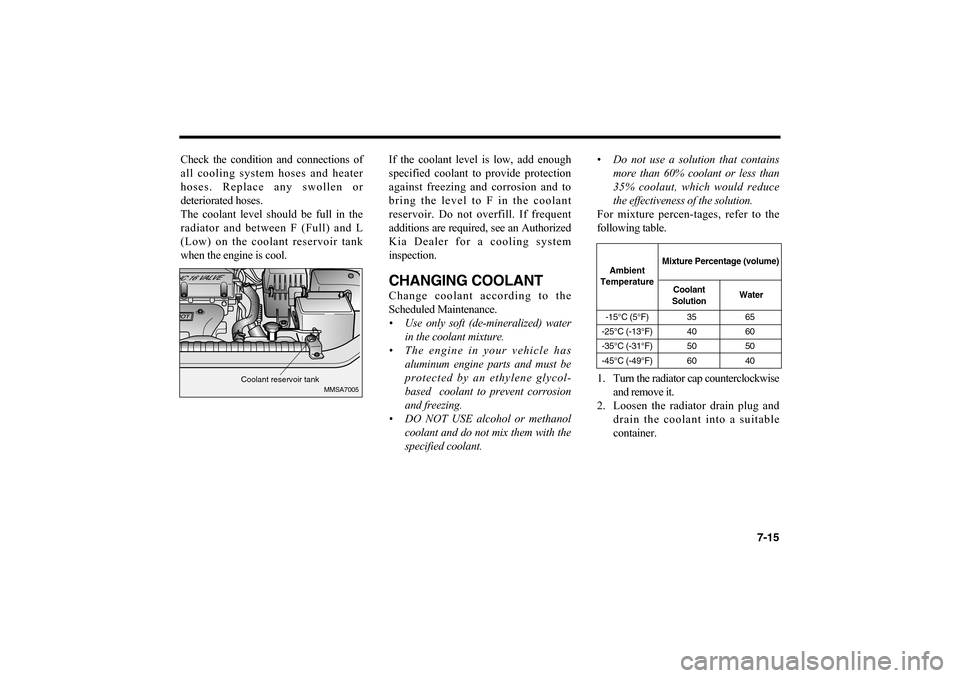
The coolant level should be full in the
radiator and between F (Full) and L
(Low) on the coolant reservoir tank
when the engine is cool.If the coolant level is low, add enough
specified coolant to provide protection
against freezing and corrosion and to
bring the level to F in the coolant
reservoir. Do not overfill. If frequent
additions are required, see an Authorized
Kia Dealer for a cooling system
inspection.
CHANGING COOLANTChange coolant according to the
Scheduled Maintenance.
• Use only soft (de-mineralized) water
in the coolant mixture.
• The engine in your vehicle has
aluminum engine parts and must be
protected by an ethylene glycol-
based coolant to prevent corrosion
and freezing.
• DO NOT USE alcohol or methanol
coolant and do not mix them with the
specified coolant.•Do not use a solution that contains
more than 60% coolant or less than
35% coolaut, which would reduce
the effectiveness of the solution.
For mixture percen-tages, refer to the
following table.
1. Turn the radiator cap counterclockwise
and remove it.
2. Loosen the radiator drain plug and
drain the coolant into a suitable
container.
MMSA7005
Coolant reservoir tank
-15°C (5°F) 35 65
-25°C (-13°F) 40 60
-35°C (-31°F) 50 50
-45°C (-49°F) 60 40Ambient
TemperatureMixture Percentage (volume)
Coolant
SolutionWater
MS-CNA-Eng 7.QXD 7/25/2005 5:09 PM Page 15
Page 224 of 225

9
INDEX
9-1
A
ir Bag - Supplemental Restraint System ................................3-42
Air Cleaner ..................................................................................7-21
Antenna .......................................................................................3-68
Automatic Heating and Cooling Control System .......................4-47
Automatic Transaxle ............................................................4-7, 7-19
B
attery.......................................................................................7-23
Before Driving ..............................................................................5-4
Brake System ..............................................................................4-12
Brakes and Clutch .......................................................................7-17
Bulb Replacement .......................................................................7-32
C
hanging tires ..........................................................................6-22
Climate Control System ..............................................................4-42
Cruise Control .............................................................................4-37
Cup Holders and Console Storage Compartment .......................3-63
D
oor Locks .................................................................................3-9
E
lectrical Circuit Protection .......................................................6-7
Emergency Starting .......................................................................6-3
Emission Control System ..............................................................5-3
Engine Compartment ..................................................................7-10
Engine Cooling System...............................................................7-14
Engine Oil and Oil Filter .............................................................7-12
Exterior Care ...............................................................................7-38
F
uel Filler Lid ...........................................................................3-55
Fuel Requirements ........................................................................5-2
G
auges ......................................................................................4-20
H
eadlight Aiming Adjustment .................................................7-42
Homelink® Wireless Control System.........................................5-12
Hood ............................................................................................3-54
How To Use This Manual .............................................................1-2
If You Have a Flat Tire .............................................................6-19
Ignition Switch ..............................................................................4-2
Immobilizer System ......................................................................3-6
Instrument Cluster .......................................................................4-19
Instrument Panel Overview ...........................................................2-3
Interior and Exterior Overview .....................................................2-2
Interior Care ................................................................................7-40
Interior Features ..........................................................................4-33
Interior Lights .............................................................................3-62K
eyless entry system .................................................................3-4
Keys ..............................................................................................3-3
L
abel Information .....................................................................5-11
Lightings .....................................................................................4-27
Lubricant Specifications .............................................................7-36
Lubricants and Fluids ..................................................................7-20
Luggage Net ................................................................................3-69
Ms-CNA-Eng-INDEX.qxd 7/25/2005 5:07 PM Page 1