2006 KIA Magnetis ignition
[x] Cancel search: ignitionPage 87 of 225
AUTOMATIC TRANSAXLE
OPERATIONAll normal forward driving is done with
the shift lever in the D (Drive) position.
To move the shift lever from the P (Park)
position, the ignition switch must be in
the ON position, the brake pedal must be
depressed, and the lock release button
must be depressed.
For smooth operation, depress the brake
pedal when shifting from N (Neutral) to
a forward or Reverse gear.
DRIVING YOUR VEHICLE
4-8
CAUTION
• Do not accelerate the engine in R
(Reverse) or any of the forward
positions with the brakes on.
When stopped on an upgrade,
do not hold the vehicle station-
ary with engine power. Use the
service brake or the parking
brake.
Do not shift from N (Neutral) or
P (Park) into D (Drive) or R
(Reverse) when the engine is
above idle speed.
WARNING - Automatic
Transaxle
Before leaving the driver’s seat,
always make sure the shift
lever is in the P (park) position;
then set the parking brake fully
and shut the engine off.
Unexpected and sudden vehicle
movement can occur if these
precautions are not followed in
the order identified.
MS-CNA-Eng 4(~39).QXD 7/25/2005 5:16 PM Page 8
Page 88 of 225

NORMAL OPERATIONP (Park)This position locks the transaxle and
prevents the front wheels from rotating.
Always come to a complete stop before
shifting into this position.
R (Reverse)Use this position to drive the vehicle
backward.N (Neutral)In this position, the wheels and transaxle
are not locked. The vehicle will roll
freely even on the slightest incline unless
the parking brake or service brakes are
applied.D (Drive)This is the normal forward driving
position. The transaxle will auto-
matically shift through a four-gear
sequence, providing the best fuel
economy and power.
4-9
WARNING
Shifting into P (Park) while the
vehicle is in motion will cause
the front wheels to lock and you
will lose driving control of the
vehicle.✻
NOTICE
The transaxle may be damaged if
you shift into P (Park) while the
vehicle is in motion.
WARNING
Do not use the P (Park)
position in place of the
parking brake when leaving
the vehicle. Always make
sure the shift lever is latched
in the P (Park) position so
that it cannot be moved
unless the lock release
button is pushed in AND the
parking brake is fully set.
Turn the ignition switch OFF
whenever you leave the
vehicle unattended. Never
leave the vehicle unattended
while the engine is running.
Unexpected and sudden
vehicle movement may occur
if these precautions are not
taken.
Never leave a child
unattended in a vehicle.
CAUTION
Always come to a complete stop
before shifting into or out of R
(Reverse). You may damage the
transaxle if you shift into R while
the vehicle is in motion, except as
explained in “Rocking the Vehicle”.
MS-CNA-Eng 4(~39).QXD 7/25/2005 5:16 PM Page 9
Page 89 of 225
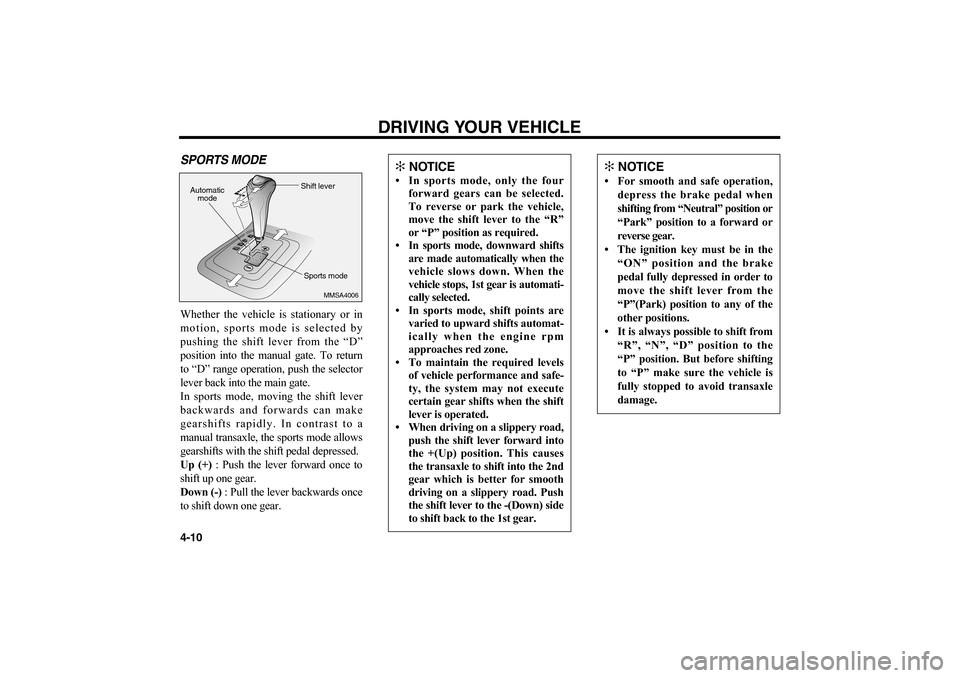
SPORTS MODEWhether the vehicle is stationary or in
motion, sports mode is selected by
pushing the shift lever from the “D”
position into the manual gate. To return
to “D” range operation, push the selector
lever back into the main gate.
In sports mode, moving the shift lever
backwards and forwards can make
gearshifts rapidly. In contrast to a
manual transaxle, the sports mode allows
gearshifts with the shift pedal depressed.
Up (+): Push the lever forward once to
shift up one gear.
Down (-): Pull the lever backwards once
to shift down one gear.
DRIVING YOUR VEHICLE
4-10
PRND
MMSA4006
Automatic
modeShift lever
Sports mode
✻
NOTICE
• In sports mode, only the four
forward gears can be selected.
To reverse or park the vehicle,
move the shift lever to the “R”
or “P” position as required.
• In sports mode, downward shifts
are made automatically when the
vehicle slows down. When the
vehicle stops, 1st gear is automati-
cally selected.
• In sports mode, shift points are
varied to upward shifts automat-
ically when the engine rpm
approaches red zone.
• To maintain the required levels
of vehicle performance and safe-
ty, the system may not execute
certain gear shifts when the shift
lever is operated.
• When driving on a slippery road,
push the shift lever forward into
the +(Up) position. This causes
the transaxle to shift into the 2nd
gear which is better for smooth
driving on a slippery road. Push
the shift lever to the -(Down) side
to shift back to the 1st gear.
✻
NOTICE
• For smooth and safe operation,
depress the brake pedal when
shifting from “Neutral” position or
“Park” position to a forward or
reverse gear.
• The ignition key must be in the
“ON” position and the brake
pedal fully depressed in order to
move the shift lever from the
“P”(Park) position to any of the
other positions.
• It is always possible to shift from
“R”, “N”, “D” position to the
“P” position. But before shifting
to “P” make sure the vehicle is
fully stopped to avoid transaxle
damage.
MS-CNA-Eng 4(~39).QXD 7/25/2005 5:16 PM Page 10
Page 90 of 225
MOVING UP A STEEP GRADE
FROM A STANDING STARTTo move up a steep grade from a
standing start, depress the brake pedal,
shift the shift lever to D (Drive). Select
the appropriate gear depending on load
weight and steepness of the grade, and
release the parking brake. Depress the
accelerator gradually while releasing the
service brakes.
When accelerating from a stop on a
steep hill, the vehicle may have a
tendency to roll backwards. Shifting
the shift lever into 2 (Second Gear)
while in Sports mode will help prevent
the vehicle from rolling backwards.
SHIFT LOCK SYSTEMFor your safety, the Automatic Transaxle
has a shift lock system which prevents
shifting the transaxle out of P (Park)
unless the brake pedal is depressed.
To shift the transaxle out of P (Park) ;
1. Depress and hold the brake pedal.
2. Start the engine or turn the ignition
key to the ON position.
3. Depress the lock release button and
move the shift lever.
When the ignition switch is in the ACC
or LOCK position, the transaxle cannot
be shifted from P (Park).
If the brake pedal is repeatedly depressed
and released with the shift lever in the P
(Park) position, a chattering noise near
the shift lever may be heard.
This is a normal condition.
Note that the ignition key cannot be
removed unless the shift lever is in the P
(Park) position. If the ignition switch is
in any other position, the key cannot be
removed.
4-11
CAUTION
Shift into the “R” and “P” posi-
tion only when the vehicle has
completely stopped.
Do not accelerate the engine in
reverse or any of the forward
positions with the brakes applied.
Always apply the footbrake when
shifting from “P” or “N”, to “R”
or “D” position.
Do not use the “P” (Park) posi-
tion in place of the parking
brake. Always set the parking
brake, shift the transaxle into
“P” (Park) position and turn off
the ignition when you leave the
vehicle, even momentarily.
Never leave the vehicle unat-
tended while the engine is run-
ning.
Check the automatic transaxle
fluid level regularly, and add
fluid as necessary.
MS-CNA-Eng 4(~39).QXD 7/25/2005 5:16 PM Page 11
Page 99 of 225

DRIVING YOUR VEHICLE
4-20GAUGESSPEEDOMETERThe speedometer indicates the forward
speed of the vehicle.ODOMETER/TRIPMETERYou can choose the odometer, tripmeter
A and tripmeter B by pressing the mode
selection button.ODOMETERThe odometer indicates the total distance
the vehicle has been driven.TRIPMETERTRIP A: Tripmeter A
TRIP B: Tripmeter B
The tripmeter indicates the distance of
individual trips selected by the driver.
Tripmeter A and B can be reset to zero
by pressing the reset button for one
second or more, and then releasing.
TACHOMETERThe tachometer indicates the approximate
number of engine revolutions per minute
(rpm).
Use the tachometer to select the correct
shift points and prevent lugging the
engine and/or over-revving it.
The tachometer pointer may move
slightly when the ignition switch is in the
ACC or ON position with the engine
OFF. This movement is normal and will
not affect the accuracy of the tachometer
once the engine is running.
FUEL GAUGEThe fuel gauge indicates the approximate
amount of fuel remaining in the fuel tank.
Fuel tank capacity: 65L (17 us gal.)
The fuel gauge is supplemented by a low
fuel warning light located in the
instrument panel.
MMSA4021
MMSA4022Red Zone
✻
NOTICE
Do not operate the engine within
the tachometer’s RED ZONE. This
may cause severe engine damage.
MS-CNA-Eng 4(~39).QXD 7/25/2005 5:16 PM Page 20
Page 100 of 225

ENGINE TEMPERATURE
GAUGEThis gauge shows the temperature of the
engine coolant when the ignition switch
is ON.
If the gauge pointer moves beyond the
normal range area toward the H position,
it indicates overheating that may damage
the engine.
Do not continue driving with an
overheated engine. If your vehicle
overheats, refer to “Overheating” in the
Index.
WARNINGS AND
INDICATORSWARNING LIGHTS/
AUDIBLE INDICATORSCHECKING OPERATIONAll the warning lights, except the brake
warning light, are checked by turning the
ignition switch ON (you do not need to
start the engine). Any light that does not
come ON should be checked by an
Authorized Kia Dealer.
If the brake system warning light does
not come ON when the ignition switch is
in the START position, have the system
checked by an Authorized Kia Dealer.
After starting the engine, check to make
sure that all warning lights are OFF. If
any are still ON, this indicates a situation
that needs attention. When releasing the
parking brake, the brake system warning
light should go OFF.
PARKING BRAKE AND
BRAKE FLUID WARNINGPARKING BRAKE WARNINGThis light comes on when the parking
brake is applied with the ignition switch
in the START or ON position. The
warning light should go OFF when the
parking brake is released.LOW BRAKE FLUID LEVEL
WARNINGIf the warning light remains ON when
the parking brake is released, it may
indicate that the brake fluid level in the
reservoir is low.
If the warning light remains ON:
1. Drive to the nearest safe location and
carefully stop your vehicle.
2. With the engine stopped, check the
brake fluid level immediately and
add fluid as required.
All brake components should also be
checked immediately for fluid leaks.
4-21
MMSA4020
MS-CNA-Eng 4(~39).QXD 7/25/2005 5:16 PM Page 21
Page 101 of 225

3. If leaks are found, if the warning
light remains ON, or if the brakes do
not operate properly, do not drive the
vehicle. Have it towed to an
Authorized Kia Dealer for a brake
system inspection and necessary
repairs.
To check bulb operation, the warning
light illuminates when the ignition switch
is in the ON position.
IMMOBILIZER
INDICATOR
(IF EQUIPPED)This light illuminates when the
immobilizer key is inserted and turned to
the ON position to start the engine.
If this light turns off or blinks when the
ignition switch is in the ON position
before starting the engine, have the
system checked by an authorized Kia
Dealer. AIR BAG WARNING This warning light will remain ON for
approximately 6 seconds each time you
turn the ignition switch ON. If the
system does not operate as described or
if the light comes on while the vehicle is
being driven, see an Authorized Kia
Dealer for immediate assistance.
SAFETY BELT WARNINGAs a reminder to the driver and
passenger, safety belt warning light will
blink for approximately 6 seconds each
time you turn the ignition switch ON.
If the driver's lap/shoulder belt is not
fastened when the key is turned ON or if
it is unfastened after the key is turned
ON, the safety belt warning light blinks
for approximately 6 seconds. SAFETY BELT WARNING
CHIME If the driver's seat belt is not fastened
when the ignition key is turned “ON” or
if it is disconnected after the key is ON,
the safety belt warning chime will sound
for approximately 6 seconds.
DRIVING YOUR VEHICLE
4-22
WARNING -
Brake
Warning Lights
Driving the vehicle with a
warning light ON is dangerous.
If the brake warning light
remains ON, have the brakes
checked and repaired
immediately.
AIR
BAG
MS-CNA-Eng 4(~39).QXD 7/25/2005 5:16 PM Page 22
Page 104 of 225

4-25
KEY REMINDER WARNING
CHIMEIf the driver’s door is opened and the
ignition key is left in the ignition switch,
the key reminder warning chime will
sound. This is to remind you to remove
your keys from the ignition before you
lock the vehicle.
HEADLIGHT HIGH
BEAM INDICATORThis indicator illuminates when the
headlights are on and in the high beam
position or when the turn signal lever is
pulled into the Flash-to-Pass position.DOOR AJAR WARNINGThis warning light comes on when a
door is not closed securely with the
ignition switch in any position.
CAUTION
Prolonged driving with the On
Board Diagnostic System
Malfunction Indicator Light ( )
illuminated may cause damage to
the emission control systems
which could effect driveability
and/or fuel economy.
If the On Board Diagnostic
System Malfunction Indicator
Light ( ) begins to flash ON
and OFF, potential catalytic con-
verter damage is possible which
could result in loss of engine
power. Have the On Board
Diagnostic System inspected as
soon as possible by an
Authorized Kia Dealer or other
competent repair shop.
CHECK
CHECK
✻
NOTICE
A loose fuel filler cap may cause the
On Board Diagnostic System
Malfunction Indicator Light ( ) in
the instrument panel to illuminate
unnecessarily. Always ensure that
the fuel filler cap is tight.
CHECK
MS-CNA-Eng 4(~39).QXD 7/25/2005 5:16 PM Page 25